
Bitcoin’s circulating supply approaches 20 million coins, with over 95% already mined. The final 1 million coins will take a century to mine, drawing renewed attention to its scarcity.
The “King of Cryptocurrency,” Bitcoin, is preparing to reach a significant milestone: the 20 millionth Bitcoin is about to be issued. According to on-chain data platform Clark Moody Dashboard, approximately 19,996,979 Bitcoins have been mined and are in circulation, leaving only about 3,000 coins to reach 20 million. Based on the block production rate, it is estimated to happen in about 7 days.
At that point, over 95% of the total supply of 21 million Bitcoins will be in circulation, while the remaining 1 million will take more than a century to mine completely.
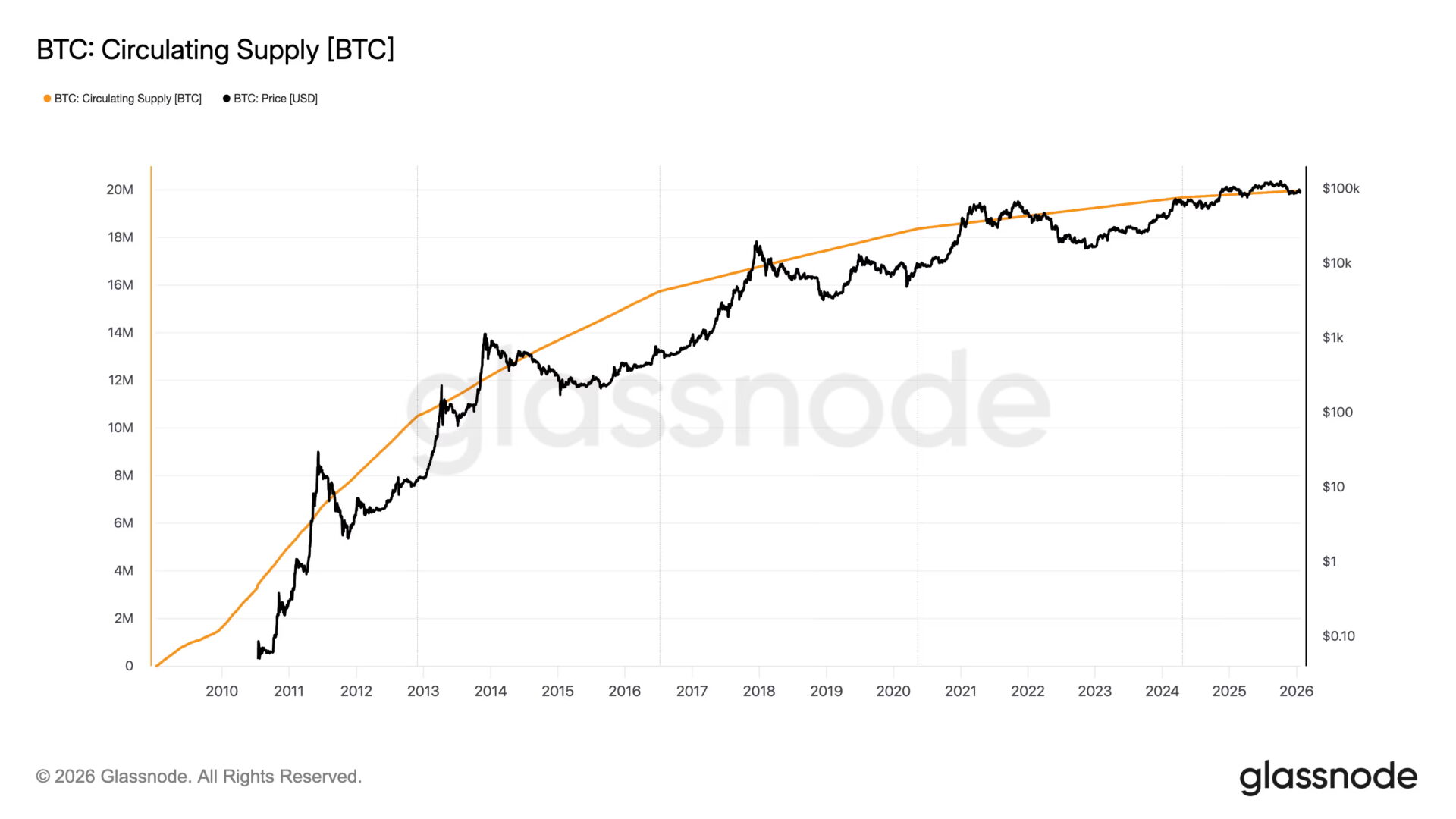
Image source: glassnode
When Bitcoin’s creator, Satoshi Nakamoto, designed the protocol, he set the maximum supply at 21 million coins in the original code, creating a form of currency with “absolute scarcity,” in stark contrast to fiat currencies issued by central banks, which can be increased at any time.
Although Nakamoto never publicly explained why he chose the number 21 million, this immutable cap has become an unshakable belief among Bitcoin enthusiasts. To them, any proposal to change the supply limit is a fundamental betrayal of Bitcoin’s value as a “hard currency.”
Bitcoin’s scarcity is often compared to gold and oil. However, in traditional commodity markets, if gold or oil prices surge, producers typically increase extraction or find new sources to boost supply and stabilize prices. Bitcoin is different; because its issuance curve is transparent and tamper-proof, no matter how wild the market prices become, the supply cannot be accelerated.
Bitcoin’s issuance rate decreases with each “halving event,” which occurs approximately every four years, halving the block rewards for miners and slowing new coin issuance. Currently, Bitcoin’s inflation rate has fallen below 1%, with about 450 new coins produced daily.
At this pace, 99% of the total supply will be mined by January 2035, and the last Bitcoin is expected to be mined around 2105. The remaining smaller fractions will continue to be released gradually until around 2140.
Once all Bitcoins are issued, miners will no longer rely on block rewards but will depend entirely on transaction fees for revenue. This means the long-term security and economic model of the Bitcoin network will ultimately depend on whether transaction demand can sustain miner income.
- This article is reprinted with permission from: “BlockCast”
- Original title: “Bitcoin Circulating Supply Approaching the 20 Million Milestone! The Last 1 Million Coins Will Take 114 Years to Mine”
- Original author: Block Sister MEL
Disclaimer: The information on this page may come from third parties and does not represent the views or opinions of Gate. The content displayed on this page is for reference only and does not constitute any financial, investment, or legal advice. Gate does not guarantee the accuracy or completeness of the information and shall not be liable for any losses arising from the use of this information. Virtual asset investments carry high risks and are subject to significant price volatility. You may lose all of your invested principal. Please fully understand the relevant risks and make prudent decisions based on your own financial situation and risk tolerance. For details, please refer to
Disclaimer.
Related Articles
Early Bitcoin Whale Transfers Millions in Funds to Exchange, Middle East Tensions Intensify Market Pressure
Gate News reported that on March 20, early Bitcoin holders (whales) recently transferred millions of dollars worth of Bitcoin funds to a certain CEX, with the specific transfer amount not yet disclosed. This move occurred against the backdrop of escalating tensions in the Middle East, energy market volatility, and tightening monetary policy by the Federal Reserve. The current market environment is putting pressure on the cryptocurrency market, with multiple macroeconomic factors compounding their impact on market sentiment.
GateNews26m ago
XRP Meme Coins Become "Invisible Accumulation Tools"? Analysis of New XRPL Strategies and Risks
As XRPL ecosystem activity increases, XRP meme coins have become a new pathway for some traders to increase their XRP holdings. The current meme coin market cap is approximately $50 million, attracting speculative capital attention. Through AMM pools trading with XRP, traders can achieve "passive accumulation." The overall market cap is approximately $418 million, with meme coins showing significant volatility, but liquidity and market attention remain limited. In the short term, they should be viewed as trading tools with both risks and rewards.
GateNews35m ago
Pi Network rebounds 3%, with the token listing on Kraken boosting buying confidence
Pi Network (PI) has recently surged, showing weakening profit-taking trends. Kraken and LBank have been added as official centralized exchanges supporting PI trading, enhancing liquidity. On-chain data shows CEX net inflows turning positive, indicating strengthened holding intent among holders. Technical analysis shows PI still faces resistance but has rebound potential, requiring a breakthrough of the 50-day moving average and rising RSI to challenge the psychological $0.20 level.
MarketWhisper43m ago
Amundi adopts Chainlink to promote tokenized funds, LINK still struggles to break $10
European asset manager Amundi has partnered with tokenization platform Spiko to launch a $100 million Spiko Amundi Overnight Swap Fund (SAFO), selecting Chainlink as its oracle infrastructure. However, LINK has failed to break above $10 since February. Despite on-chain data showing declining LINK holdings and increased ETF inflows, market sentiment remains cautious, making it difficult for prices to rise in the short term, and institutional adoption has yet to become a price catalyst.
MarketWhisper47m ago
VanEck: Bitcoin Miners "Sell Immediately After Mining," Put Option Signals Reach New Highs
VanEck research report indicates that while Bitcoin prices have declined, volatility and futures funding rates have stabilized. Miners face survival pressure and have sold off nearly all newly mined Bitcoin. Options market shows strong put demand, with historical data suggesting potential for a rebound. Overall on-chain activity has decreased, reflecting deepening financialization of the market.
MarketWhisper55m ago
Ethereum TVL Continues to Lead L1 Track: DeFi, Institutional Capital, and Network Effects Build Moat
Ethereum maintains its leading position in the L1 blockchain market with its superior Total Value Locked (TVL), continuously attracting concentrated capital and users. Its mature smart contracts and decentralized architecture deepen the ecosystem, attracting institutional participation. Although other chains have advantages in efficiency and cost, Ethereum still leads significantly in stability and application composability. Future competition will focus on performance and application scenarios.
GateNews1h ago


