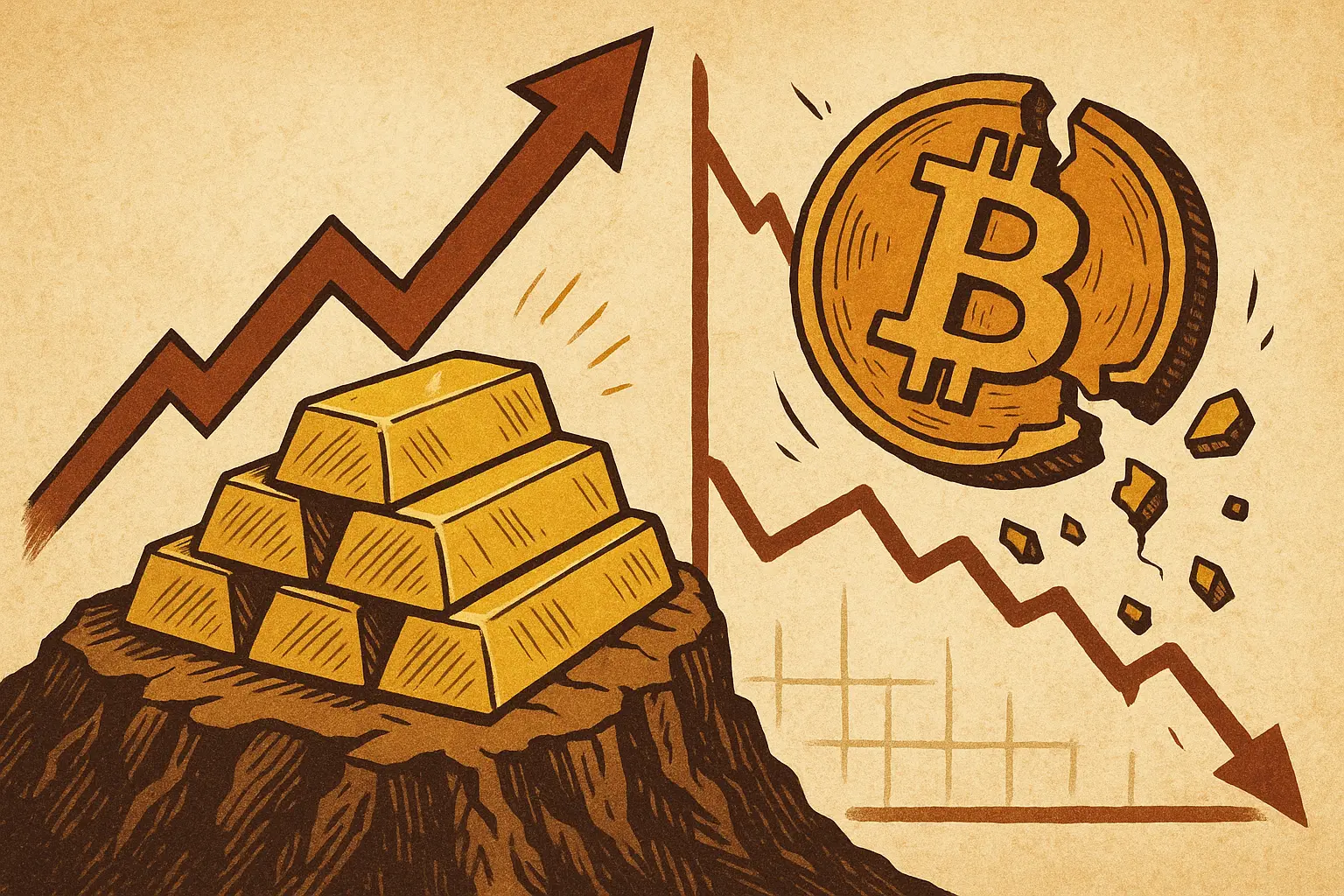
Grayscale research shows that Bitcoin prices are highly correlated with software stocks and have zero correlation with gold. The report’s author, Zach Pandl, points out that Bitcoin has fallen 50% from its October high of $126,000, while gold has surpassed $5,000. This reflects Bitcoin’s deeper integration with traditional finance, driven by institutional participation and ETF activity, but its long-term value storage potential remains optimistic.
Bitcoin’s Correlation with Software Stocks Surges: The Collapse of the Digital Gold Myth
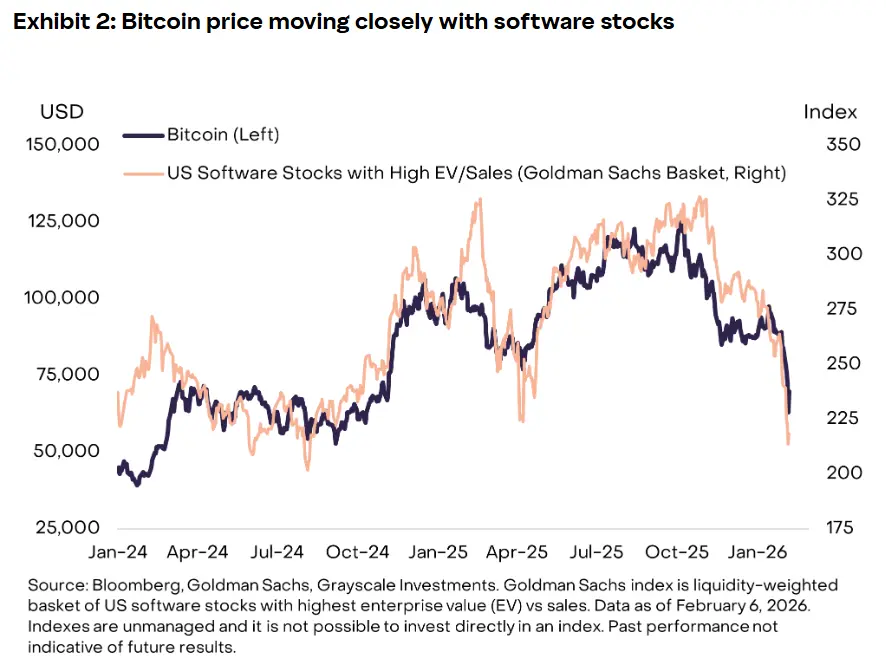
(Source: Grayscale)
According to Grayscale’s latest research, the long-term narrative of Bitcoin as “digital gold” is being challenged, as its recent price movements increasingly resemble those of high-risk growth assets rather than traditional safe havens. On Tuesday, author Zach Pandl stated that although Grayscale remains bullish on Bitcoin due to its fixed supply and independence from central banks, recent market behavior suggests otherwise.
Pandl wrote, “Bitcoin’s short-term price movements are not closely correlated with gold or other precious metals,” noting that gold and silver prices have hit record highs. Gold broke $5,000 per ounce in January, up over 35% from the beginning of the year’s $3,700. Silver surged to $100 per ounce, a more than 230% increase from $30 earlier this year. These trends exemplify safe-haven characteristics: rising counter to market panic.
In stark contrast, Bitcoin’s performance during the same period was entirely different. When Trump announced a 100% tariff increase on China, triggering global market panic, investors sold stocks and cryptocurrencies and flocked to gold. Bitcoin not only failed to serve as a safe haven but also became one of the assets sold off. Similar patterns appeared during the March 2020 pandemic crash and the 2022 Fed rate hike cycle, indicating these are not isolated events but intrinsic to Bitcoin’s market nature.
Grayscale’s charts clearly show that Bitcoin’s recent plunge mirrors the collapse of software stocks since early 2026. When the IGV (iShares Expanded Tech Software ETF) index declines, Bitcoin almost follows the same trajectory and magnitude. This mirror relationship is statistically significant, with correlation coefficients likely exceeding 0.8 (perfect correlation being 1).
Pandl’s core argument is that “Bitcoin’s short-term price movements are not tightly correlated with gold or other precious metals.” This observation challenges the core assumption of Bitcoin as digital gold. If Bitcoin truly were digital gold, it should maintain high correlation with physical gold, rising in tandem during safe-haven demand. Yet, data shows the correlation is near zero or even negative at times.
Grayscale’s Long-Term Defense: Evolution, Not Failure
Grayscale argues that Bitcoin’s recent failure to establish itself as a safe-haven asset should not be seen as a setback but as part of its ongoing development. Pandl states that expecting Bitcoin to replace gold as a monetary asset in such a short period is unrealistic. He notes, “Gold has been used as money for thousands of years, and until the early 1970s, it was the backbone of the international monetary system.”
This defense aims to position Bitcoin as a “growing store of value” rather than a “mature safe-haven asset.” Grayscale’s logic is that gold took millennia to establish its safe-haven status, while Bitcoin, with only 16 years of history, is still evolving. As time progresses and markets mature, Bitcoin may gradually acquire safe-haven properties.
Pandl emphasizes that although Bitcoin has not yet achieved a similar monetary role, the increasing digitization of the global economy through AI, autonomous agents, and tokenized financial markets could steer Bitcoin toward that future. This narrative links Bitcoin to the future of digital economy rather than its past as gold.
Grayscale’s charts show that despite recent poor performance, Bitcoin’s annualized returns over the past decade have significantly outperformed gold. From 2015 to 2025, Bitcoin’s annualized return is approximately 230%, compared to just 8% for gold. This substantial return differential supports its classification as a growth asset rather than a safe haven. Investors buy Bitcoin primarily for capital appreciation, not for preservation during crises.
In the short term, Bitcoin’s recovery may depend on new capital inflows, whether through ETF re-investment or retail investor re-entry. Market maker Wintermute notes that recent retail participation has been concentrated in AI-related stocks and growth concepts, limiting demand for crypto assets. This further confirms Bitcoin’s competitive relationship with growth assets. When retail investors with limited funds choose between AI stocks and Bitcoin, they currently favor the former due to clearer applications and profit models.
From an investment strategy perspective, Grayscale’s research redefines Bitcoin’s role. Investors should view Bitcoin as a growth allocation within their portfolios, not as a safe-haven. This implies that the appropriate allocation to Bitcoin should be comparable to technology stocks, not gold. In risk management terms, holding Bitcoin does not hedge against stock market declines and may even amplify overall portfolio volatility.
Disclaimer: The information on this page may come from third parties and does not represent the views or opinions of Gate. The content displayed on this page is for reference only and does not constitute any financial, investment, or legal advice. Gate does not guarantee the accuracy or completeness of the information and shall not be liable for any losses arising from the use of this information. Virtual asset investments carry high risks and are subject to significant price volatility. You may lose all of your invested principal. Please fully understand the relevant risks and make prudent decisions based on your own financial situation and risk tolerance. For details, please refer to
Disclaimer.
Related Articles
Bank of America Survey: Institutional Investors' Emerging Market Stock Holdings Hit Highest Level Since February 2021
Market analyst Jared Blikre points out that Bank of America's global fund manager survey shows that large institutional investors have increased their positions in emerging market equities and commodities, while reducing their US dollar holdings. Powell's remarks have a significant impact on market trends. If the US Dollar Index breaks through 100, it will increase investment pressure; conversely, it would be conducive to emerging market development.
GateNews1h ago
Citi Downgrades Certain Crypto Trading Platform to Sell, Target Price Cut from $13 to $5.5
Gate News reported that on March 18 and March 19, Citibank downgraded a certain crypto trading platform's rating from neutral to sell, lowering the target price from $13 to $5.5, stating that the platform will need several more years to achieve profitability. Additionally, Citibank announced on the same day that it lowered BTC's target price for the next 1 year to $112,000, and ETH's target price to $3,175.
GateNews2h ago
XRP Supply Shift: Whales Add 200 Million Tokens as Price Eyes $1.50 - U.Today
XRP has seen a significant increase in whale activity, with 200 million XRP bought recently, while network activity and wallet numbers reach new highs. A "golden cross" signals potential price rises, as the SEC clarifies crypto asset regulations.
UToday3h ago
US Vice President Vance: Will announce several measures on oil prices within 24 to 48 hours
Gate News reported that on March 18, U.S. Vice President Vance will meet with oil company executives on March 19 amid soaring oil prices and will also meet with members of the American Petroleum Institute (API) board. When discussing oil prices, Vance stated that several measures will be announced within the next 24 to 48 hours.
GateNews3h ago
US Bitcoin Spot ETF Attracts Inflows for Seven Consecutive Days, Institutional Funds Return
US cryptocurrency spot ETF fund flows have shown a notable warming trend recently. On the eve of the Federal Reserve's interest rate decision, investors' willingness to allocate to digital assets has rebounded, driving consecutive daily net inflows into Bitcoin and Ethereum spot ETFs. On the 17th, the US Bitcoin spot ETF recorded approximately $199.4 million in net inflows for a single day, marking the seventh consecutive trading day of capital inflows and creating the longest consecutive inflow record in nearly five months. On the same day, the Ethereum spot ETF also recorded approximately $138.2 million in net inflows, continuing positive flows for the sixth day.
From a single product perspective, Bitcoin spot ETF capital inflows remain concentrated among large issuers. According to Farside Investors data, on the 17th, BlackRock's IBIT attracted $169.3 million in net inflows for the day, while Fidelity's
区块客3h ago
Today, the U.S. Bitcoin ETF saw a net inflow of 2,492 BTC, and the Ethereum ETF experienced a net inflow of 13,478 ETH.
Gate News reports that on March 18, according to Lookonchain monitoring, as of press time, the US Bitcoin ETF saw net inflows of 2,492 BTC (valued at $179.33 million), Ethereum ETF saw net inflows of 13,478 ETH (valued at $29.99 million), and SOL ETF saw net inflows of 189,025 SOL (valued at $17.01 million).
GateNews5h ago


