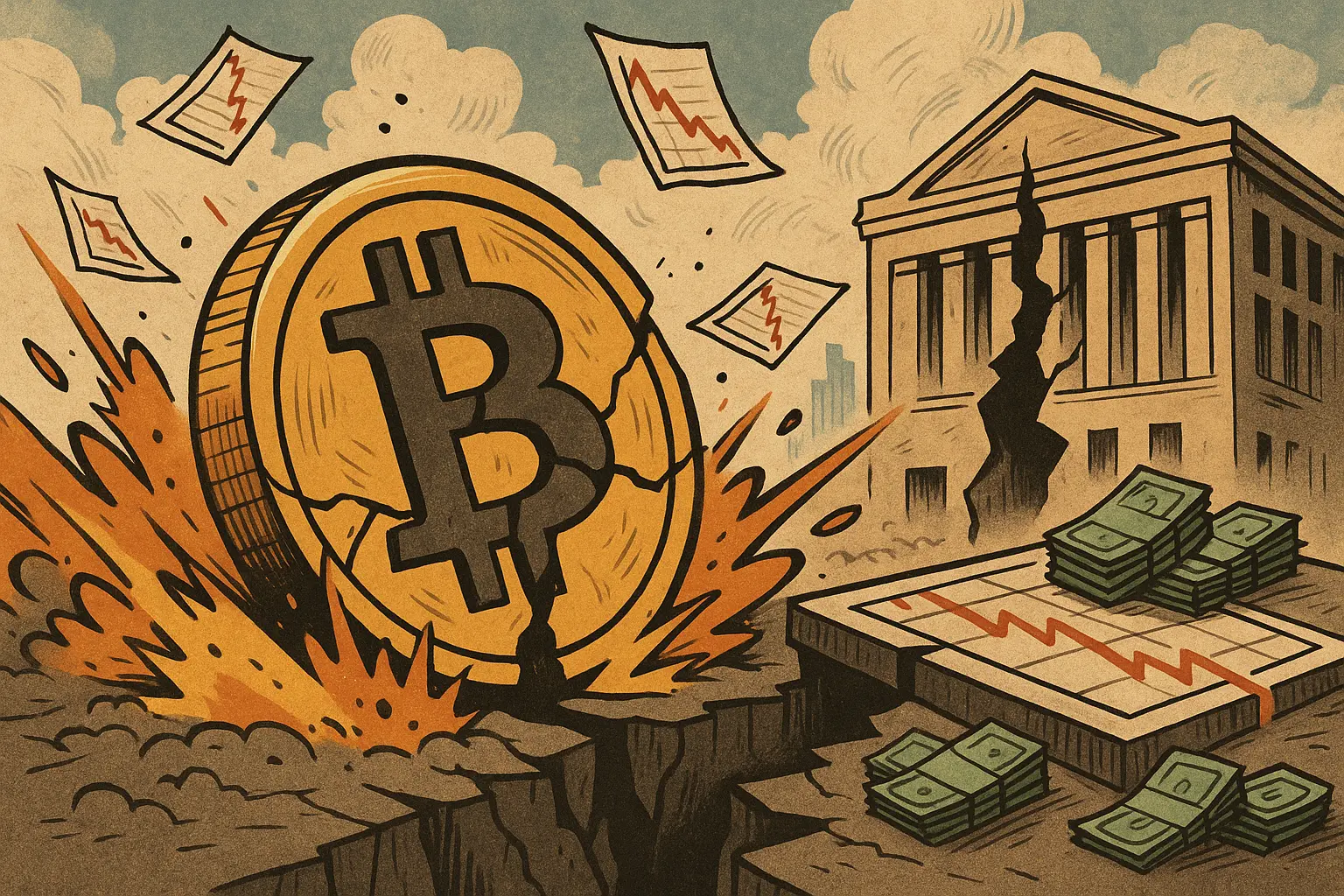
Bitcoin’s weekend plunge led to the fourth-largest gap in CME history (8%), dropping from $84,177 to $75,947. Since Thursday, over $5.4 billion has been liquidated, and open interest has fallen to $24.17 billion, hitting a nine-month low. Option skew has fallen below -12%, with traders rushing to buy puts for protection.
CME’s Fourth Largest Gap in History Signals Volatility
Bitcoin experienced a fierce sell-off, resulting in one of the largest gaps ever in Chicago Mercantile Exchange (CME) futures prices, with momentum indicators reaching levels typically seen only during sharp declines. The scale of the weekend crash is most evident in the CME futures price gap. Since CME, the world’s largest derivatives market, was closed on Friday and reopened on Monday, this disconnection caused a gap of over 8%—the fourth-largest since Bitcoin futures launched in 2017.
CoinEx Research chief analyst Jeff Ko told media: “This CME gap is one of the largest since the COVID sell-off in March 2020.” When Bitcoin spot prices move during CME’s closure, a gap forms, leaving a price gap when trading resumes. Traders usually expect this gap to be filled eventually.
Ko pointed out that while most CME gaps tend to be filled within a few days to a week, the timing of the mean reversion in February will largely depend on macro variables such as bond yields and broader risk sentiment. Andri Fauzan Adziima, head of research at Bitrue, said that once volatility narrows, the gap between $77,000 and $84,000 could attract traders.
“Under current pressure, the gap may not be filled this week, but if overselling eases, a rebound could push it toward $84,000 in the coming weeks,” Adziima explained. The gap-filling theory is widely used in technical analysis, as gap areas often become future support or resistance levels. However, not all gaps are filled, especially during strong trends, where gaps can persist long-term.
The importance of CME gaps in Bitcoin derivatives markets lies in CME being a regulated institutional exchange, whose price discovery function anchors the entire crypto market. When CME futures prices diverge significantly from spot prices, arbitrageurs typically step in to narrow the spread, pushing spot prices toward futures and filling the gap.
$5.4 Billion Liquidation Drains Speculative Foundations
During the weekend’s low liquidity, this crash triggered $2.56 billion in liquidations on Sunday, the largest single liquidation in over three months. According to CoinGlass data, since Thursday, total liquidations have exceeded $5.42 billion. Deleveraging effectively drained the market’s speculative base, and CryptoQuant data shows Bitcoin derivatives open interest plummeted to $24.17 billion, a nine-month low.
Open interest refers to the total value of all unsettled futures and perpetual contracts. This sharp decline indicates a large number of positions being forcibly closed or exited voluntarily. The combination of $5 billion in liquidations and open interest hitting a nine-month low signals a thorough deleveraging. While painful in the short term, this may be healthy in the medium to long term, as it reduces systemic risk from excessive leverage.
Experts say the overall risk-off environment has intensified due to macroeconomic and geopolitical factors. Major catalysts include the risk of a partial US government shutdown, trade war news, rising long-term Japanese government bond yields, and geopolitical tensions such as ongoing conflicts with Iran and escalating friction in the South China Sea. These factors erupted over the weekend, and low weekend liquidity amplified price swings, leading to extraordinary declines.
Three Major Deleveraging Signals in Bitcoin Derivatives
Open interest collapse: Dropped from high levels to $24.17 billion, a nine-month low, indicating large position exits
Record liquidation scale: $2.56 billion on Sunday, over $5.42 billion since Thursday
CME’s fourth-largest gap: 8% price dislocation reflecting extreme weekend panic selling
Analysts remain divided on the outlook. Ko describes the current phase as “healthy deleveraging,” not a structural bear market. He said, “Despite ongoing macroeconomic uncertainties, volatility may persist into Q1, but this environment could also create opportunities to accumulate Bitcoin at a discount.” This view suggests that after deleveraging, the market structure is healthier and sets the stage for the next rally.
Options Market Defensive Premium Surges
The options market remains skewed toward defensive strategies. The 7-day and 30-day 25-delta skew in Bitcoin derivatives fell below -12% and -8% over the weekend, respectively, indicating investors are willing to pay higher premiums for downside protection (puts). The skew measures the relative prices of puts versus calls; negative values show puts are more expensive, reflecting market concern about downside risks.
-12% 7-day skew is an extreme reading, signaling intense short-term panic. Adziima said, “Traders have shifted into defensive mode. Futures positions are shrinking, and the options market shows heavy buying of puts.” Such defensive behavior typically appears when market confidence collapses, with participants willing to pay high costs for insurance rather than risk naked downside exposure.
According to Galaxy research head Alex Thorn, this sell-off has also pushed Bitcoin down to a key psychological bottom: the average cost basis of US spot Bitcoin ETFs. After experiencing the second and third-largest outflows in history, Bitcoin’s trading price has fallen below this threshold. This suggests ETF holders are overall underwater, potentially triggering more redemptions.
Data from Bitcoin Treasury shows this decline has also dangerously approached the Strategy’s average purchase price, around $76,000. Falling below this level could raise concerns about forced liquidations or forced sales by Strategy, despite the company’s holding of 700,000 BTC, which would cause catastrophic market impacts if sold.
Bitrue analysts forecast a target price of $60,000 to $70,000, while CoinEx analysts are more conservative, seeing $68,000 to $70,000 as key support zones. Fisher8 Capital’s investment analyst Lai Yuan is more pessimistic, stating retail investors’ speculative funds have shifted into space stocks, AI stocks, and storage stocks, “Funds need a reason to cycle back into crypto assets.”
Related Articles
The crypto race against quantum explodes, with many tokens up as much as 50%
The crypto race against quantum attacks is booming, with many tokens up as much as 50%
The cryptocurrency market is seeing a notable wave of shifting priorities as investors begin favoring assets believed to be capable of withstanding risks from quantum computers. Amid growing concerns about cybersecurity
TapChiBitcoin3m ago
Quantum threat controversy flares up again, with anti-quantum encrypted cryptocurrencies seeing a short-term increase of up to 50%
Google’s quantum computing research results have prompted the cryptocurrency market to reassess technical risk, but Bitcoin and Ethereum prices have shown limited volatility. Anti-quantum cryptographic tokens have performed strongly, with some gains reaching 50%. Although the quantum threat remains in the theoretical stage, investors’ attention to post-quantum cryptography projects may drive volatility in related asset prices.
GateNews9m ago
Scaramucci Warns the CLARITY Act Is Blocked: Bitcoin May Swing, Layer 1 Prospects Face Pressure
Former White House communications director Anthony Scaramucci pointed out that the CLARITY Act is running into obstacles, which could leave the 2026 crypto market facing long-term uncertainty. The bill is being blocked mainly due to political factors and resource depletion; in the short term, the regulatory framework will be difficult to implement, affecting market structure. However, he remains optimistic about Bitcoin’s long-term outlook and believes its Future still has upside potential.
GateNews13m ago
The RWA Yield Infrastructure Trade
The essay highlights challenges in direct RWA token exposure, emphasizes the potential in leverage opportunities amid settlement delays, critiques Morpho's governance token structure, and presents Fluid as a more effective token model with stablecoin links.
CoinDesk24m ago
Bitcoin ETF ends a run of seven consecutive red days, and renewed pressure returns to the Bitcoin price
After U.S. spot Bitcoin ETFs saw net inflows for seven consecutive trading days, they have recently switched to outflows, indicating that fund flows have become more cautious. Bitcoin’s price briefly fell below $70,000, reflecting weakness in market sentiment and liquidity. ETF outflows stem from investors re-evaluating the macro environment; amid expectations for high interest rates and geopolitical risks, investors’ risk appetite has declined. $70,000 has become a short-term line between bulls and bears, and technical indicators show that market confidence still needs to be restored.
区块客28m ago
Tom Lee: The stock market has already digested 90% of the sell-off pressure; the initial stage of the U.S.-Iran conflict was already at the bottom
Tom Lee said in an interview on CNBC that the stock market has absorbed 90% to 95% of the selling pressure and may be in the process of rebuilding a base. He analyzed historical data and noted that, beginning in the early stages of wars since 1900, stock markets typically bottom out. He predicts that the crypto market may end the winter by the end of April, but there is disagreement in the market about the timing of the bottom, and analysts have differing views. Lee also noted that excessive deleveraging could lead to a V-shaped rebound.
MarketWhisper32m ago


