- According to Coinbase, approximately 70% of professional investors believe Bitcoin is currently priced below its actual worth.
- Most big players plan to buy more or hold their current positions if prices drop another 10%.
- Expected interest rate cuts and a growing GDP may boost digital assets later this year.
The crypto market is currently moving through a rough patch and Bitcoin has seen its price drop since it reached a peak in October. Because of this, many people are now watching the charts as gold and silver reach new highs.
However, professional money managers do not seem worried about what is going on, and a new report from Coinbase shows that most large firms think Bitcoin is undervalued right now.
Major Firms See Bitcoin as Undervalued Amid Market Stress
These investors looked at the price range between $85,000 and $95,000 during a recent survey and about 71% of them said this price does not show the true value of the asset.
In fact, only a tiny fraction of them felt the price was too high. This sentiment comes at a time when traditional safe havens are performing very well and Gold recently crossed the $5,000 mark.
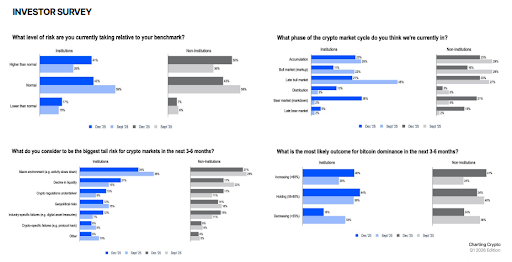
Coinbase investor survey shows institutions are still bullish | source
Meanwhile, Bitcoin is down about 30% from its all-time high of $126,080.
This happened as the crypto space faced a massive shock on October 10, when a market crash wiped out billions of dollars in leveraged positions. Since then, prices have mostly moved sideways or downward.
External factors are also making investors afraid, including trade threats and tensions in the US, China and the Middle East. Through it all, Coinbase warned that trouble in energy markets could continue to hurt how people feel about risk.
Despite these hurdles, professional investors still strongly believe Bitcoin is undervalued. Independent investors are a bit more careful with their decisions, but 60% of them still agree with the institutions.
Just 4% of surveyed firms see the market as overpriced, signaling that major money managers are waiting to make their move.
Institutional Plans to Buy the Dip
When asked what they would do if prices fell another 10%, 80% of institutions said they would hold or buy more.
These investors do not seem interested in selling during a panic. Instead, they are viewing these moments as chances to build their portfolios and over 60% of these investors have actually increased their holdings since the October peak.
This behaviour shows a high level of conviction as many of these firms believe the market is currently in an accumulation phase.
They view the current bear market sentiment as temporary within the supercycle, even as volatility scares some retail traders.
Economic Factors That Could Help Prices
The economy actually looks quite stable despite the drama in the news. Consumer inflation stayed around 2.7% in December and real gross domestic product grew by more than 5% in the final months of last year.
These numbers show that the financial foundation is solid and Coinbase believes this stability will eventually help the crypto market find its feet again.
Central bank decisions are also a huge part of this, because many experts expect the Federal Reserve to cut interest rates twice this year.
Lower rates often make riskier assets like crypto more attractive to investors and if borrowing becomes cheaper, more money could flow into the crypto space.
Disclaimer: The information on this page may come from third parties and does not represent the views or opinions of Gate. The content displayed on this page is for reference only and does not constitute any financial, investment, or legal advice. Gate does not guarantee the accuracy or completeness of the information and shall not be liable for any losses arising from the use of this information. Virtual asset investments carry high risks and are subject to significant price volatility. You may lose all of your invested principal. Please fully understand the relevant risks and make prudent decisions based on your own financial situation and risk tolerance. For details, please refer to
Disclaimer.
Related Articles
BTC Falls 0.50% in 15 Minutes: Large Position Transfers and Long Liquidations Trigger Cascading Decline
On March 19, 2026, from 04:00 to 04:15 (UTC), the BTC price declined by 0.50% within the short-term window, with an amplitude of 0.68%, and a price range of 70,729.6 to 71,214.1 USDT. Market attention significantly increased, with spot and derivatives trading volumes expanding simultaneously. Short-term activity became more active, and market sentiment turned slightly cautious.
The main driver of this movement was the transfer of approximately 2,800 BTC from large on-chain holdings to exchange hot wallets between 04:05 and 04:10, which triggered large sell-offs in the spot market. Liquidity pressure rose, directly pushing the price down.
GateNews9m ago
Data: BTC breaks through $74,643, with the liquidation strength of major CEX short positions reaching $1.842 billion
Gate News reports that on March 19, according to Coinglass data, if BTC breaks through $74,643, the cumulative short liquidation intensity across mainstream CEX will reach $1.842 billion. Conversely, if BTC falls below $67,727, the cumulative long liquidation intensity across mainstream CEX will reach $1.172 billion.
GateNews12m ago
ETF Absorbs Over $1.1 Billion Yet Struggles to Rescue the Market? Powell and Oil Prices Team Up to Put Pressure On, Bitcoin Breaks Key Support
Despite Bitcoin ETF inflows of $1.16 billion, Bitcoin price pulled back to $71,000, declining over 4%. Analysts attribute the pullback to interest rate expectations and inflation pressures, while ETF inflows indicate that institutions view Bitcoin as a long-term asset. The weakness in U.S. equities has also impacted the crypto market.
GateNews59m ago
Gold and Bitcoin decline simultaneously by 3.6% and 4.6%, respectively, as the global market faces stagflation shocks.
On March 19, escalating geopolitical conflicts and hawkish Federal Reserve policies exposed global markets to stagflation pressures driven by oil. Rising oil prices, coupled with declining equities and metals, also impacted cryptocurrencies. Macroeconomic dynamics revealed intensifying energy tensions and widespread risk-averse sentiment across markets.
GateNews1h ago


