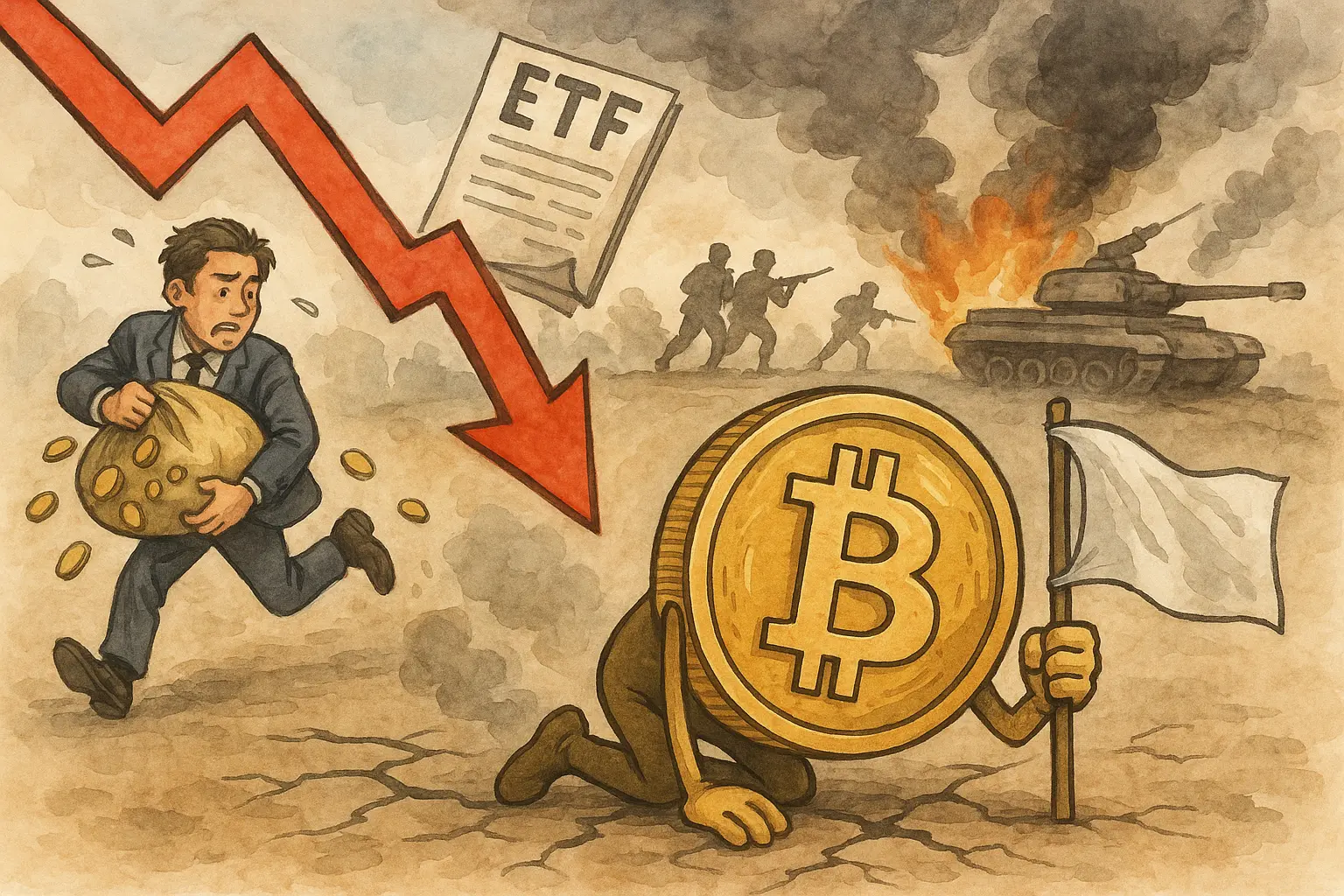
Bitcoin dips below $67,000, with a weekly decline of about 3%. U.S. Vice President JD Vance said Iran’s military operations will “continue for a little while longer,” oil prices briefly broke above $100 per barrel, and global risk assets are broadly under pressure. Spot Bitcoin ETF recorded $296 million in net outflows over the same period, ending a streak of four consecutive weeks of inflows. The Crypto Fear and Greed Index fell to 9, and the market is stuck in “extreme fear.”
Geopolitical Risk: “Operation Epic Fury” Continues to Weigh on Market Sentiment
U.S. military actions against Iran under “Operation Epic Fury” began on February 28, 2026. As of late March, strikes on more than 11,000 targets have already been carried out. In an interview, Vance said the operation is intended to fundamentally weaken Iran’s threat capabilities. He noted that “the vast majority of military targets have basically been completed,” but the operation still needs to be carried forward.
The U.S. Central Command also announced that the amphibious assault ship USS Tripoli, carrying about 3,500 Marines, has entered the Middle East area of responsibility, showing that the ceasefire timeline remains highly uncertain. Intelligence obtained by Reuters likewise indicates that only about one-third of Iran’s missile and drone stockpiles have been destroyed, which differs from more optimistic public remarks by some officials.
The Strait of Hormuz carries critical global oil shipping. The conflict’s continuation keeps inflation expectations elevated, further compressing the Federal Reserve’s rate-cutting space and directly weighing on valuation logic for risk assets such as Bitcoin.
ETF Outflows and a Fed Policy Shift: A Double Macroeconomic Headwind
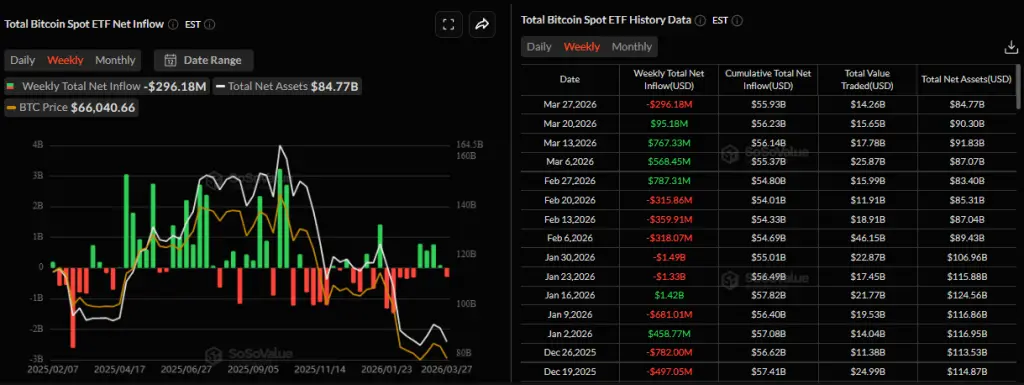 (Source: SoSoValue)
Spot Bitcoin ETFs saw net outflows of $296 million for the week from March 23 to 27. Ethereum ETFs recorded net outflows of $206 million over the same period, as institutional capital shifts to defense in the short term.
Structural change in the macro picture is also starting to take effect, and market expectations for the Fed’s policy path have undergone a fundamental shift:
Rate-hike expectations return to pricing: The market has already priced in roughly 18 basis points of rate hikes; short-term rate-cut expectations are nearly fully discounted
Nonfarm employment becomes a key observation window: February’s employment surprise shrank by 92,000 jobs, while March is expected to add about 48,000; if the data sustains resilience, consensus that “high rates will last longer” will be further reinforced
Inflation pressure stays high: The Middle East situation layered on top of oil prices running at elevated levels makes the path for inflation cooling more circuitous
ISM Services PMI and job openings data will also be released throughout this week, providing the market with more reference signals about economic momentum.
Miner Capitulation Signals Emerge: MARA Holdings Sells 15,133 BTC
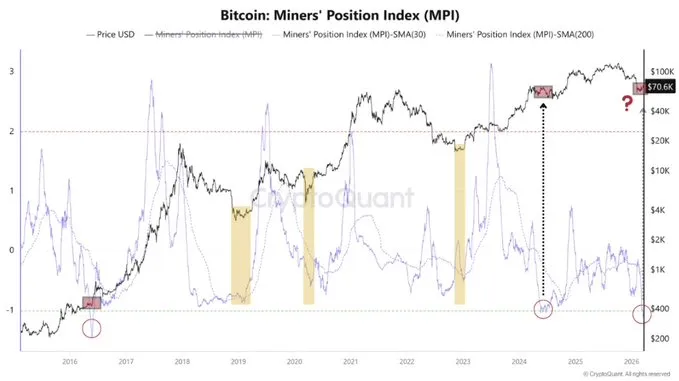 (Source: CryptoQuant)
The miners’ position index (MPI) fell to -1.04 this week, the third-lowest level in history. CryptoQuant analyst Ignacio Moreno de Vicente noted that this value indicates miners are moving far fewer BTC to exchanges than the annual average, which structurally reduces selling pressure and is a potentially bullish signal. He also warned: “If there is no clear synchronized confirmation of demand expansion— including spot inflows, ETF inflows, or the build-up of derivatives positions— then a low MPI alone cannot lead to sustained upside.”
A CoinShares report, meanwhile, shows that 20% of Bitcoin miners are exhibiting capitulation behavior. For listed miners, the weighted average BTC holding cost per coin is $79,995. Large miner MARA Holdings announced this week that it has sold 15,133 BTC, raising about $1.1 billion, with the proceeds used to repurchase company bonds—indicating that financial pressures in the mining industry are still continuing to accumulate. Crypto’s total market cap is currently about $2.37 trillion, with Bitcoin accounting for 56.1%.
Common Questions
What is the core reason Bitcoin is falling today?
This round of declines is driven by three factors: the U.S. military actions against Iran continue to spill over, pushing up oil prices and driving risk-aversion sentiment; spot Bitcoin ETFs recorded $296 million in net outflows in the week; and the market has repriced Fed rate-hike expectations, squeezing valuation space for risk assets.
Do large ETF outflows mean institutions are bearish on Bitcoin long-term?
This week’s ETF outflows mainly reflect a defensive adjustment of capital amid short-term geopolitical risk, not a fundamental shift in institutional long-term holdings direction. Analysts say Bitcoin’s next leg of movement still depends on how macroeconomic conditions and the geopolitical landscape evolve overall.
What reference significance do miner capitulation signals have for future price action?
When MPI falls to historical lows, it typically means selling pressure from miners is easing. Historically, after such signals appear, prices often stabilize. However, analysts emphasize that it’s necessary to pair it with synchronized confirmation such as spot inflows or an expansion in ETF demand; only then does the signal have substantive reference value.
Disclaimer: The information on this page may come from third parties and does not represent the views or opinions of Gate. The content displayed on this page is for reference only and does not constitute any financial, investment, or legal advice. Gate does not guarantee the accuracy or completeness of the information and shall not be liable for any losses arising from the use of this information. Virtual asset investments carry high risks and are subject to significant price volatility. You may lose all of your invested principal. Please fully understand the relevant risks and make prudent decisions based on your own financial situation and risk tolerance. For details, please refer to
Disclaimer.
Related Articles
Solv Protocol Integrates Utexo to Launch Native Bitcoin Yield Solution on RGB and Lightning Network
Solv Protocol and Utexo have partnered to create a Bitcoin yield solution using the RGB protocol and Lightning Network, allowing direct BTC and USDT swaps while prioritizing self-custody and privacy. Solv also invested in Utexo's recent funding round led by Tether.
GateNews16m ago
Bitcoin bull market index rises to 40 points; Bloomberg: the U.S. and Iran are considering extending the ceasefire agreement by two weeks
Bitcoin’s price as of April 16 is approaching $74,700. The Bullish Sentiment Index (BSI) has risen to 40 points, indicating a rebound in market sentiment. The United States and Iran are evaluating options to extend the current ceasefire agreement, and they are also discussing navigation issues in the Strait of Hormuz, as diplomatic negotiations continue.
MarketWhisper37m ago
Tether Adds $70M Bitcoin Reserve, Increases Holdings to 97,141 BTC
Tether has transferred 951 BTC valued at approximately $70 million to its Bitcoin reserve, increasing its total holdings to 97,141 BTC worth about $7.16 billion. This move aligns with Tether's strategy of investing 15% of operating profits into Bitcoin.
GateNews1h ago
BlackRock Withdraws 3,446 BTC from Major CEX in 8 Hours, Worth $255.2M
BlackRock withdrew 3,446 BTC, worth about $255.2 million, from a major CEX, signaling ongoing institutional accumulation in the Bitcoin market.
GateNews1h ago
BTC 15-minute up 0.46%: spot trading volume expansion and derivatives long position buildup as two drivers
From 2026-04-15 19:30 to 19:45 (UTC), the BTC price fluctuated between 74,706.2 and 75,276.9 USDT. Within 15 minutes, the return reached +0.46%, and the range was 0.76%. Trading activity in the market for this window was active: spot trading volume rose 18% compared with the previous hour’s average. Volatility increased in the short term, and overall market attention improved.
The main drivers behind this abnormal move are the short-term amplification of spot market trading volume and the coordinated increase in long positions in the derivatives market. Derivatives futures open interest (Open Interest) during this period, on a month-over-month basis,
GateNews6h ago


