
The Financial Action Task Force (FATF) has pointed out that stablecoins are the preferred choice for illegal transactions involving North Korea, Iran, and others, with estimated fraud amounts reaching $51 billion. To prevent vulnerabilities in non-custodial wallets, they strongly urge countries to strengthen anti-money laundering regulations on issuers.
FATF: Stablecoins Are the Top Choice for Illegal Transactions
According to a 42-page report released by the Financial Action Task Force (FATF), stablecoins are currently the most popular virtual assets used in illegal transactions (including sanctions evasion). Participants include countries like Iran and North Korea, prompting calls for stricter regulation of stablecoin issuers.
In January this year, FATF stated that stablecoins account for the majority of on-chain illegal activity transactions. The organization estimates that in 2024, illegal stablecoin activities related to scams and fraud will total approximately $51 billion.
North Korea and Iran Favor Stablecoins
FATF further explained that North Korea’s Lazarus Group and other organizations use stablecoins to purchase military equipment; Iran’s Islamic Revolutionary Guard Corps also relies on stablecoins to acquire drone parts; terrorist groups and drug trafficking organizations heavily depend on Tether ($USDT) and USDC for fund transfers and money laundering.
On July 2, 2025, Tether, the issuer of USDT, conducted the largest-ever freeze of Iran-related funds, freezing 42 cryptocurrency wallet addresses, over half of which are heavily linked to the local exchange Nobitex.
As a global standard-setting body focused on international anti-money laundering efforts, FATF points out that stablecoins, with features like price stability and high liquidity, are attractive tools for criminals to transfer funds.
Further Reading:
Fiat currency devalued by 90%! Iran’s central bank buys $500 million USDT to save rial exchange rate. Iran’s banks are paralyzed, and exchanges have been hacked! Can Bitcoin hedge against information warfare in the Taiwan Strait?
Vulnerabilities in Non-Custodial Wallets Record Illegal Stablecoin Receipts
In its latest report from March 2026, FATF again warns that stablecoins pegged to the US dollar have become key tools in illegal financial activities.
The organization cites a report from blockchain analysis firm Chainalysis, stating that in 2025, illegal virtual asset transactions totaled $154 billion, with stablecoins accounting for 84%, a stark contrast to the Bitcoin-dominated illegal transactions of 2020.
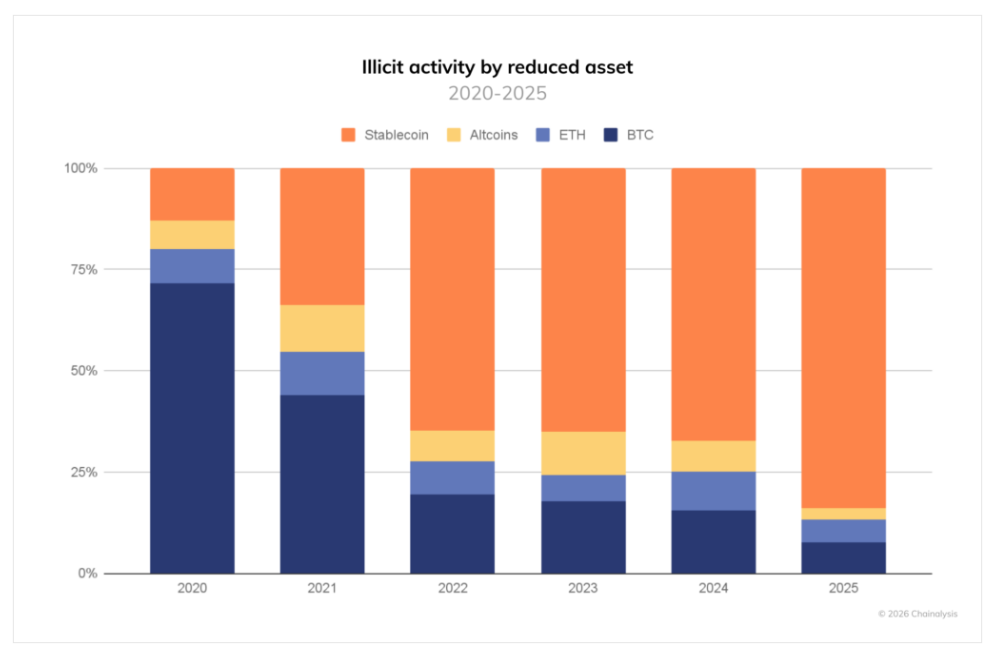
Source: Chainalysis — In 2025, illegal virtual asset transactions reached $154 billion, with stablecoins accounting for 84%
Additionally, according to a report released in mid-February by blockchain analysis firm TRM Labs, illicit entities received a total of $141 billion in stablecoins in 2025, setting a five-year high. The report notes that last year, overall stablecoin activity repeatedly exceeded $1 trillion per month, with 86% related to sanctions.
The report emphasizes that malicious actors often hide their funds using cross-chain technology, decentralized exchanges, and OTC brokers. FATF highlights that peer-to-peer transfers through non-custodial wallets are a critical vulnerability, as these transactions occur in environments lacking anti-money laundering controls, making it difficult for regulators to track geographic locations and beneficiaries.
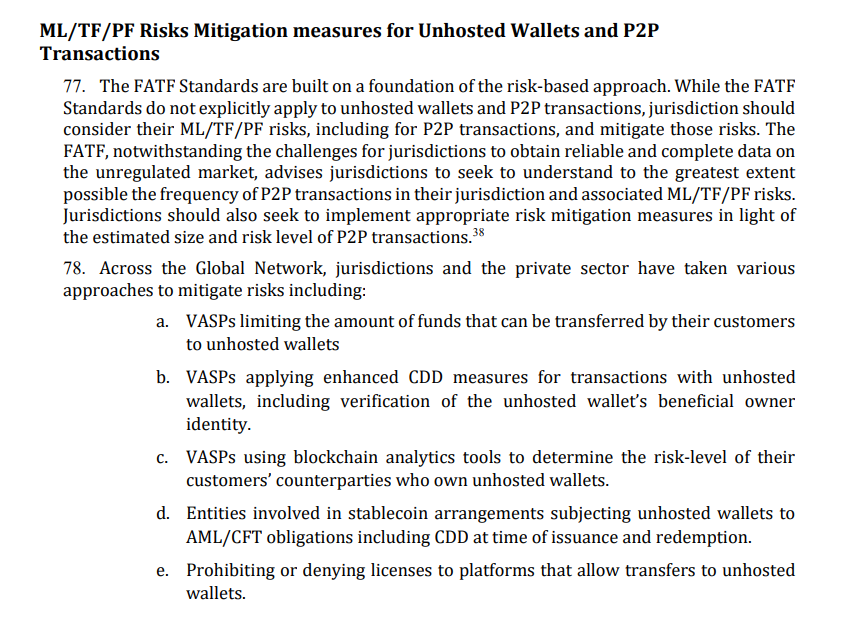
Source: FATF report — Peer-to-peer virtual asset transfers via non-custodial wallets are a key vulnerability
Stablecoin Market Cap Surpasses $300 Billion, Urgent Need for Regulation
It’s important to note that FATF does not call for banning stablecoins outright but strongly urges countries to impose anti-money laundering obligations on stablecoin issuers and intermediaries.
FATF recommends that stablecoin issuers utilize smart contract control features to establish whitelists and blacklists to restrict certain wallet transactions. Issuers should have the technical capability to intercept, freeze, and destroy suspicious stablecoins in secondary markets. To address cross-border operational challenges, FATF encourages countries to establish international regulatory bodies to enhance information sharing and joint oversight.
Currently, the global stablecoin market value has exceeded $300 billion. As adoption accelerates and integration with traditional finance deepens, FATF believes that regulators worldwide must act swiftly and implement blockchain analysis tools to close regulatory and compliance gaps.
Further Reading:
Preparing for Crypto Legislation! E.SUN Bank: Banking sector to adopt three-tier financial models, not missing out on stablecoins and tokenization
Conflict impacts Gaza banks! Trump’s Peace Commission plans to use US dollar stablecoins to promote digital transactions
Disclaimer: The information on this page may come from third parties and does not represent the views or opinions of Gate. The content displayed on this page is for reference only and does not constitute any financial, investment, or legal advice. Gate does not guarantee the accuracy or completeness of the information and shall not be liable for any losses arising from the use of this information. Virtual asset investments carry high risks and are subject to significant price volatility. You may lose all of your invested principal. Please fully understand the relevant risks and make prudent decisions based on your own financial situation and risk tolerance. For details, please refer to
Disclaimer.
Related Articles
Crypto political action committee appoints Tether executive as chair, as controversy over the U.S. stablecoin policy continues
Crypto Super Political Action Committee Fellowship PAC appoints Tether U.S. executive Jesse Spiro as chair, pushing for action supporting pro-crypto candidates. Meanwhile, the “Digital Asset Market CLARITY Act” is stalled in the Senate, with controversy over stablecoin yield policy affecting the bill’s progress. The crypto industry is stepping up lobbying efforts, seeking a more favorable policy environment.
GateNews1h ago
Iran reiterates that it will blockade the Strait of Hormuz as a countermeasure and will study opening other potential fronts
Gate News news, on April 1, the Office of Iran’s Supreme Leader posted on social media the first remarks of Supreme Leader Mojtaba Khamenei, released that day, reaffirming that Iran will continue to use the blockade of the Strait of Hormuz as a countermeasure. The Office of Iran’s Supreme Leader also said in the remarks that Iran is studying ways to open up “other potential fronts,” and believes that the adversary in the relevant area “lacks experience and has clear weaknesses.” The remarks stated that if the fighting continues, after taking into account the relevant factors comprehensively, “these fronts will be activated.” (CCTV News)
GateNews7h ago
Insider: U.S. Vice President Vance says Trump has lost patience with the Iran issue
Gate News message, April 1, according to sources, U.S. Vice President Vance held talks with an "intermediary" on the Iran conflict on Tuesday. U.S. President Trump instructed Vance to privately convey that, as long as certain U.S. demands are met—such as reopening the Strait of Hormuz—he is willing to accept a ceasefire. Vance relayed Trump's "tough" message, saying that Trump has lost patience and warning that unless Iran reaches an agreement, pressure on Iran's infrastructure will increase.
GateNews8h ago
The Strait of Hormuz remains restricted for navigation, and Brent crude oil futures are holding above $100
Gate News message, April 1, although expectations of a de-escalation in the Iran war situation have warmed somewhat, navigation through the Strait of Hormuz is still constrained, and tensions have not been fully eased. Brent crude oil futures (the international crude benchmark price) are currently holding at around $100 per barrel, indicating that the market is still waiting to see whether the situation improves. Forex.com market analyst Fawad Razaqzada noted that in the absence of a clear timetable for the Strait of Hormuz to reopen and sufficient credibility, oil prices are unlikely to sustainably fall below $100.
GateNews9h ago
St. Louis Fed President Musalem: The Iran war energy shock will raise overall inflation
Gate News reports that on April 1, the President of the St. Louis Fed, Mousalem, stated on Wednesday at an event hosted by the American Enterprise Institute in Washington that energy shocks related to the war with Iran will definitely impact overall inflation and may exert pressure on core prices. Mousalem said, "I expect increases in commodity prices to feed into overall inflation on a one-for-one basis, and there will be a period of high overall inflation." He added, "Core inflation will also be affected to some extent by pass-through; I will closely monitor the degree of pass-through and the correlation between the two."
GateNews9h ago
Google Quantum AI Warns Crypto Wallet Encryption May Be Easier to Break Than Expected
Google Quantum AI warns that 256-bit elliptic curve cryptography may be broken in minutes with under 500,000 qubits, a 20-fold reduction from prior estimates. This urges the crypto sector to expedite the transition to post-quantum cryptography.
CryptoNewsFlash9h ago


