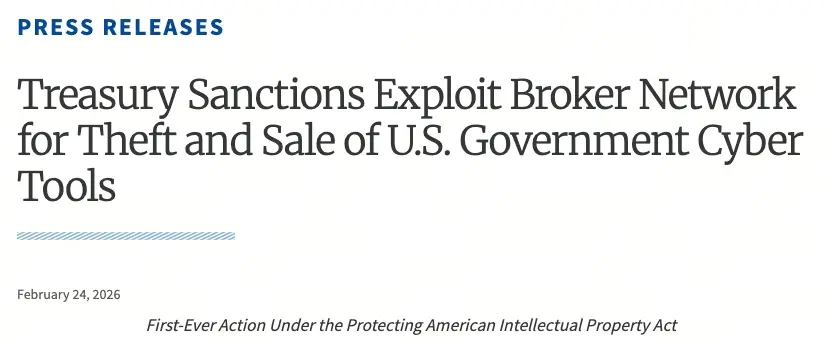
The U.S. Department of the Treasury’s Office of Foreign Assets Control (OFAC) announced on February 25th sanctions against Russian exploitation broker Sergei Zelenyuk and his St. Petersburg company Matrix LLC (also known as “Operation Zero”). They are accused of selling stolen U.S. government proprietary network tools, marking the first law enforcement case under the “Protecting American Intellectual Property Act” to target digital trade secrets theft.
Operation Zero’s Operations and Sanctioned Entities
(Source: U.S. Department of the Treasury)
“Operation Zero” was launched in 2021, employing a public bounty system to purchase security vulnerabilities targeting mainstream operating systems and encrypted communication apps. Multiple bounties have been publicly posted on the X platform. Known rewards include $500,000 for 26 iOS vulnerabilities (November 2025) and $4 million for a complete attack chain vulnerability in Telegram (March 2025).
OFAC states that the exploits sold by “Operation Zero” enable attackers to gain unauthorized access, steal information, or remotely control targeted systems. The client base is explicitly limited to “private and government organizations in Russia,” focusing on offensive security research and software tools.
The sanctions also target two individuals: Oleg Vyacheslavovich Kucherov, suspected member of the Trickbot cybercriminal group, and Marina Evgenyevna Vasanovich, described as Zelenyuk’s assistant.
Australian Contractor Data Theft Case: $1.3 Million in Cryptocurrency as Key Evidence
The sanctions stem from investigations by the U.S. Department of Justice and FBI into Australian citizen Peter Williams. Williams, a former employee of a U.S. defense contractor, is accused of stealing eight “commercial secret zero-day exploits” between 2022 and 2025, selling them to “Operation Zero” for $1.3 million in cryptocurrency. Williams pleaded guilty in October 2025 to two counts of commercial secrets theft.
The U.S. State Department emphasized in an independent statement that the stolen tools were originally intended solely for sale to the U.S. government and its allies. Unauthorized resale poses a direct threat to U.S. intelligence capabilities. The Treasury also disclosed that “Operation Zero” is involved in developing espionage software and AI-driven tools to steal personal identification information, recruiting hackers via social media, and establishing contacts with foreign intelligence agencies.
Key Information on the Sanctions
Sanctioned Parties: Sergei Zelenyuk and Matrix LLC (“Operation Zero”), Kucherov, Vasanovich
Legal Basis: Protecting American Intellectual Property Act, marking its first application to digital trade secrets theft cases
Stolen Tools: Eight U.S. government proprietary network tools, originally intended for U.S. government and specific allies
Cryptocurrency Payments: Peter Williams sold stolen zero-day exploits for $1.3 million in cryptocurrency
Highest Bounty: “Operation Zero” previously offered a $4 million reward for a Telegram attack chain vulnerability
Frequently Asked Questions
What is the historical significance of the legal basis for these U.S. Treasury sanctions?
These sanctions are executed under the Protecting American Intellectual Property Act, which is the first time this law has been used to combat the theft and sale of digital trade secrets. OFAC states this signifies an expansion of U.S. enforcement tools against cyber tool theft into the realm of commercial secrets law, setting an important legal precedent.
What is “Operation Zero,” and how do their vulnerability trading operations work?
“Operation Zero” is a Russian exploitation broker led by Sergei Zelenyuk, purchasing security vulnerabilities for operating systems and encrypted communication apps through public bounties. Its clients are limited to Russian private and government organizations. The bounty rewards can reach up to $4 million, with transactions publicly posted on X, reflecting transparency in their dealings.
What implications does the use of cryptocurrency payments in this case have for crypto regulation?
Peter Williams paid $1.3 million in cryptocurrency to acquire stolen U.S. government zero-day exploits, highlighting cryptocurrency’s role as a primary payment method in transnational cyber espionage. This case raises regulatory concerns about the role of cryptocurrencies in national security crimes and underscores the importance of on-chain tracking tools and anti-money laundering measures in combating such transactions.
Disclaimer: The information on this page may come from third parties and does not represent the views or opinions of Gate. The content displayed on this page is for reference only and does not constitute any financial, investment, or legal advice. Gate does not guarantee the accuracy or completeness of the information and shall not be liable for any losses arising from the use of this information. Virtual asset investments carry high risks and are subject to significant price volatility. You may lose all of your invested principal. Please fully understand the relevant risks and make prudent decisions based on your own financial situation and risk tolerance. For details, please refer to
Disclaimer.
Related Articles
Meta Abandons Libra Cryptocurrency Project Amid Regulatory Pressure
Meta Platform Inc. is discontinuing its Libra cryptocurrency project due to regulatory pressures and is considering selling its assets through the Diem Association. The initiative faced significant setbacks from government scrutiny and loss of key partners.
CryptoFrontier16m ago
Bitcoin's Quantum Defense Plan BIP-361 Draws Criticism Over 1.7M BTC Recovery Gap
Bitcoin developers are working on BIP-361 to protect against quantum computing threats by migrating funds to safer formats, potentially freezing 1.7 million BTC. Charles Hoskinson critiques the plan, arguing it may lead to permanent freezing of vulnerable coins. The debate highlights tensions in adapting Bitcoin's protocols.
GateNews29m ago
Hong Kong suspends the legalization of basketball betting and studies the impact and compliance issues of prediction markets
Hong Kong has suspended the legalization of basketball betting this week, while also planning to launch a study to assess the impact of prediction markets in Hong Kong and their level of adoption. Macie Mak, Commissioner for Home and Youth Affairs in Hong Kong, said that the monthly trading volume of prediction markets has grown from less than $100 million two years ago to more than $13 billion last year, with about 40% related to sports.
MarketWhisper1h ago
Kalshi appeals Nevada event contract ban; CFTC jurisdiction dispute may reach the Supreme Court
Prediction market platform Kalshi has appealed a ruling by the state of Nevada banning its event contracts, and the U.S. Ninth Circuit Court of Appeals held oral arguments on April 17, but did not issue an immediate decision after the hearing. The core dispute in the case is whether Kalshi’s event contracts are “swap agreements” that fall under the jurisdiction of the Commodity Futures Trading Commission (CFTC), or whether they must be regulated by state-level activity under gambling licensing regimes. Multiple legal experts predict that the case may ultimately be appealed to the U.S. Supreme Court.
MarketWhisper4h ago
CFTC Chairman Selig: Prediction-market fraudsters will face harsh legal penalties; will not pause rulemaking
In a House hearing, U.S. CFTC Chairman Selig emphasized a “zero-tolerance policy” toward market fraud and manipulation. He responded to questions regarding a $500 million oil futures transaction and said the CFTC is drafting rules to regulate prediction markets. Selig also mentioned a cooperation memorandum of understanding with the SEC to strengthen oversight of digital assets. Given that the CFTC currently has only one commissioner—himself—Selig emphasized operational efficiency and will hire new staff to enhance regulatory capacity.
MarketWhisper6h ago
MTN Nigeria Suspends Xtratime Airtime and Data Borrowing Service to Comply with Digital Lending Regulations
MTN Nigeria has suspended its Xtratime service due to new regulatory compliance from the FCCPC. While normal purchases continue, the suspension aims to align with upcoming digital lending rules. The company does not foresee significant financial impact and will monitor user response.
GateNews10h ago


