Danske Bank Ends 8-Year Ban, Opens Bitcoin and Ethereum ETP Trading to Retail Customers, Signaling a Shift in European Banking Attitudes
As the EU’s crypto asset regulation (MiCA) comes into effect and market demand heats up, traditional Nordic financial giants are showing a significant change in stance. Denmark’s largest asset bank, Danske Bank, announced yesterday (2/11) that it will officially open trading services for Bitcoin ($BTC) and Ethereum ($ETH) exchange-traded products (ETPs) to its retail clients.
This decision marks the end of the bank’s strict 8-year restrictions on cryptocurrencies, allowing customers to directly invest in crypto derivatives offered by well-known issuers like BlackRock and WisdomTree through its eBanking and mobile banking platforms.
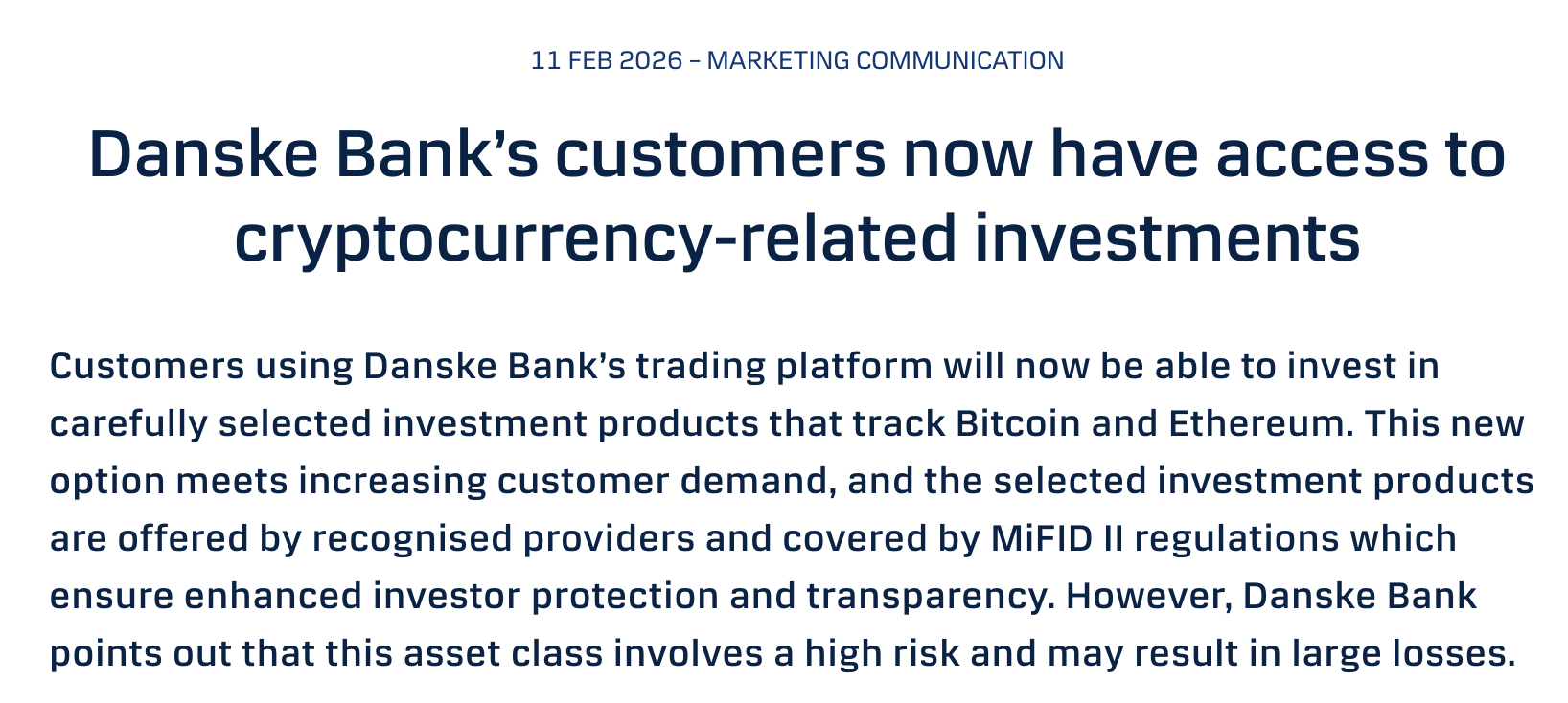
Image source: Danske Bank Danske Bank officially opens Bitcoin ($BTC) and Ethereum ($ETH) ETP trading services to retail clients
Major Policy Shift, Ending Eight Years of Crypto Ban
With over five million customers, Danske Bank is one of the most influential retail banks in Scandinavia. Looking back at its previous stance on cryptocurrencies, the bank issued a statement in 2018 expressing negative views and banning related transactions on its platform, citing concerns over lack of transparency, regulatory uncertainty, and potential financial crime risks. This policy remained conservative even in its 2021 update, where the bank stated it would not interfere with transactions from other crypto platforms but still refused to offer direct crypto services.
The newly opened products include three carefully selected ETPs, two tracking Bitcoin and one tracking Ethereum. Through these products, investors can gain exposure to crypto prices without holding private keys or managing digital wallets, alleviating concerns about asset custody security for traditional investors.
The bank emphasizes that this service is only available to “self-directed investors,” meaning clients who trade on the bank’s platform but do not receive investment advice from the bank.
Regulatory Environment Key, Emphasizing High-Risk Non-Recommendation
The main driver behind this policy shift is growing customer demand and an improved regulatory environment. Kerstin Lysholm, Head of Investment Products at Danske Bank, stated that as cryptocurrencies become a more common asset class, the bank has received increasing inquiries from clients wishing to include them in their portfolios. She specifically mentioned that the EU’s implementation of the Markets in Crypto-Assets Regulation (MiCA) has improved the regulatory landscape, boosting the bank’s confidence in this asset class, and now is the right time to offer these products to clients willing to accept high risks.
Despite opening trading channels, Danske Bank remains cautious about risk management. Lysholm clearly stated that providing ETP trading options does not mean the bank is recommending the asset class. The bank still regards cryptocurrencies as “opportunistic investments,” not a core part of long-term portfolios, and warns investors of potential significant losses. To ensure clients are aware of the risks, they must pass an “appropriateness test” before trading, demonstrating sufficient experience and knowledge to understand the characteristics and risks of crypto ETPs.
Danish Tax and Institutional Challenges
In addition to retail services, Danske Bank has already ventured into the crypto industry through its own investment holdings. According to disclosures, the bank holds approximately 132,746 shares of MicroStrategy, valued at around $17.6 million, indirectly exposing it to Bitcoin. This indicates that even traditional conservative financial institutions cannot ignore the role of crypto assets in modern portfolios.
However, Danish investors face potential tax challenges. The Danish Tax Agency proposed in 2024 to amend crypto asset taxation rules, suggesting the introduction of an “inventory tax system,” which would impose an annual tax of up to 42% on unrealized gains in investment portfolios. Although this proposal was scheduled to take effect in 2026, it has not yet been enacted, and the Danish Tax Agency confirmed that the proposal has not undergone full legislative debate. Market analysts believe that if passed, it could force investors to sell assets to pay taxes on unrealized gains, potentially leading to capital outflows.
Danske Bank’s move reflects a broader trend in the European banking industry. Besides Danske, Spain’s second-largest bank BBVA has launched Bitcoin and Ethereum trading and custody services in Switzerland and Spain; Germany’s Deutsche Bank is reportedly planning to partner with Bitpanda and Taurus to launch crypto custody services by 2026. As traditional financial institutions compete for market share, the integration of crypto assets with conventional finance is accelerating.
Further Reading
Institutional Endorsement! Spanish Bank Advises Wealthy Clients to Invest 3%-7% of Funds in Bitcoin
Germany’s Top Two Banks! Planning to Launch Digital Asset Custody and Trading in 2026 to Capture Crypto Market
Germany’s Second-Largest Bank DZ Bank Approved by Regulators! Customers Can Trade Cryptocurrencies via Bank App
Disclaimer: The information on this page may come from third parties and does not represent the views or opinions of Gate. The content displayed on this page is for reference only and does not constitute any financial, investment, or legal advice. Gate does not guarantee the accuracy or completeness of the information and shall not be liable for any losses arising from the use of this information. Virtual asset investments carry high risks and are subject to significant price volatility. You may lose all of your invested principal. Please fully understand the relevant risks and make prudent decisions based on your own financial situation and risk tolerance. For details, please refer to
Disclaimer.


