
Justin Bieber in January 2022 purchased BAYC 3001 for 500 ETH ($1.3 million). The current price is 5.36 ETH ($13,000), down 99%. At its peak, it reached $429,000 driven by speculative non-collectible demand. The simultaneous decline of CryptoPunks and Pudgy Penguins indicates a structural correction in blue-chip NFTs, with celebrity holdings unable to sustain premiums.
Justin Bieber’s Emotional Decision to Buy the Floor Ape
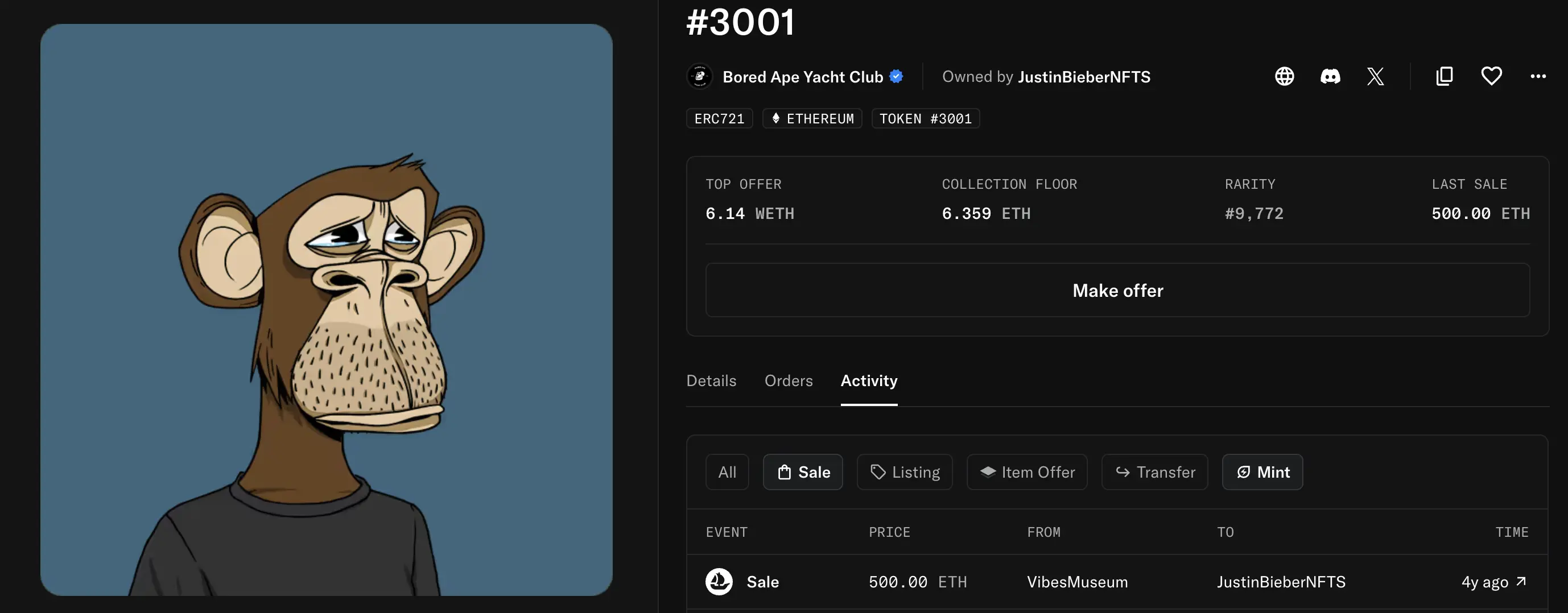
(Source: Opensea)
Pop star Justin Bieber, during the craziest peak of the NFT craze in January 2022, spent 500 ETH—about $1.3 million—to buy Bored Ape Yacht Club #3001, a bored ape NFT. This moment became a symbol of celebrity entry into Web3. The market was extremely optimistic, with blue-chip NFTs seen as digital luxury goods and status symbols. Many artists, athletes, and executives swapped their profile pictures to apes, and the community called holders “club members.”
However, this transaction was controversial at the time because the NFT lacked rarity features and was a “floor price” buy, yet Bieber paid a premium of 5-6 times the floor price. In January 2022, the Bored Ape floor was about 80-100 ETH (~$26,000–$32,000). Bieber’s 500 ETH purchase was 5-6 times the floor. Industry insiders questioned whether his decision was overly emotional rather than based on collection logic.
Why did he pay such a high premium? Possible reasons include: Bieber’s team unfamiliar with the NFT market and misled by intermediaries or agents; or a “don’t care about the price” attitude, wanting to buy quickly without regard for cost; or FOMO-driven fear of missing out on the hype. Regardless, this irrational purchase put Bieber at a significant disadvantage from the start.
Three Major Mistakes Bieber Made Buying BAYC
Buying at the Peak: January 2022 was the height of the NFT bubble—worst timing
Paying a Premium for a Floor-Only NFT: No rarity features but paying 5-6 times the floor price
Lacking Collection Logic: Emotional purchase rather than based on rarity or artistic value
At that time, Bieber set the bored ape as his social media avatar, sparking media coverage and fan discussion. This “celebrity effect” temporarily boosted the ape’s attention and price, but also attracted many speculators following the trend. When the hype faded, these speculators suffered the biggest losses.
Collapse from $429,000 to $13,000
As the NFT market cooled in late 2022, liquidity and buying interest evaporated rapidly, and the Bored Ape floor price declined steadily. Today, the BAYC NFT is valued at only 5.36 ETH (~$13,000), a nearly 99% drop from Bieber’s purchase price. This 99% decline means an $1.3 million investment is now worth only $13,000, evaporating $1.287 million.
In fact, BAYC’s floor once peaked at about $429,000, driven by a speculative frenzy rather than sustainable demand. That peak occurred in April 2022, when ETH prices were high and the crypto market was in a euphoric bull run. Within months, the Terra/Luna collapse, Three Arrows Capital bankruptcy, and FTX failure plunged the crypto market into a deep bear. NFTs, as the most speculative asset class, bore the brunt.
From $429,000 down to $13,000, the decline is about 97%. Even from Bieber’s $1.3 million purchase, it’s a 99% drop. Such a severe decline is rare in asset markets. During the 2008 financial crisis, Lehman Brothers’ stock fell 100% (bankruptcy). Yuga Labs, the project behind Bored Apes, still operates, but their NFTs’ value is nearly zero, showing NFT valuation is even more fragile than stocks.
Even CryptoPunks and Pudgy Penguins, once considered digital art benchmarks, have also fallen, indicating a structural correction across blue-chip NFTs rather than a single project’s failure. CryptoPunks’ floor price dropped from about $800,000 to around $30,000–$50,000, a decline of over 90%. Pudgy Penguins fell from about $40,000 to roughly $5,000, an 87% drop. This widespread collapse reveals that NFT valuations in 2022 were detached from reality, built on a Ponzi-like “there will always be a next buyer” logic.
The Disillusion of Celebrity Aura and Market Rationality
Market analysis suggests that while celebrity ownership records can boost narratives, in a liquidity-constrained environment, prices ultimately revert to supply, demand, and utility. Even though Bieber’s holding story is sensational, it’s unlikely to sustain long-term premiums in highly homogeneous NFTs. Yuga Labs continues to push metaverse projects like Otherside and offline membership spaces, aiming to create new narratives for the bored ape ecosystem, but the market no longer buys into visions alone.
Bieber’s purchase of the bored ape in early 2022 coincided with the “celebrity NFT craze” peak. Besides him, NBA star Stephen Curry bought a bored ape for 55 ETH, rapper Snoop Dogg, Eminem, actress Gwyneth Paltrow, and many other celebrities bought bored apes or other blue-chip NFTs. This “celebrity effect” temporarily inflated prices but also created an unsustainable bubble.
When ordinary investors see idols buying NFTs, they often fall into the trap of “if celebrities are buying, it must be valuable,” leading to herd behavior. But celebrities’ motivations differ from ordinary investors. For Bieber, $1.3 million might be a small fraction of his annual income. This “play money” purchase is very different from ordinary people risking their life savings. When the market crashes, celebrities can endure a 99% loss and still hold or laugh it off, but ordinary investors might go bankrupt.
This transaction now serves as a reflection of an era, illustrating how NFT bubble valuations were built and how they quickly reverted to reality after the hype faded. It’s also a vivid example that “celebrity endorsement does not equal investment advice.” Following celebrity investments can turn you into the worst bagholder.
Disclaimer: The information on this page may come from third parties and does not represent the views or opinions of Gate. The content displayed on this page is for reference only and does not constitute any financial, investment, or legal advice. Gate does not guarantee the accuracy or completeness of the information and shall not be liable for any losses arising from the use of this information. Virtual asset investments carry high risks and are subject to significant price volatility. You may lose all of your invested principal. Please fully understand the relevant risks and make prudent decisions based on your own financial situation and risk tolerance. For details, please refer to
Disclaimer.
Related Articles
ETH 15-minute jump of 0.62%: spot and on-chain funds in sync driving price moves
2026-04-10 11:00 to 2026-04-10 11:15 (UTC), the ETH price saw a clear intraday surge, with a 15-minute return of +0.62%. The candlestick price range was 2197.27 to 2212.8 USDT, with a swing of 0.71%. During this period, trading activity increased significantly, market attention rose, and volatility intensified.
The main drivers behind this sudden move are a simultaneous rise in spot trading volume and the total value of on-chain transfers. In the first 10 minutes, spot trading volume was about $420,000, significantly higher than the average over the previous hour, confirming a more noticeable
GateNews1h ago
Ethereum Foundation Converts 5,000 ETH to Fund Operations
The Ethereum Foundation has begun converting 5,000 ETH into stablecoins to support operations and grants, using Cowswap’s TWAP mechanism. The move reflects a broader shift away from routine ETH sales toward diversified funding strategies.
Key Takeaways:
Ethereum Foundation sold 5,000 ETH, worth a
Coinpedia1h ago
Claude code leak sparks an LLM crisis, hackers have stolen researchers’ ETH
Security research reveals that in the LLM agent ecosystem, over 20% of free API routers actively inject malicious code, leading to asset theft and credential crises. In addition, the Claude code-leak incident has enabled attackers to spread malware by exploiting developers’ curiosity. The research team proposes a three-layer defense mechanism to address supply-chain security risks.
MarketWhisper5h ago
Solayer founder issues a warning: AI agent routers face malicious injection risks, and ETH is being stolen
Solayer’s founder exposes a security vulnerability in large language model (LLM) routers; in 428 routers, more than 20% exhibit malicious behavior, such as private keys being stolen. The research recommends that developers implement a separate end-to-end integrity verification mechanism on the client side and provides three defense options to mitigate supply-chain attacks.
MarketWhisper5h ago
Giant whale “first set 10 big goals” keeps adding to BTC and ETH short positions, with a position size of up to $270 million
Gate News announcement, April 10, the whale “sets 10 big targets first” (social media account @Jason60704294) has updated its latest positions. Currently, total unrealized profit is $644k. The specific holdings include: BTC short positions of 2567.49 units, entry price $71,554.61, unrealized loss of $644k; ETH short positions of 38,465.22 units, entry price $2,248.74, unrealized profit of $1.37M.
GateNews6h ago


