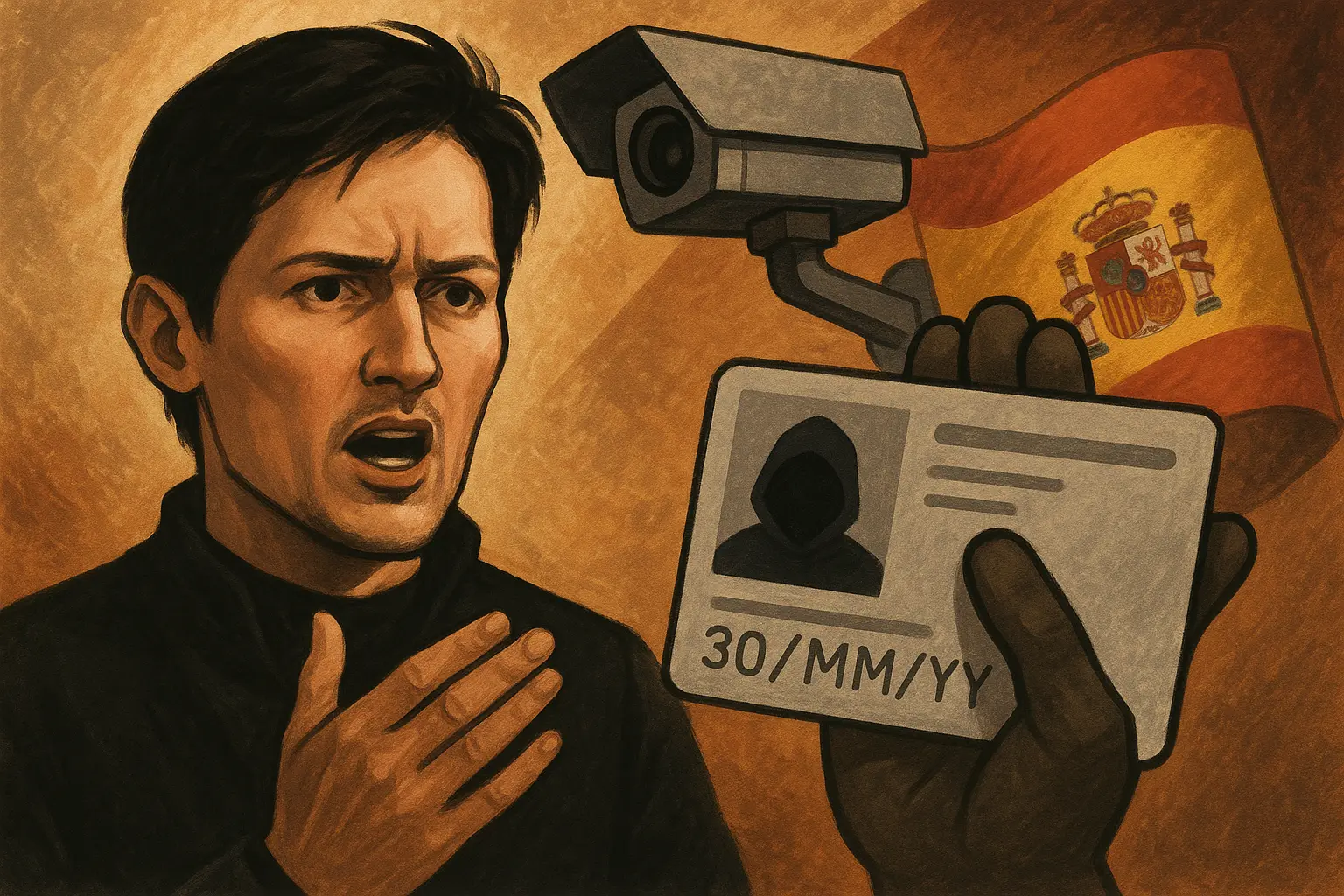
Telegram founder Pavel Durov warns that Spain’s online age verification law will eliminate anonymity and turn the country into a surveillance state. Spanish Prime Minister Sánchez announced at the Dubai summit that social media use will be restricted for those under 16, claiming “social media has become a failed state, and we must take back control to protect children.” Critics argue this is about control, not protection, and Concordium CEO suggests using blockchain zero-knowledge proofs to verify age without revealing identities.
Spanish Prime Minister’s Social Media War Sparks Controversy
On Tuesday, Spanish Prime Minister Pedro Sánchez stated at the World Government Summit in Dubai: “Social media has become a failed state. If we want to protect our children, the only thing we can do is: take back control.” This statement immediately drew strong opposition from privacy advocates and crypto punks, who believe such policies restrict free speech and give governments more power to censor content for political reasons.
Sánchez announced that Spain will implement online age verification policies already adopted in other parts of Europe (including the UK). These policies require social media platforms to verify user ages, banning minors under 16 from registering and using these services. On the surface, this aims to protect children from cyberbullying, inappropriate content, and mental health risks. However, implementing age verification necessarily involves identity authentication, meaning users must provide government IDs or biometric data, thereby losing online anonymity.
Durov responded on social media Wednesday: “The Pedro Sánchez government is pushing dangerous new regulations that threaten your online freedom. These measures were just announced yesterday, and they may be disguised as ‘protection,’ but they turn Spain into a surveillance state.” This accusation points to the potential abuse risks of such policies, suggesting that protecting children is just a pretext, and the real goal is establishing a comprehensive online monitoring system.
Once an age verification system is in place, the government will have access to a complete database of user identities, enabling tracking of anyone’s online activities, speech, and social networks. Such capability in the hands of authoritarian regimes is extremely dangerous, potentially used to suppress dissent, monitor political opponents, or censor unfavorable content. Even in democratic countries, this power could be abused; history shows government surveillance powers are often difficult to roll back.
Three Major Concerns About Age Verification Policies
Loss of Anonymity: Users must provide IDs or biometric data, ending online anonymity
Surveillance Infrastructure: Government gains full user identity database, tracking all online activity
Legitimization of Censorship: Under the guise of protecting children, paving the way for content censorship and speech control
A user named Campari commented: “You want to control those exposing government corruption.” Billionaire Elon Musk also posted a negative comment, mocking Sánchez. This widespread opposition indicates that age verification policies have transcended technical issues and become a fundamental debate over free speech and government power.
Critics: Everything Is About Control, Not Protection
Critics argue that age verification is about control, not child protection. “This has nothing to do with ‘protecting children,’” said journalist Taylor Lorenz, urging people worldwide to oppose online age verification laws. Lorenz, a veteran tech and internet culture reporter, notes that many restrictive laws in history have been justified as “protecting children” but ultimately evolved into broad social control tools.
This skepticism is not unfounded. Looking back, the 2001 US Patriot Act, justified by anti-terrorism, granted broad surveillance powers that were later revealed by Edward Snowden to be massively abused for monitoring ordinary citizens. China’s real-name registration system was initially implemented to combat cybercrime and protect minors but eventually became a comprehensive social surveillance system. Whether Spain’s age verification law will follow a similar path is the biggest concern among critics.
“You want to control those exposing government corruption,” is a pointed critique. Anonymity is a vital safeguard for whistleblowers and dissenters. When journalists, activists, or ordinary citizens seek to expose corruption, abuse of power, or injustice, anonymity allows them to speak out without fear of retaliation. Destroying anonymity through age verification exposes these individuals to great risks. Although Spain is a democracy, government corruption and political reprisals are real issues, and age verification could become a tool to suppress critical voices.
Musk’s mocking comment also carries symbolic weight. As owner of X and a staunch supporter of free speech, Musk has often clashed with European government content regulation policies. His ridicule of Sánchez reflects broader Silicon Valley tech giants’ dissatisfaction with European regulatory models. This transatlantic clash over surveillance philosophy is becoming a core issue in global internet governance.
Blockchain Zero-Knowledge Proofs Offer a Third Way
Others believe that while protecting minors from harmful content is necessary, current age verification methods are counterproductive. Boris Bohrer-Bilowtzki, CEO of the blockchain platform Concordium, proposes a technical middle ground. He explains that current age checks are easily bypassed using VPNs, which route traffic through servers in different locations to hide IP addresses.
This circumvention actually exposes minors to greater risks. When they use VPNs and fake identities to register accounts, platforms cannot verify their true age, rendering protections ineffective. Worse, VPN use can lead minors into darker corners of the internet, where content regulation is even more lax. This “forbidden fruit” phenomenon has been seen repeatedly in internet regulation history.
Bohrer-Bilowtzki suggests that blockchain technology can be used to cryptographically prove user age without revealing any identifying information. This is called “Zero-Knowledge Proof” (ZKP), allowing users to demonstrate “I am over 16” without disclosing their name, birth date, ID number, or any personal data. The platform only receives a cryptographically verified “age proof,” which cannot be reverse-engineered to identify the user.
This approach balances protection and privacy. Minors are effectively excluded, achieving the goal of safeguarding them. Meanwhile, user anonymity is preserved, preventing governments from building comprehensive user identity databases. Technically, zero-knowledge proofs are mature and feasible for identity verification. The question remains whether governments genuinely want a “privacy-preserving and protective” solution, or if they are primarily interested in surveillance.
Durov and other critics suspect that if governments truly only wanted to protect children, they would adopt privacy-friendly solutions like zero-knowledge proofs. Their insistence on real-name verification suggests their true motives include control and monitoring, not just protection.
Disclaimer: The information on this page may come from third parties and does not represent the views or opinions of Gate. The content displayed on this page is for reference only and does not constitute any financial, investment, or legal advice. Gate does not guarantee the accuracy or completeness of the information and shall not be liable for any losses arising from the use of this information. Virtual asset investments carry high risks and are subject to significant price volatility. You may lose all of your invested principal. Please fully understand the relevant risks and make prudent decisions based on your own financial situation and risk tolerance. For details, please refer to
Disclaimer.
Related Articles
AT Global Markets analyst: The global markets may decline further today
Gate News, April 2, AT Global Markets chief market analyst Nick Twidale said that there is high expectation for clear information on when the conflict will end, but recent remarks have instead added even more uncertainty. Twidale noted that global markets today could see further downside. He said that the market originally expected an announcement of a ceasefire today, but while the parties involved claim the war will end soon, they also said that they will target Iran over the coming weeks. This message is bearish for the market, implying that the war may continue.
GateNews6m ago
Bitcoin, stocks soar as markets respond to chance of US and Israel-Iran war ending
Bitcoin (BTC) briefly jumped to $68,589, and US stock markets rallied as investors reacted to US President Donald Trump's statements on considering options for ending the US and Israel-Iran war. Separate, unconfirmed comments attributed to Iranian President Masoud Pezeshkian also suggested that Iran
Cointelegraph49m ago
Trump’s speech declares victory in the Iran war! Gold slips down 60 dollars, and oil prices fall below the 100 mark
U.S. President Trump announced in a White House address that the “Epic Raging Operation” had achieved a decisive victory and that he plans to end the military intervention within two to three weeks. The market reaction was intense: spot gold and crude oil prices fell sharply, while Bitcoin remained stable. The Iranian president then issued a public letter questioning U.S. conduct and emphasizing Iran’s right to self-defense.
MarketWhisper50m ago
WTI crude oil breaks above $103, Brent crude rises to $102.86, and U.S. stock index futures fall
Gate News reports that on April 2, WTI crude oil broke through $103 per barrel, rising 4.07% intraday; Brent crude oil surged by $4 intraday, currently at $102.86 per barrel, up 4.06%. According to reports, Trump stated that if no agreement is reached, he will strike Iran’s energy facilities. As a result, U.S. stock index futures declined; S&P 500 index futures are down 0.5% latest.
GateNews51m ago
Trump threatens to strike Iran’s energy infrastructure, WTI crude oil breaks above $103, up more than 4% intraday
Gate News report, April 2, international oil prices continued to rise. WTI crude oil (West Texas Intermediate crude oil futures) broke through $103 per barrel, up 4.07% on the day; Brent crude oil (international benchmark crude oil futures) surged by $4 on the day, now at $102.86 per barrel, up 4.06%. In the news, Trump said that if an agreement is not reached, he will strike Iran’s energy facilities.
GateNews51m ago
Gate Daily Report (April 2): The U.S. Department of the Treasury releases a notice of proposed rules for the “GENIUS Act”; the CFTC says it is prepared to regulate the entire crypto market
Bitcoin (BTC) dipped in the short term to $67,600. The U.S. Department of the Treasury launched a small consultation on regulatory guidance for stablecoins under the “GENIUS Act,” and the CFTC Chair said he is ready to regulate the entire crypto market. Amid market developments, spot Bitcoin inflows are slightly higher than outflows, and the CFTC and the SEC have signed an agreement to coordinate digital asset regulation.
MarketWhisper53m ago


