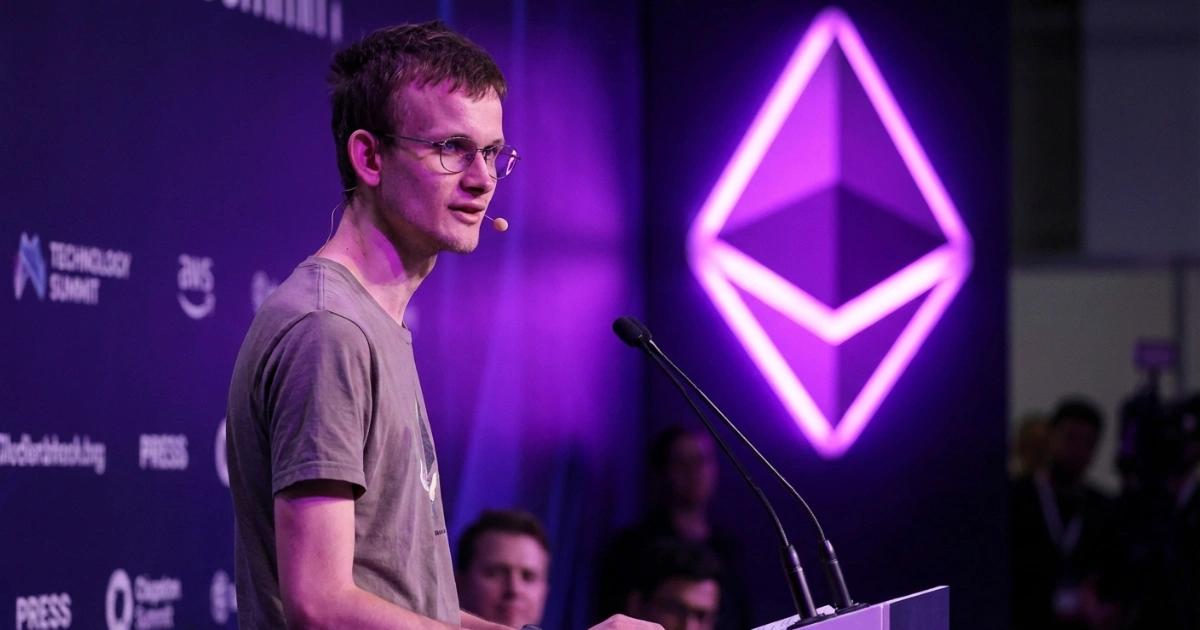
Vitalik proposes revisions to Ethereum’s scaling roadmap, believing that the mainnet performance has improved and that Layer2 should no longer serve as “branded sharding,” but instead focus on diverse functionalities and specialized value.
Ethereum Scaling Blueprint Undergoes Major Revision: Vitalik Suggests Ending the “Branded Sharding” Vision
Ethereum co-founder Vitalik Buterin shared his views yesterday (2/3), sparking a industry-wide reassessment of the role of Layer2 scaling solutions. Vitalik pointed out that the original “Rollup-centric” roadmap is no longer fully applicable in the current context and that a new development path must be sought.
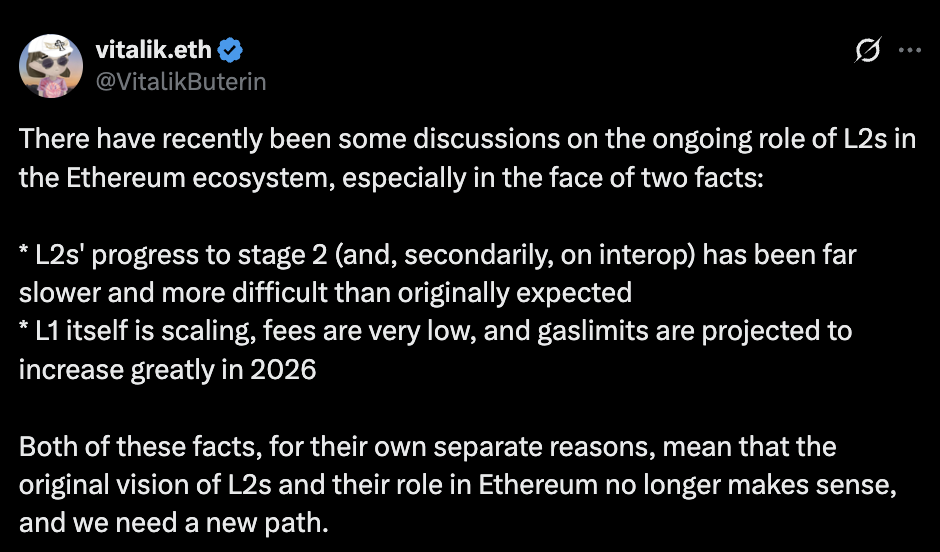
Image source: X/@VitalikButerin Vitalik notes that Ethereum’s original “Rollup-centric” roadmap is no longer fully suitable in the current environment
For a long time, Ethereum developers have pursued scaling goals, aiming to create enough block space to accommodate various applications and transactions without sacrificing security and decentralization. Historically, the Ethereum community generally believed that the mainnet should shift toward handling settlement, transferring most transaction and application loads to third-party built Layer2 scaling networks such as Arbitrum, Optimism, and Base. These networks were once defined as Ethereum’s “Branded Shards,” bearing the social status and responsibility as extensions of the mainnet.
However, Vitalik believes this vision has become disconnected from reality, primarily because Layer2’s progress toward decentralization has fallen short of expectations, and Ethereum’s mainnet (Layer1) has significantly improved its scaling capacity.
Mainnet scaling performance has greatly improved, shifting Layer2’s core value spectrum
Ethereum’s mainnet scaling speed is exceeding expectations, which is a key fact driving the change in perspective. Currently, transaction fees on Ethereum Layer1 remain low, and the Gas Limit is expected to increase substantially in 2026 and in the coming years. As the mainnet continues to scale, Layer1 has become capable of operating independently and no longer relies on Layer2 to serve as “branded sharding.”
Although Layer2 was previously likened to a “overflow room” in a conference hall to reduce congestion in the main venue, advances in technologies like PeerDAS and improvements in data availability have enabled the mainnet to handle data demands more effectively. Vitalik proposes defining Layer2 as a “Full Spectrum” network series. In this spectrum, different networks should offer varying levels of connectivity and technical features based on user needs. Some networks can still be secured by Ethereum’s strong security guarantees, while others can opt for looser connection methods, with users choosing based on personal or automated requirements.
Decentralization bottleneck: Vitalik warns that multi-sig cross-chain does not equal Ethereum scaling
Beyond mainnet performance improvements, Layer2 faces difficulties in progressing toward full decentralization, which is also a reason for Vitalik’s change of stance. According to his previous decentralization architecture proposal, Layer2 networks should evolve from “Stage 0” to “Stage 2,” representing fully trustless, permissionless systems. “Stage 1” is defined as a state with “limited training wheels,” including a decentralized governance security council and permissionless fault proofs. Currently, most Layer2 solutions are still in early stages, with only a few, like Coinbase-supported Base network, successfully reaching Stage 1 last year.
Vitalik openly states that many Layer2 networks cannot meet the security and decentralization standards required for true branded sharding. He is especially critical of networks relying on “multisig bridges.” A network claiming to support 10,000 transactions per second (10k TPS) via an EVM-compatible chain, if connected to Ethereum mainnet through a multisig-controlled cross-chain bridge, does not constitute real “scaling Ethereum.” Genuine scaling must be guaranteed by Ethereum’s trust model, ensuring transactions are valid, censorship-resistant, and irreversible.
Seeking specialized industry competitiveness: Layer2 developers must create unique value propositions
In response to the dramatic changes in the Ethereum ecosystem, Vitalik offers new strategic advice to Layer2 developers: seek value-added services beyond “scalability.” As the mainnet becomes more efficient, simply pursuing lower transaction costs is no longer a sufficient competitive advantage.
Some Layer2 projects, possibly due to regulatory requirements, may choose to remain at Stage 1 indefinitely to maintain ultimate control over customer needs.
Vitalik believes this is appropriate for certain clients, but such systems should not be described as scaling Ethereum. He encourages Layer2 teams to focus on “extreme performance” or “specialized architectures” that are difficult to implement on the mainnet, such as non-EVM virtual machines designed for specific applications, privacy features, or ultra-low latency ordering properties. For existing Layer2 projects, Vitalik’s bottom line is that they must at least reach Stage 1 decentralization, especially for networks involving Ethereum (ETH) assets. The value of Layer2 lies in “creating new things,” not merely extending the mainnet. This revision of the roadmap is a pragmatic adjustment under current technological conditions and a realistic recalibration of Ethereum’s multi-layer vision.
Disclaimer: The information on this page may come from third parties and does not represent the views or opinions of Gate. The content displayed on this page is for reference only and does not constitute any financial, investment, or legal advice. Gate does not guarantee the accuracy or completeness of the information and shall not be liable for any losses arising from the use of this information. Virtual asset investments carry high risks and are subject to significant price volatility. You may lose all of your invested principal. Please fully understand the relevant risks and make prudent decisions based on your own financial situation and risk tolerance. For details, please refer to
Disclaimer.
Related Articles
Tom Lee's Bitmine Acquires 40,000 ETH Worth $82.07 Million
Gate News message, Tom Lee's Bitmine purchased an additional 40,000 ETH valued at $82.07 million from centralized exchanges today. The transaction marks another significant ETH accumulation by the firm.
GateNews3h ago
Ethereum Foundation stakes another $93 million ether, reaching its 70,000 ETH target
The Ethereum Foundation staked $93 million in ether, reaching nearly $143 million in total staked ETH, almost fulfilling its 70,000 ETH target. This shift to staking generates yield for funding operations without selling assets, although some ETH remains unstaked.
CoinDesk4h ago
Early ETH Accumulation Hints at Breakout—Can Momentum Hold?
Ethereum shows early accumulation, with most holders near breakeven and selling pressure easing.
Taker Buy/Sell Ratio rising indicates growing demand and selective buying across exchanges.
Sustained momentum above key levels could trigger a breakout toward higher price targets.
At press
CryptoNewsLand4h ago
$ETH Whale Pulls $82M From FalconX, Market Speculates Tom Lee Connection
An Ethereum whale withdrew $82M in ETH from FalconX, increasing their holdings to 40,000 ETH. The transaction pattern resembles Bitmine's, sparking speculation about Tom Lee's involvement. Traders are monitoring its market impact.
BlockChainReporter5h ago
Ethereum Revisits $2,000 While Smart Money Turns to BlockchainFX, the Best Crypto Presale Approac...
Twelve times. That’s how many times Ethereum has touched $2,000 since April 2021, and somehow April 2026 is on that list too. While ETH holders stare at the same number they’ve been staring at for five years, a different crowd is moving quietly and deliberately into BlockchainFX (BFX), a
BlockChainReporter7h ago
Naoris Protocol's quantum-resistant blockchain goes live as Bitcoin and Ethereum face 'Q-Day' threats
Naoris Protocol launched a quantum-resistant blockchain, designed to secure transactions against future quantum threats. It utilizes post-quantum cryptography and has validated over 100 million transactions, preparing to protect digital assets despite vulnerabilities in existing systems like Bitcoin and Ethereum.
CoinDesk7h ago


