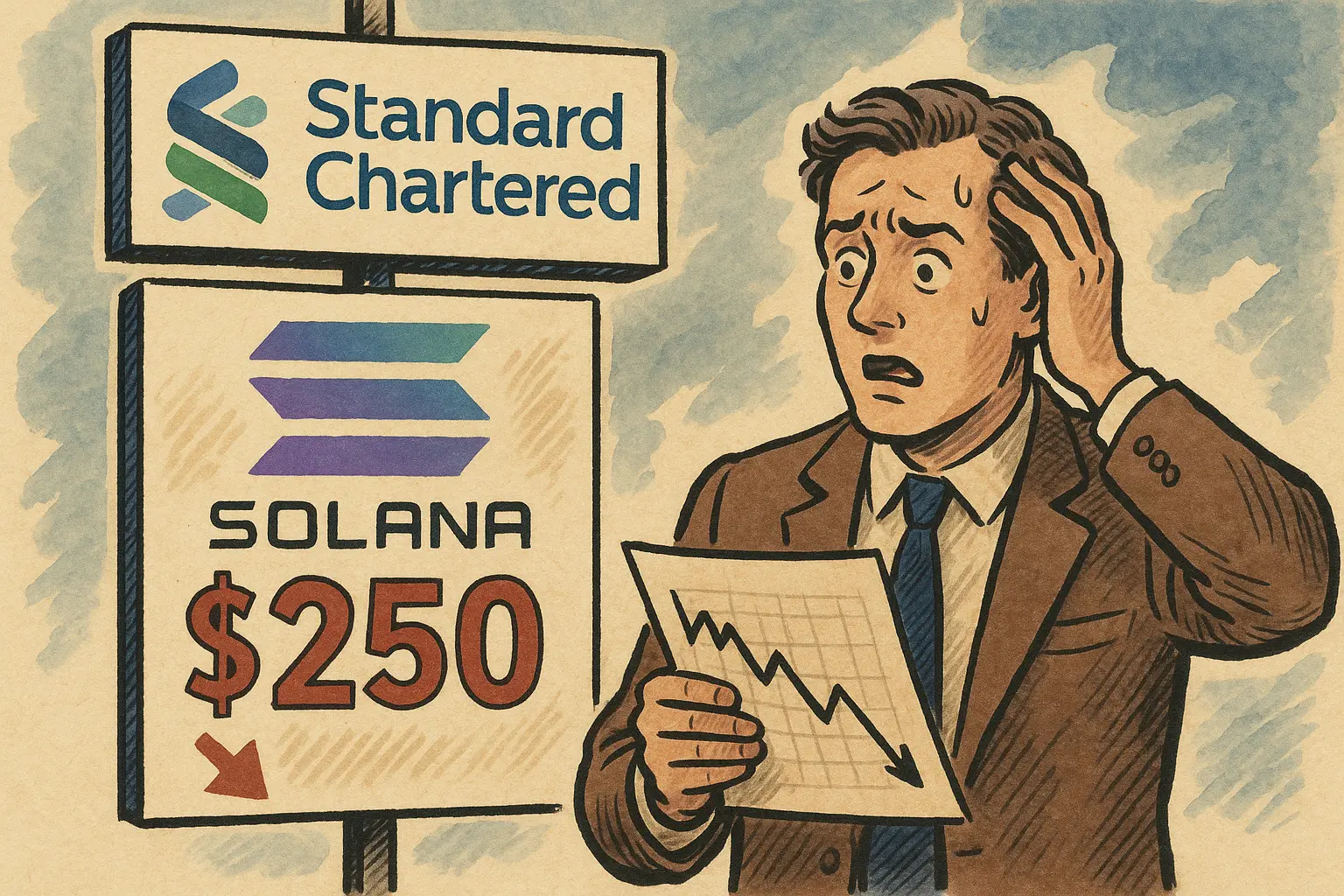
Standard Chartered Bank has lowered its 2026 target price for Solana to $250, but expects it to reach $2,000 by 2030. The bank believes Solana is shifting from meme coins to micro-payments, with stablecoin transaction speeds 2-3 times faster than Ethereum. They project that in 2026-27, Solana will perform below Ethereum, but from 2027 to 2030, it will outperform Bitcoin.
Contradictory Logic Behind Standard Chartered Bank’s Lowered Solana Target Price
Standard Chartered Bank states that recent sell-offs in the cryptocurrency market have created buying opportunities, as market pressure begins to distinguish high-quality protocols from more speculative projects. Jeffrey Kendrick, Head of Global Digital Asset Research at Standard Chartered Bank, says he is a “buyer during this digital asset decline,” and adds that this downturn marks an early stage of increased performance differentiation within the industry.
In a report issued on Tuesday, Kendrick revised his price forecast for Solana at the end of 2026, lowering the projected price from $310 to $250, citing that the network’s next major use case will take time to scale. This adjustment of about 19% indicates a cautious short-term outlook for Solana. At the current price of around $100, a $250 target implies a potential upside of 150% over the next 10 months, but is clearly more conservative than the previous $310 forecast.
However, he also significantly raised his long-term projections, expecting SOL to reach $400 in 2027, $700 in 2028, $1,200 in 2029, and $2,000 by the end of 2030. This aggressive long-term forecast, with a $2,000 target representing a 20-fold increase from current levels, reflects confidence in Solana’s narrative shift but also acknowledges that such transformation will require time.
Kendrick states that as forced selling subsides, fundamentals will begin to reassert themselves, and the current market environment is more suitable for selective positioning rather than broad investments. This perspective suggests that the recent market correction is healthy, clearing out speculative bubbles and highlighting truly valuable projects. In this context, Solana is viewed as one of the few high-quality protocols worth long-term investment.
Evolution of Standard Chartered Bank’s Solana Price Targets
End of 2026: $250 (down from $310)
2027: $400
2028: $700
2029: $1,200
End of 2030: $2,000 (20 times current price)
This forecast, which accelerates year by year, reflects Standard Chartered Bank’s long-term optimism for Solana’s micro-payment narrative. They believe that as applications mature and network effects develop, Solana’s value will grow exponentially.
From Meme Coin Frenzy to Stablecoin Micro-Payments Transformation
(Source: Standard Chartered Bank)
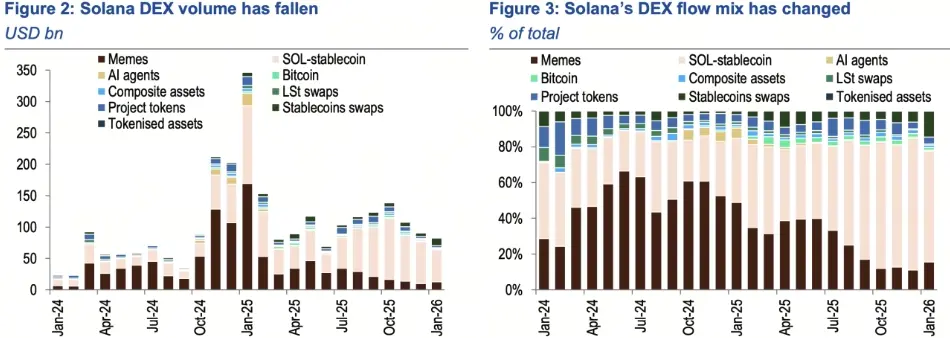
Standard Chartered Bank states that as decentralized trading activity shifts toward SOL stablecoin trading pairs, Solana is “evolving from meme coins to micro-payments.” The firm cites on-chain data indicating that Solana is no longer like last year’s “one-trick pony,” relying solely on meme coin trading. “When we started paying attention to Solana in May 2025, activity was mainly driven by meme coin trading on decentralized exchanges (DEXs),” Kendrick wrote.
By 2025, this situation changed, with capital moving away from meme-centric activity (peaking when Trump coin launched in mid-January) toward tokenized dollars. This turning point was extremely significant; Trump coin’s launch pushed Solana’s meme coin trading to a historic high, with daily trading volumes exceeding billions of dollars at times. However, subsequent crashes and the cooling of speculative fervor created space for Solana’s narrative shift.
“However, a deeper analysis of capital flows on Solana DEXs shows that as trading volume declines, the composition of funds on DEXs has shifted from meme coin trading to SOL-stablecoin pairs,” Kendrick wrote, adding that if this trend continues, “it could indicate that in the post-meme coin era, Solana is pioneering a new frontier.” This change in capital flow structure is a core reason why Standard Chartered Bank remains optimistic about Solana’s long-term prospects.
What does an increase in stablecoin trading pairs mean? It indicates that Solana is transitioning from a purely speculative platform to an infrastructure for actual payments and value transfer. Meme coin trading is zero-sum, with winners and losers, and does not generate real value. In contrast, stablecoin micro-payments support real economic activities: cross-border remittances, content payments, tips, and rewards. This transformation will bring more sustainable demand and stable revenue streams for Solana.
Kendrick believes Solana’s ultra-low transaction costs have fostered new use cases driven by AI-powered micro-payments, further increasing the network’s attractiveness. The bank states that the turnover speed of stablecoins on Solana is already 2 to 3 times that of Ethereum, indicating that as internet-native protocols supported by Coinbase, such as x402, become more widespread, Solana is playing a unique role in transactions. Turnover speed is a key indicator of capital efficiency; a 2-3x advantage shows that Solana’s technical performance is translating into real economic activity.
2026-2027 Lagging Ethereum, but 2027-2030 Outperforming Bitcoin
However, Kendrick notes that this transition will take time. Standard Chartered Bank expects Solana to underperform Ethereum in 2026 and 2027, but as micro-payment adoption and scale expand, Solana will gradually catch up. In the long term, the bank forecasts that SOL will outperform Bitcoin between 2027 and 2030. This phased outlook reveals the bank’s assessment of the competitive landscape among different crypto assets.
The reasoning behind Solana underperforming Ethereum in 2026-2027 is that mainstream stablecoin and tokenized asset applications will still primarily be built on Ethereum. Ethereum has a more mature DeFi ecosystem, more institutional adoption, and stronger brand recognition. During this period, Solana’s micro-payment narrative is still in its early stages and has yet to reach significant scale. In comparison, Standard Chartered reaffirms that Ethereum remains its preferred large-cap digital asset in the near term.
But from 2027 to 2030, the competitive landscape may reverse. When micro-payment scenarios mature and reach hundreds of millions of users, Solana’s technical advantages—such as 65,000 transactions per second and $0.001 fees—will be fully realized. At that point, Ethereum’s high gas fees and slower transaction speeds will become disadvantages. The bank expects that during this phase, Solana will not only catch up with Ethereum but surpass Bitcoin’s performance. This outlook is based on the premise that the micro-payment market will far exceed the current DeFi market in size.
The bank’s forecast also implies a view on Bitcoin’s future role. Bitcoin will continue to serve as a store of value and a large-value settlement tool, but its technical limitations in daily payments and small transactions will make it difficult to compete with Solana. This division of roles and positioning among assets is a core logic for institutional investors when allocating crypto assets.
Disclaimer: The information on this page may come from third parties and does not represent the views or opinions of Gate. The content displayed on this page is for reference only and does not constitute any financial, investment, or legal advice. Gate does not guarantee the accuracy or completeness of the information and shall not be liable for any losses arising from the use of this information. Virtual asset investments carry high risks and are subject to significant price volatility. You may lose all of your invested principal. Please fully understand the relevant risks and make prudent decisions based on your own financial situation and risk tolerance. For details, please refer to
Disclaimer.


