Author: Go2Mars’s Web3 Research
1. What is a Prediction Market?
First, clarify a concept: prediction markets are not gambling, but rather probability forecasts of upcoming events. They are a market mechanism based on trading the outcomes of future events. Essentially, they are tools that leverage collective intelligence to predict the likelihood of uncertain events. Participants express their views on event outcomes by buying and selling “contracts,” whose value ultimately depends on whether the event occurs or what the result is. The focus is on information aggregation and prediction accuracy.
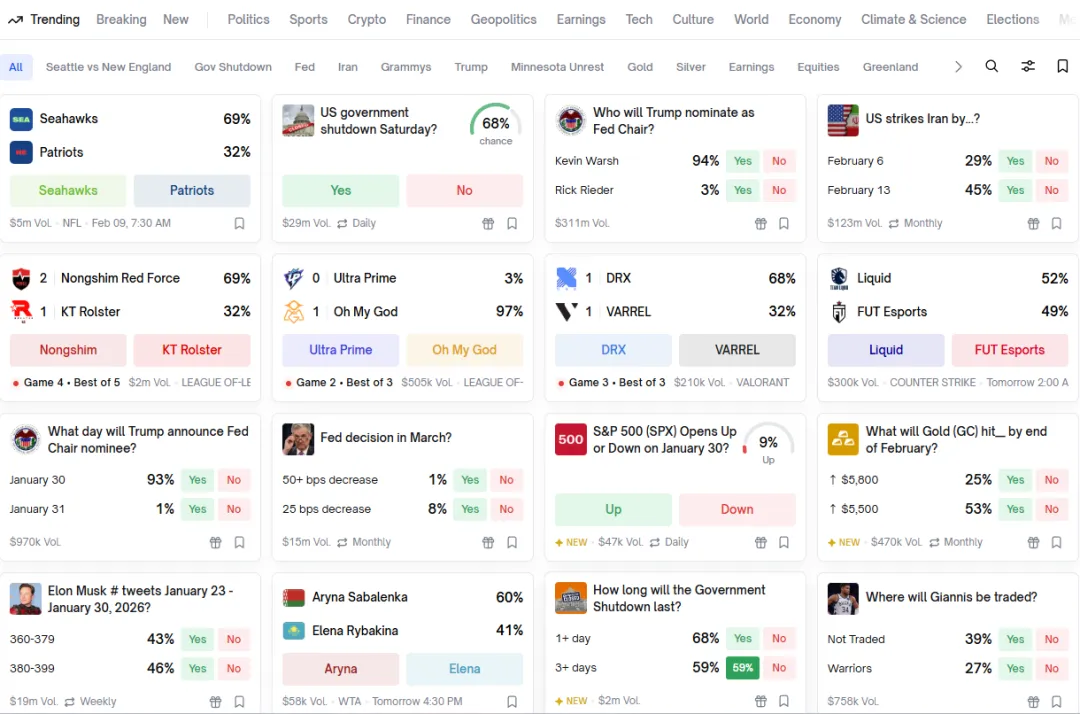
In simple terms, prediction markets are like trading the “outcome of future events.” Participants are not buying stocks but are trading judgments on whether an event will happen or not. For example, for the event “2024 US Presidential Election, will Biden be elected?”, the market issues “Yes” and “No” contracts. The contract prices directly reflect the market consensus probability of the event: if the “Yes” contract is priced at $0.60, it indicates the market believes there is a 60% chance Biden will be elected.
Prediction markets typically use binary contracts (Yes/No), but can also be extended to multi-outcome events. Their advantage lies in encouraging participants to reveal truthful information through market incentives, thereby improving prediction accuracy.
2. Prediction Market Order Book Trading
Platforms like Polymarket adopt a Central Limit Order Book (CLOB) model, similar to traditional centralized exchanges (such as stock markets). In this model, prices are no longer preset by algorithms but are driven in real-time by buy and sell limit orders submitted by participants. Market prices are determined by supply and demand, reflected in the matching of best bid and ask prices.
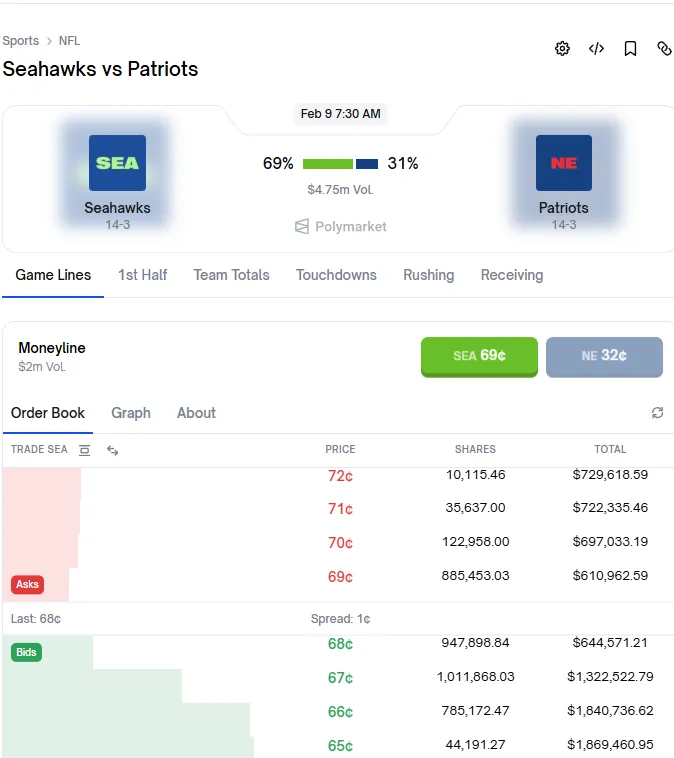
Recall what we mentioned earlier: contract prices reflect the market’s perceived probability of an event occurring. Yes, the order book model aligns perfectly with the concept of prediction markets. It allows market dynamics to adjust probability estimates. However, it’s important to note that the market price (probability) does not always perfectly reflect the true probability of the event. Influences such as FOMO emotions, independent information channels, or market makers can cause deviations. This creates arbitrage opportunities: identifying mispricings and buying the undervalued side.
3. How to Arbitrage
Prediction markets present many arbitrage opportunities. Participants usually play two roles:
- Role A: Market Makers / Liquidity Providers buy the undervalued side at extreme odds and sell the overvalued side, closing positions when prices normalize for profit.
- Role B: Direction-neutral arbitrageurs bet on one side of the prediction market while hedging with perpetual contracts to manage directional risk. The focus is not on betting up or down but on exploiting odds discrepancies to lock in profits.
Below, specific arbitrage methods are introduced one by one. Note that all arbitrage involves risk and is affected by market sentiment, fees, and liquidity constraints.
3.1 Finding Value Discrepancies
Unlike traditional betting with fixed odds from a bookmaker, polymarket’s prices are determined in real-time by user supply and demand. Markets can be influenced by emotions, leading to distorted prices that reflect “probabilities.” By scanning numerous events and combining human judgment, one can identify when market prices deviate from true value, buying the undervalued side.
Note: Markets may not correct (if sentiment persists), or your probability estimate may be wrong. This is not risk-free.
3.2 On-Platform Arbitrage
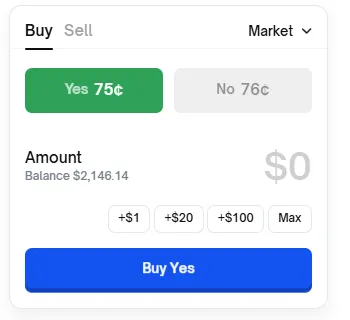
Basic idea: For the same event, the sum of Yes and No contract prices should equal 1 (or, for multi-outcome events, the total should sum to 1). If deviations occur, arbitrage opportunities arise.
- If the total > 1 (market overestimates probability): short the overvalued side to lock in profit.
- If the total < 1 (market underestimates probability): buy all outcomes; upon settlement, profit is guaranteed (total value ≥ 1).
Fundamental concept: YES + NO ≠ 1, or multiple outcomes sum ≠ 1.
Caution: this strategy can be eroded by:
- Trading fees
- Slippage (price impact of large orders)
- Limit orders and platform position restrictions
3.3 Cross-Platform Arbitrage
The same event may have different odds on different platforms (e.g., Polymarket vs. Kalshi). Suppose Platform A has higher odds for “Event occurs” (market bullish), and Platform B has higher odds for “Event does not occur” (market bearish). If both describe the same event, you can bet on both sides simultaneously.
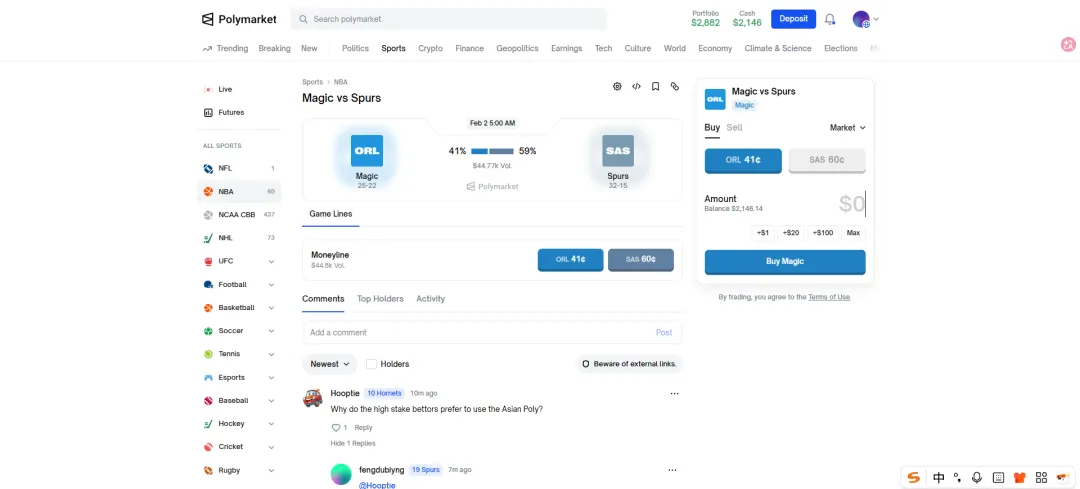
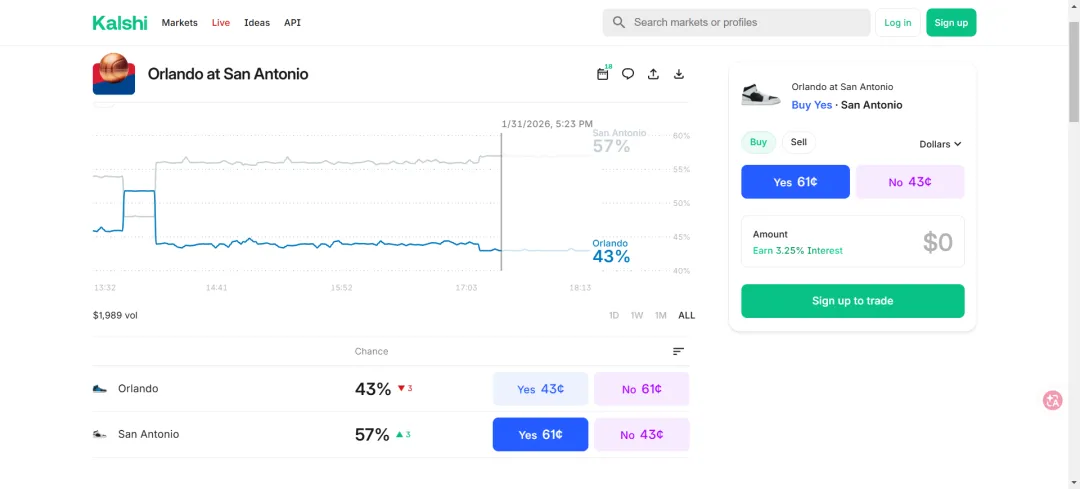
By comparing real odds on Polymarket and Kalshi, we can create a table:
|
|
|
| Platform |
Magic (ORL) |
Spurs (SAS) |
| polymarket |
41% |
60% |
| Kalshi |
43% |
57% |
If you buy the Magic team winning on Platform B at 41¢ and buy the Spurs team winning on Platform A at 57¢, total cost = 41¢ + 57¢ = 98¢.
- Regardless of which team wins, you will receive $1 (100¢) at settlement.
- Net profit = 100¢ - 98¢ = 2¢, yield ≈ 2%.
Caution: Fees, transfer costs, and settlement differences between platforms may erode profits. Ensure event definitions are consistent.
4. Summary and Action Arbitrage
Prediction markets are filled with automated bots and professional market makers who leverage efficient algorithms and techniques to capture most profits. As ordinary participants, we should reflect: what is our competitive advantage when facing these mechanized processes? We cannot monitor all arbitrage opportunities with high-frequency scans, so we should rely more on subjective judgment.
AI-assisted tools combined with personal expertise in specific event domains will be key to standing out. This collaborative approach can effectively fill algorithmic blind spots and achieve differentiated profits.
Action recommendations:
- Record and review: For each bet, meticulously log position size, hedging details, and settlement outcomes. Later, analyze whether Yes/No contract prices significantly deviated from 1 or if there were arbitrage mismatches. Use this review to optimize future decisions.
- Semi-automated monitoring: Use market tools, develop scripts or bots to track odds deviations in real-time and send alerts, improving efficiency rather than relying solely on manual operations.
- Small-scale real trading: Use minimal capital to run the full process, including prediction market bets and perpetual hedging, to verify strategy feasibility and accumulate practical experience.
Always remember: markets are unpredictable. Arbitrage requires rigorous risk management and continuous learning.
Disclaimer: The information on this page may come from third parties and does not represent the views or opinions of Gate. The content displayed on this page is for reference only and does not constitute any financial, investment, or legal advice. Gate does not guarantee the accuracy or completeness of the information and shall not be liable for any losses arising from the use of this information. Virtual asset investments carry high risks and are subject to significant price volatility. You may lose all of your invested principal. Please fully understand the relevant risks and make prudent decisions based on your own financial situation and risk tolerance. For details, please refer to
Disclaimer.
Related Articles
Polymarket Fee Reform Takes Effect March 30, Biggest Impact on Crypto Trading
Prediction market platform Polymarket announced that it will expand trading fees to most market categories, with cryptocurrency market fees rising to 1.8% and sports betting market fees at 0.75%. Fee rates fluctuate based on event odds, while simultaneously launching a referral program and new market integrity rules to comply with regulatory requirements and promote market transparency.
MarketWhisper28m ago
BitGo Prime and Susquehanna Crypto Launch Institutional-Grade OTC Prediction Market Trading Service with Minimum Threshold of $100,000
BitGo Prime and Susquehanna Crypto jointly launched an over-the-counter prediction market trading service for institutional clients, allowing institutional investors to use digital assets held in BitGo custody as collateral, with a minimum trade size of $100,000, liquidity provided by Susquehanna, primarily serving hedge funds and ultra-high-net-worth investors.
GateNews1h ago
Stripe Co-Founder: Kalshi Integrating Stripe Connect
Golden Finance reports that on March 24, recently Stripe co-founder John Collison and Paradigm co-founder Matt Huang had a dialogue with Kalshi's two founders Tarek Mansour and Luana Lopes Lara. In the video conversation, the Stripe co-founder confirmed that Kalshi is integrating Stripe.
金色财经_9h ago
Gate Officially Integrates Polymarket, CEX First to Integrate Prediction Market Free Beta
Gate officially integrates Polymarket, becoming the first centralized exchange platform globally to integrate it, and launches a dedicated portal in the Gate App. Users can participate in prediction trading through USDT in their spot accounts without on-chain operations, and transaction fees are waived during the public beta period. It offers both prediction and trading modes to meet different needs and supports diverse event types and trading methods. In the future, it will expand the event scope and enhance price discovery functionality.
MarketWhisper9h ago
Polymarket Data: 34% probability of a US-Iran ceasefire before April 15
Gate News reported that on March 24, the latest Polymarket data showed that market bets on a US-Iran ceasefire by March 31 stood at 14%, by April 15 at 34%, and by May 31 at 57%. The prediction market's trading volume has exceeded $39.85 million.
GateNews9h ago


