Analysts at Bernstein believe that the current downturn in the crypto market could pave the way for a recovery cycle in 2026, even though Bitcoin is still trading about 40% below its all-time high of around $75,000 at the start of Monday.
In a client report, the research team led by Gautam Chhugani stated that the market may still be in a “short-term crypto bear cycle.” However, they expect this trend to reverse within this year, with Bitcoin potentially bottoming out near the previous cycle’s peak, around $60,000 in the first half of the year, before forming a higher base.
Bernstein places this recent correction in the context of Bitcoin’s relative weakness compared to gold over the past year — a period coinciding with a strong gold-buying wave from central banks. According to the firm, Bitcoin’s market capitalization has fallen to about 4% of gold’s, close to a two-year low, as central banks including China and India ramp up gold accumulation, increasing gold’s share in global reserves to approximately 29% by the end of 2025.
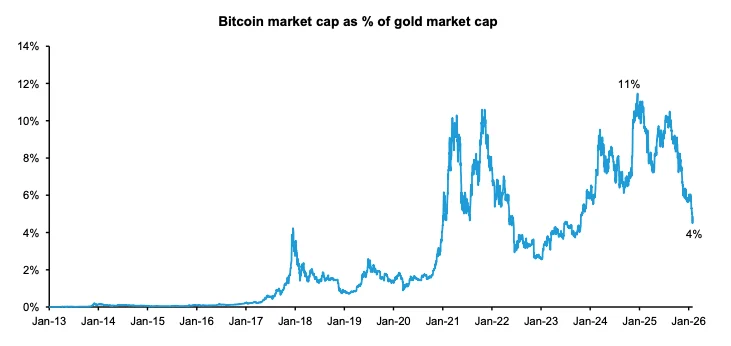
The Most Significant Cycle
Despite this relative weakness, Bernstein argues that the past two years still mark a “structural cycle” for Bitcoin. The highlight is the strong growth of spot Bitcoin ETF funds, with total assets under management reaching around $165 billion, along with a trend of companies adding Bitcoin to their balance sheets.
According to the firm, these developments have contributed to a strong rally before the market correction, making the current cycle different from previous boom-and-bust phases primarily driven by retail investors.
The analysts also point to US policy factors as a potential catalyst. They mention the establishment of a strategic Bitcoin reserve based on the government’s seized digital assets, and suggest that changes in the Federal Reserve leadership under nominee Kevin Warsh, along with broader political consensus around the crypto industry, could open scenarios where Bitcoin is taken more seriously as a national reserve asset — though this remains uncertain.
“We do not believe the US government will stay on the sidelines if the digital asset market continues to decline,” the analysts wrote.
Regarding capital flows and market structure, Bernstein notes that institutional participation remains quite resilient. The amount of capital withdrawn from ETFs since the peak of assets is relatively small compared to total holdings, and there has been no wave of sell-offs driven by leverage from miners as seen in previous cycles.
Large holders like Strategy continue to buy during downturns, adding about $3.8 billion worth of Bitcoin since the start of the year, even though the company’s market value has at times been below its cost basis. Meanwhile, mining companies are diversifying revenue streams into AI data centers.
According to Bernstein, these factors reinforce the view that the current weakness may be just a late-cycle correction rather than the start of a prolonged “crypto winter.” While short-term volatility may persist, the firm expects a turnaround in 2026 to lay the foundation for what could be considered Bitcoin’s “most meaningful cycle,” with long-term impacts potentially surpassing traditional four-year market models.
Thach Sanh
Disclaimer: The information on this page may come from third parties and does not represent the views or opinions of Gate. The content displayed on this page is for reference only and does not constitute any financial, investment, or legal advice. Gate does not guarantee the accuracy or completeness of the information and shall not be liable for any losses arising from the use of this information. Virtual asset investments carry high risks and are subject to significant price volatility. You may lose all of your invested principal. Please fully understand the relevant risks and make prudent decisions based on your own financial situation and risk tolerance. For details, please refer to
Disclaimer.
Related Articles
European Bitcoin Reserve Strategies Diverge from MicroStrategy Model as Local Approaches Gain Traction
European enterprises face unique regulatory challenges compared to the U.S. in issuing financial instruments, leading them to adopt localized strategies for bitcoin investments. Major European bitcoin-holding companies are significantly smaller than U.S. firms.
GateNews41m ago
Bitcoin ETFs See $291 Million Outflow as Ether Gains $9 Million
Bitcoin exchange-traded funds (ETFs) opened the week with heavy outflows, reversing last week’s momentum. Ether ETFs posted modest gains, while XRP declined, and solana activity stalled.
Key Takeaways:
Bitcoin ETFs saw $291.11 million outflows led by Fidelity FBTC, signaling renewed caution.
Et
Coinpedia52m ago
Adam Back Advocates Optional Quantum Resistance Upgrade, Opposing BIP-361 Forced Freeze Plan
Blockstream CEO Adam Back supports an optional Bitcoin quantum resistance upgrade at Paris Blockchain Week, opposing the BIP-361 proposal to freeze quantum-vulnerable addresses. He emphasizes proactive measures over crisis responses.
GateNews1h ago
Cato Institute Criticizes U.S. Bitcoin Tax Rules as Barrier to Payments, Calls for Reform
The Cato Institute criticizes U.S. bitcoin tax policies for complicating transactions and hindering adoption. They propose reforms like eliminating capital gains taxes on small crypto payments and increasing exemption thresholds for better usability.
GateNews1h ago
Bhutan Sells $18.46M BTC in 24 Hours, $264M Holdings Remain
Bhutan sold about $18.46 million in Bitcoin recently, retaining around 3,524 BTC valued at $264 million. Their strategy has shifted from accumulation through hydropower mining to active liquidation, having sold $198 million since 2026. Further sales could reduce holdings significantly by September 2026.
GateNews1h ago
Central African Republic Approves Cryptocurrency Regulation Bill, Not Bitcoin Legal Tender
The Central African Republic's parliament approved a cryptocurrency regulation bill, legalizing its use in financial markets while imposing strict penalties for offenses. The regulation aims to streamline remittances and provide access to digital currencies, despite concerns over crime and donor disbursements.
GateNews2h ago


