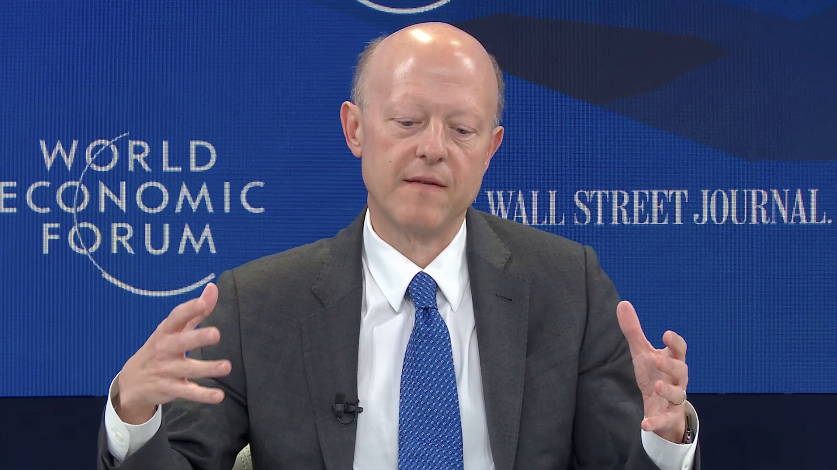
(Source: World Economic Forum)
Circle CEO Jeremy Allaire dismissed concerns on Thursday at the Davos World Economic Forum that stablecoin yields could lead to bank runs as “completely absurd,” citing the $11 trillion money market fund as a historical analogy to demonstrate that interest payments do not undermine monetary policy. He emphasized that stablecoin interest helps with user stickiness and predicted that “billions of AI agents” will need stablecoins as the only feasible payment system.
Circle CEO at Davos Forum dismisses bank run concerns
On Thursday at the Davos World Economic Forum, Allaire stated that concerns that stablecoin yields might cause bank runs are “completely absurd,” citing historical precedents and existing reward-based financial services. “They help increase user stickiness and attract customers,” Allaire said, adding that interest alone is not enough to disrupt monetary policy.
This statement comes amid intense debate over stablecoin yields, including discussions on the U.S. CLARITY Act, which aims to establish a federal market framework for digital assets. Whether stablecoin yields could trigger traditional bank deposit outflows and lead to bank runs has become one of the most concerning issues for regulators and traditional financial institutions.
The core logic of bank runs is that if stablecoins start paying interest higher than bank deposits, depositors might transfer large amounts of funds from banks to stablecoins, causing liquidity crises. This concern was heightened after the collapse of Silicon Valley Bank in 2023, when the bank faced difficulties due to rapid deposit withdrawals.
However, Allaire believes this concern exaggerates the threat of stablecoins, overlooking similar products already existing in the financial system. As the issuer of USDC, the world’s second-largest stablecoin with a market cap exceeding $60 billion, Circle’s stance has significant industry influence. Allaire’s public rebuttal indicates that Circle is actively shaping the regulatory discussion and trying to dispel policymakers’ doubts about stablecoin yields.
$11 trillion money market fund provides historical analogy
Allaire pointed out that government money market funds are a similar historical example, noting they also faced warnings that they would drain bank deposits. However, despite the growth of money market funds “to about $11 trillion, with varying growth patterns,” this did not halt lending activities.
Money market funds are mutual funds investing in short-term debt instruments, typically offering higher yields than traditional savings accounts. Since their introduction in the 1970s, they have attracted large amounts of bank deposits, but the financial system did not collapse because of them. Instead, banks adapted by adjusting interest rates, developing new products, and shifting to other revenue sources.
Allaire’s argument is that stablecoin yields are structurally similar to money market funds—both are liquidity tools offering higher returns to investors. If regulators did not ban their development back then, they should not overreact now to stablecoin yields. This historical analogy provides a strong basis for Circle’s position.
“Meanwhile, lending activities have already begun shifting from banks to private credit and capital markets. In the U.S., most GDP growth over recent economic cycles has come from capital market debt financing rather than bank loans,” he said. “We aim to build a stablecoin-based lending model.”
This statement reveals Allaire’s deeper perspective on the evolution of the financial system. The dominance of traditional banks in lending has weakened, with private equity, hedge funds, and capital markets taking on more financing roles. In this context, stablecoins are not a threat to banks but a natural extension of the de-intermediation trend in finance.
Circle hopes to establish a stablecoin-based lending model, meaning USDC will not only be a payment tool but also serve as the base currency for credit markets. If realized, this vision could reshape global credit allocation, making borrowing and lending more transparent, efficient, and bypassing traditional banking intermediaries.
AI agents are the killer app for stablecoins
Allaire also emphasized that artificial intelligence is a key driver for the future adoption of stablecoins. He stated, “Billions of AI agents” will need a payment system, and added that “currently, there are no alternatives besides stablecoins.” This perspective shifts the discussion of stablecoins from competition with banks to building the infrastructure for the future digital economy.
AI agents are software programs capable of autonomous task execution, ranging from simple chatbots to complex automated trading systems. As AI technology advances, these agents will need to perform financial transactions such as paying service fees, purchasing data, or settling with other agents. Traditional banking systems are ill-equipped to support these needs because:
Limitations of traditional payment systems
Identity verification issues: AI agents cannot pass KYC (Know Your Customer) procedures and cannot open bank accounts
Slow transaction speeds: Bank transfers take hours or days, unsuitable for real-time needs of AI agents
Cross-border complexity: International remittances involve multiple intermediaries, costly and opaque
In contrast, stablecoins offer an ideal solution. AI agents can hold crypto wallets and execute instant peer-to-peer transactions without human intervention. The programmability of stablecoins also allows payment logic to be embedded directly into smart contracts, enabling automated conditional payments.
Other parts of the forum echoed similar views. Binance former CEO Zhao Changpeng stated on Thursday at Davos that crypto payments are crucial for AI-driven transactions. In September, Galaxy Digital CEO Michael Novogratz predicted that AI agents will become the largest users of stablecoins “in the near future.”
These consistent views from top figures in the crypto industry demonstrate that the integration of AI and stablecoins has become an industry consensus. If these predictions come true, stablecoin usage could grow exponentially, as the number of AI agents far exceeds human users. This demand will transform stablecoins from fringe financial products into core infrastructure of the global digital economy.
Regulatory debate and the significance of the CLARITY Act
As Allaire made these remarks, a heated debate was underway regarding stablecoin yields, including discussions on the U.S. CLARITY Act, which aims to establish a federal market framework for digital assets. One of the core issues in this legislation is whether stablecoins should be allowed to pay yields.
Proponents argue that yields are a natural result of market competition and can provide better financial services to users. Opponents worry that this could weaken the transmission of monetary policy by central banks and potentially cause financial instability. Allaire’s “completely absurd” comment clearly aligns with the supporters, aiming to influence legislative direction.
Circle, as a stablecoin issuer seeking to go public, has a strong motivation to promote transparency and compliance in regulation. The company needs to convince regulators that stablecoin yields are harmless and can even promote financial innovation and financial inclusion. The public stance at the World Economic Forum is an important part of Circle’s lobbying strategy.


