
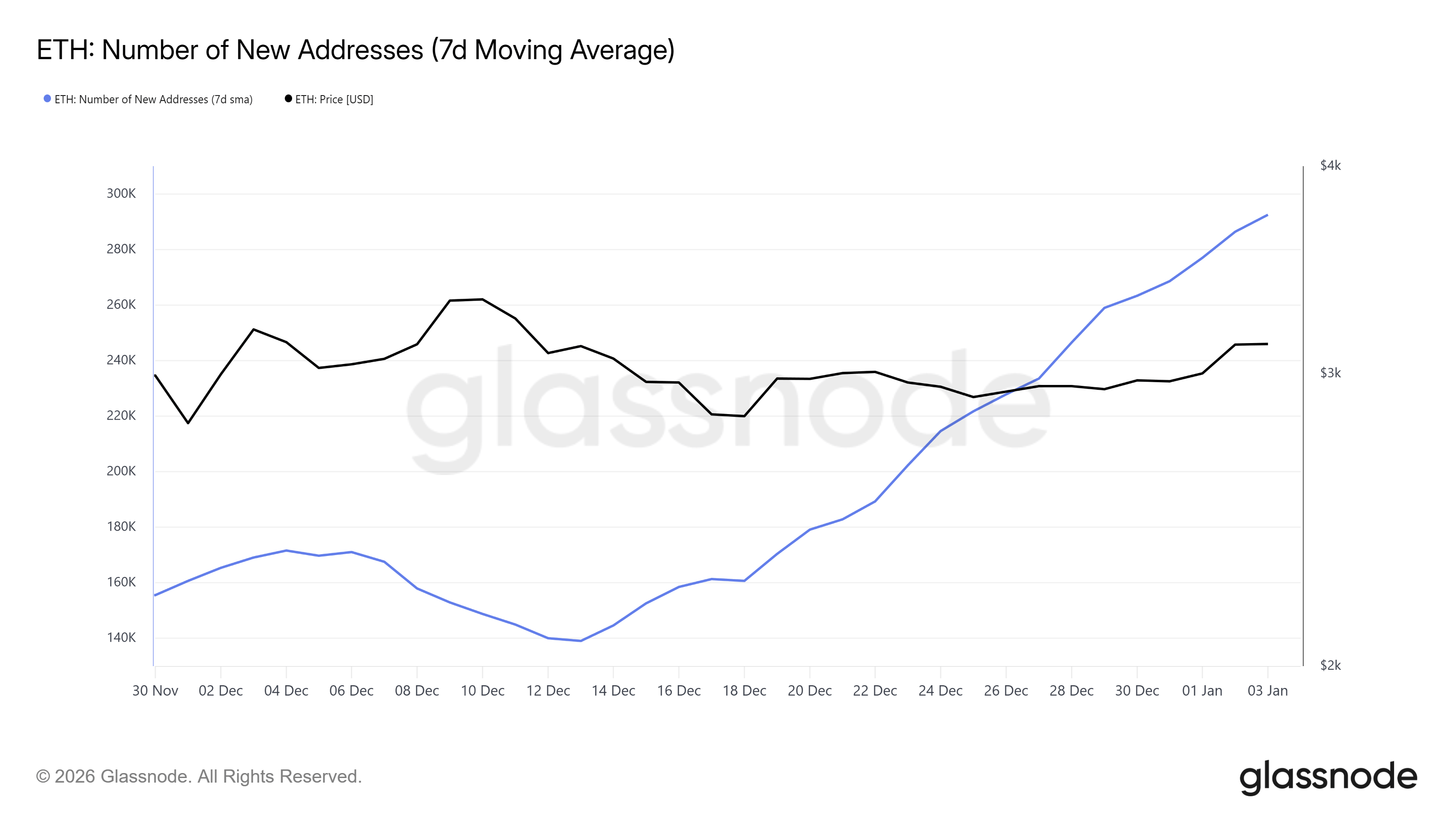
Since the Ethereum Fusaka upgrade went live on December 3, new holders have surged by 110%, with approximately 292,000 addresses added daily. The upgrade enhances scalability and reduces Layer 2 costs, addressing high fee issues. Ethereum is currently trading at $3,141, near the breakout zone of a descending wedge pattern, with technical indicators showing a 29.5% upside potential. Mid-term holders are compelled to hold their positions, providing support but possibly limiting gains.
Fusaka Upgrade Drives Network Activity Surge
(Source: Glassnode)
Over the past three weeks, Ethereum network activity has grown rapidly. Glassnode data shows that the number of new addresses (defined as wallets interacting with Ethereum for the first time) has increased significantly, growing about 110% during this period, highlighting an accelerated user adoption rate. Currently, Ethereum adds about 292,000 new addresses daily, reflecting a combined effect of seasonal factors and structural upgrades.
The Christmas 2025 and New Year positioning, along with optimistic sentiment around the Fusaka upgrade, seem to be reactivating the entire ecosystem. The Fusaka upgrade went live on December 3, with core improvements including increased scalability and reduced Layer 2 costs. For a long time, Ethereum has been criticized for high transaction fees and network congestion, especially during the DeFi boom and NFT frenzy, where single transactions could cost hundreds of dollars, severely hindering ordinary user participation.
The Fusaka upgrade optimizes data availability and execution efficiency, significantly lowering operational costs for Layer 2 solutions like Arbitrum, Optimism, and zkSync. These improvements directly enhance user experience, attracting a large influx of new users. The growth in address count usually precedes an increase in transaction demand; although not every new address represents a long-term investor, this sustained growth indicates expanding participation.
A broader influx of users typically increases liquidity depth and enhances price resilience during market volatility. As network activity rises, on-chain transaction fee revenue also increases, directly impacting Ethereum’s economic model. Since the implementation of EIP-1559, Ethereum has adopted a burn mechanism, where part of the transaction fees are permanently destroyed, reducing ETH supply. Higher network activity results in greater burn volume, which theoretically supports the price.
The Double-Edged Effect of Mid-Term Holders Being Forced to Hold
(Source: Glassnode)
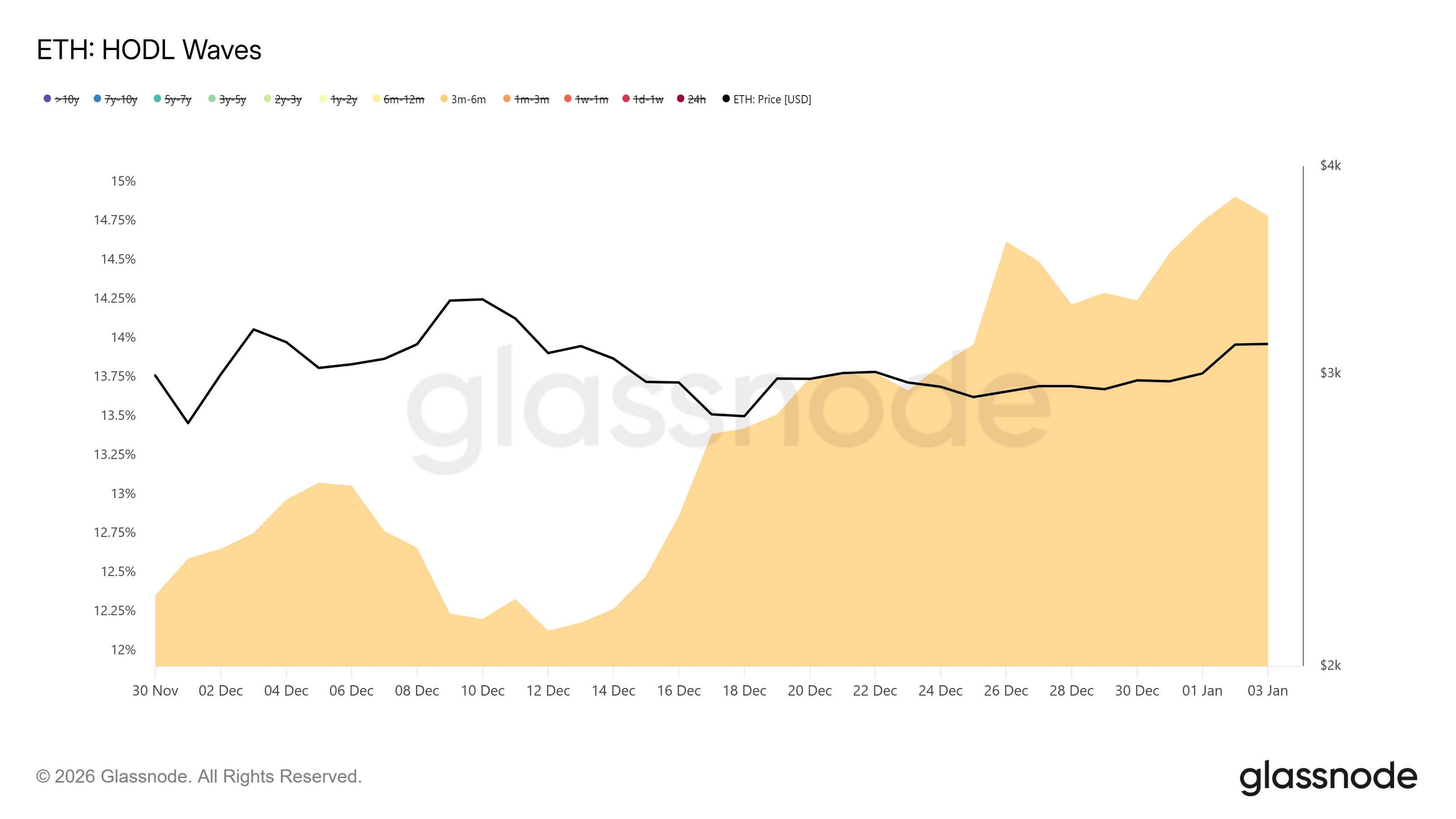
HODL Waves indicator shows an increase in the number of mid-term holders holding Ethereum for 3 to 6 months. Most of these investors entered positions between July and October 2025. Investors who entered in early July are currently in profit, while those who entered after mid-July are still at a loss.
Distribution of Mid-Term Holders’ Cost Basis and Market Impact
Profit Group (Entered Early July)
· Cost basis around $2,800–$3,000
· Current price $3,141, with 5-12% profit
· Facing profit-taking pressure
· May sell near $3,300
Unrealized Loss Group (Entered Mid to Late July)
· Cost basis around $3,200–$3,500
· Still at a loss currently
· Forming a forced holding situation
· Waiting for price to rebound to cost basis
Market Dynamics Balance
· Forced holding reduces selling pressure during pullbacks
· Provides temporary price support
· Price increases may trigger profit-taking
· Continuous inflow of new capital must offset the supply from trapped positions for sustained upward movement
This distribution creates a forced holding scenario, as many holders are waiting for prices to recover. This positioning can provide temporary support by easing selling pressure during corrections. However, price increases may trigger these holders to sell. As Ethereum approaches the breakeven point for mid-term holders, the risk of selling rises. Unless new capital flows in to offset the profit-taking from trapped supply, this dynamic may limit further gains.
Historically, when many holders are near breakeven, the market often encounters strong resistance in these price ranges. The $3,200–$3,500 zone could become a critical test area; a breakout would require strong buying momentum.
Breakout Target of 4,061 USD from Descending Wedge
Ethereum’s price continues to fluctuate within the descending wedge pattern formed in early November. Currently, ETH trades near $3,141, close to the potential breakout point. This pattern indicates tightening momentum, often signaling an imminent directional expansion. The descending wedge is a classic bullish pattern in technical analysis, characterized by price oscillating within two downward-sloping trendlines with volume gradually decreasing.
This pattern suggests a theoretical upside of about 29.5%, with a target of $4,061. This target is derived from measuring the widest part of the wedge and projecting upward from the breakout point. While ambitious, achieving this requires stronger buying pressure than currently observed.
A more realistic scenario is that Ethereum breaks above and surpasses $3,287, opening the path to challenge $3,447 in the short term. The $3,287 level is a key resistance at the upper boundary of the wedge; a confirmed breakout above this level would validate the pattern. The $3,447 level is an important resistance in the previous consolidation zone; breaking through would open the upward channel toward $4,000.
If macroeconomic conditions worsen or the breakout fails, downside risks remain. A failed breakout could see Ethereum fall below the psychological support of $3,000. In that case, ETH might retest the $2,902 support level, negating the bullish outlook and reinforcing a range-bound market.
From volume analysis, a breakout must be accompanied by increased volume for confirmation. A breakout on low volume often signals a false move, with prices quickly retreating back into the wedge. Conversely, a breakout with significant volume, especially from institutional large buy orders, greatly enhances its validity.
Multiple Catalysts Converging in 2026
These developments are part of market participants’ preparations for 2026, creating favorable conditions for network growth and price stability. The successful implementation of the Fusaka upgrade demonstrates the Ethereum development team’s execution capability and lays the foundation for further technical upgrades. Lower Layer 2 costs will attract more developers to build applications on Ethereum, creating a positive feedback loop.
The surge in new addresses reflects the combined effects of seasonal factors and structural upgrades. Seasonally, the end of the year is typically a more active period in crypto markets, with gift-giving during Christmas and New Year, and year-end bonuses driving new user onboarding. Structurally, the Fusaka upgrade addresses the core issue of high transaction fees, a long-standing obstacle to Ethereum’s widespread adoption, and its improvement will lead to sustained user growth.
On the technical side, Ethereum is at a critical breakout juncture. The convergence of the descending wedge pattern indicates that the battle between bulls and bears is about to tip. Coupled with a 110% increase in new holders and the technical improvements from the Fusaka upgrade, the probability of an upward breakout is increasing.


