
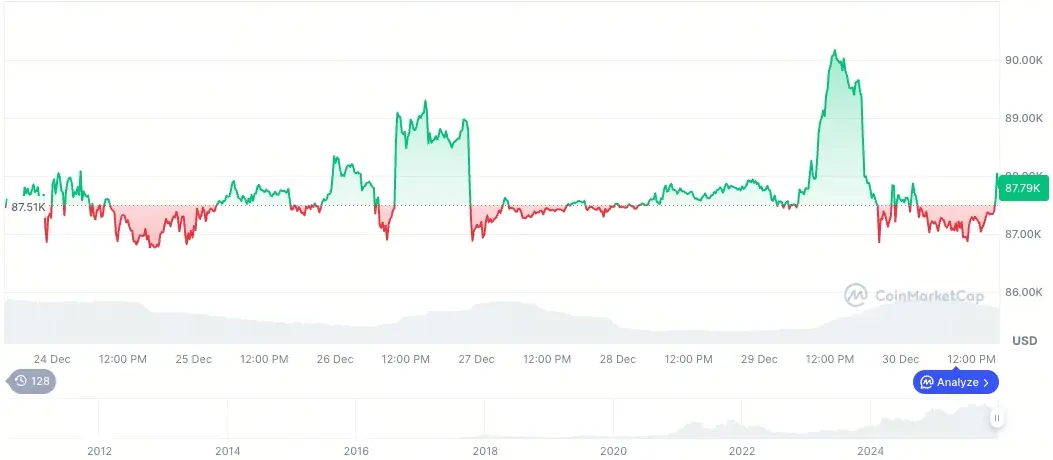
Bitcoin fluctuated around $87,800 on Wednesday, failing to break the $90,000 level earlier in the week. The market is focused on Thursday’s Federal Reserve minutes for clues on potential rate cuts. QCP pointed out that after options expiration, open interest dropped 50%, and market makers turning short gamma could amplify the rally. Market divergence is extreme: Standard Chartered and Cathie Wood forecast $500,000 by 2030, while analysts warn it could fall to $10,000.
Federal Reserve Minutes as a Key to Bitcoin Breaking $90,000
The Federal Reserve meeting minutes released on Thursday (December 31) will reveal policymakers’ true thoughts on the rate cut path through 2026. Currently, the market expects a 25 basis point rate cut in March, but this expectation is very fragile. If the minutes show increased concerns about inflation rebound or a more optimistic assessment of labor market resilience, the rate cut in March could be delayed until mid-year or canceled altogether. Such a policy shift would severely impact risk assets, and Bitcoin could quickly retest support at $84,000.
Conversely, if the minutes show most members support gradual rate cuts and maintain confidence in a soft landing, market risk appetite will rebound. In this scenario, Bitcoin could challenge $90,000 again and, after breaking through, quickly target the key resistance at $94,000. QCP Capital emphasizes that the market maker’s shift to short gamma means that rising prices will increase hedging demand, creating a positive feedback loop.
The biggest current market issue is liquidity exhaustion. Bitcoin fluctuated between $86,780 and $90,247 on Monday, but trading volume was extremely thin. Year-end holidays led many institutional traders to exit, causing severe market depth shortages. Moderate orders in either direction could cause sharp price swings. This “sharp volatility and lack of trend” characteristic of low liquidity greatly reduces the reliability of technical analysis.
After reaching a historic high of $125,000 in October 2025, Bitcoin has retraced over 30%. This deep correction makes it highly sensitive to liquidity changes and risk sentiment. As the last major macro event of the year, the Fed minutes could be a critical catalyst for Bitcoin’s potential rebound in early 2026. Traders are generally cautious, waiting for the minutes to be released before deciding on their positions.
The Triple Battle for the $90,000 Psychological Level
(Source: CMC)
The $90,000 level has become the most important short-term reference point for Bitcoin trading. On Monday, Bitcoin briefly broke above $90,000 in early trading, reaching a high of $90,247, but momentum quickly faded, closing down 0.4% at $87,129. This marks the third failed attempt to break this level recently, indicating heavy selling pressure above.
Technical analysts point out that there are many historical high-volume zones around $90,000, where trapped positions may take profits or stop-loss when prices return near cost basis. Additionally, $90,000 as an integer level has strong psychological significance, with many traders placing take-profit or stop-loss orders here, creating technical resistance. To truly break through, volume must increase and sustained buying support must appear; short-term spikes in low liquidity environments are unlikely to succeed.
Bitcoin Magazine analysts believe the overall market remains within an expanding wedge pattern, with multiple rejections at lower levels indicating weakening downside momentum. Bulls need to first break resistance at $91,400 and then hold above the more critical $94,000. Achieving a weekly close above $94,000 could open further upside, targeting $101,000 and even $108,000.
On the downside, $84,000 is seen as a key support. If broken, the price could quickly fall to the $72,000–$68,000 zone. Further breakdown below $68,000 would significantly increase the risk of deeper retracement. John Glover, former Barclays managing director and current Chief Investment Officer at Ledn, favors gradually increasing long positions between $71,000 and $84,000, viewing this stage as a Wave 4 correction in Elliott Wave theory. He expects a rebound to $145,000 after establishing a bottom in the first or second quarter of 2026.
Contradictory Signals in Capital Flows
Corporate Buying Continues: MicroStrategy purchased 1,229 BTC between December 22 and 28 for a total of $108,800,000 at an average price of $88,568, holding a total of 672,497 BTC. This steadfast buying indicates long-term institutional confidence remains intact.
ETF Funds Outflow: Data from CoinShares shows digital asset investment products outflowed $446,000,000 last week, with Bitcoin products outflowing $443,000,000. This contrasts with corporate buying and suggests institutional investors are risk-off at year-end.
Selective Allocation Emerges: XRP and Solana-related products saw net inflows during the same period, indicating investors are not fully exiting but engaging in selective allocation. This divergence may signal sector rotation in the crypto market by 2026.
$500,000 in 2030 vs. $10,000 in 2026
Market expectations for Bitcoin’s long-term trajectory are extremely divided. On the bullish side, Standard Chartered predicts a breakthrough to $500,000 by 2030, driven by ETF demand and corporate accumulation. Cathie Wood’s “pessimistic scenario” for 2030 also targets $500,000, while the “optimistic scenario” goes as high as $1,200,000. Michael Saylor presents an extreme path: $1.3 million in 10 years and $17 million in 20 years.
On the bearish side, analysts like Bloomberg’s Mike McGlone believe Bitcoin could plummet to $10,000 within the next year. This extreme pessimism is based on concerns over liquidity tightening and regulatory pressures. Market participants note that Bitcoin must compete for capital with AI industries and precious metals. Gold rose 60% and silver surged 150% in 2025, indicating asset rotation is underway.
This divergence reflects the fundamental valuation dilemma of Bitcoin: lacking cash flow or physical backing, its value depends entirely on market consensus and liquidity environment. Optimists believe institutional adoption and scarcity will drive long-term gains, while pessimists argue current valuations are detached from any rational basis. The Fed minutes may influence short-term sentiment but cannot resolve this fundamental divide.
Related Articles
BTC rises 0.58% in 15 minutes: whale large-capital transfers and derivatives defensive positioning drive spot buying
2026-04-20 06:30 to 2026-04-20 06:45 (UTC), the BTC price recorded a +0.58% return rate. The candlestick range was 74347.7 to 74898.0 USDT, with an amplitude of 0.74%. During this period, market attention increased because large orders and on-chain capital flow showed abnormal fluctuations, resulting in a higher overall volatility.
The main driver behind this anomalous move is whale entities concentrating large withdrawals and transfers targeting exchanges. Over the past 24 hours, the total reached 3,824 BTC, directly reducing the exchange’s BTC liquidity and bringing increased buy pressure to the spot market. On-chain data shows that the value of large transfers per transaction exceeding 1 million US dollars rose significantly during this window. As exchange immediate liquidity contracted, it pushed the BTC price upward in the short term. In addition, the derivatives market’s positioning structure changed: total futures open interest (OI) fell, and some defensive options positions shifted toward spot buying, further strengthening upside momentum.
Second, overall market liquidity remains in a fragile range. Order book data shows that large market buy orders were heavily concentrated, and buy-side depth increased noticeably. Meanwhile, in the same period, market Mempool activity and on-chain transaction fees were at low levels, and trading activity declined—making the impact of large single transfers and buy orders on price more pronounced. At the same time, leveraged funds leaving the derivatives market and options’ “maximum pain” strike price being below the spot price increased the spot market’s sensitivity to volatility. With multiple factors converging, the short-term upward price impulse was amplified.
Currently, market liquidity risk is rising, and in the short term the price is dominated by large buy orders in the order book and on-chain whale liquidity. Traders should continue to monitor the direction of whale capital flows and changes in exchange reserves, and be alert to possible price pullbacks caused by capital returning. At the same time, the key support range (72,000–74,000 USDT), order book depth, and derivatives positioning structure remain the core monitoring indicators for near-term volatility. Investors should be mindful of the risks stemming from fragile short-term liquidity and keep an eye on more real-time market developments.
GateNews25m ago
Musk’s X introduces smart tags, driving $1 billion in global trading volume in 3 days
Musk’s social platform X rolled out a brand-new “Smart Cashtags” feature on the evening of April 15 (last Tuesday). On April 17, Nikita Bier, X’s product lead, announced that in just 3 days the feature drove about $1 billion in trading volume across global markets, based on aggregated data from X’s trading pilot program.
MarketWhisper40m ago
BTC 15-minute rise of 0.53%: Institutional derivatives adding positions drives a short-term rebound
Between 2026-04-20 01:30 and 2026-04-20 01:45 (UTC), the BTC spot price fluctuated within a narrow range of 74290.9 to 74709.7 USDT. Over the 15-minute period, the return was +0.53%, with a range of 0.56%. Overall market volatility increased, drawing attention, but the number of active on-chain addresses remained steady, with no sign of extreme capital movements.
The main driver behind this move is institutional capital inflows into mainstream futures platforms and adjustments to derivatives position structures, especially CME futures open interest (OI), which rose against the trend by 2.61%. Meanwhile, some institutions added to defensive hedges and positioned for short-term rebounds within the price consolidation range. In addition, short-term Put options trading on platforms such as Deribit was active: the main contracts were concentrated on near-term downside protection, indicating that derivatives capital has increased its allocation to defensive strategies and that the spot market has passively followed the upward move.
In addition, ETF funds recorded $1.87 billion in net inflows in Q1, easing the consecutive net outflow trend seen earlier before March and providing medium-term background support for spot prices. Although on-chain active addresses over 1 hour stayed in the 19500–19600 range without abnormal increases or decreases, structural behavior by institutions across the derivatives and ETF markets converged to push short-term price volatility higher. There were no signals of sell pressure from retail traders or major whales, and no large transfers or extreme liquidation events; overall momentum came from institutional-level maneuvering.
It is worth noting that the derivatives market Put/Call ratio remains on the high side. If the price cannot continue moving upward, short-term exit pressure could intensify at any time. With overall OI shrinking, the activity of leveraged funds in the market weakens. Going forward, it is important to focus on changes in derivatives positions, ETF fund flows, and the in-and-out movements of active capital on-chain in order to respond to the risk of sharp short-term volatility. For more market information, it is recommended to continuously track relevant data indicators and capital-level anomalies.
GateNews5h ago
BTC falls 0.44% in 15 minutes: ETF fund outflows and derivatives shorts add to the slide
From 21:45 to 22:00 (UTC) on April 19, 2026, the BTC price dropped by 0.44% within 15 minutes. The candlestick range was 74,366.1 to 74,789.3 USDT, with an amplitude of 0.57%. Short-term volatility was concentrated. During this period, the trading volume for large orders rose significantly, market attention increased, and volatility intensified.
The main driving force behind this deviation was that U.S. spot Bitcoin ETFs saw a large net outflow of $291 million over two days from April 18 to April 19. This reflected institutional funds pulling away in the short term, which led to a marked increase in sell pressure in the spot market. At the same time, BTC perpetual contract
GateNews9h ago
BTC falls below 74000 USDT
Gate News bot message, Gate market data shows that BTC has fallen below 74000 USDT, with a current price of 73979.6 USDT.
CryptoRadar9h ago
BTC dips slightly by 0.53% in 15 minutes: whale transfers increase sell pressure and amplified liquidity widen the short-term drop
From 17:45 to 18:00 (UTC) on 2026-04-19, within 15 minutes BTC’s spot price fell -0.53%, with a price range of 74648.4 to 75212.8 USDT and a swing of 0.75%. During this period, market attention increased, volatility clearly accelerated, and the magnitude of the abnormal move exceeded typical levels for the same timeframe.
The main driver behind this abnormal move was that large-whale accounts concentrated transfers of BTC to a certain major exchange; the All Exchanges Whale Ratio (EMA14) rose to a near-ten-month high, and sell pressure increased significantly in a short time, becoming a direct cause of the spot price decline.
GateNews13h ago


