Author: Aaron Zhang Source: X, @zzmjxy
In October 2024, research firm 1A1z released a major report: Building Bitcoin: Funding a $1.2 Trillion Dollar Project. This is the most comprehensive survey of the Bitcoin Core funding ecosystem to date, with dozens of hours of interviews with the heads of almost all major sponsoring organizations.
This article is my interpretation of this report.
I. Core Numbers
In 2023, the total funding for Bitcoin Core development worldwide: 8.4 million USD.
Comparison of the same period:
- The market capitalization of Polkadot is only 1% of Bitcoin, yet it has spent almost the same amount on protocol development.
- The Ethereum Foundation's core development expenditure in 2023 is approximately $32 million.
- The market-cap close Meta has hired 20,000 engineers.
What about Bitcoin? 41 active Core Devs, 5 Maintainers.
2. Who's paying? Panorama of 13 sponsoring organizations
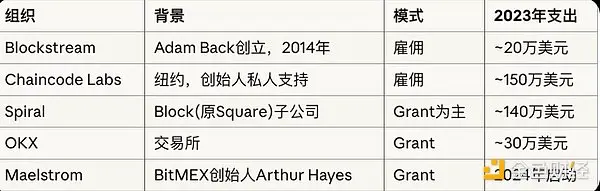
There are currently 13 active Bitcoin Core development sponsors, divided into two categories:
Private Funding Type (5)
Donation-based (8)
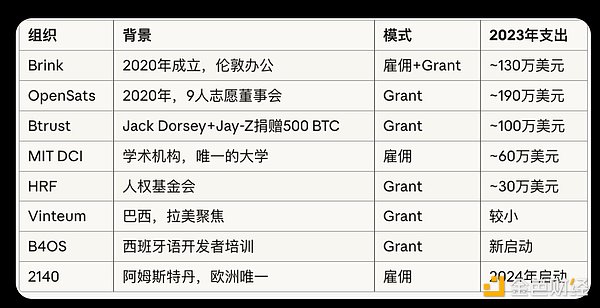
Data source: The 1A1z report is based on public financial disclosures, typical Grant sizes, and employee number estimates.
Employment vs Grant: A Key Distinction
Only 6 organizations offer regular employment (stable salary, benefits, long-term contracts). The rest are Grant models – essentially “reapply for a job once a year”. In the words of one of the developers interviewed in the report: It's like having to re-interview every year to keep your job.
3. One Person Supports Half the Sky: Jack Dorsey's Financial Landscape
The most shocking finding in the report:
- OpenSats: 90.5% of the funding comes from Jack Dorsey's #startsmall charity program.
- Brink: 14.2% of donations come from Dorsey
- Btrust: 100% donated by Dorsey and Jay-Z (500 BTC, approximately $23.6 million at the time)
- Spiral: A subsidiary of Block, Dorsey is the co-founder and CEO of Block.
- MIT DCI: Also received donations from Dorsey
One person, directly or indirectly, affects most of the funding sources of the Bitcoin Core development ecosystem.
During the interview with the report's author, someone referred to this as “Dorsey Problem”.
It should be noted that after Dorsey donated the funds, he hardly intervened in specific decisions, and the independent operations of the organizations are generally recognized. The issue is not with Dorsey himself, but with the structural risk of single-point dependency—if he changes his mind, shifts focus, or encounters any issues, what will happen to the entire ecosystem?
The problem is not Dorsey, but “over-reliance on any single node”. This is a common risk in all engineering systems.
4. Who Maintains? The Power Distribution of 5 Maintainers
Bitcoin Core has a special role: Maintainer. Only they have the authority to merge code into the main branch.
Current 5 Maintainers:
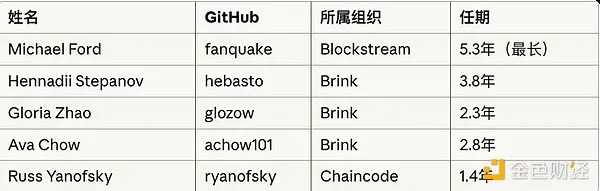
3 out of 5 people are in Brink.
This is what some respondents referred to as “Brink Risk”.
Brink has done exceptionally well, making significant contributions within a limited budget, and is highly recognized by the community. However, from a decentralization perspective, the ideal situation should be that the 5 Maintainers come from 5 different organizations.
Historically, there have been 13 maintainers in the past 10 years, of which 9 (69%) come from only 4 organizations.
5. Where are the developers?
Among the 41 active Core Devs, 33 have publicly disclosed their geographical locations:
by number of people
- United States: 11
- United Kingdom: 7 people
- Netherlands, Switzerland: 2 persons each
- India, Nigeria: 1 person each
- China: 0 people
By code contributions (commits)
- Europe: 56%
- USA: 25%
- Asia + Africa + Australia: Less than 10% in total
There is also an imbalance in the geographical distribution of sponsoring organizations:
- Registered in the US: 6 (46%)
- Europe: The first one (2140) will not be until 2024.
- Asia: 0 local-focused sponsoring organizations
6. My Three Layers of Feelings
Layer One: Awe
41 individuals, 84 million dollars, no company, no foundation, no treasury, maintaining a global financial infrastructure worth 2 trillion dollars.
It is a miracle of human self-organization. It is also the strongest evidence of Bitcoin's antifragility - it is precisely because there is no centralized resource pool that can be attacked, bought, and regulated that it has survived to this day.
Layer 2: Concerns
But structural risks are real:
- Talent is too narrow (bus factor is extremely high)
- Over-concentration of funds (Dorsey Problem)
- Regional severe imbalance
- Long-term lack of stable funding models
This is not the risk of “tomorrow will crash,” but the risk that “the pace of evolution in the next ten years will be limited.”
Third Layer: Opportunity
This is also what I want to say the most.
VII. A Letter to Asian Developers: This is Our Window of Opportunity
Asia accounts for 78% of the world's population.
Asia has the largest Bitcoin user base, a strong computing power center, a complete industrial ecosystem, a well-established computer education system, and the largest group of engineers.
But in Bitcoin Core - the place that defines what Bitcoin is - the contribution of Asian developers is almost zero. Out of 41 core developers, there is 1 from India and none from China.
What does this mean?
This means that the evolution direction, prioritization, and technical trade-offs of the entire protocol lack input from an Asian perspective. It means that when big decisions happen, there aren't enough local people who understand these discussions. It means a system that serves users around the world, and its core development circle is almost isolated from Asia.
This is a vacancy. This is an imbalance. But this is also an opportunity.
Bitcoin protocol development is not a closed club. It is open. Anyone can submit code, participate in reviews, write BIPs, and contribute tests. Chaincode, Brink, and OpenSats all have mature training and funding paths.
You don't need to be a “master” to get started.
Documents, translations, testing, toolchains, teaching - every direction needs people. Every PR from Asia and every review comment from Chinese developers are filling this gap.
I've always believed that one of the most important changes to the Bitcoin protocol layer over the next decade will be the rise of developers in Asia. It's not a prediction, it's inevitable – because the vacancies are too big, because the talent pool is too deep, because this thing is too important.
The question is: who will be the first batch?
VIII. Call to Action
To developers: If you are interested in the Bitcoin protocol, now is the best time to get in.
To institutions: Bitcoin can't rely on “accidental generosity” forever. Exchanges, mining pools, ETF issuers, custodians – all businesses that benefit from Bitcoin should have a long-term, stable developer support program.
To the community: Get to know these organizations and learn about their work. Direct donations are the easiest way to support.
Bitcoin is not a “system that automatically becomes better.” It is sustained by people, culture, responsibility, and hundreds of thousands of hours of engineering labor.


