Gate's November 25 crypto assets market analysis shows that Bitcoin (BTC) is currently priced at $87,952.2, with a 24-hour fall of 0.38%. This sideways consolidation often occurs before significant trend reversals. In terms of alts, ATRS has seen a big pump of 38.51% to $0.001262. The fear and greed index at 20 (extreme fear) reflects that market sentiment remains low.
Mainstream Coin Crypto Assets Market Analysis: Institutions Hold BTC Create History
The current price of Bitcoin (BTC) is $87,952.2, with a 24-hour fall of 0.38%. In the short term, the price is consolidating around $110,000, and the battle between bulls and bears is intensifying. This sideways consolidation often occurs before significant trend reversals, and the market is waiting for clear directional guidance. Key support level is $85,279.8, and resistance level is $89,226.7.
The most noteworthy highlight of the crypto assets market analysis is the rising enthusiasm among institutional investors, with the amount of coins held by listed companies surpassing 1 million for the first time, demonstrating strong market confidence. This is a historic milestone, representing that institutional allocation to Bitcoin has reached an unprecedented scale. The continuous purchases by listed companies such as MicroStrategy, Tesla, and Block provide solid support for Bitcoin prices.
A trading volume of 758,441,135 USD indicates good market depth, which helps maintain liquidity. This high trading volume means that even in the presence of large sell orders, the market can effectively absorb them without causing drastic price fluctuations. From the perspective of Crypto Assets market analysis, this is an important sign of market maturity.
Ethereum (ETH) is currently priced at 2,935.74 USD, with a drop of over 4% in the last 24 hours. Short-term volatility is expected to rise, but the long-term outlook remains optimistic. Key support level is 2,779.19 USD, and resistance level is 2,986.55 USD. On-chain adds 2 billion USDT, with increased PoS network activity indicating continuous ecosystem development. Trading volume is 382,532,681 USD, although lower than BTC, it is still at a healthy level.
Key Price Levels for Mainstream Coins
BTC support level: 85,279.8 USD | Resistance level: 89,226.7 USD
ETH Support Level: 2,779.19 USD | Resistance Level: 2,986.55 USD
Alts Surging Against the Trend: ATRS Leading with a 38.51% Pump
The current price of ATRS is $0.001262, with a 24-hour pump of 38.51%, indicating strong market demand and active trading. This big pump often results from significant project announcements or community hype. Against the backdrop of mainstream coins falling, ATRS has managed to rise against the trend, demonstrating that it has independent catalysts. From the perspective of Crypto Assets market analysis, this kind of increase is attractive but also comes with extremely high volatility risk.
The current price of SNS is $0.0003931, with a 24-hour pump of 26.72%. The project's innovative model is gradually gaining market recognition. SNS's stable rise indicates that it is not just a short-term speculation, but has substantial value support. Continued positive news or partnership announcements may be the reasons driving its price increase.
INTR current price is 0.0011441 USD, with a 24-hour pump of 24.56%, reflecting an increase in investor interest in the project. The collective rise of three alts indicates that market funds are flowing from mainstream coins to high-risk, high-reward alts, which is a typical manifestation of heightened speculative sentiment.
However, it must be pointed out that the price analysis of Crypto Assets often indicates that the high pump of alts is difficult to sustain. These small-cap coins are easily manipulated, and investors should participate cautiously, setting strict stop-loss orders to avoid significant losses during sudden pullbacks.
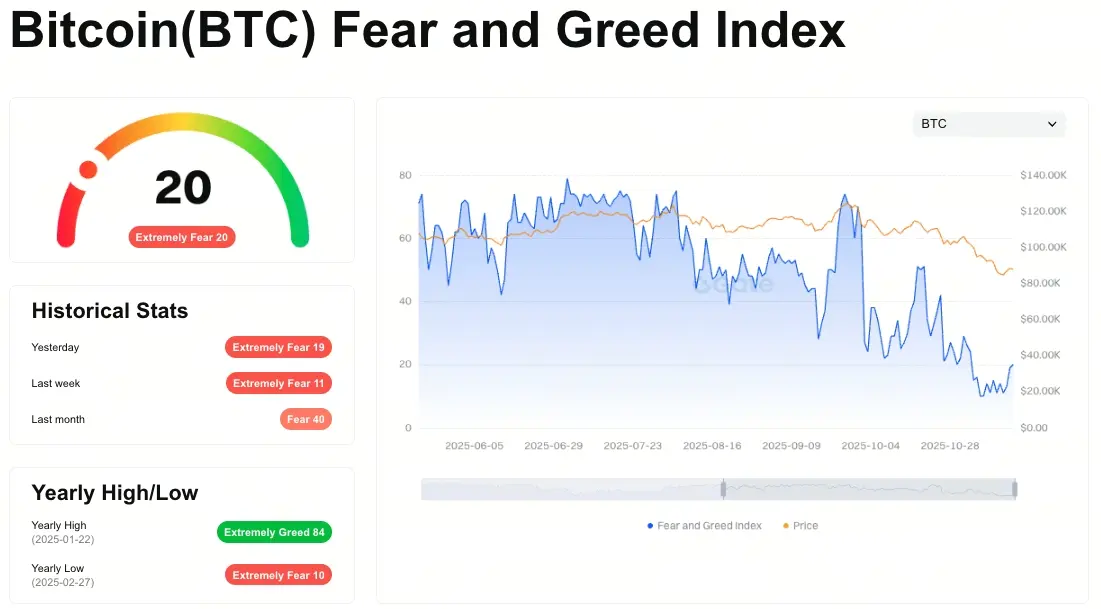
Technical Indicator Comprehensive Judgment: Fear and Greed Index 20 “Extreme Fear”
(Source: Gate)
The Fear and Greed Index is at 20 (extreme fear), reflecting a gloomy market sentiment. Combining trading volume and volatility, the current market is in a cautious state, requiring close attention to subsequent capital inflow. The Fear and Greed Index is an important tool for measuring market sentiment, with a value range from 0 (extreme fear) to 100 (extreme greed). When the index falls below 25, it is usually considered an extreme fear zone, which often presents buying opportunities for long-term investors.
Historical data shows that the Fear and Greed Index often signals market bottoms when in the extreme fear zone. In March 2020 during the “312 big fall” and after the FTX collapse in 2022, the Fear and Greed Index dropped to the extreme fear zone of 10-20, followed by strong rebounds in the market over the next few months. The current reading of 20 suggests that while short-term market sentiment is pessimistic, this might be the time for “be fearful when others are greedy.”
From the perspective of cryptocurrency market analysis, extreme panic is often accompanied by excessive selling. When retail investors sell off recklessly due to panic, smart money tends to quietly accumulate. The fact that publicly listed companies hold over 1 million BTC is a typical example of this counter-cyclical operation. Institutional investors, with a longer investment horizon and stronger risk tolerance, build positions during market panic, preparing for the future bull market.
The current price differences between mainstream coins are relatively small, but there are certain arbitrage opportunities in alts, requiring attention to the differences between exchanges. In terms of price stability, BTC and ETH have both seen slight declines recently, but the overall volatility is not significant. Alts such as ATRS, SNS, and INTR are showing higher volatility, providing opportunities for short-term traders, but this also comes with higher risks.
Short-term operation strategy and risk management
Entry timing suggestion: If ETH retraces to $2,779, it may be considered for purchase, as this is a key support level where there is usually a large influx of buy orders. BTC can be appropriately increased in position around $85,279, as this price level represents significant technical support. From the perspective of crypto assets market analysis, buying near support levels can provide a better risk-reward ratio.
Take profit and stop loss settings: Set the stop loss for ETH at $2,700, with the upper target price at $3,200, a risk-reward ratio of about 1:3. The stop loss for BTC is set at $84,000, with the upper target price at $92,000, a risk-reward ratio of about 1:2. The stop loss placement should be strictly enforced to avoid losses from emotional decisions.
Position Management: It is recommended to allocate 30% to mainstream coins and 70% to alts to diversify risks. This configuration is suitable for investors with a higher risk tolerance. For conservative investors, it is advisable to adjust the ratio to 70% mainstream coins and 30% alts. In terms of risk rating, the current market risk level is moderately high, and one should remain vigilant and flexibly adjust strategies.
Mid-term Investment Layout and Scenario Analysis
In the medium term, we are bullish on ETH and BTC, as institutional investment continues to increase, which is expected to drive further gains. From a medium-term perspective of cryptocurrency market analysis, institutions holding BTC exceeding 1 million coins is a strong bullish signal. As for allocation recommendations, it is advised to allocate BTC and ETH in a ratio of 60% to 40%. BTC's position as “digital gold” is becoming more solid, while ETH benefits from the continuous expansion of its smart contract ecosystem.
Key Node Monitoring: Pay attention to changes in regulatory policies and the potential impact of large options expiring soon. The SEC's decision regarding the Bitcoin ETF will be an important catalyst event and will have a significant impact on the market. Additionally, the expiration of large options at the end of each month and quarter often triggers market volatility, and investors should prepare in advance.
Three Scenario Analysis
Bull Market Scenario (Probability 40%): Should actively increase holdings, mainstream coins can reach BTC 92,000, ETH 3,200.
Volatile Market Scenario (Probability 50%): Employ a range trading strategy, buy low and sell high.
Bear Market Scenario (Probability 10%): Need to reduce positions in a timely manner and hold cash for better buying opportunities.
It is expected that there will be a period of sideways consolidation in the short term (1 month), and in the medium term (3 months), a rebound market is anticipated. This timeframe provides investors with clear expectations management guidance.
Core Risk Identification and Response Strategies
In terms of systemic risk, global economic uncertainty and interest rate fluctuations may affect the entire Crypto Assets market. The current fluctuating inflation data in the United States and the unclear Federal Reserve policies have a direct impact on the crypto market. Regarding individual coin risks, BTC faces uncertainties related to technical upgrades, while ETH needs to pay attention to potential issues in its ecological development process.
Liquidity risk should not be ignored. Although the trading volume of BTC and ETH shows good market depth, insufficient market liquidity may lead to slippage during large trades, especially during periods of market panic. Regulatory risk remains the sword of Damocles hanging over the crypto market. Policy changes could have a significant impact on the legitimacy of crypto assets, necessitating close attention to relevant developments.
In summary from the perspective of cryptocurrency market analysis, the current market is in the bottom-building stage, with the Fear and Greed Index at 20 indicating extreme fear. However, institutions holding BTC above 1 million and the on-chain addition of 2 billion USDT show that smart money is positioning against the trend. Investors should seize the key support buy points at ETH 2,779 and BTC 85,279, set strict stop-losses, and patiently wait for a mid-term rebound.


