The institution reported that argt, a peso-linked stablecoin, constitutes a security, subject to the regulatory regime for capital markets for these instruments. The stablecoin, issued by Twin Finance and listed by Belo, offered up to 32% APR.
Regulator Classifies Argentine Peso Stablecoin as a Security, Blocks Operations
The Argentine equivalent of the SEC, the CNV, executed the first measure against a stablecoin linked to the national fiat currency, the Argentine peso.
On March 12, the institution issued a resolution ordering the suspension of the listing, offering, and intermediation of argt, stating that the token was classified as a security offered to investors without complying with the rules established for these assets.
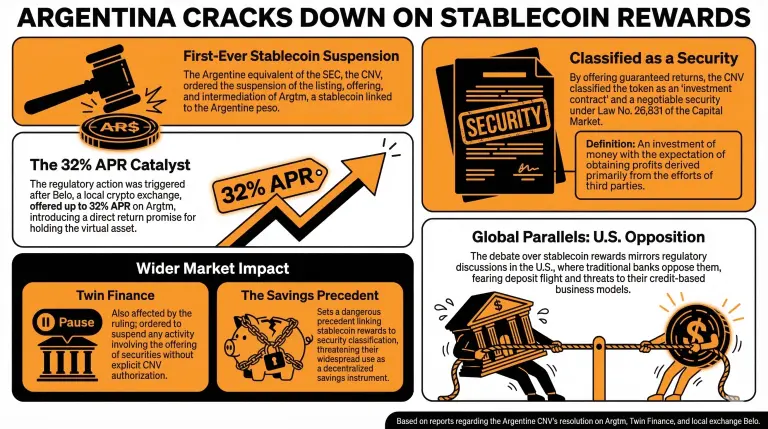
The action comes after Belo, an exchange that listed the stablecoin, offered up to 32% in APR, introducing a return promise linked to holding the virtual asset. As a consequence, the CNV assessed that this would make it “fall under the figure of an investment contract included in the definition of negotiable security provided for in article 2 of Law No. 26,831 of the Capital Market, which results in its classification as a negotiable security subject to the public offering regime.”
The institution clarified that when these assets meet the criteria of an investment contract, “an investment of money in a joint venture with the expectation of obtaining profits derived primarily from the efforts of third parties,” it can be considered a security, and will be subject to the compliance regime described for these assets.
The action also affects Twin Finance, which will have to suspend any activity, including the offering of securities, without the CNV’s authorization.
The development sets a precedent in Argentina, linking the offering of rewards for holding a stablecoin to its classification as a security, closing the potential savings use case for these instruments in the future, with no regulation tackling this issue.
The subject of stablecoin rewards is also being discussed in the U.S., as banks have opposed it, alleging that it could fuel deposit flight from the financial system and affect their credit intermediation-based business model.
FAQ
- What recent action did Argentina’s CNV take regarding a stablecoin?
The CNV suspended the listing and intermediation of argt, classifying it as a security being offered without regulatory compliance.
- Why was argt classified as a security?
The token was categorized as a security because it was linked to an investment contract promising up to 32% APR for holding the virtual asset.
- What implications does this resolution have for Twin Finance?
Twin Finance must halt all activities involving the stablecoin, including offering securities, without prior authorization from the CNV.
- What broader impact does this decision have on stablecoin offerings in Argentina?
This action sets a precedent by linking rewards for holding stablecoins to their classification as securities, potentially limiting their use for savings in the country.
Disclaimer: The information on this page may come from third parties and does not represent the views or opinions of Gate. The content displayed on this page is for reference only and does not constitute any financial, investment, or legal advice. Gate does not guarantee the accuracy or completeness of the information and shall not be liable for any losses arising from the use of this information. Virtual asset investments carry high risks and are subject to significant price volatility. You may lose all of your invested principal. Please fully understand the relevant risks and make prudent decisions based on your own financial situation and risk tolerance. For details, please refer to
Disclaimer.
Verwandte Artikel
Rep French Hill sagt, der CLARITY Act könnte die Stablecoin-Debatte lösen
Rep. French Hill sagt, dass der CLARITY Act möglicherweise wichtige Regulierungsfragen zu Stablecoins im Kongress ansprechen könnte.
Der GENIUS Act schuf einen frühen Rahmen, der dollar-gedeckte Stablecoins als Blockchain-Zahlungsinstrumente definiert.
Banken warnen, dass vorgeschlagene Regeln Kryptofirmen bevorzugen könnten, während das Finanzministerium die Rendite ansprechen könnte.
CryptoFrontNews5Std her
Die CCTV-315-Gala deckt die Datenvergiftungs-Industriekette bei großen KI-Modellen auf, bei der bezahlte Manipulationen die Antworten der KI steuern können.
CCTV 315 Gala deckt Daten-"Vergiftungs"-Industriekette von KI-Großmodellen auf, an der ein Geschäft namens GEO beteiligt ist. Dienstanbieter verdienen Gebühren, indem sie Kundenprodukte in KI-Modellen hervorheben, was zur Entstehung von Pressemitteilungsunternehmen führt, die ein wichtiger Link in der Datenmanipulation geworden sind.
GateNews7Std her
Die erste Liste der Hongkonger "Stablecoin-Lizenzen" steht bevor! Gerüchten zufolge gehen sie an "HSBC, Standard Chartered und OSL"
Hongkongs erste Liste der „Lizenzen für Stablecoin-Emittenten" wird nächste Woche veröffentlicht. Die drei Hauptantragsteller sind HSBC, Standard Chartered Bank und die Virtual-Asset-Plattform OSL. Diese Lizenzerteilung könnte sich eher zugunsten von Banken neigen, da diese über Kapitalstärke und Regulierungsvorteile verfügen, während OSL umfangreiche praktische Erfahrung hat. Obwohl Gerüchte besagen, dass die Hauptliste bereits vorliegt, könnten sich die tatsächlichen Verhältnisse noch ändern.
区块客9Std her
SEC-Kommissar: Wird tokenisierte Wertpapiere "Innovationsbefreiung" sorgfältig prüfen, konzentriert sich auf Offenlegung und andere Schlüsselfragen
Der SEC-Kommissar Hester M. Peirce kündigte das Programm „Innovation Exemption" für tokenisierte Wertpapiere an, das begrenzte Transaktionen und Tests ermöglicht. Das Programm wird vorsichtiger sein, verschiedene Tokenisierungsmodelle erkunden und Mechanismen zum Schutz der Anleger berücksichtigen. Die SEC bewertet auch relevante Offenlegungs- und Regulierungsfragen.
GateNews10Std her
Eine südkoreanische CEX wird morgen einer Sanktionsprüfung unterzogen, Geldstrafen könnten 35,2 Milliarden Won übersteigen
Gate News Nachricht: Am 15. März wird eine südkoreanische CEX am 16. März einer Sanktionsprüfung unterzogen. Da die Anzahl ihrer nicht angemeldeten Transaktionen eine andere südkoreanische CEX überschreitet, erwartet der Markt allgemein, dass die Geldbuße für diese Börse 352 Milliarden Won übersteigen könnte, und die Betriebsunterbrechungszeit könnte auch länger als 6 Monate sein.
GateNews10Std her
Die Unsicherheit bei der Regulierung von Stablecoins führt dazu, dass traditionelle Banken ihre Investitionen in die Infrastruktur aufschieben, während Krypto-Unternehmen mit Renditen von 4 % bis 5 % eine beschleunigte Kapitalverlagerung vorantreiben könnten.
Die unklare Regulierung von Stablecoins führt zu operativen Schwierigkeiten für traditionelle Banken, während Kryptounternehmen in der Grauzone weiterhin expandieren können. Banken werden von Ratschlägen ihrer Rechtsberater beeinflusst und trauen sich nicht, massiv in die Stablecoin-Infrastruktur zu investieren, was ihre Bereitstellung einschränkt. Obwohl dies bislang nicht zu massiven Einlagenabflüssen geführt hat, nimmt der Wettbewerbsdruck zu.
GateNews11Std her


