Dragon_fly3

vip
Age 0.1 Yıl
Peak Tier 0
No content yet
#FirstTradeOfTheWeek
#GateSquareAprilPostingChallenge
📅 Date: April 9, 2026
💰 BTC Price: $72,300
📈 24h Change: +1.59%
🔴 PART 1: Post-Ceasefire Market Fluctuations (Fear & Uncertainty Phase)
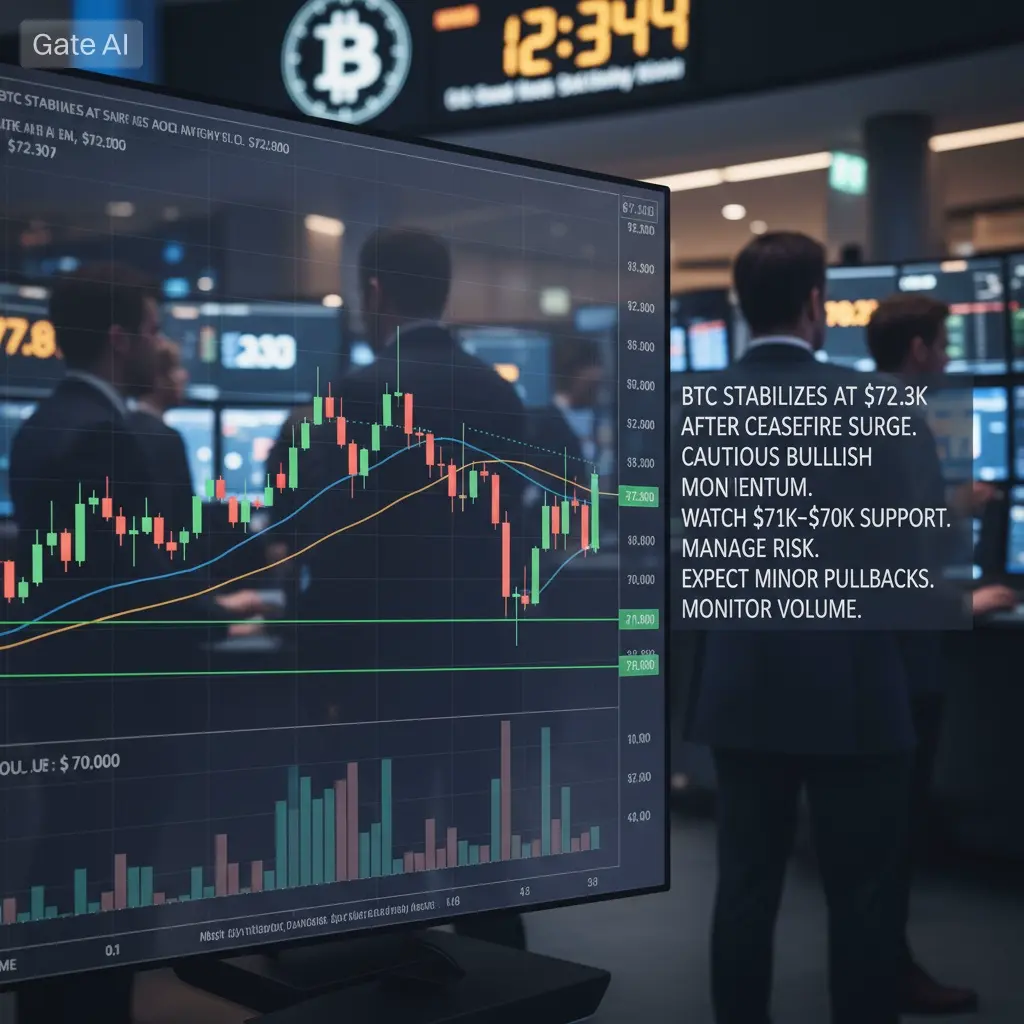
After the ceasefire confirmation, BTC surged from $70K → $72.8K, but volatility remains high.
Price fluctuated between $71K–$72.5K as traders take profits and institutional players stabilize positions.
Volume slightly lower than peak (~4,800 BTC), suggesting some short-term consolidation.
Market shows cautious optimism, but fear of sharp pullbacks persists in short-term traders.
🟢 PART 2: Market Liqui
BTC1,76%
HighAmbition
#FirstTradeOfTheWeek
#GateSquareAprilPostingChallenge
📅 Date: April 9, 2026
💰 BTC Price: $72,300
📈 24h Change: +1.59%
🔴 PART 1: Post-Ceasefire Market Fluctuations (Fear & Uncertainty Phase)
After the ceasefire confirmation, BTC surged from $70K → $72.8K, but volatility remains high.
Price fluctuated between $71K–$72.5K as traders take profits and institutional players stabilize positions.
Volume slightly lower than peak (~4,800 BTC), suggesting some short-term consolidation.
Market shows cautious optimism, but fear of sharp pullbacks persists in short-term traders.
🟢 PART 2: Market Liquidity & Reactions
Institutions continue buying on dips, with ~$150M–$200M shorts recently liquidated.
BTC attempts to hold above the $72K level, showing strong support forming in the $71K–$71.5K zone.
Liquidity inflow remains moderate; market is digesting recent gains while preparing for the next directional move.
⚡ PART 3: Technical View
Daily trend: Mildly bullish, consolidation ongoing
4H trend: Upward momentum slowing slightly
Short-term: Overbought signals appear; minor pullback possible
👉 Expect small retracements before continuation
🚀 PART 4: Bull Scenario
If momentum sustains:
Short term: $73.5K–$75K
Mid term: $78K–$82K
Strong rally: $90K+
👉 Requires sustained volume (~6K–10K BTC daily)
🔻 PART 5: Bear Scenario
If market loses momentum:
Immediate support: $71K–$70K
Next: $68K–$66K
Worst case: $62K–$60K
👉 Over-leveraged positions can trigger rapid drops
🧠 PART 6: Trading Strategy
Avoid chasing pumps; wait for minor pullbacks
Potential entry: $71K–$71.5K
Strong support: $70K zone
Stop-loss: below $69K
👉 Enter in portions, manage risk, watch liquidity closely
📊 Final Verdict
BTC stabilized above $72K after ceasefire surge, but market is digesting gains.
👉 Smart move: observe pullbacks, manage risk, monitor institutional flows, and watch for volume spikes.
repost-content-media
  • Reward
  • Comment
  • Repost
  • Share
#GateLaunchesPreIPOS
📢 Gate Plaza Hot Topics: Gate.io Launches Revolutionary Digital Pre-IPO Access
A groundbreaking transformation is reshaping the global investment world as Gate.io expands its early-access ecosystem with the launch of its new digitalized Pre-IPO participation model. The platform is emerging as a powerful bridge connecting the dynamic realm of digital assets with traditionally exclusive early-stage investing opportunities. For decades, access to pre-listing tokens, tokenized equities, and Pre-IPO exposure was largely reserved for institutions, venture capitalists, and high
HighAmbition
#GateLaunchesPreIPOS
📢 Gate Plaza Hot Topics: Gate.io Launches Revolutionary Digital Pre-IPO Access
A groundbreaking transformation is reshaping the global investment world as Gate.io expands its early-access ecosystem with the launch of its new digitalized Pre-IPO participation model. The platform is emerging as a powerful bridge connecting the dynamic realm of digital assets with traditionally exclusive early-stage investing opportunities. For decades, access to pre-listing tokens, tokenized equities, and Pre-IPO exposure was largely reserved for institutions, venture capitalists, and high-net-worth individuals who could meet high capital requirements and navigate complex networks.
Through continuous innovation in blockchain technology and digital finance, Gate.io is now democratizing these high-potential opportunities. With powerful tools such as Pre-Market Trading, xStocks (tokenized equities), its vibrant launch ecosystem, and the newly opened digital Pre-IPO reservation portal, users can engage with promising growth assets at much earlier stages. This creates a seamless, digital-first experience that removes long-standing barriers — including complicated onboarding, large minimum investments, geographical restrictions, and heavy reliance on traditional intermediaries. What was once an elite-only domain is rapidly becoming an inclusive, efficient, and globally accessible marketplace powered by stablecoins and intuitive interfaces.
Understanding Early-Stage Investing in Depth
Early-stage investing gives participants the exciting opportunity to enter assets before they achieve full public exposure, whether through pre-listing crypto tokens or equity-like instruments approaching their IPO phase. This early window often delivers substantial upside potential when the project or company performs strongly after launch or public listing. At the same time, it carries notable challenges such as limited liquidity in the initial phases, valuation uncertainty during price discovery, and elevated volatility as the market finds its footing.
Traditionally, accessing these opportunities required far more than capital alone. Investors needed significant financial commitments, strong connections within exclusive venture and private equity circles, and the expertise to handle intricate legal frameworks, brokerage systems, and regulatory requirements. These barriers frequently left ordinary retail investors watching from the sidelines while early gains flowed primarily to a privileged minority.
Gate.io is changing this reality in a meaningful way. By enabling participation through widely available stablecoins like USDT, integrating secure and user-friendly wallets, and offering straightforward platform tools, the exchange lowers entry barriers dramatically. Users can now explore and engage with early-stage opportunities without depending on traditional banks or brokers, enjoying greater speed, transparency, and efficiency within a secure trading environment. The recent opening of the Pre-IPO reservation portal further simplifies the process, allowing direct subscription using stablecoins without complex procedures or high capital thresholds.
Core Innovations Driving the Change
Pre-Market Trading
Gate.io’s Pre-Market Trading feature is a true game-changer. It allows users to trade selected tokens before their official spot market listing, creating an organized space for early price discovery. Informed traders can position themselves ahead of broader market entry, capitalizing on early volatility while applying careful risk management, as prices can swing sharply in these formative stages.
xStocks — Tokenized Equities
A standout innovation is the xStocks section, which brings tokenized versions of major global stocks such as Tesla (TSLAx), Apple (AAPLx), Nvidia (NVDAx), and others directly to the crypto platform. These assets support true 24/7 trading, fractional ownership, and seamless integration with crypto wallets and stablecoins. Users no longer need traditional stockbrokers, lengthy account setups, or strict market hours. Instead, they enjoy flexible exposure to leading equities combined with the speed, liquidity, and borderless nature of digital asset trading. This powerful fusion of traditional finance and blockchain is redefining diversified portfolio building.
Gate Launch Ecosystem
Through its active launch initiatives, users can participate in carefully selected early-stage crypto projects under transparent and structured conditions. This model significantly reduces barriers compared to conventional venture capital investing, while still opening doors to high-growth opportunities that hold strong potential for impressive returns upon successful development and listing.
The Path to Digital Pre-IPO Access
With the launch of its digitalized Pre-IPO mechanism and the now-open reservation portal, Gate.io marks an important milestone. Users can subscribe to quality Pre-IPO projects directly using stablecoins on the platform, bypassing many traditional complexities. This development clearly signals the platform’s strategic direction toward broader, blockchain-powered access to pre-public equity opportunities, potentially transforming how everyday investors worldwide interact with the next generation of high-growth companies.
Strategic Impact on the Financial Landscape
Gate.io’s initiatives represent a deep convergence between cryptocurrency and traditional finance. By linking digital assets with global equity markets, the platform greatly expands the practical utility of stablecoins beyond basic trading. It improves liquidity mechanisms, speeds up price discovery, and — most importantly — democratizes access to early-stage investments that were previously out of reach for most people.
This evolution points to a future where engaging with high-growth opportunities becomes as straightforward as executing an everyday crypto trade. It encourages fresh capital flows, promotes wider participation from both retail and institutional investors, and helps build a more dynamic and inclusive global financial system.
Investor Opportunities in This New Era
The expanding Gate.io ecosystem unlocks several compelling benefits for strategic investors:
The chance to position early, well before mainstream attention pushes valuations significantly higher
Substantially reduced barriers compared to legacy financial systems
Faster, fully digital execution with real-time transparency and greater control
Enhanced diversification spanning crypto-native projects and equity-like tokenized assets
When paired with thorough research, disciplined timing, and smart portfolio management, early access through Gate.io can deliver meaningful advantages — particularly during successful project launches, listings, or IPO transitions. Success in this space still requires patience, continuous learning, and a clear awareness of market cycles.
Risks to Consider — Maintaining Balance
While the potential is significant, it remains essential to approach these opportunities thoughtfully. Important risks include limited liquidity during early phases, which can complicate exits; uncertainty surrounding valuations and long-term fundamentals; evolving regulatory developments affecting digital assets and tokenized equities; notable post-listing or post-IPO volatility as markets adjust; and possible allocation constraints in highly popular offerings.
Responsible participation calls for solid risk management practices, ongoing due diligence, and viewing early-stage investing as one component of a well-diversified, long-term strategy rather than a shortcut to quick profits.
Final Perspective: Toward a More Inclusive
Financial Future
Gate.io is positioning itself strongly at the forefront of financial innovation by blending accessibility, technological efficiency, and early-stage exposure into one cohesive ecosystem. In doing so, it contributes to building a more inclusive investment environment where transformative opportunities are no longer limited to a small group of elites but are increasingly available to a diverse global audience of informed participants.
As blockchain technology matures and regulatory clarity grows, platforms like Gate.io are helping shape a future in which early investing feels natural, efficient, and fully aligned with the digital world we live in today.
Community Discussion — Let’s Engage
1. Which unicorn company would you most like to see offered through Gate.io’s Pre-IPO or tokenized access?
This question sparks a highly engaging and forward-looking conversation. Gaining access to unicorn companies before they go public remains one of the most powerful wealth-building opportunities in modern finance — especially as Gate.io works to make such exposure more inclusive, efficient, and digitally seamless for users around the world instead of restricting it to traditional elite circles.
Community members often highlight transformative names such as OpenAI (leading the AI revolution), SpaceX (pushing boundaries in space exploration and global connectivity), ByteDance (the powerhouse behind TikTok and digital content), Stripe (revolutionizing online payments and fintech infrastructure), and others. These companies stand out not merely for brand recognition but for their deep roots in sectors that will define the coming decades: artificial intelligence, space technology, advanced fintech, and global digital ecosystems.
Strategically, their appeal in a Pre-IPO context stems from strong fundamentals, disruptive innovation, massive scalability, and support from top investors. Early positioning could offer substantial upside if these firms transition successfully to public markets. At the same time, this discussion reminds us of the need for careful selection and research, since not every high-valuation private company performs equally well after going public. Gate.io can add real value here by curating quality projects, offering transparent information, and providing integrated tools that help users analyze and manage positions more effectively than traditional fragmented systems.
2. Compared to traditional IPOs, what key advantages do you see in Gate.io’s digital participation mechanism?
This question focuses on one of the most transformative aspects of Gate.io’s approach. Traditional IPO processes have long suffered from inefficiencies, exclusivity, delayed retail access, limited allocations, complex paperwork, lengthy approvals, and frequent geographical or accreditation barriers that prevent many capable investors from participating meaningfully in early growth.
By contrast, Gate.io’s digital-first model offers a streamlined and highly accessible framework. Users can engage using stablecoins like USDT, navigate intuitive interfaces, and operate within a fast, transparent, 24/7 globally connected environment. This removes multiple layers of friction — no more waiting for bank clearances, broker approvals, or regional limitations. Decision-making becomes quicker, execution near-instant, and portfolio management far more flexible.
Other notable advantages include improved transparency through blockchain elements, the integration of multiple tools (Pre-Market Trading, xStocks, and Launch initiatives) into one platform, and the ability to diversify or hedge across asset classes without switching between disconnected systems. This marks a clear improvement over the often siloed structures of traditional finance.
Naturally, digital mechanisms do not remove all risks. Allocation uncertainty, market volatility, and regulatory factors still apply. The real power emerges when Gate.io’s technological strengths are combined with disciplined research and sound risk management.
repost-content-media
  • Reward
  • Comment
  • Repost
  • Share
#CryptoMarketsDipSlightly
As of now, Bitcoin (BTC) is trading around $71,890, and what we are witnessing is not a breakdown, not a reversal, and definitely not weakness — it is a controlled, calculated, and technically necessary slight dip after tapping the $72K liquidity zone. This distinction is extremely important, because most retail traders misinterpret these small pullbacks as bearish signals, while in reality, they are often the foundation of the next upward expansion.
Let’s break this down with deeper clarity and sharper market understanding 👇
🔴 The Meaning of a “Slight Dip” (Not a
BTC1,76%
ETH1,89%
HighAmbition
#CryptoMarketsDipSlightly
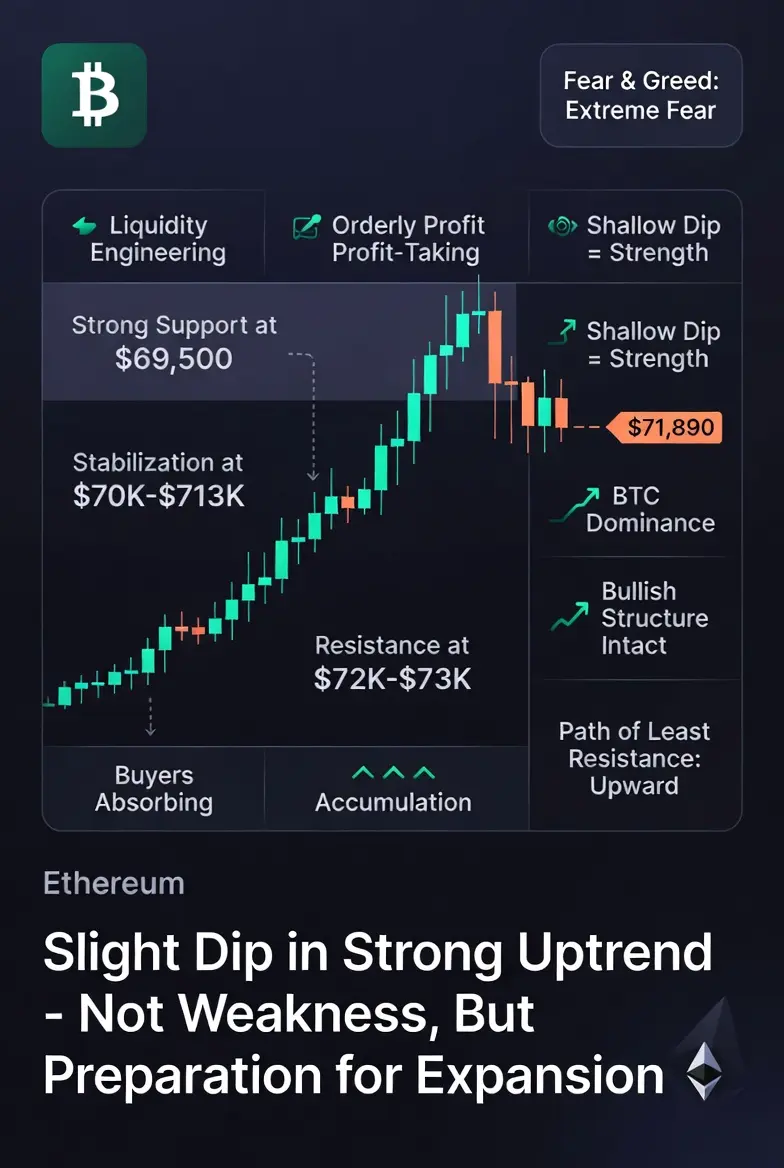
As of now, Bitcoin (BTC) is trading around $71,890, and what we are witnessing is not a breakdown, not a reversal, and definitely not weakness — it is a controlled, calculated, and technically necessary slight dip after tapping the $72K liquidity zone. This distinction is extremely important, because most retail traders misinterpret these small pullbacks as bearish signals, while in reality, they are often the foundation of the next upward expansion.
Let’s break this down with deeper clarity and sharper market understanding 👇
🔴 The Meaning of a “Slight Dip” (Not a Crash, Not a Reversal)
The move from ~$72,800 down toward the $70K–$71K region is very shallow in percentage terms, especially considering the strong impulsive move from $67K. A drop of less than 2–3% at these levels is structurally insignificant — in fact, it signals strength, not weakness.
This kind of dip shows:
Buyers are not aggressively exiting
Sellers are not dominating the order book
The market is cooling down, not collapsing
In strong bullish structures, price does not move vertically forever — it breathes, pauses, and then continues.
🧠 Liquidity Engineering — Why $72K Caused a Reaction
The $72K–$73K region acted as a liquidity magnet, not just resistance. When price reached this zone:
Previous trapped buyers exited at breakeven
Short-term traders closed positions
Smart money distributed partially
This created a temporary supply spike, which pushed price slightly lower — but notice the key word: slightly.
If the market was weak, we would have seen:
A sharp rejection (5–10% drop)
Panic selling
High-volume breakdown
Instead, we got a controlled pullback, which confirms that: 👉 Demand is still present
👉 Buyers are absorbing sell pressure
💰 Profit-Taking — Healthy, Not Bearish
After a clean rally from $67K → $72K+, the market needed profit-taking.
But here’s the critical insight:
Selling was orderly, not aggressive
No cascade of liquidations occurred
Price held above key support zones
This tells us: 👉 Traders are booking profits, but not abandoning the market
👉 Capital is rotating, not exiting
A market that cannot pull back is unstable — this dip actually stabilizes the trend.
📉 Why the Dip Stayed “Slight” (Key Strength Signal)
The most important part of this entire move is not the dip itself — it’s how small and controlled it remained.
Reasons:
Strong spot demand absorbing selling
Low exchange supply limiting downside pressure
Institutional positioning supporting dips
No panic sentiment spike, despite Fear Index being low
This creates a situation where: 👉 Every dip gets bought quietly
👉 Price refuses to break structure
This is classic accumulation within an uptrend.
🧠 Psychology Mismatch — Fear vs Reality
The Fear & Greed Index at 14 (Extreme Fear) is completely disconnected from price structure.
This creates a powerful dynamic:
Retail: “Market is weak, it will fall”
Smart money: “Market is stable, keep accumulating”
Historically, when:
Price holds strong
Fear remains high
👉 It often leads to explosive upside later
Because once sentiment flips, late buyers chase price upward aggressively.
📊 Ethereum’s Larger Dip — Confirming BTC Strength
Ethereum dropping more (~2.4%) while BTC barely dips shows:
BTC is acting as the market anchor
Altcoins are still in recovery mode
This divergence is important: 👉 When BTC stabilizes, altcoins usually lag
👉 When BTC breaks out, altcoins accelerate
So this slight BTC dip is not weakness — it is dominance strength.
⚖️ Market Structure — Still Bullish
Even after the dip, structure remains intact:
$69,500 → Strong support
$70K–$71K → Stabilization zone
$72K–$73K → Resistance / breakout trigger
As long as BTC holds above ~$69.5K: 👉 The trend is unchanged bullish
A slight dip above support = continuation pattern, not reversal.
🚀 What This Slight Dip Actually Signals
This is the most important conclusion:
This dip is:
A liquidity reset
A momentum cooling phase
A re-accumulation zone
NOT:
A bearish reversal
A structural breakdown
A market failure
In fact, the shallower the dip: 👉 The stronger the underlying demand
🎯 Strategic Insight (Advanced View)
Smart traders don’t react emotionally to dips — they read depth and behavior:
Deep, fast drops → weakness
Shallow, slow dips → strength
Right now we are clearly seeing: 👉 Shallow + controlled = bullish continuation bias
🧾 Final Verdict — The Reality Behind the Dip
The move from $72K down to around $71,890 is a textbook example of a slight dip inside a strong trend, driven by liquidity interaction, profit-taking, and psychological hesitation — not by any real weakness in the market.
The market is not rejecting higher prices — it is simply preparing for them.
As long as structure holds and dips remain shallow: 👉 The path of least resistance remains upward
And when $73K breaks with volume: 👉 This “slight dip phase” will be remembered as accumulation before expansion.
repost-content-media
  • Reward
  • Comment
  • Repost
  • Share
#OilEdgesHigher
Oil markets remain extremely volatile, with wide-ranging movements across sessions:
Brent Crude Oil:
Currently fluctuating between $95 and $113, with repeated attempts to break above $115, and occasional spikes toward $116–$118 during thin liquidity periods, while strong buying interest continues to appear near the $92–$95 support zone, showing that traders are actively defending lower levels even during bearish phases.
WTI Crude Oil:
Trading within a broader range of $96 to $116, briefly touching $117–$119 in reaction to supply fears, while maintaining a near-term consolidati
HighAmbition
#OilEdgesHigher
Oil markets remain extremely volatile, with wide-ranging movements across sessions:
Brent Crude Oil:
Currently fluctuating between $95 and $113, with repeated attempts to break above $115, and occasional spikes toward $116–$118 during thin liquidity periods, while strong buying interest continues to appear near the $92–$95 support zone, showing that traders are actively defending lower levels even during bearish phases.
WTI Crude Oil:
Trading within a broader range of $96 to $116, briefly touching $117–$119 in reaction to supply fears, while maintaining a near-term consolidation band between $100 and $110, indicating that the market is struggling to find a stable equilibrium between risk premium and fundamental pressure.
Volatility Structure:
Daily price changes of +1% to +4% have become routine, while extreme sessions have produced 8% to 15% swings, highlighting a market that is no longer calm or predictable, but instead driven by rapid sentiment shifts and aggressive positioning.
➡️ Importantly, even after sharp corrections, crude oil is still trading approximately 25–35% above its pre-conflict February 2026 levels, confirming that geopolitical risk premium remains deeply embedded in current pricing.
Why Oil Prices Continue to Edge Higher – Full Debate and Market Psychology
The phrase “edges higher” might suggest stability, but in reality, it reflects a slow grind upward driven by uncertainty rather than confidence, where buyers are cautiously pushing prices higher while constantly reacting to new risks emerging from geopolitical developments.
1. Strait of Hormuz – The Core Battlefield of Oil Pricing
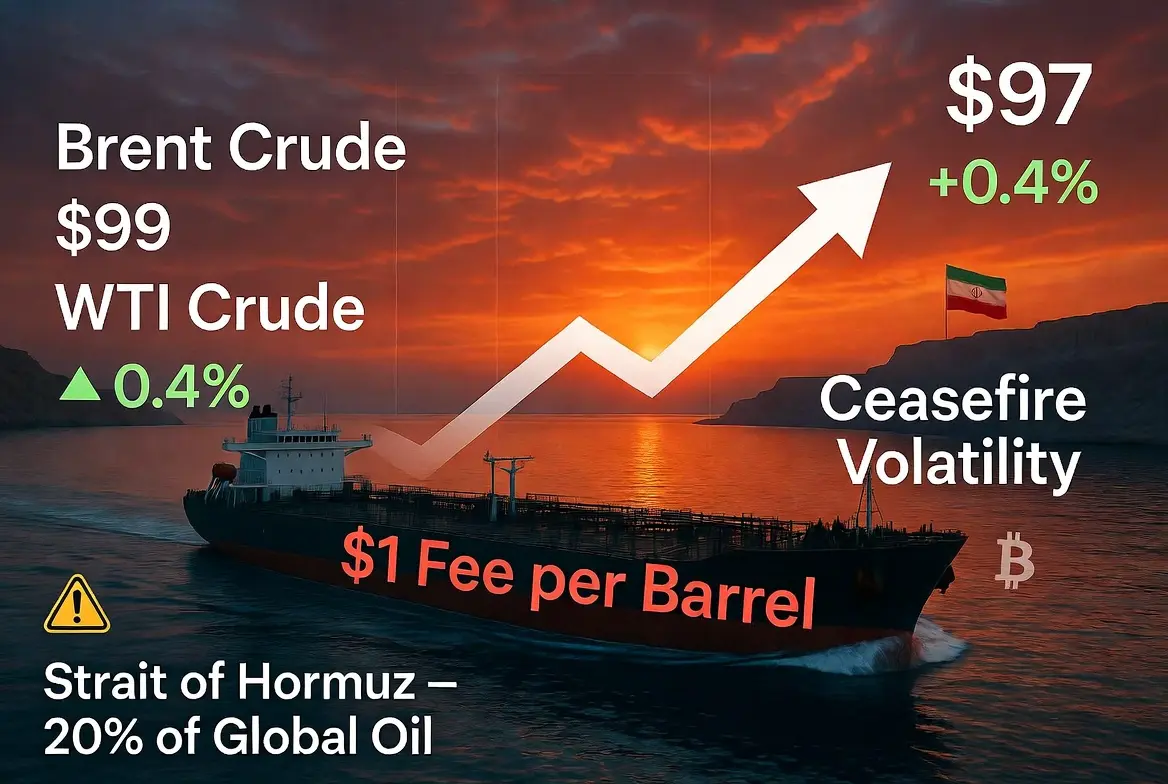
The Strait of Hormuz is not just a shipping route—it is the heartbeat of global oil supply, carrying nearly 20% of the world’s crude exports, and any disruption here, whether real or perceived, immediately translates into higher prices because the market begins to price in worst-case scenarios such as tanker blockages, military escalation, or restricted access.
In such an environment, even rumors or unverified reports can trigger instant $5–$10 price spikes, as traders rush to secure positions before supply tightness becomes a reality, creating a feedback loop where fear itself becomes a driver of price increases.
2. Iran’s $1/Barrel Demand – Symbolism vs Real Impact
At first glance, a $1 per barrel fee appears insignificant in a market where prices fluctuate by tens of dollars, but the deeper implication lies in the control and authority that Iran is asserting over a critical global chokepoint, effectively introducing a new layer of complexity into oil logistics.
The requirement for crypto-based payments, combined with inspection procedures and administrative approvals, creates operational friction that can slow down tanker movement, and while the direct financial cost is minimal, the indirect impact in terms of delays, uncertainty, and compliance risk can tighten short-term supply and support higher prices.
From a debate perspective, one side argues that this is merely symbolic and will be absorbing by major importers like China and India, while the opposing view highlights that even small disruptions in such a critical route can amplify market fear and sustain elevated price levels.
3. Geopolitical Pressure and Market Sentiment
The aggressive tone and firm deadlines set by global powers have injected a strong element of fear into the market, pushing traders to price in the possibility of escalation, and this fear-driven behavior has been a major contributor to the upward movement in oil prices over recent weeks.
However, the same market that reacts strongly to fear also reacts sharply to relief, as seen in the dramatic selloff following the ceasefire announcement, where prices collapsed within hours, demonstrating that sentiment—not fundamentals—is currently the dominant force
.
4. Supply Tightness vs Long-Term Oversupply – The Core Conflict
This is where the real debate becomes intense, because the oil market is being pulled in two opposite directions at the same time:
On one side, short-term supply disruptions caused by tanker delays, production cuts, and geopolitical risks are supporting higher prices, while on the other side, long-term fundamentals such as rising inventories, moderate demand growth, and the potential return of full production capacity are pointing toward lower prices.
This creates a highly unstable structure where the market can move sharply in either direction depending on which narrative gains dominance at any given moment.
Ceasefire Shock – Proof of Market Sensitivity
The April 8 ceasefire served as a perfect example of how quickly sentiment can shift:
Oil prices dropped 13–16% in a single day, with Brent falling from around $118 to near $100 and WTI dropping from $115 to the $98–$102 range, clearly ցույց کرتے ہوئے کہ when supply fears ease, the market rapidly removes the risk premium.
This event reinforces the idea that current price levels are heavily dependent on geopolitical uncertainty rather than structural demand.
Bull vs Bear – Full Market Argument
Bullish Argument (Upside Potential)
If tensions escalate again or the ceasefire fails, the market could quickly return to panic mode, driving prices higher as supply risks intensify.
In such a scenario:
Brent could move toward $115 → $120 → $130+
WTI could climb toward $118 → $125+
The key driver here would be renewed disruption in Hormuz or stricter enforcement by Iran, which would reduce effective supply and push prices upward rapidly.
Bearish Argument (Downside Risk)
If stability holds and supply normalizes, the market will eventually refocus on fundamentals, which currently suggest an environment of potential oversupply.
In this case:
Brent could fall toward $90 → $85 → $75
WTI could decline toward $88 → $80
Analysts widely expect that after a possible Q2 peak around $110–$115, prices may gradually trend lower toward the end of the year.
Balanced Reality – A Market in Conflict
The truth lies somewhere in between, as the oil market is currently caught in a tug-of-war between geopolitical fear and fundamental reality, where neither side has full control, resulting in continuous volatility and unpredictable price action.
The $1 fee alone will not drive the market, but it contributes to the broader narrative of uncertainty, which is enough to keep prices elevated in the short term.
Stability Outlook – What Happens Next
Short-Term (Next 2 Weeks):
This is the most critical phase, where the market will closely watch tanker movements, compliance with ceasefire terms, and any signs of escalation, with expected volatility of 5–10% swings.
Q2 2026:
Peak uncertainty period, where Brent may test the $110–$115 range again depending on developments.
H2 2026:
If geopolitical tensions ease, supply normalizes and inventories rebuild, leading to a more stable range of $76–$95.
Final Conclusion – Deep Market Insight
#OilEdgesHigher is not just about prices moving slightly upward—it is a reflection of a market operating under constant pressure, where geopolitical developments dictate short-term direction while fundamental forces quietly shape the long-term trajectory.
At this stage, oil remains a headline-driven, high-risk asset, where sudden spikes and sharp corrections are both equally likely, and the only certainty is uncertainty itself, making it essential for traders and analysts to remain flexible, informed, and cautious in an environment where conditions can change at any moment.
repost-content-media
  • Reward
  • Comment
  • Repost
  • Share
#USIranCeasefireTalksFaceSetbacks
PART 1 — THE BEGINNING: How Did This War Even Start?
Background (Late 2025 - Early 2026):
Tensions between the US and Iran had been escalating for years over Iran's nuclear enrichment program and its regional proxy network (Hezbollah, Houthis, Hamas).
In late February 2026, a full-scale US-Iran war broke out — the conflict that became the defining geopolitical event of early 2026.
The war involved direct US military strikes on Iranian military and nuclear infrastructure, while Iran retaliated and closed the Strait of Hormuz, threatening roughly 20% of the wor
HighAmbition
#USIranCeasefireTalksFaceSetbacks
PART 1 — THE BEGINNING: How Did This War Even Start?
Background (Late 2025 - Early 2026):
Tensions between the US and Iran had been escalating for years over Iran's nuclear enrichment program and its regional proxy network (Hezbollah, Houthis, Hamas).
In late February 2026, a full-scale US-Iran war broke out — the conflict that became the defining geopolitical event of early 2026.
The war involved direct US military strikes on Iranian military and nuclear infrastructure, while Iran retaliated and closed the Strait of Hormuz, threatening roughly 20% of the world's oil supply.
Thousands of additional US troops were deployed to the Middle East as the conflict intensified through March 2026.
PART 2 — NUCLEAR TALKS BACKGROUND (April–May 2025)
Before the war escalated to full conflict, there had already been multiple rounds of nuclear talks in 2025:
Round 1 — April 12, 2025 (Oman): First indirect round. Iran and the US completed talks mediated in Oman. Both sides agreed to continue.
Round 2 — April 19, 2025: Second round. Both sides indicated some progress. Expert-level technical meetings were planned.
Round 3 — April 26, 2025 (Oman): Steve Witkoff (US Special Envoy) met Iranian FM Abbas Araghchi. Iran proposed a three-phased deal with uranium enrichment remaining inside Iran as a red line.
Result: No clear progress. Iran's demands — enrichment rights + full sanctions removal — were incompatible with US demands. Talks stalled, and the situation deteriorated into military conflict by early 2026.
PART 3 — THE WAR ESCALATES: March–Early April 2026
By late March 2026, the US-Iran conflict was in its 6th week.
Trump threatened Iran with "annihilation" on social media — a post so aggressive that Iranian mediators briefly halted participation in talks.
The US prepared a massive bombing campaign targeting Iran's energy facilities — the operational plan was ready to execute.
Iran's 10-point proposal broadcast on state TV included maximalist demands:
1. Halt to killings of Iranian officials
2. Guarantees against future US/Israeli strikes
3. Iran's control over the Strait of Hormuz
4. Right to uranium enrichment
5. Lifting of all US sanctions
6. Termination of all UN and IAEA resolutions against Iran
7. Withdrawal of US forces from the region
8. War reparations
9. Ceasefire across all fronts including Lebanon
10. International guarantees of non-aggression
These demands were seen as completely unrealistic by Washington.
PART 4 — PAKISTAN ENTERS AS MEDIATOR (April 6–7, 2026)
April 6, 2026: Regional mediators began pushing for a 45-day ceasefire as a first phase, followed by permanent negotiations.
April 7, 2026: Pakistani Prime Minister Shahbaz Sharif made a last-minute direct phone call to Trump, personally requesting that the US not bomb Iranian power plants and bridges.
Trump extended his self-imposed 8 PM Tuesday deadline for Iran to reopen the Strait of Hormuz.
Trump publicly said he was in "heated negotiations" over a new Pakistani two-week ceasefire plan.
Markets immediately cheered — stocks rallied, oil dropped.
PART 5 — THE CEASEFIRE ANNOUNCEMENT (April 8, 2026)
April 8, 2026: Trump announced a 14-day (2-week) ceasefire between the US and Iran.
He called Iran's modified proposal a "workable basis on which to negotiate."
Iran had softened several demands — including positions on nuclear enrichment, US troop withdrawal, and war reparations — after intense mediation.
VP JD Vance was assigned to lead the US delegation in upcoming peace talks in Islamabad, Pakistan, scheduled for Friday, April 10, 2026.
Iranian officials began arriving in Islamabad on April 9, 2026.
PART 6 — THE SETBACKS: Why Is the Ceasefire Fragile?
This is the core of #USIranCeasefireTalksFaceSetbacks — and there are multiple serious fractures:
Setback 1 — The Lebanon Dispute:
Iran's ceasefire proposal included a halt to Israeli strikes on Lebanon as a core condition.
But the US and Israel explicitly stated Lebanon is NOT part of the ceasefire agreement.
Israel continued its biggest strikes yet on Lebanon, killing at least 182 people.
Iranian President Masoud Pezeshkian stated that Israeli strikes on Lebanon make negotiations "meaningless."
Iran's Parliament Speaker Ghalibaf insisted Lebanon must be included. France and UK also called on Israel to stop Lebanon strikes.
Setback 2 — Two Different Ceasefire Documents:
Iran published its 10-point ceasefire plan publicly via state media.
A US official flatly stated that "the plan circulating is NOT the one agreed to by the US."
Two different documents, two different understandings — a fundamental disagreement on what was even signed.
Setback 3 — Strait of Hormuz Still Restricted:
Despite the ceasefire, Iran has not fully reopened the Strait of Hormuz.
This is a direct violation of Trump's core demand and keeps global oil markets and military tensions elevated.
Setback 4 — US Troops Not Withdrawing:
Trump stated clearly: "US military will stay deployed near Iran until Tehran complies with the ceasefire deal."
Iran views continued US military presence as a provocation.
Setback 5 — Trust Deficit:
VP Vance acknowledged the "choppiness" but downplayed setbacks, saying: "No ceasefire ever goes without a little bit of choppiness."
Pakistan is under massive pressure as a mediator — analysts warn that if talks collapse, Pakistan risks being seen as "overpromising and underdelivering."
PART 7 — WHERE ARE TALKS NOW? (April 9–10, 2026)
The Islamabad talks are proceeding as of April 10, 2026 — the fact that talks are still going is keeping market optimism alive.
VP JD Vance is leading the US delegation.
Iran's delegation has arrived in Pakistan.
Key unresolved issues: Lebanon, Strait of Hormuz, nuclear enrichment rights, sanctions relief.
A permanent deal is still far away — the 14-day ceasefire is a temporary pause, not a resolution.
PART 8 — CRYPTO MARKET: Full Journey
Before the Ceasefire — The War Period:
Bitcoin and the broader crypto market were suppressed in a war range of $65,000–$73,000.
Geopolitical risk drove investors toward safe havens. Risk appetite was crushed.
Fed rate cut expectations collapsed to zero — the war pushed inflation higher, making rate cuts nearly impossible.
The market was pricing no rate cuts for all of 2026, with some even pricing a potential rate hike.
April 6 — Ceasefire Talks Surface:
Reports of a possible 45-day ceasefire emerged.
BTC jumped 3% to $69,120, squeezing roughly $196 million in short positions within 24 hours.
Short liquidations outpaced longs nearly 3-to-1.
April 8 — Ceasefire Announced:
Bitcoin surged past $72,000, hitting a 3-week high.
The announcement triggered a 4%+ rally in BTC, briefly exceeding $72,500.
US spot Bitcoin ETFs absorbed $471 million in a single day.
Oil prices dropped 14%+, global equities rallied, gold and silver also gained.
Bitcoin $100K probability jumped from 31% to 36.5% YES on prediction markets.
The dollar saw its worst weekly performance since the conflict began.
April 9 — Fragile Ceasefire, Cautious Markets:
Markets remained cautious as Strait of Hormuz was still restricted and Lebanon conflict continued.
Dollar struggling to rebound.
Julius Baer warned: "Markets still need an air of cautiousness."
CNBC analysts described the rally as "an impulsive short-covering rally" — not a fundamental shift yet.
BTC remains in its war range — the breakout above $75,000 is the key level to watch.
Where Is Crypto Heading?
Scenario Crypto Market Outcome
Islamabad talks succeed — permanent deal progress BTC likely breaks above $75K resistance, possible run toward $80K+
14-day ceasefire holds but no deal BTC stays rangebound $68K–$74K, cautious sentiment
Ceasefire collapses, Lebanon conflict widens Sharp sell-off, BTC tests $65K support or below
Strait of Hormuz reopens fully Oil crashes further, inflation eases, Fed rate cuts back on table — very bullish for crypto
Summary in One Line:
The US-Iran ceasefire is real but fragile — Lebanon, the Strait of Hormuz, and contradictory documents are the three fault lines that could collapse it. Crypto surged on the announcement, but a confirmed durable peace deal is the catalyst needed for a sustained breakout above $75,000. Until then, every headline from Islamabad moves the market.
repost-content-media
  • Reward
  • Comment
  • Repost
  • Share
#MorganStanleyLaunchesSpotBitcoinETF
Morgan Stanley Launches Spot Bitcoin ETF (MSBT):
Core Event
On April 8, 2026, Morgan Stanley launched its own spot Bitcoin ETF (MSBT) on NYSE Arca. Unlike futures ETFs or third-party products, MSBT is directly issued and managed by Morgan Stanley and holds actual Bitcoin in custody. This marks a major structural shift in traditional finance adoption of Bitcoin.
The launch triggered strong market attention, highlighting Bitcoin’s growing role as a mainstream institutional asset.
Key Highlights
1. First Major U.S. Bank Issuing Spot Bitcoin ETF
Morgan Stanle
BTC1,76%
HighAmbition
#MorganStanleyLaunchesSpotBitcoinETF
Morgan Stanley Launches Spot Bitcoin ETF (MSBT):
Core Event
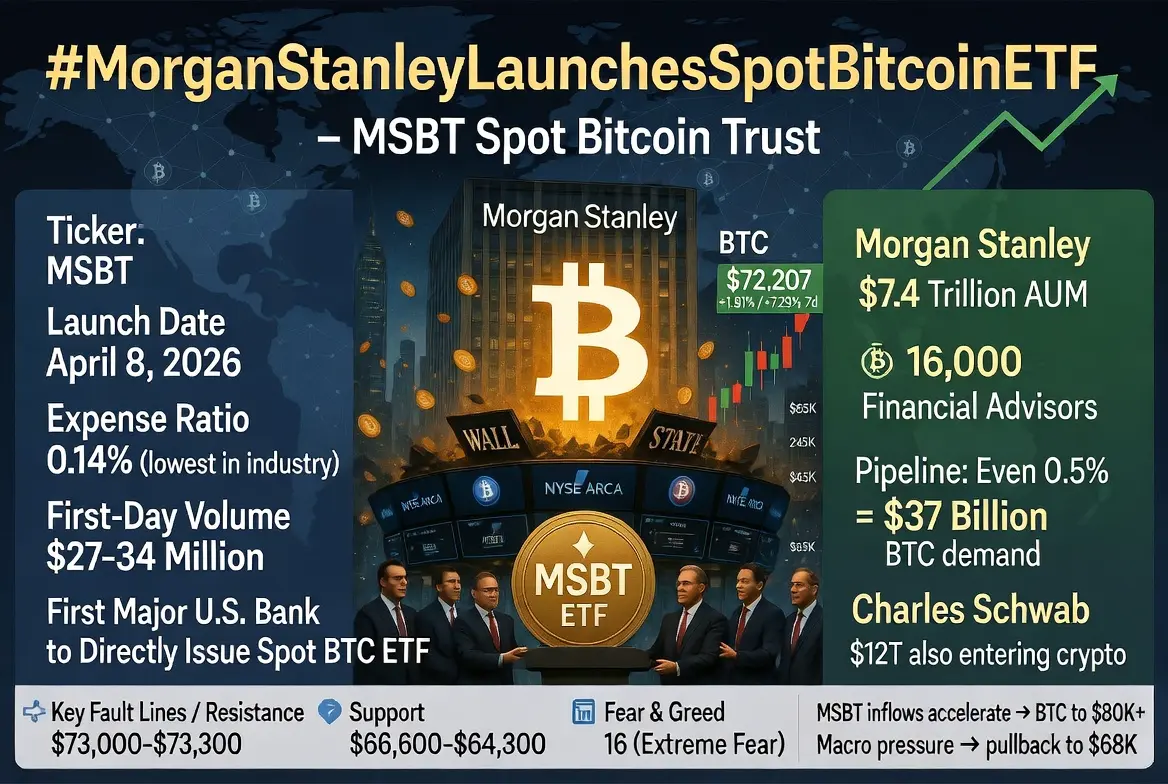
On April 8, 2026, Morgan Stanley launched its own spot Bitcoin ETF (MSBT) on NYSE Arca. Unlike futures ETFs or third-party products, MSBT is directly issued and managed by Morgan Stanley and holds actual Bitcoin in custody. This marks a major structural shift in traditional finance adoption of Bitcoin.
The launch triggered strong market attention, highlighting Bitcoin’s growing role as a mainstream institutional asset.
Key Highlights
1. First Major U.S. Bank Issuing Spot Bitcoin ETF
Morgan Stanley becomes the first major U.S. bank to directly issue and manage a spot Bitcoin ETF rather than simply distribute others like IBIT or FBTC. This signals deeper institutional commitment and long-term positioning in Bitcoin.
2. Ultra-Low Fee Competition (0.14%)
MSBT launched with a 0.14% fee, undercutting competitors:
BlackRock IBIT: 0.25%
Fidelity FBTC: 0.25%
Grayscale GBTC: 1.5%
This aggressive pricing starts a “fee war,” designed to attract long-term institutional flows and shift assets toward MSBT.
3. Strong Early Market Activity
MSBT recorded $27–34 million first-day volume, a solid debut for a new institutional ETF. While smaller than early IBIT inflows, the real importance lies in future advisor-driven allocations.
4. $7.4 Trillion Distribution Power
Morgan Stanley’s $7.4T AUM and 16,000 financial advisors are the real catalyst. Even:
1% allocation = $74B BTC demand
0.1% allocation = $7.4B BTC demand
This creates long-term structural inflows into Bitcoin via advisory networks.
5. Broader TradFi Expansion
Alongside Morgan Stanley, Charles Schwab ($12T AUM) is preparing direct crypto trading. This indicates a broader shift where Bitcoin becomes integrated into traditional retirement and brokerage systems.
Bitcoin Market Impact
As of April 10, 2026, BTC trades around $72,207, showing short-term strength but still below key resistance.
Short-Term (0–30 days)
BTC surged ~6% around ETF + geopolitical news
Resistance: $73K–$73.3K
ETF launch added sentiment boost, not sole driver
Medium-Term (1–6 months)
MSBT advisor-driven flows expected to grow gradually
ETF demand translates directly into spot Bitcoin buying
Total ETF market already ~$135B in BTC exposure
Long-Term
Institutional adoption creates structural demand
Bitcoin increasingly treated as mainstream portfolio asset
Reinforces long-term scarcity-driven price pressure
Market Constraints
Despite bullish structural signals:
Fear & Greed Index: 16 (Extreme Fear)
Inflation and oil prices remain elevated
US-Iran geopolitical tensions still unresolved
Fed remains cautious on rate cuts
BTC still faces macro uncertainty and is not in a pure risk-on environment.
Trader Sentiment
Bullish View
MSBT + Schwab = massive institutional inflow pipeline
Expect breakout toward $80K–$90K
Bearish View
Macro risks remain strong
Possible rejection at $73K zone
Some traders expect pullback toward $65K
Neutral Institutional View
Recent move seen as liquidity-driven, not trend breakout
Resistance remains $73K–$73.3K
Support sits near $64K–$66K
Whale Activity
Large leveraged short positions exist, but are under pressure
Market shows mixed conviction, not strong directional bias yet
Practical Trading Insights
MSBT is long-term catalyst, not short-term pump driver
Watch $73K–$73.3K resistance closely
ETF inflows are now key price driver
Extreme fear can signal opportunity but needs confirmation
Avoid chasing ETF news spikes
Position sizing should account for macro volatility
BTC dominance may rise if institutional flows increase
Bigger Picture
MSBT represents a shift where Bitcoin moves from speculative asset to institutionally distributed portfolio product. With Morgan Stanley and Schwab entering, Bitcoin exposure is becoming embedded in mainstream wealth management systems.
This creates long-term structural demand, but short-term price action will still depend on macro conditions and liquidity cycles.
Summary
MSBT is not just another ETF — it is a structural bridge between Wall Street and Bitcoin. While short-term price action remains range-bound near $73K resistance, long-term institutional inflows could significantly reshape Bitcoin’s demand profile over the next 12–24 months.
repost-content-media
  • Reward
  • Comment
  • Repost
  • Share
#GateSquareAprilPostingChallenge
🚀 Ethereum (ETH) Analysis – April 2026 Update
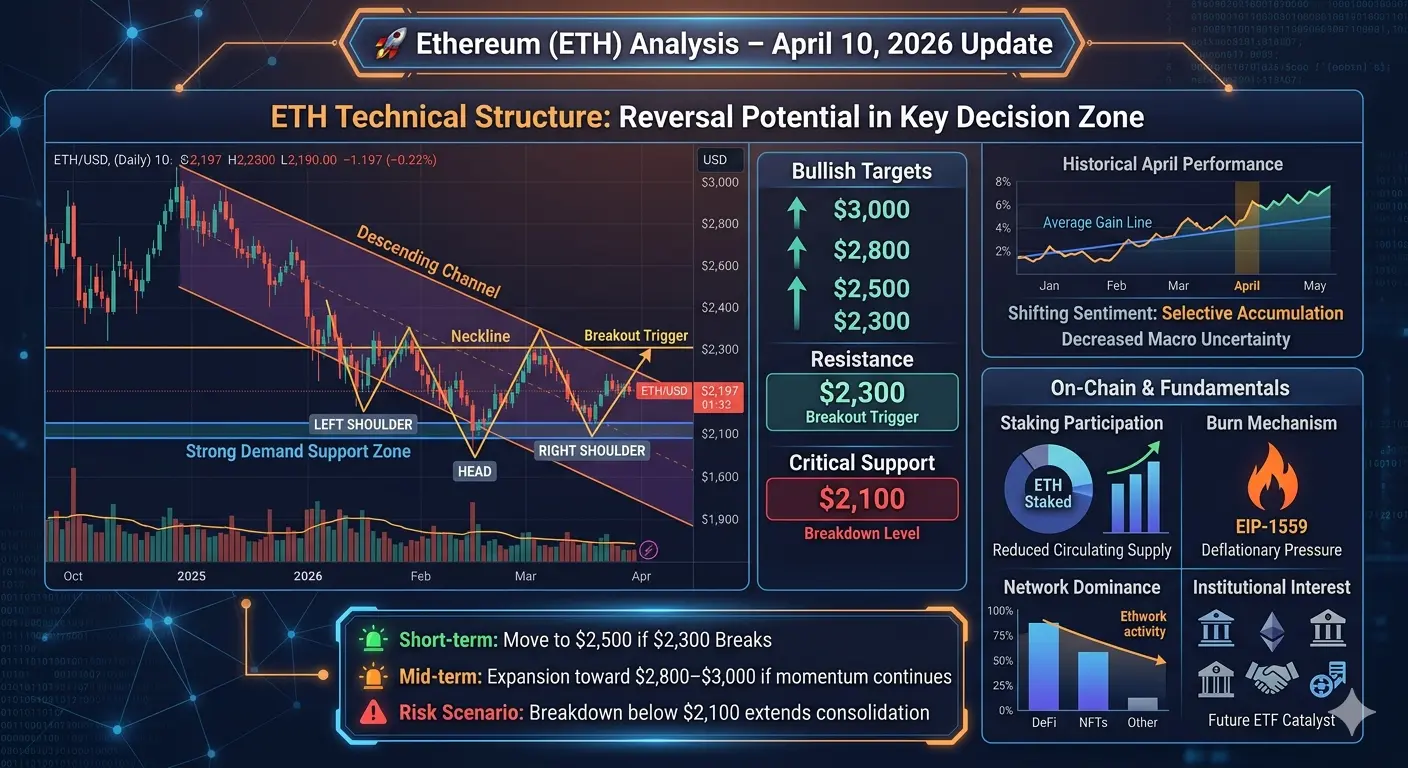
Ethereum is currently trading around $2,197 (April 10, 2026), after going through a prolonged correction phase that followed the 2025 market highs. The broader structure shows that ETH is now trying to shift from a downtrend recovery phase into a possible early accumulation and reversal zone.
At the moment, price is consolidating in a tight range between $2,100 and $2,200, which is acting as a strong demand support area. This zone is important because buyers have repeatedly stepped in here, preventing further bre
ETH1,89%
HighAmbition
#GateSquareAprilPostingChallenge
🚀 Ethereum (ETH) Analysis – April 2026 Update
Ethereum is currently trading around $2,197 (April 10, 2026), after going through a prolonged correction phase that followed the 2025 market highs. The broader structure shows that ETH is now trying to shift from a downtrend recovery phase into a possible early accumulation and reversal zone.
At the moment, price is consolidating in a tight range between $2,100 and $2,200, which is acting as a strong demand support area. This zone is important because buyers have repeatedly stepped in here, preventing further breakdowns and indicating that selling pressure is gradually weakening.
📊 Technical Structure (In-Depth)
From a technical perspective, ETH is still trading inside a descending channel, meaning the overall trend has been downward for some time. However, recent price action suggests that momentum is starting to change.
On the daily chart, ETH is forming a potential inverted head-and-shoulders pattern, which is widely considered a bullish reversal formation if confirmed. This pattern typically signals that selling pressure is exhausting and buyers are preparing to take control.
Key levels to watch:
Support: $2,100 (critical breakdown level)
Resistance: $2,300 (first breakout trigger)
Next targets: $2,500 → $2,800 → $3,000 (if momentum expands)
A clean daily close above $2,300 would likely confirm bullish continuation and attract fresh buying volume from both retail and institutional traders.
📈 Market Sentiment & Seasonal Behavior
Historically, April has been a strong month for Ethereum, with average gains around 18%, driven by improved liquidity conditions and positive risk sentiment across global markets.
Currently, sentiment is gradually shifting from caution to selective accumulation, especially after reduced geopolitical tensions and improving macro stability. When uncertainty decreases, high-volatility assets like ETH tend to recover faster due to renewed risk appetite.
🔗 On-Chain & Fundamental Strength
Fundamentally, Ethereum continues to show strong long-term resilience:
High staking participation → reduces circulating supply in the market
Burn mechanism (EIP-1559) → continues to create deflationary pressure
Network dominance → remains leader in DeFi, NFTs, and Layer-2 scaling activity
Institutional interest → potential ETF inflow expectations remain a key future catalyst
These factors collectively support Ethereum’s long-term value proposition, even during corrective phases.
🧠 Final Outlook (My View)
ETH is currently in a key decision zone. As long as the $2,100 support holds, the structure remains constructive and favors a bullish recovery scenario.
Short-term outlook: Move toward $2,500 if $2,300 breaks
Mid-term outlook: Expansion toward $2,800–$3,000 if momentum continues
Risk scenario: Breakdown below $2,100 could extend consolidation or delay recovery
Overall, Ethereum is showing early signs of trend reversal potential, but confirmation is still required above resistance levels.
repost-content-media
  • Reward
  • Comment
  • Repost
  • Share
#GateSquareAprilPostingChallenge
🎉 GateSquare April Posting Challenge + Gate’s 13th Anniversary
The GateSquare April Posting Challenge and Gate’s 13th Anniversary celebration in 2026 represent a major ecosystem event designed to boost community engagement, reward creators, and highlight the long-term growth of the Gate platform.
GateToken is currently trading around $6.50 and plays a central role in powering the entire Gate ecosystem. It is not just a utility token, but also a key driver of platform engagement, fee efficiency, and Web3 expansion.
🎯 What is the GateSquare April Posting Chal
GT1,7%
HighAmbition
#GateSquareAprilPostingChallenge
🎉 GateSquare April Posting Challenge + Gate’s 13th Anniversary
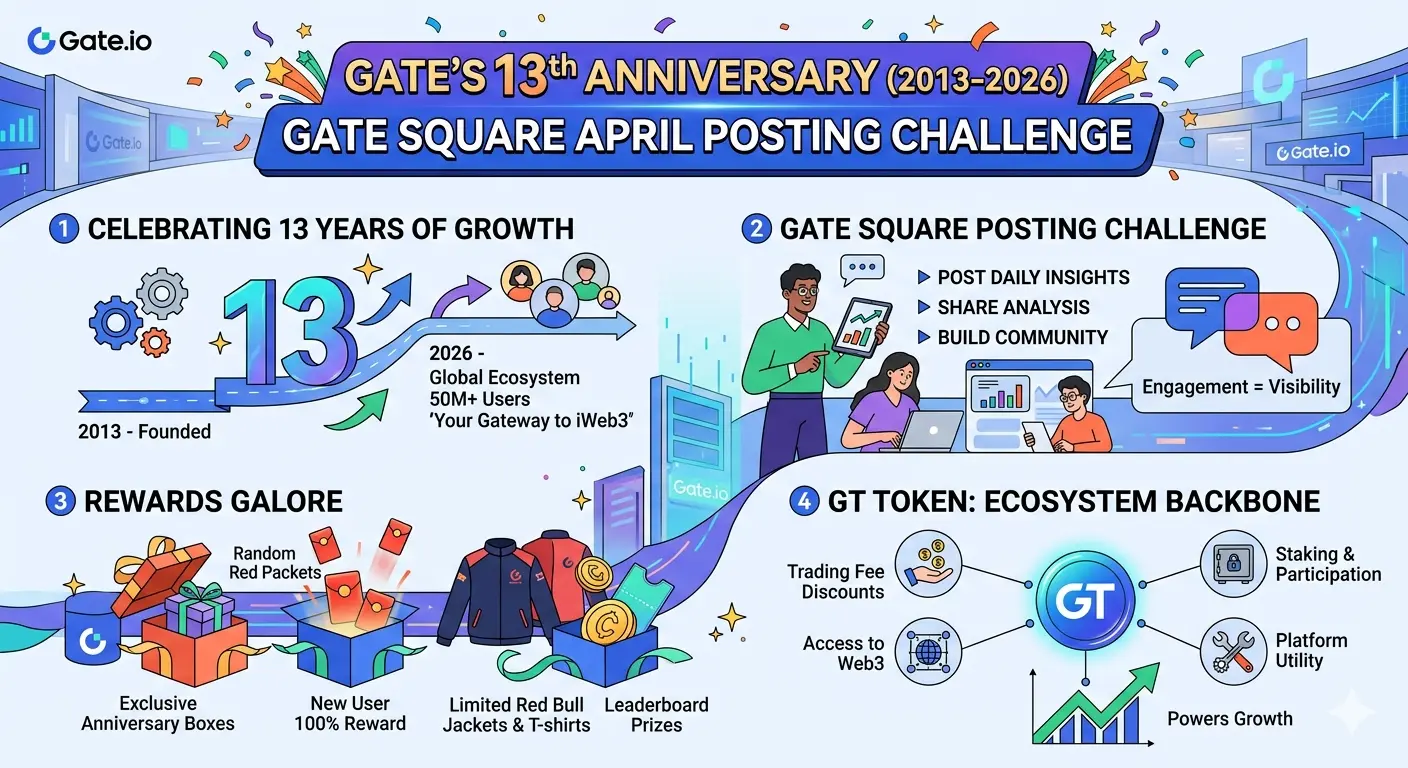
The GateSquare April Posting Challenge and Gate’s 13th Anniversary celebration in 2026 represent a major ecosystem event designed to boost community engagement, reward creators, and highlight the long-term growth of the Gate platform.
GateToken is currently trading around $6.50 and plays a central role in powering the entire Gate ecosystem. It is not just a utility token, but also a key driver of platform engagement, fee efficiency, and Web3 expansion.
🎯 What is the GateSquare April Posting Challenge?
This is a community-driven event where users are encouraged to:
Post daily high-quality crypto insights on Gate Square
Share market analysis, trends, and educational content
Engage with other creators to build visibility
In return, participants can earn:
🎁 Random Red Packet rewards (instant rewards for posting activity)
🆕 New user benefit: 100% chance reward on first post
🏆 Leaderboard prizes for top creators
Top performers can win:
Exclusive Gate 13th Anniversary Gift Boxes
Limited edition Red Bull jackets & T-shirts
Platform vouchers and bonus rewards
This makes the campaign both competitive and rewarding, encouraging consistency and content quality
🧠 Why GT Token Matters in This Ecosystem
GateToken is the core utility asset of Gate.io, and it powers multiple functions:
💸 Trading fee discounts for active users
🔒 Staking and ecosystem participation
🚀 Access to Web3 and platform utilities
🔄 Integration across Gate services and campaigns
As the ecosystem grows, GT becomes more deeply integrated into platform activity, making it an important token within the Gate infrastructure.
🎉 Gate 13th Anniversary – “Your Gateway to iWeb3”
Gate.io, founded in 2013, is now one of the longest-running crypto exchanges globally, serving 50+ million users worldwide.
The 13th anniversary campaign highlights:
Long-term survival through multiple market cycles
Expansion into iWeb3 vision (intelligent Web3 ecosystem)
Strong focus on innovation, user rewards, and creator economy
This milestone is not just a celebration — it reflects platform maturity, trust, and global adoption.
📈 Why This Campaign Matters for Users
This initiative is more than just posting for rewards:
It builds creator reputation and visibility
Encourages consistent market engagement
Rewards users for real analysis and insights
Strengthens the overall Gate community ecosystem
For active participants, this can turn into both:
Short-term rewards (red packets, merch, vouchers)
Long-term benefits (audience growth + influence + ranking)
🧠 Pro Strategy for Maximum Rewards
To perform well in the challenge:
Post consistently every day
Focus on real, valuable market insights
Avoid spam — quality matters more than quantity
Engage with other users to increase visibility
Track trending topics for better reach
Consistency + quality + engagement = higher leaderboard ranking potential
🚀 Final Thought
The GateSquare April Challenge combined with the 13th Anniversary celebration shows how Gate.io is pushing toward a more interactive, reward-driven Web3 ecosystem.
GateToken acts as the backbone of this system, connecting users, rewards, and platform utility into one growing network.
repost-content-media
  • Reward
  • Comment
  • Repost
  • Share
#GateSquareAprilPostingChallenge
🚨 Crypto Market Reacts to US-Iran Ceasefire: BTC Update & Market Analysis
The global crypto market is buzzing as news of a US-Iran ceasefire has temporarily eased geopolitical tensions in the Middle East. This news triggered a relief rally, pushing Bitcoin (BTC) to a 3-week high of $72,865, signaling renewed risk-on sentiment among traders and investors. The surge reflects the market’s sensitivity to global macro events, especially in regions like the Strait of Hormuz, which remains a key chokepoint for global energy trade and a frequent driver of market vola
BTC1,76%
HighAmbition
#GateSquareAprilPostingChallenge
🚨 Crypto Market Reacts to US-Iran Ceasefire: BTC Update & Market Analysis
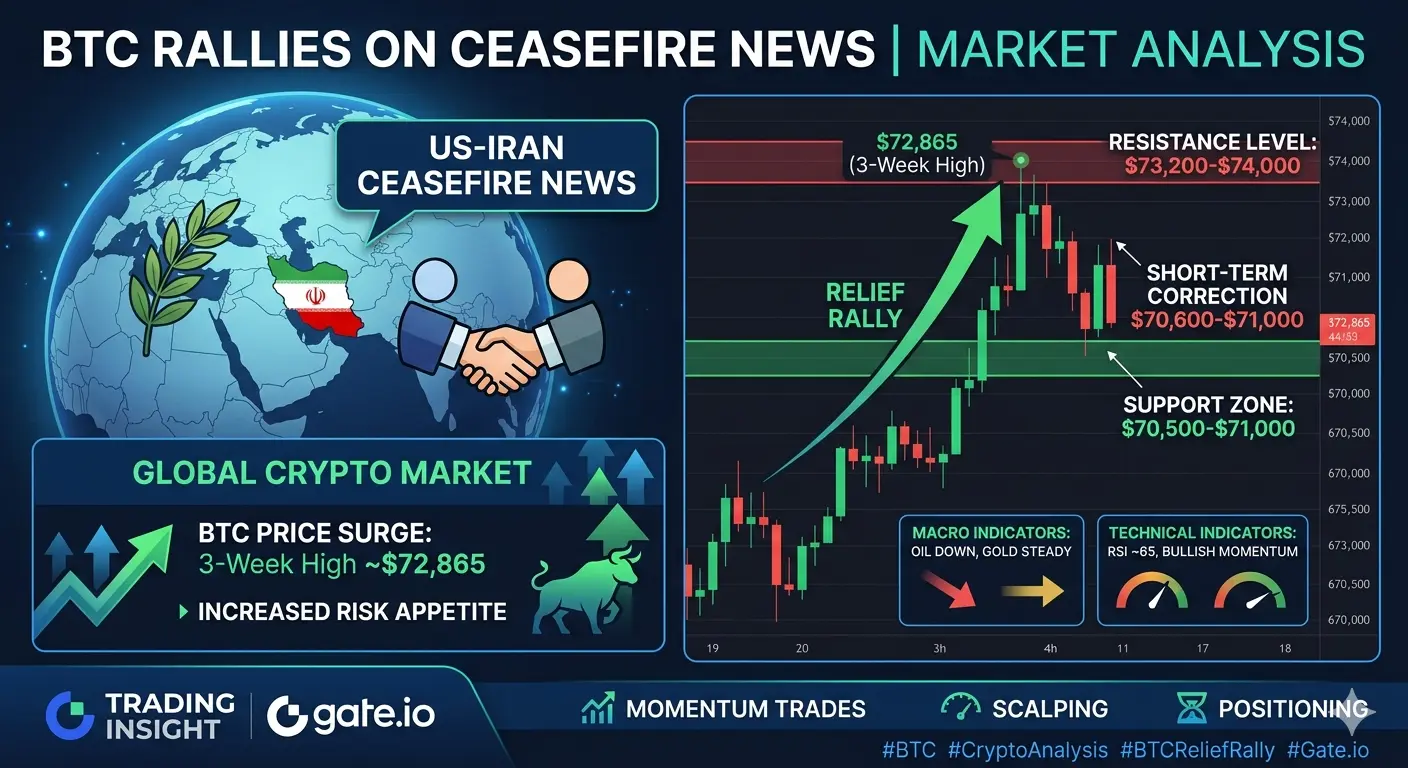
The global crypto market is buzzing as news of a US-Iran ceasefire has temporarily eased geopolitical tensions in the Middle East. This news triggered a relief rally, pushing Bitcoin (BTC) to a 3-week high of $72,865, signaling renewed risk-on sentiment among traders and investors. The surge reflects the market’s sensitivity to global macro events, especially in regions like the Strait of Hormuz, which remains a key chokepoint for global energy trade and a frequent driver of market volatility.
While BTC has pulled back slightly to the $70,600–$71,000 range, this short-term correction is not alarming. In fact, it is a healthy consolidation following a sharp upward move. The broader picture shows that the bullish trend remains intact, supported by increasing market momentum, improving investor confidence, and a cooling of geopolitical risk premiums. For traders, this setup provides both opportunity and caution – momentum trading can capture further gains, but volatility remains high, meaning risk management is crucial.
💹 Technical Perspective:
BTC’s support zones are holding strong around $70,500–$71,000, providing a solid floor for potential upward moves.
Resistance levels to watch are near $73,200–$74,000, where profit-taking and technical selling may occur.
Short-term moving averages suggest recovery potential, while RSI and momentum indicators hint at room for further upside, provided macro stability continues.
🌐 Macro & Market Context:
The ceasefire news has restored some risk appetite, which benefits both crypto and traditional markets.
Traders are keeping a close eye on oil and gold markets, as fluctuations in energy prices and safe-haven assets often correlate with BTC volatility.
While the immediate relief rally is positive, any renewed geopolitical tensions could quickly reverse sentiment, emphasizing the importance of strategic positioning and nimble trading.
📈 Trading Insight:
For those active on Gate.io, this moment represents a prime opportunity to engage with momentum trades, scalping short-term gains, or carefully positioning for a potential new uptrend. Combining technical analysis with macro awareness can help traders maximize returns while minimizing exposure to sudden swings.
⚡ Community Engagement:
What are your BTC price targets in this relief rally? Are you expecting this uptrend to continue past $74,000, or will we see further consolidation around the $70K mark? Share your insights, analyses, and predictions – this is the perfect time to join discussions, exchange strategies, and trade smarter.
In summary, the US-Iran ceasefire has created a momentary bullish window for Bitcoin, but volatility is far from gone. Traders and investors must remain alert, monitor both macro and technical signals, and leverage Gate.io’s tools to navigate the market confidently
repost-content-media
  • Reward
  • Comment
  • Repost
  • Share
#MyAdviceExperienceSharing
Stick to the Plan!
Trading crypto is not about luck. It’s not about chasing hype or predicting the next pump. It’s about discipline, planning, and emotional control. I learned this the hard way. In my early days, I acted on emotion, thinking a coin “was going to explode,” and lost 40% of my portfolio overnight. That experience was brutal, but it taught me my most valuable edge: having a plan and following it relentlessly.
Since then, I have developed a structured framework that allows me to trade confidently, manage risk, and stay profitable even in volatile markets
BTC1,76%
ETH1,89%
DYOR0,21%
post-image
dragon_fly2
#MyAdviceExperienceSharing
Stick to the Plan!
Trading crypto is not about luck. It’s not about chasing hype or predicting the next pump. It’s about discipline, planning, and emotional control. I learned this the hard way. In my early days, I acted on emotion, thinking a coin “was going to explode,” and lost 40% of my portfolio overnight. That experience was brutal, but it taught me my most valuable edge: having a plan and following it relentlessly.
Since then, I have developed a structured framework that allows me to trade confidently, manage risk, and stay profitable even in volatile markets. Here’s what I consider the foundation of bulletproof crypto trading:
1. Risk Management is Non-Negotiable
I risk a maximum of 1–2% per trade. No exceptions. In a 10% market crash, my portfolio stays protected. Ignoring this rule once cost me 35% of my account. If you don’t protect your capital, no strategy will save you.
2. Set Stop-Loss and Take-Profit in Advance
Before entering a trade, I always determine stop-loss and take-profit levels, usually 2–3x the risk. Waiting for “a little more” or chasing FOMO is the fastest way to losses. Treat trades like mechanical operations, not emotional bets.
3. Follow the Plan Without Deviation
Every trade starts with a written plan: reason for entry, target, risk-reward ratio. If the market moves against me, I follow the plan without hesitation. Any deviation is immediately corrected. Discipline, not intuition, is what creates consistency.
4. DYOR (Do Your Own Research)
I study the coin’s whitepaper, team, tokenomics, and chart for at least an hour before entering. Social media hype or celebrity tweets are never a reason to trade. Most big losses come from ignoring research.
5. Use Leverage Responsibly
High leverage can destroy accounts quickly. I trade a maximum of 5–10x leverage. For 20x or higher, I risk no more than 0.5% of my portfolio. One liquidation is enough to teach a lifelong lesson in risk management.
6. Maintain a Trade Journal
After every trade, I log why I entered, if I followed the plan, and what I learned. Weekly reviews reduce emotional trading, highlight mistakes, and identify patterns. Over time, this practice alone decreased impulsive trades by 80%.
7. Portfolio Allocation Matters
BTC and ETH make up 40–50% of my holdings. No single altcoin exceeds 30%, and I limit altcoin positions to 3–4 at a time. Diversification is a shield against volatility and unexpected market crashes.
8. News and Macro Data are for Confirmation, Not Signals
I track whale movements, funding rates, and open interest, along with news feeds and TradingView alerts. But I never trade purely based on news. It’s confirmation, not guidance. Let news inform your plan, not dictate it.
9. Profit-Taking Discipline
I realize 50% of profits at targets and trail the rest. Holding everything in hope of a bigger move often leads to regret. Consistent profit-taking is what compounds wealth over time.
10. Rest and Reset
Charts are addictive. Continuous monitoring leads to fatigue and poor decisions. I dedicate one day per week to rest, detox, and reset. The clearest, most profitable trades happen when the mind is sharp and focused.
The Bottom Line
Success in crypto trading is not about being smarter than the market; it’s about being disciplined, patient, and consistent. Follow your rules, respect risk, avoid impulsive trades, and never chase hype.
Markets will test your patience, discipline, and emotional control every single day. Your plan is your armor. Discipline is your weapon. Those who master these will not only survive but thrive in both bear and bull markets.
Create your own system. Write your plan. Stick to it without compromise. Everything else is noise.
repost-content-media
  • Reward
  • 1
  • Repost
  • Share
ybaser:
Hold on tight, take off immediately🛫 To The Moon 🌕Hold on tight, take off immediately🛫 To The Moon 🌕
  • Pin