


# ArbitrumFreezesKelpDAOHackerETH

51.15K
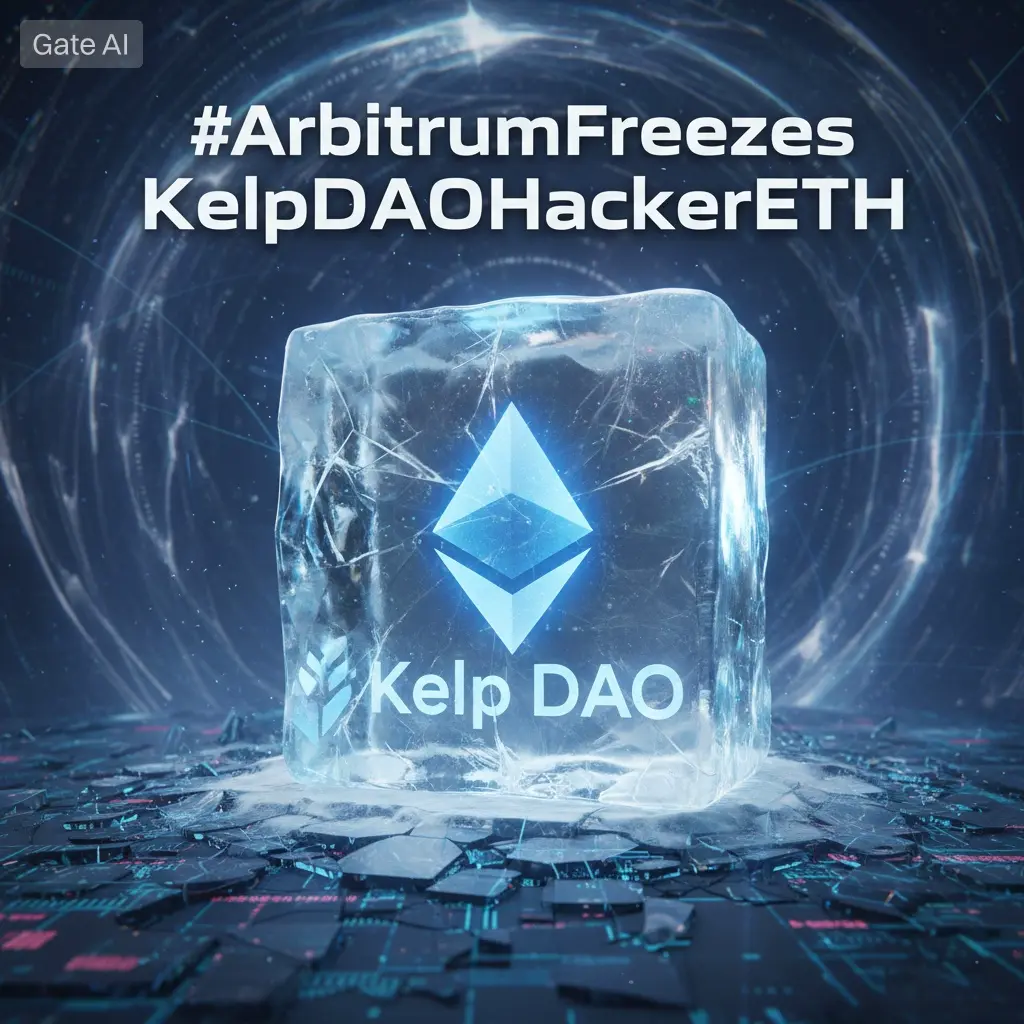
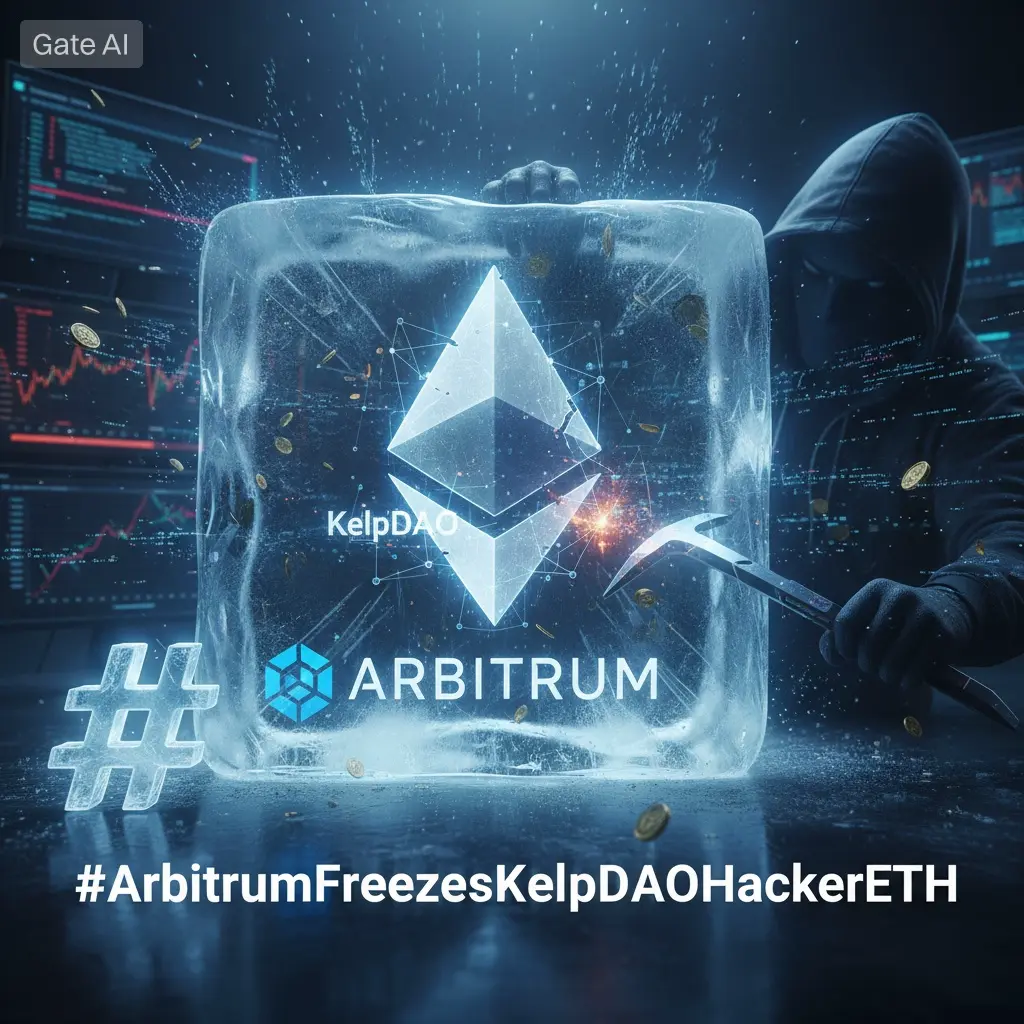
#ArbitrumFreezesKelpDAOHackerETH 🚨 | DeFi Strikes Back ⚔️
This is not normal market news…
👉 This is a power move by DeFi infrastructure itself.
---
📊 What Just Happened (April 2026)
Arbitrum took emergency action and:
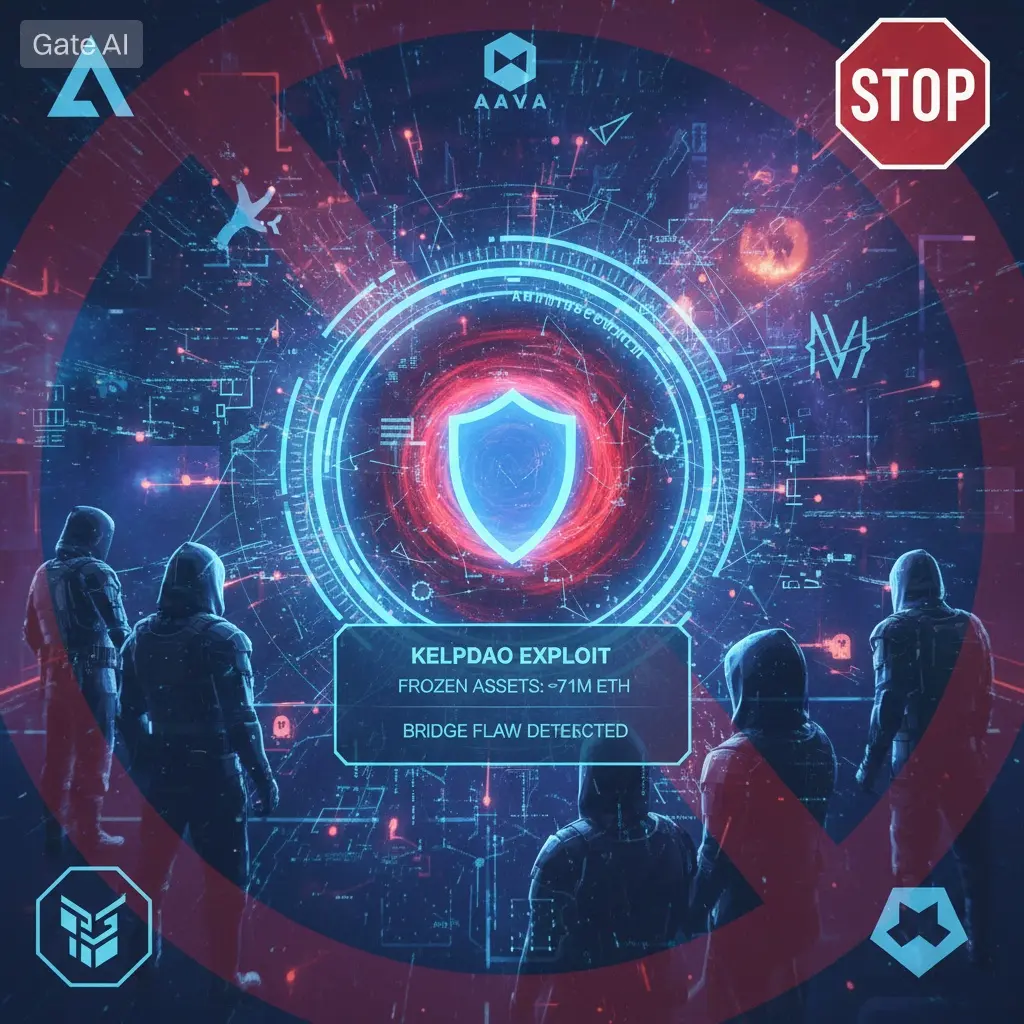
• ❄️ Froze 30,766 ETH (~$70M+)
• 🎯 Funds linked to Kelp DAO hacker
• 🔐 Assets moved to a secured freeze wallet
• ⚖️ Only governance can unlock now
👉 Hacker LOST access instantly
---
💥 Why This Is Massive
This isn’t just recovery — it’s controversial:
• 🛡️ DeFi protected users from losses
• 🚫 But… blockchain intervention actually happened
• 🤯 Raises question: Is DeFi tr
ETH-3,44%
ARB-3,22%
ZRO0,18%
post-image
post-image
  • Reward
  • 2
  • Repost
  • Share
Lock_433:
2026 GOGOGO 👊
View More
#ArbitrumFreezesKelpDAOHackerETH
Arbitrum Security Council Freezes $71 Million in Stolen ETH: The KelpDAO Exploit and Its Far-Reaching Impact on Crypto Markets
Executive Summary On April 21, 2026, the Arbitrum Security Council took unprecedented emergency action to freeze approximately 30,766 ETH (valued at over $71 million) linked to the massive KelpDAO exploit that occurred just days earlier on April 18. This incident represents one of the largest DeFi security breaches of 2026, with total losses estimated at $292 million, and has sent shockwaves through the cryptocurrency ecosystem. The at
post-image
  • Reward
  • 2
  • Repost
  • Share
Lock_433:
To The Moon 🌕
View More
#ArbitrumFreezesKelpDAOHackerETH
This is a major DeFi security + centralization flashpoint — and it’s already becoming a market-wide narrative.
Here’s the clean, updated, Gate Square–style breakdown 👇
🚨 The Arbitrum–Kelp DAO incident isn’t just an exploit story anymore.
It’s now a precedent-setting intervention in DeFi history.
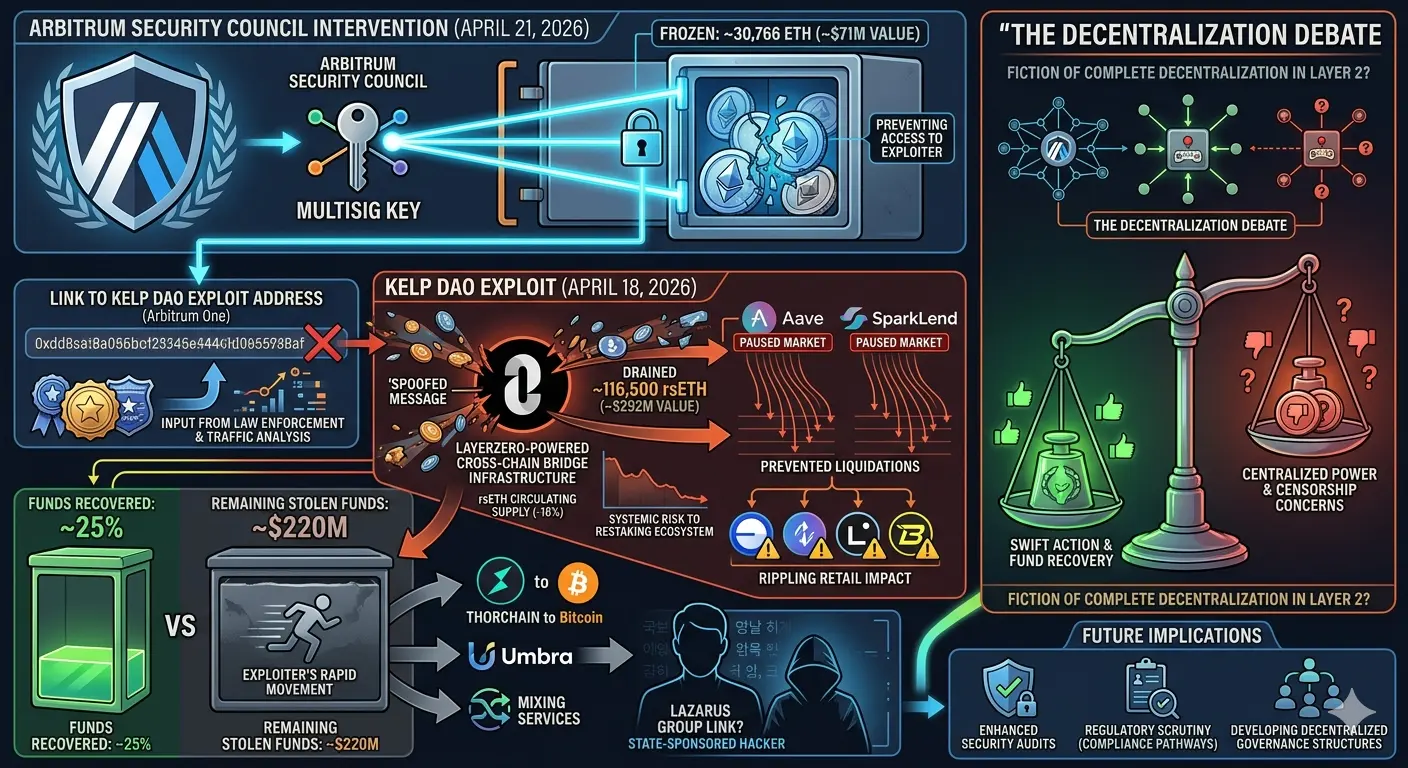
The security council of Arbitrum has frozen ~30,766 ETH (~$71M) linked to the Kelp DAO hack, after a massive cross-chain exploit drained nearly $290M from the system.
This move immediately sparked one core debate:
👉 “Security vs decentralization — where is the line
ETH-3,44%
ARB-3,22%
ZRO0,18%
post-image
  • Reward
  • 4
  • Repost
  • Share
HighAmbition:
thnxx for the latest information good 👍
View More
#ArbitrumFreezesKelpDAOHackerETH
April 23, 2026 The DeFi space just witnessed one of the most defining moments of this cycle. What initially looked like another major exploit has now evolved into a broader debate about the future of decentralization, security, and governance power.
The Situation What Actually Happened
On April 18, 2026, Kelp DAO became the target of a sophisticated cross-chain exploit. Attackers managed to drain 116,500 rsETH, valued at approximately 292 million USD, by exploiting weaknesses in LayerZero’s infrastructure.
This wasn’t a simple smart contract bug. It was a co
ARB-3,22%
ETH-3,44%
BTC-1,48%
ZRO0,18%
post-image
  • Reward
  • Comment
  • Repost
  • Share
#ArbitrumFreezesKelpDAOHackerETH
In a major move highlighting the growing strength of on-chain security and rapid response mechanisms, Arbitrum has successfully frozen a significant portion of ETH linked to the KelpDAO hacker. This action comes shortly after the exploit that shook the DeFi community, raising concerns about vulnerabilities and risk management across decentralized platforms.
🔍 What Happened?
KelpDAO recently fell victim to a sophisticated exploit, resulting in the loss of a substantial amount of ETH. As the hacker attempted to move the stolen funds across networks, Arbitrum’s
ARB-3,22%
ETH-3,44%
post-image
post-image
post-image
  • Reward
  • Comment
  • Repost
  • Share
#ArbitrumFreezesKelpDAOHackerETH
April 23, 2026 The DeFi space just witnessed one of the most defining moments of this cycle. What initially looked like another major exploit has now evolved into a broader debate about the future of decentralization, security, and governance power.
The Situation What Actually Happened
On April 18, 2026, Kelp DAO became the target of a sophisticated cross-chain exploit. Attackers managed to drain 116,500 rsETH, valued at approximately 292 million USD, by exploiting weaknesses in LayerZero’s infrastructure.
This wasn’t a simple smart contract bug. It was a co
ARB-3,22%
ETH-3,44%
ZRO0,18%
AAVE-1,65%
Yusfirah
#ArbitrumFreezesKelpDAOHackerETH
April 23, 2026 The DeFi space just witnessed one of the most defining moments of this cycle. What initially looked like another major exploit has now evolved into a broader debate about the future of decentralization, security, and governance power.
The Situation What Actually Happened
On April 18, 2026, Kelp DAO became the target of a sophisticated cross-chain exploit. Attackers managed to drain 116,500 rsETH, valued at approximately 292 million USD, by exploiting weaknesses in LayerZero’s infrastructure.
This wasn’t a simple smart contract bug. It was a coordinated infrastructure-level attack involving RPC poisoning and DDoS tactics, allowing the attackers to bypass the 1-of-1 DVN (Decentralized Verifier Network) setup and generate forged cross-chain messages.
From my perspective, this highlights a critical truth: in 2026, the biggest risks in DeFi are no longer just code vulnerabilities — they are infrastructure design flaws.
Arbitrum’s Historic Intervention
On April 20, 2026, at 23:26 ET, Arbitrum’s Security Council took an unprecedented step:
30,766 ETH (around 71 million USD) linked to the exploit were frozen.
The funds were redirected to a controlled intermediary wallet that can only be accessed through governance mechanisms. This action was reportedly based on intelligence from law enforcement linking the attack to North Korea’s Lazarus Group.
This is not just a technical move — it’s a governance milestone. For the first time at this scale, a major L2 actively intervened to halt illicit funds post-exploit.
Technical Reality Check
Let’s be clear about the root cause:
Single validator (1-of-1 DVN) architecture created a single point of failure
RPC poisoning enabled message manipulation
Lack of multi-DVN implementation left the bridge exposed
Following this, LayerZero has already confirmed it will discontinue support for 1-of-1 DVN configurations.
In my view, this will become a turning point where security standards across cross-chain protocols are permanently upgraded.
Market Reaction — Controlled Panic, Not Collapse
Despite the scale of the exploit, the market response has been surprisingly resilient:
DeFi TVL dropped by 13 billion USD within 48 hours (99.5B → 86.3B)
Aave is facing potential bad debt scenarios ranging from 123.7M to 230.1M USD
ETH price held relatively stable around 2,300 USD
This stability tells us something important:
The market is no longer reacting emotionally — it’s pricing in risk more efficiently.
The Bigger Debate — Decentralization vs Intervention
This is where things get interesting.
Arbitrum’s action has divided the space:
One side argues this undermines decentralization principles
The other sees it as necessary risk management in a high-stakes environment
As Dan Robinson from Paradigm stated:
“Decentralization is not a suicide pact.”
Personally, I see this as the beginning of a hybrid era — where pure decentralization meets pragmatic safeguards. The real challenge ahead is defining the limits of that power.
Current Developments
Attackers reportedly moved around 1.5 million USD from Ethereum to Bitcoin after the freeze (per ZachXBT)
Kelp DAO is exploring recovery mechanisms, including rescue funds and loss socialization
Aave has partially reopened WETH markets
Meanwhile, a larger pattern is emerging:
In April 2026 alone, Lazarus Group-linked attacks have extracted approximately 575 million USD across DeFi, including:
Drift: 285M
Kelp DAO: 292M
Final Insight
This event is a wake-up call. Not just for developers, but for every participant in DeFi.
Security is no longer optional.
Infrastructure design is no longer secondary.
And decentralization without safeguards is no longer sufficient.
From my experience in tracking market behavior, moments like this don’t just create fear — they reshape standards. The protocols that adapt will lead the next phase of DeFi. Those that don’t will become case studies.
repost-content-media
  • Reward
  • 2
  • Repost
  • Share
HighAmbition:
good 👍 good information 👍
View More
#ArbitrumFreezesKelpDAOHackerETH ARBITRUM FREEZES KELPDAO HACKER ETH: A DEFINING MOMENT FOR L2 SECURITY AND DECENTRALIZATION
THE INCIDENT: LARGEST DEFI EXPLOIT OF 2026
On April 18, 2026, the DeFi ecosystem faced one of its biggest shocks when Kelp DAO’s cross-chain bridge was exploited, draining 116,500 rsETH worth around 292 million dollars. This accounted for nearly 18 percent of the total rsETH supply and became the largest DeFi exploit of 2026.
The attacker used a fake cross-chain message that appeared legitimate, triggering the bridge to release funds to a controlled wallet via LayerZero’
ARB-3,22%
ETH-3,44%
STETH-3,41%
post-image
Luna_Star
#ArbitrumFreezesKelpDAOHackerETH
ARBITRUM FREEZES KELPDAO HACKER ETH: A DEFINING MOMENT FOR L2 SECURITY AND DECENTRALIZATION
THE INCIDENT: LARGEST DEFI EXPLOIT OF 2026
On April 18, 2026, the DeFi ecosystem faced one of its biggest shocks when Kelp DAO’s cross-chain bridge was exploited, draining 116,500 rsETH worth around 292 million dollars. This accounted for nearly 18 percent of the total rsETH supply and became the largest DeFi exploit of 2026.
The attacker used a fake cross-chain message that appeared legitimate, triggering the bridge to release funds to a controlled wallet via LayerZero’s EndpointV2. The wallet had been pre-funded through Tornado Cash, highlighting a well-planned and sophisticated attack strategy.
THE ARBITRUM SECURITY COUNCIL INTERVENTION
In a highly controversial but decisive move, the Arbitrum Security Council intervened on April 21, freezing 30,766 ETH worth approximately 71 million dollars that had been bridged to Arbitrum One.
Nine out of twelve council members approved the action, meeting the required supermajority. The frozen funds were transferred to a governance-controlled wallet, ensuring they cannot be accessed without further approval.
This action has sparked major debate. Supporters argue it prevented further damage and preserved recoverable funds, while critics question whether such intervention undermines decentralization.
THE KELP DAO EXPLOIT MECHANICS
Kelp DAO operates as a liquid restaking protocol where users deposit assets like stETH or cbETH and receive rsETH. These assets are bridged across multiple chains using LayerZero infrastructure.
The vulnerability came from how cross-chain verification was configured. The attacker exploited a weak validation setup, allowing a fake message to be accepted as legitimate. This resulted in funds being released without proper backing.
As a consequence, a large portion of rsETH supply is now effectively unbacked, raising serious concerns for holders across different blockchains.
THE BLAME GAME
LayerZero has stated the issue was due to Kelp DAO’s configuration, specifically the use of a single verifier setup, which created a single point of failure.
Kelp DAO, on the other hand, has pushed responsibility back, arguing that the configuration was based on LayerZero’s documentation and infrastructure design.
This dispute highlights a deeper issue in DeFi: unclear accountability between protocol layers.
MARKET IMPACT AND USER CONFIDENCE
The exploit has shaken confidence in liquid restaking and cross-chain systems. rsETH faced heavy pressure as users questioned its backing and security.
Liquidity fragmentation across chains has made recovery more complex, while users are now reassessing risk in multi-chain DeFi strategies.
At the same time, the Arbitrum intervention has reassured some investors that funds can be protected in extreme scenarios, even if it comes at the cost of decentralization purity.
SECURITY VS DECENTRALIZATION DEBATE
This event has reignited one of crypto’s oldest debates: should decentralized systems have emergency controls
On one side, the ability to freeze funds prevented further loss and may allow partial recovery for victims.
On the other side, critics argue that if networks can intervene and freeze assets, then they are not fully decentralized.
Arbitrum’s decision sets a precedent where Layer 2 governance bodies may act similarly in future crises.
IMPLICATIONS FOR LAYER 2 ECOSYSTEMS
Layer 2 networks are growing rapidly, but this incident shows that security models are still evolving.
Governance councils, multisig controls, and emergency powers are becoming critical components of network design.
Future L2 systems may need to clearly define the balance between decentralization and security intervention to maintain trust.
CROSS-CHAIN RISKS UNDER SPOTLIGHT
The exploit also exposes the risks of cross-chain bridges, which remain one of the most vulnerable parts of DeFi infrastructure.
Complex messaging systems, multiple chains, and validator dependencies create attack surfaces that are difficult to secure completely.
Protocols will likely move toward stronger validation models, multi-verifier systems, and stricter auditing processes.
FUTURE OUTLOOK
This incident will likely accelerate major changes in DeFi
Stronger security standards for cross-chain bridges
Better risk disclosure for users
More transparent governance frameworks
Increased regulatory attention on DeFi security practices
It may also push protocols to prioritize safety over speed when launching new features.
CONCLUSION
The Kelp DAO exploit and Arbitrum’s response mark a turning point for DeFi and Layer 2 ecosystems.
It highlights both the vulnerabilities in current infrastructure and the evolving role of governance in protecting users.
While the freeze has preserved part of the stolen funds, it has also challenged the core principles of decentralization.
Going forward, the industry must find a balance between security and trustlessness.
This event will not just be remembered as the largest exploit of 2026, but as a moment that forced DeFi to confront its biggest question: how decentralized should it really be
repost-content-media
  • Reward
  • Comment
  • Repost
  • Share
#ArbitrumFreezesKelpDAOHackerETH
Arbitrum Security Council Freezes $71M in Stolen ETH from KelpDAO Exploit
On April 20, 2026, the Arbitrum Security Council executed a rare emergency intervention, freezing approximately 30,766 ETH valued at roughly $71 million connected to the KelpDAO exploit that occurred on April 18. The funds were transferred to an intermediary frozen wallet under governance control, rendering them inaccessible to the attacker.
The exploit itself was devastating: attackers leveraged a vulnerability in KelpDAO's LayerZero-powered bridge to mint approximately $293 million in
ETH-3,44%
AAVE-1,65%
ZRO0,18%
TRX-0,17%
post-image
post-image
  • Reward
  • 1
  • Repost
  • Share
HighAmbition:
good 👍 good
#ArbitrumFreezesKelpDAOHackerETH
On April 21, 2026, the Arbitrum Security Council executed an emergency intervention that sent shockwaves through the DeFi ecosystem. They froze approximately 30,766 ETH, valued at roughly $71 million, held in an address on Arbitrum One directly linked to the Kelp DAO exploit that had occurred just days earlier.
This action represents one of the most significant instances of Layer 2 governance intervention in recent memory. The funds were not merely locked but were transferred to a governance-controlled intermediary wallet, effectively placing them beyond the e
ETH-3,44%
ARB-3,22%
ZRO0,18%
post-image
post-image
  • Reward
  • 2
  • Repost
  • Share
GateUser-928d764b:
To The Moon 🌕
View More
#ArbitrumFreezesKelpDAOHackerETH
Arbitrum Security Council Freezes $71 Million in Stolen ETH: The KelpDAO Exploit and Its Far-Reaching Impact on Crypto Markets
Executive Summary On April 21, 2026, the Arbitrum Security Council took unprecedented emergency action to freeze approximately 30,766 ETH (valued at over $71 million) linked to the massive KelpDAO exploit that occurred just days earlier on April 18. This incident represents one of the largest DeFi security breaches of 2026, with total losses estimated at $292 million, and has sent shockwaves through the cryptocurrency ecosystem. The at
HighAmbition
#ArbitrumFreezesKelpDAOHackerETH
Arbitrum Security Council Freezes $71 Million in Stolen ETH: The KelpDAO Exploit and Its Far-Reaching Impact on Crypto Markets
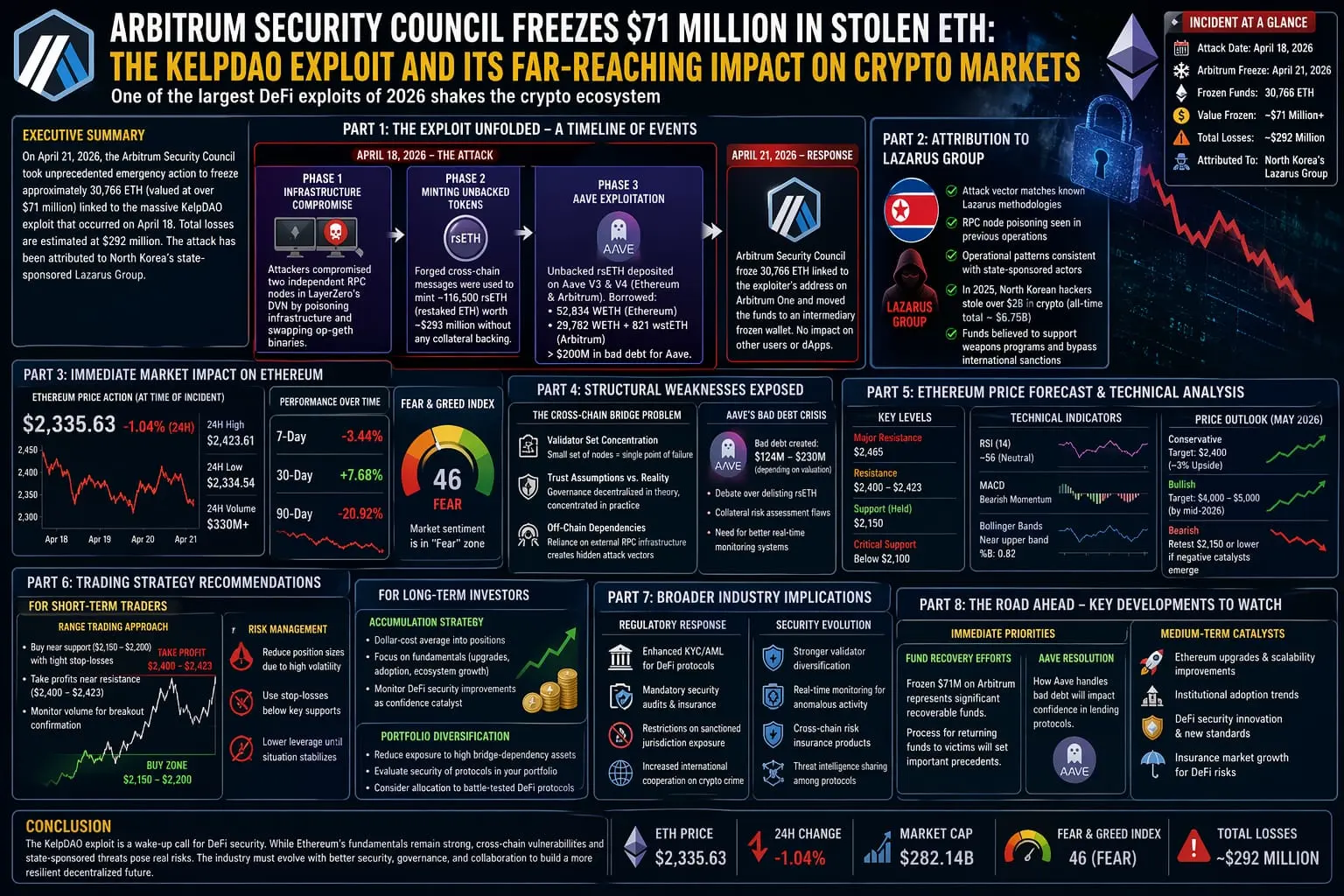
Executive Summary On April 21, 2026, the Arbitrum Security Council took unprecedented emergency action to freeze approximately 30,766 ETH (valued at over $71 million) linked to the massive KelpDAO exploit that occurred just days earlier on April 18. This incident represents one of the largest DeFi security breaches of 2026, with total losses estimated at $292 million, and has sent shockwaves through the cryptocurrency ecosystem. The attack has been attributed to North Korea's state-sponsored Lazarus Group, highlighting the growing sophistication of nation-state actors targeting decentralized finance infrastructure.
Part 1: The Exploit Unfolded - A Timeline of Events
April 18, 2026: The Initial Attack
The exploit began when attackers targeted KelpDAO's LayerZero-powered cross-chain bridge infrastructure. The attack methodology was sophisticated and multi-phased:
Phase 1: Infrastructure Compromise
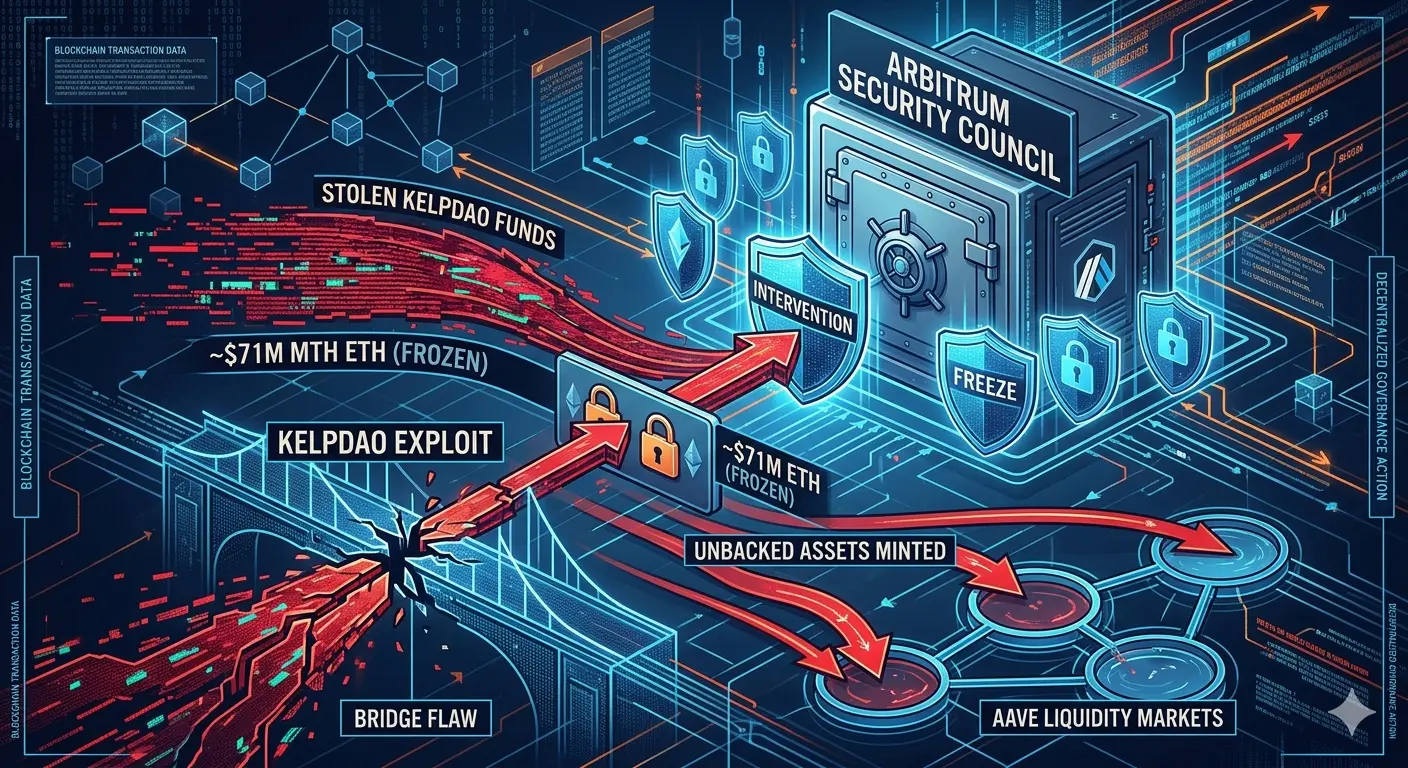
The attackers gained access to KelpDAO's validation infrastructure by compromising two independent RPC nodes running on separate clusters. These nodes were part of LayerZero's Decentralized Verifier Network (DVN). The attackers poisoned the downstream RPC infrastructure and swapped out binaries running the op-geth nodes, effectively gaining control over message validation.
Phase 2: Minting Unbacked Tokens
Using the compromised infrastructure, the attackers forged cross-chain messages to mint approximately 116,500 rsETH (restaked ETH) tokens worth roughly $293 million. These tokens were created without any actual collateral backing them, representing a fundamental breach of the protocol's economic security.
Phase 3: Aave Exploitation
The attackers then deposited the unbacked rsETH as collateral on Aave V3 and V4 markets across both Ethereum mainnet and Arbitrum.
They proceeded to borrow:
52,834 WETH on Ethereum mainnet
29,782 WETH plus 821 wstETH on Arbitrum
This created over $200 million in bad debt for Aave, leaving the lending protocol with significant losses.
April 21, 2026: Arbitrum's Emergency Response
The Arbitrum Security Council, after receiving information from law enforcement regarding the exploiter's identity, invoked emergency powers to freeze the stolen funds. The council moved 30,766 ETH from the attacker's address on Arbitrum One into an intermediary frozen wallet. This action was taken without impacting any other Arbitrum users or applications, demonstrating the council's ability to execute targeted interventions.
Part 2: Attribution to North Korea's Lazarus Group
Multiple security firms and blockchain analysts have attributed this attack to North Korea's Lazarus Group, also known as TraderTraitor. The evidence supporting this attribution includes:
Technical Indicators
The attack vector matches known Lazarus Group methodologies, particularly the patient intrusion and infrastructure compromise approach
The use of RPC node poisoning aligns with previous North Korean operations
The operational security patterns observed during the attack are consistent with state-sponsored actors
Pattern Recognition
This attack follows a disturbing trend of North Korean operations targeting DeFi protocols. In 2025 alone, North Korean hackers stole over $2 billion in cryptocurrency, bringing their all-time total to approximately $6.75 billion. The KelpDAO exploit represents a continuation of this campaign, with attackers evolving from simple credential theft to sophisticated infrastructure attacks.
State-Sponsored Motivation
The stolen funds are believed to support North Korea's weapons programs and circumvent international sanctions. The scale and sophistication of the attack suggest state backing rather than independent criminal activity.
Part 3: Immediate Market Impact on Ethereum
Price Action Analysis
At the time of the incident, Ethereum was trading at approximately $2,336, down 1.04% over the past 24 hours. The price action during and after the exploit reveals several important patterns:
Short-Term Volatility
ETH experienced heightened volatility during April 18-21, with intraday swings of over 4%
The 24-hour high reached $2,423.61 while the low touched $2,334.54
Trading volume spiked significantly, with over $330 million in 24-hour volume
Broader Market Context
Despite the exploit, Ethereum has shown resilience over longer timeframes:
7-day performance: -3.44%
30-day performance: +7.68%
90-day performance: -20.92%
This suggests that while the exploit created short-term uncertainty, the broader market structure remains intact.
Fear and Greed Index
The crypto fear and greed index currently stands at 46, indicating a state of "Fear" in the market. This neutral-to-bearish sentiment reflects broader concerns about DeFi security and the potential for additional exploits.
Part 4: Structural Weaknesses Exposed
The Cross-Chain Bridge Problem
The KelpDAO exploit highlights a fundamental vulnerability in DeFi infrastructure: cross-chain bridges remain a single point of failure despite being marketed as decentralized systems.
Validator Set Concentration
Many bridge protocols delegate security to a small set of validator nodes. If these nodes are compromised, attackers gain complete control over cross-chain message approval. The KelpDAO incident demonstrated how compromising just two RPC nodes could enable a $292 million theft.
Trust Assumptions vs. Reality
DeFi protocols often operate with governance that is decentralized in theory but concentrated in practice. This creates accountability gaps when failures occur, as seen in the dispute between KelpDAO and LayerZero regarding responsibility for the exploit.
Off-Chain Dependencies
The attack exploited dependencies on off-chain infrastructure (RPC nodes), creating attack vectors that are difficult to monitor and secure. This raises questions about how auditors should evaluate control effectiveness when validation mechanisms rely on external systems.
Aave's Bad Debt Crisis
The exploit left Aave with between $124 million and $230 million in bad debt, depending on the valuation methodology used. This has prompted discussions about:
Whether rsETH should be permanently delisted from Aave markets
How lending protocols can better assess cross-chain collateral risks
The need for more robust collateral monitoring systems
Part 5: Ethereum Price Forecast and Technical Analysis
Current Technical Position
Ethereum is currently trading around $2,336, holding above the critical support level near $2,150.
Support and Resistance Levels
Immediate support: $2,150 (held throughout April)
Key resistance: $2,400-$2,423
Major resistance: $2,465 (recent high)
Indicator Analysis
RSI: Neutral at approximately 56
MACD: Showing bearish momentum in the near term
Bollinger Bands: ETH trading near the upper band with a %B position of 0.82
Price Predictions for May 2026
Conservative Scenario
ETH could target $2,400 within 4 weeks if resistance breaks, representing approximately 3% upside from current levels.
Bullish Scenario
Some analysts point to heavy whale accumulation, with predictions targeting $4,000-$5,000 by mid-2026.
Bearish Scenario
If additional exploits occur or regulatory pressure increases, ETH could retest the $2,150 support level or lower.
Part 6: Trading Strategy Recommendations
For Short-Term Traders
Range Trading Approach
Buying near support ($2,150-$2,200) with tight stop-losses below $2,100
Taking profits near resistance ($2,400-$2,423)
Monitoring volume for breakout confirmation
Risk Management
Position sizes should be reduced given heightened volatility
Stop-losses are essential
Consider reducing leverage
For Long-Term Investors
Accumulation Strategy
Dollar-cost averaging into positions
Focusing on fundamental developments
Monitoring DeFi security improvements
Portfolio Diversification
Reducing exposure to bridge-dependent assets
Evaluating protocol security models
Considering allocation to established DeFi protocols
Part 7: Broader Industry Implications
Regulatory Response
Enhanced KYC/AML procedures for DeFi protocols
Security audit and insurance requirements
Restrictions on sanctioned jurisdictions
International Cooperation
Improved cooperation in tracking and freezing stolen assets, with Arbitrum setting precedent.
Security Evolution
Technical Improvements
Validator diversification requirements
Real-time monitoring systems
Insurance products for cross-chain risks
Governance Changes
Ongoing debate between decentralization and emergency intervention powers.
Part 8: The Road Ahead - Key Developments to Watch
Immediate Priorities
Fund Recovery Efforts
The frozen $71 million on Arbitrum represents a major recovery milestone.
Aave Resolution
Approaches may include:
Loss socialization
Insurance fund use
Treasury intervention
Medium-Term Catalysts
Ethereum upgrade developments
Institutional adoption trends
Competition among Layer 1 and Layer 2 ecosystems
DeFi Security Innovation
New cross-chain security frameworks
Insurance market expansion
Threat intelligence sharing
Conclusion
The Arbitrum freeze of KelpDAO hacker funds represents a major moment for DeFi security and governance. While the immediate Ethereum market impact has been contained, the incident exposes deep structural vulnerabilities in cross-chain infrastructure. The involvement of Lazarus Group adds a geopolitical layer to crypto security risks, likely accelerating regulation and international cooperation.
Investors and traders should remain cautious, focus on risk management, and closely monitor fund recovery efforts, Aave’s debt resolution, and ongoing security improvements in the ecosystem.
Current Ethereum Price: $2,335.63
24-Hour Change: -1.04%
Market Cap: $282.14 billion
Fear and Greed Index: 46 (Fear)
repost-content-media
  • Reward
  • 3
  • Repost
  • Share
Vortex_King:
2026 GOGOGO 👊
View More
Load More