The Argentine Securities and Exchange Commission (CNV) now recognizes cryptocurrencies as assets that can be considered part of an individual’s net worth to qualify as an investor. The move might allow investors to reach the nearly $478K in assets to be part of this class.
Key Takeaways:
- CNV Resolution 1125/2026 lets crypto count for the $479K investor limit, expanding future market access.
- A 2022 Central Bank ban still halts retail crypto services, but banks are testing blockchain settlement.
- President Milei is expected to lift the 2022 banking ban soon, expanding Argentina’s crypto adoption.
Argentina Changes Law to Recognize Crypto as Net Worth for Qualified Investors
Argentina is slowly working to open its financial industry to crypto assets, moving to increase the recognition of cryptocurrency across all sectors of its economy.
The Argentine Securities and Exchange Commission (CNV) issued General Resolution 1125/2026, which establishes that virtual assets will be recognized as part of an individual’s worth for reaching the classification of a qualified investor in the country.
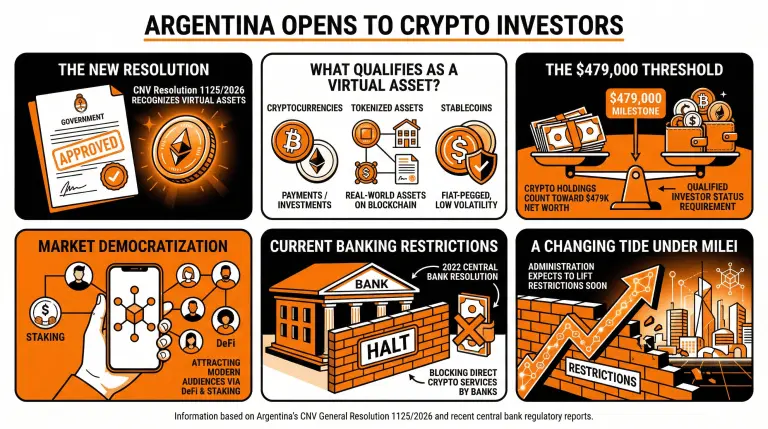
The resolution defines virtual assets as “any digital representation of value that can be traded and/or transferred digitally and used for payments or investments.” This means that cryptocurrencies, tokenized assets, and even stablecoins could be used as these assets.
The CNV argued that “the progressive incorporation of new asset classes—such as Virtual Assets—into investment portfolios renders their inclusion advisable for the purpose of demonstrating the required financial capacity, since they constitute an additional manifestation of the investor’s economic capacity and financial experience.”
Before, when investors disclosed their crypto holdings, these could not be accounted as part of the assets needed to reach the nearly $479,000 to enter this investment classification.
With this measure, the CNV seeks to democratize and open investment markets to new target audiences who are not normally interested in traditional investments and focus more on digital alternatives, including staking and decentralized finance platforms.
While Argentina is advancing in this regard, financial institutions cannot offer cryptocurrency services to their customers, as the central bank issued a resolution in 2022 to “mitigate the risks associated with operations with these assets that could be generated for users of financial services and for the financial system as a whole.”
Nonetheless, some banks are testing blockchain-based plumbing for their internal settlements. Reports indicate this restriction will be lifted in the short term, as President Milei’s administration opens up to crypto.
Disclaimer: The information on this page may come from third parties and does not represent the views or opinions of Gate. The content displayed on this page is for reference only and does not constitute any financial, investment, or legal advice. Gate does not guarantee the accuracy or completeness of the information and shall not be liable for any losses arising from the use of this information. Virtual asset investments carry high risks and are subject to significant price volatility. You may lose all of your invested principal. Please fully understand the relevant risks and make prudent decisions based on your own financial situation and risk tolerance. For details, please refer to
Disclaimer.
Related Articles
Hong Kong suspends the legalization of basketball betting and studies the impact and compliance issues of prediction markets
Hong Kong has suspended the legalization of basketball betting this week, while also planning to launch a study to assess the impact of prediction markets in Hong Kong and their level of adoption. Macie Mak, Commissioner for Home and Youth Affairs in Hong Kong, said that the monthly trading volume of prediction markets has grown from less than $100 million two years ago to more than $13 billion last year, with about 40% related to sports.
MarketWhisper18m ago
Kalshi appeals Nevada event contract ban; CFTC jurisdiction dispute may reach the Supreme Court
Prediction market platform Kalshi has appealed a ruling by the state of Nevada banning its event contracts, and the U.S. Ninth Circuit Court of Appeals held oral arguments on April 17, but did not issue an immediate decision after the hearing. The core dispute in the case is whether Kalshi’s event contracts are “swap agreements” that fall under the jurisdiction of the Commodity Futures Trading Commission (CFTC), or whether they must be regulated by state-level activity under gambling licensing regimes. Multiple legal experts predict that the case may ultimately be appealed to the U.S. Supreme Court.
MarketWhisper3h ago
CFTC Chairman Selig: Prediction-market fraudsters will face harsh legal penalties; will not pause rulemaking
In a House hearing, U.S. CFTC Chairman Selig emphasized a “zero-tolerance policy” toward market fraud and manipulation. He responded to questions regarding a $500 million oil futures transaction and said the CFTC is drafting rules to regulate prediction markets. Selig also mentioned a cooperation memorandum of understanding with the SEC to strengthen oversight of digital assets. Given that the CFTC currently has only one commissioner—himself—Selig emphasized operational efficiency and will hire new staff to enhance regulatory capacity.
MarketWhisper5h ago
MTN Nigeria Suspends Xtratime Airtime and Data Borrowing Service to Comply with Digital Lending Regulations
MTN Nigeria has suspended its Xtratime service due to new regulatory compliance from the FCCPC. While normal purchases continue, the suspension aims to align with upcoming digital lending rules. The company does not foresee significant financial impact and will monitor user response.
GateNews9h ago
Pakistan Opens Banking System to Licensed Crypto Firms, Reversing 2018 Ban
Pakistan's central bank has opened its banking system to licensed virtual asset service providers, reversing a previous ban. This change, following the Virtual Assets Act 2026, allows crypto businesses access to banking services under strict regulations.
GateNews13h ago
Musk’s X Money hasn’t launched yet—but it’s already making headlines! Mizuho says it will shake up the U.S. payments market and also downgrades PayPal’s rating
Elon Musk’s financial product X Money is expected to launch in April, potentially upending the U.S. payments market and putting pressure on PayPal, as Mizuho Securities has downgraded PayPal’s rating to “Neutral.” However, regulatory variables have become the main challenge, especially the legal uncertainty surrounding crypto-asset payments and yield-generating products. X has also rolled out a “Cashtags” feature that integrates real-time financial data.
ChainNewsAbmedia13h ago


