Trump raised the temperature again with a fresh Iran deadline and warnings of overwhelming force. The rhetoric was extreme, and markets treated it as immediate macro risk.
To be precise, widely cited reports quote Trump saying Iran could be destroyed “in one night” if no deal is reached, not that “whole civilization will die tonight.” Coverage from BBC, Euronews, and CBS ties the ultimatum to Strait of Hormuz pressure and potential strikes on Iranian infrastructure.
The Ultimatum And Why Crypto Cared
The immediate market concern was not geopolitics in isolation. It was the second-order chain:
- Hormuz disruption risk -> higher oil sensitivity
- Higher oil sensitivity -> inflation and rate-cut uncertainty
- Rate uncertainty -> pressure on risk assets
That macro path has repeatedly shown up in crypto this cycle. When war headlines tighten energy risk, traders reduce leverage first and ask narrative questions later.
BTC, ETH, And XRP Price Reaction
As of April 7, 2026 market snapshots:
- BTC: about $68,276, down 0.84%
- ETH: about $2,087.75, down 0.93%
- XRP: about $1.31, down 1.13%
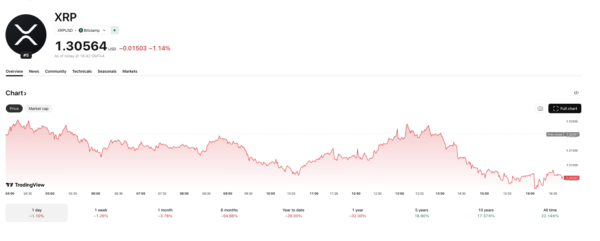
Trump Issues Iran Deadline, BTC ETH XRP React to Risk Shock
The relative move matters. XRP printed the deepest percentage decline of the three, which fits the pattern seen in other stress windows where beta expands in larger-cap alts while Bitcoin absorbs the first flow shock.
BTCUSD now trading near $68,000 on latest available snapshots. Chart: TradingView
Other Data You Should Watch
Crypto did not move alone. Cross-asset pricing around the ultimatum window shows why this stayed a macro trade:
- Brent crude traded around the $109 to $110+ zone in early April as Hormuz and strike-risk headlines intensified, based on Reuters global markets coverage and Reuters wrap.
- Prompt oil stress remained elevated after Reuters also reported earlier that near-term contracts were trading at unusually large premiums to later delivery in this conflict phase, signaling immediate supply fear.
- U.S. equities and volatility showed a risk-off/risk-on tug-of-war, with AP describing investors positioning for sharply different outcomes heading into the ultimatum deadline.
In short, BTC, ETH, and XRP were reacting to a broader volatility regime, not an isolated crypto headline.
Derivatives Context (BTC-led)
Desk commentary around this cycle has repeatedly pointed to two mechanisms:
- Funding rate resets during escalation phases, where leveraged longs are forced out and perpetual pricing cools.
- Open interest shifts around ceasefire rumors versus strike rhetoric, with participation rising on relief days and trimming on hard-deadline headlines.
Treat these as confirmation signals. If BTC funding turns healthier while oil cools, ETH and XRP often stabilize faster. If funding weakens again while crude reprices higher, altcoin beta can expand to the downside.
Epic Fury Or Epic Failure: How Traders Are Framing It
There are now two competing narratives in markets:
- Epic Fury frame: maximal pressure forces faster political outcomes, risk stabilizes quickly.
- Epic Failure frame: escalation extends uncertainty, oil remains jumpy, and crypto stays headline-driven.
For now, tape action favors the second frame in the short run. Not because markets have picked a final geopolitical winner, but because positioning remains fragile whenever policy language shifts from diplomacy to deadlines.
What To Watch Next
In the next 24 to 72 hours, crypto desks are focused on:
- Any verification of backchannel diplomacy
- Fresh Strait of Hormuz shipping updates
- Brent and WTI direction into U.S. session opens
- BTC perpetual funding and open interest reset speed
If crude cools and rhetoric softens, BTC usually stabilizes first, then ETH, then XRP beta catches up. If threats harden and oil reprices higher again, the reverse order can return quickly.
Disclaimer: The information on this page may come from third parties and does not represent the views or opinions of Gate. The content displayed on this page is for reference only and does not constitute any financial, investment, or legal advice. Gate does not guarantee the accuracy or completeness of the information and shall not be liable for any losses arising from the use of this information. Virtual asset investments carry high risks and are subject to significant price volatility. You may lose all of your invested principal. Please fully understand the relevant risks and make prudent decisions based on your own financial situation and risk tolerance. For details, please refer to
Disclaimer.
Related Articles
BTC slides 0.70% in the short term: On-chain fund outflows and derivatives deleveraging align to weigh on the market
Between 09:30 and 09:45 (UTC) on 2026-04-17, the BTC price’s return within 15 minutes was -0.70%. During the day, it fluctuated in the 75511.9 to 76307.6 USDT range, with an amplitude of 1.04%. Short-term market sentiment became more cautious; although capital activity increased, volatility noticeably accelerated.
The main driving force behind this move is the large-scale outflow of funds on-chain and active deleveraging in the derivatives market. On-chain data shows that, within this time window, the net outflow from BTC exchanges increased, with a 24-hour net outflow of -2,844.68 BTC. Investors transferred a large amount of BTC to cold wallets, significantly weakening market liquidity and pressuring buy-side demand, which dragged prices lower. In the derivatives space, open interest in perpetual contracts fell in tandem; some leveraged funds actively reduced exposure, indicating the market’s more conservative stance on short-term price action, thereby further weakening support.
In addition, multiple large transfers and whale address activity occurred frequently during the anomaly period, amplifying pressure on capital flows and causing sentiment in the derivatives market to turn even colder. The funding rate dropped briefly within the window, indirectly reflecting that some position holders moved into cold wallets for safer risk management. At the same time, the number of active addresses remained persistently high at over 120k, suggesting network participation was not hit and the fundamentals remained stable; however, the combined effect of frequent outflows amplified market volatility in the short term.
What needs to be watched is that continuous net outflows of funds on-chain and a decline in holdings pose a threat to the stability of support levels. Large address behavior could lead to further capital escaping. In the short term, focus on changes in exchange BTC balances, on-chain transfer volumes, whale address flow, and the dynamics of derivatives open interest. If capital does not return later, volatility risk may further expand; it is recommended to closely monitor real-time market conditions and key on-chain indicators.
GateNews7m ago
The U.S. vetoes the Iran-war powers resolution, while the BTC price trades in a range near $75,000
On April 17, Bitcoin traded in a tight range near $75,500. The U.S. vetoed a war-powers resolution against Iran, while Israel and Lebanon reached a 10-day ceasefire—geopolitical signals moved in opposite directions. Institutional fund inflows coexisted with outflows on-chain; Bitcoin’s correlation with the Nasdaq briefly turned negative—leaving the market waiting for a breakout in either direction.
GateInstantTrends15m ago
BTC breaks through 76000 USDT
Gate News bot message, Gate market data shows that BTC has broken through 76000 USDT, with the current price at 76188.7 USDT.
CryptoRadar26m ago
CleanSpark (CLSK) Highest Shorted BTC Mining Stock at 34.89%
CleanSpark (Nasdaq: CLSK) has the largest share of short open interest among Bitcoin mining and treasury companies, with short positions representing 34.89% of the free float and 4.71 days to cover, according to the source analysis. The stock traded at $11.42, up from $8.18 at the end of March,
CryptoFrontier43m ago
BTC up 0.58% in 15 minutes: exchange net outflows and ETF buy orders converge to lift the price
Between 2026-04-17 08:45 and 2026-04-17 09:00 (UTC), the BTC price surged in the short term. The candlestick return was +0.58%, with a price range of 75265.0 - 75862.3 USDT and a range of 0.79%. Market volatility increased and attention rose, with trading volume significantly higher than usual, reflecting a convergence between capital flow and technical signals.
The main driver behind this unusual move is the exchange’s net outflow of BTC in sync with ETF capital inflows. Data shows that within the past 24 hours, exchanges recorded a net outflow of 2,844.68 BTC
GateNews52m ago
Spot Bitcoin and Ethereum ETFs Post Strong Inflows, BlackRock IBIT and ETHA Lead
Spot Bitcoin ETFs saw $26 million in inflows on April 16, led by BlackRock's IBIT with $81 million. Ethereum ETFs also performed well, with BlackRock's ETHA gaining $30.51 million, highlighting ongoing institutional interest in crypto markets.
GateNews52m ago


