
According to tracking data from the on-chain monitoring platform Onchain Lens, on April 9 the government of Bhutan transferred 319.7 BTC (about $22.67 million) to two separate wallets: one new wallet that may be linked to a centralized exchange (CEX), and one older wallet that had previously been used multiple times to sell Bitcoin through exchanges or via Galaxy Digital.
On-Chain Moves by the Government of Bhutan: Routes Point to a “Sell-Off” Intent
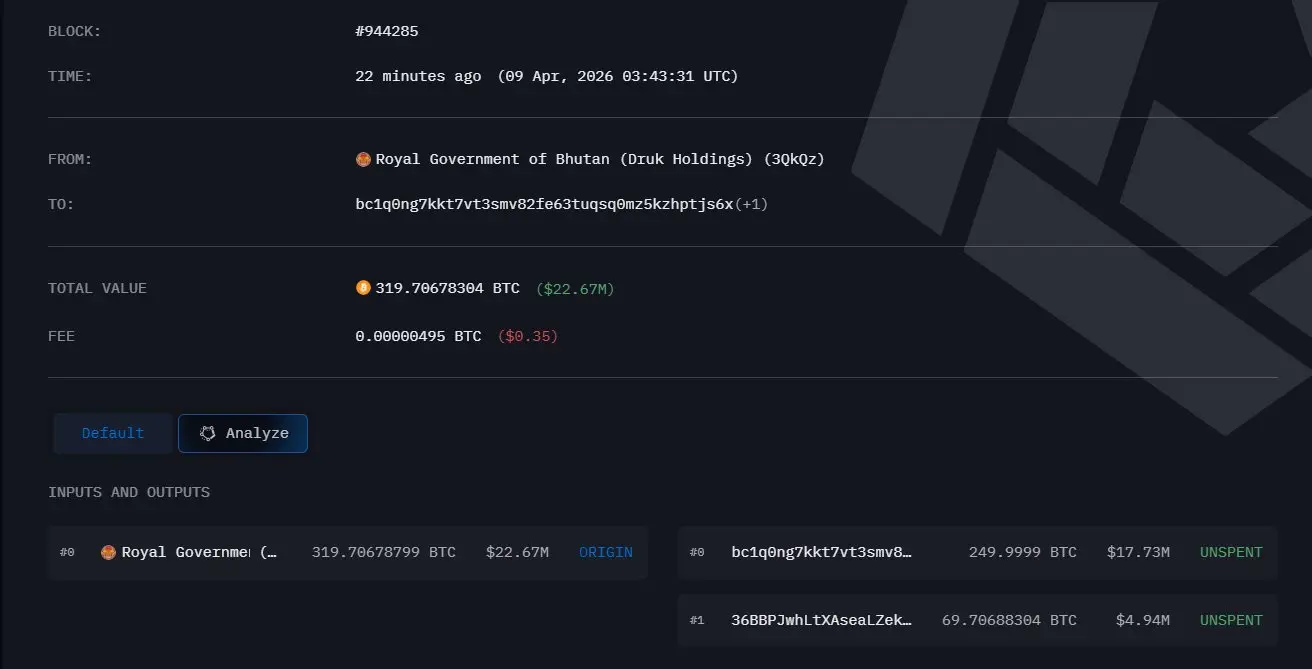 (Source: Arkham)
Bhutan is one of the few sovereign governments worldwide that actively accumulates Bitcoin under the country’s name, and its on-chain activity has consistently drawn heavy market attention. The two transfers detected by Onchain Lens in this instance show a clear intention to unload holdings: the appearance of a new wallet is considered to possibly indicate preparatory actions for direct deposits into centralized exchanges, while the historical records of the older wallet show that, previously, Bitcoin was moved off-chain via institutions such as Galaxy Digital and sold through exchanges multiple times.
Market analysts say that Bhutan’s latest operations continue its selling pattern over the past few months. Against the backdrop of Bitcoin’s ongoing weakness, the selling pressure faced by sovereign holders is gradually increasing. However, the government of Bhutan has not yet released any public explanation for this transfer.
Coordinated Selling on the Corporate Side: Sell-Off Actions by Three Public Companies
In the same time window during which Bhutan was selling, several public companies previously viewed as long-term Bitcoin holders also began unloading their positions one after another.
Overview of Bitcoin Sell-Offs by Public Companies
Empery Digital (EMPD): Last Wednesday, it sold 370 BTC at an average price of $66,632 per coin, raising $24.70 million, with 2,989 BTC remaining. Some of the proceeds were used to fully repay outstanding term loans, and roughly 1,800 BTC previously held as collateral was released. The company started building a Bitcoin treasury in July 2025, accumulating about 4,000 BTC at its peak. As of now, its stock price is down 75% from its $15.80 high in 2025.
Genius Group (GNS): This Bitcoin-focused AI education company previously held as many as 440 BTC in March 2024, but it has now fully liquidated. The final 84 BTC were used to repay $8.5 million in debt. The company said it will restore its Bitcoin reserves after the market environment improves.
Riot Platforms (RIOT): According to Lookonchain on-chain data, Riot Platforms, one of the largest publicly traded Bitcoin miners in the United States, has also continued selling Bitcoin. The main reason is that high energy costs are creating persistent pressure on operating profit.
The Core Logic Behind Persistent Selling Pressure: Weak Coin Price Forces a Re-Positioning of Holdings
A common backdrop for this wave of selling is Bitcoin’s continued underperformance in recent times. For companies that accumulated Bitcoin through debt financing or strategic allocation, a decline in the coin price directly compresses the health of their balance sheets. After the value of collateral shrinks, some companies are forced to liquidate under pressure to repay at maturity. For sovereign holders such as Bhutan, the on-chain path pointing to an exchange indicates that an immediate liquidity need is an important factor. If Bitcoin cannot return to higher levels in the short term, ongoing sell pressure from both sovereign and corporate sides could become a downward force in the market that cannot be ignored.
FAQ
Why does Bhutan hold Bitcoin, and why did it choose to sell now?
Bhutan mainly accumulates Bitcoin through its mining operations run by its state-owned energy company. This sell-off is believed to be related to liquidity needs or to a strategy of locking in gains at relatively higher levels. Specific motives have not yet been disclosed by the government of Bhutan. The CEX transfer pattern indicated by the on-chain path is currently the most direct market clue.
Why did Empery Digital sell a large amount of Bitcoin?
Empery Digital’s core goal is to fully repay outstanding term loans and release about 1,800 BTC held as collateral for the loans. This reflects the financial pressure and asset restructuring needs that arise when debt-based strategies to accumulate Bitcoin face falling coin prices in a high-interest-rate environment.
What impact does synchronized selling by sovereigns and corporations have on the Bitcoin market?
Such sell-offs create some downward pressure in the short term, but the scale of each batch is still limited relative to total average daily trading volume. More importantly, the key impact is on market sentiment. Sell-off signals from major holders could deepen investors’ doubts about maintaining long-term positions, and during a time when market confidence is already fragile, this can transmit negative expectations.
Disclaimer: The information on this page may come from third parties and does not represent the views or opinions of Gate. The content displayed on this page is for reference only and does not constitute any financial, investment, or legal advice. Gate does not guarantee the accuracy or completeness of the information and shall not be liable for any losses arising from the use of this information. Virtual asset investments carry high risks and are subject to significant price volatility. You may lose all of your invested principal. Please fully understand the relevant risks and make prudent decisions based on your own financial situation and risk tolerance. For details, please refer to
Disclaimer.


