US Senator Cynthia Lummis has dismissed claims that the Digital Asset Market Clarity Act fails to protect decentralized finance innovators from legal repercussions, rebutting that recent changes to the draft will make it the “strongest protection for DeFi and developers ever enacted.”
Her comments on Friday came in direct response to crypto lawyer Jake Chervinsky, who argued that Title 3 of the current draft undermines the Blockchain Regulatory Certainty Act — another crypto bill focused on developer protections — by subjecting non-custodial software developers to know-your-customer obligations.
“Don’t believe the FUD,” Lummis said, adding, “We have worked on a bipartisan basis for the last few weeks to make changes to Title 3 that make this bill the strongest protection for DeFi and developers ever enacted. We have to pass the Clarity Act to get these protections.”
The latest changes to the CLARITY Act have not been publicly released.
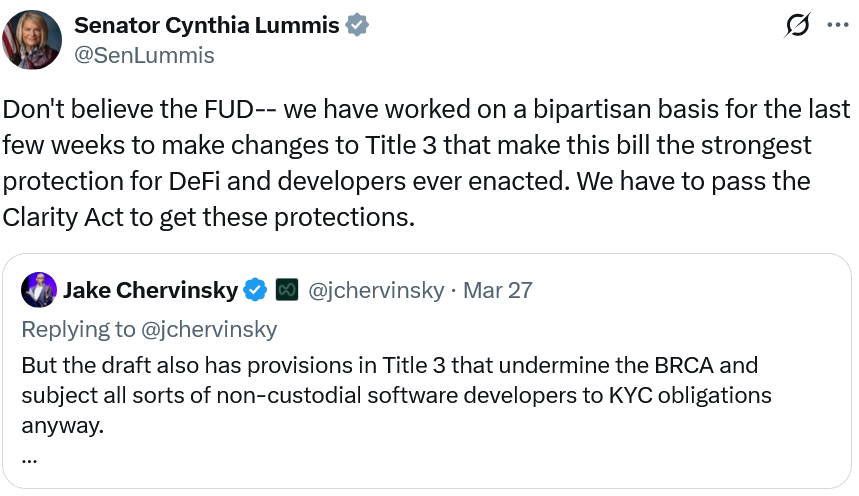
_Source: _Cynthia Lummis
Chervinsky said these DeFi protection provisions have been overshadowed by intense focus on stablecoin rewards provisions in the CLARITY Act.
His biggest issue with the Senate Banking Committee’s latest CLARITY Act draft is that Title 3’s money transmitter definitions could still expose many non-custodial DeFi builders to liability.
This is despite the CLARITY Act incorporating the BRCA in section 604, which clarifies that non-controlling developers and providers of non-custodial software are not to be treated as financial institutions subject to Bank Secrecy Act KYC obligations.
“The biggest challenge is ensuring non-custodial software developers aren’t misclassified as money transmitters,” Chervinsky argued.
“That’s non-negotiable for DeFi, and it’s still unsettled.”
His concerns come amid several high-profile prosecutions and convictions of developers in the US in recent months, including Tornado Cash co-founder, Roman Storm, who was convicted in August 2025 of conspiracy to operate an unlicensed money transmitting business.
**Related: **__Delaware eyes stablecoin licensing framework under banking laws
US lawmakers have said the CLARITY Act is moving closer toward a Senate Banking Committee markup expected in April after recent bipartisan progress on stablecoin rewards provisions.
Passage of the CLARITY Act is necessary to ensure DeFi developers are afforded legal protections under the BRCA, Lummis noted.
**Magazine: **__Are DeFi devs liable for the illegal activity of others on their platforms?
Cointelegraph is committed to independent, transparent journalism. This news article is produced in accordance with Cointelegraph’s Editorial Policy and aims to provide accurate and timely information. Readers are encouraged to verify information independently. Read our Editorial Policy https://cointelegraph.com/editorial-policy
- #Law
- #United States
- #Bills
- #Developers
- #DeFi
- #Regulation
Disclaimer: The information on this page may come from third parties and does not represent the views or opinions of Gate. The content displayed on this page is for reference only and does not constitute any financial, investment, or legal advice. Gate does not guarantee the accuracy or completeness of the information and shall not be liable for any losses arising from the use of this information. Virtual asset investments carry high risks and are subject to significant price volatility. You may lose all of your invested principal. Please fully understand the relevant risks and make prudent decisions based on your own financial situation and risk tolerance. For details, please refer to
Disclaimer.
Related Articles
The Thailand SEC releases a regulatory proposal allowing digital asset firms to directly apply for derivative brand licenses.
According to an April 23 announcement from the Thai Securities and Exchange Commission (SEC), the agency has formally submitted amendments to its digital asset derivatives business licensing rules. The proposal would allow firms that already hold digital asset operating licenses to apply directly for a derivatives business license without needing to establish a separate legal entity. The proposal also introduces requirements for managing conflicts of interest for companies that engage in both digital asset and derivatives businesses, and it calls for financial standards for derivatives exchanges and clearing institutions to align with international benchmarks.
MarketWhisper29m ago
Kalshi: Three candidates illegally bet on their own campaigns, fined and barred for five years
According to a report by The New York Times on April 23, Kalshi, a prediction market platform, issued disciplinary actions to three political candidates who attempted to bet on their own election campaigns, and the relevant disciplinary action letters have been posted on Kalshi’s website. Bobby Deno, head of enforcement and legal counsel at Kalshi, said the sanctions are part of the platform’s “proactive engineering solution,” designed to identify trading activity that violates the platform’s recently updated rules.
MarketWhisper1h ago
TD Cowen Identifies Five Major Obstacles to Clarity Act Beyond Stablecoin Yield Issues
Gate News message, April 23 — Investment bank TD Cowen has identified five major obstacles facing the passage of the Clarity Act, beyond the stablecoin yield issue, according to The Block.
The first obstacle is that the U.S. Commodity Futures Trading Commission (CFTC) currently has only one
GateNews2h ago
SEC Faces Mounting Pressure to Turn DeFi Guidance Into Formal Rules
Industry participants are urging the U.S. Securities and Exchange Commission (SEC) to formalize its crypto guidance on decentralized tools, arguing clearer rules would reduce uncertainty and better align oversight with blockchain infrastructure.
Key Takeaways:
Over 30 crypto industry participants
Coinpedia3h ago
The UK Financial Conduct Authority launches its first crackdown on illegal peer-to-peer cryptocurrency trading
The FCA’s first wave of enforcement actions, working together with HMRC and the South West Regional Organised Crime Unit, raided multiple London locations suspected of running unregistered P2P cryptocurrency trading venues, issuing stop orders and bringing the matters into a criminal investigation. Experts say such unregistered platforms are illegal and carry high risk, and regulators will strengthen oversight gaps with regulations such as those on anti-money laundering. The UK is gradually building a cryptocurrency regulatory framework, with full implementation expected by 2027; in 2026, a registration application channel will be opened, and investors should carefully assess risks.
ChainNewsAbmedia9h ago
Hyperliquid Launches Policy Center in U.S. to Advance Decentralized Derivatives Regulation
Gate News message, April 22 — Hyperliquid has established the Hyperliquid Policy Center (HPC) in the United States, funded by the Hyper Foundation. The initiative aims to secure legal clarity and protections for U.S. users and developers, with a focus on on-chain perpetual futures contracts.
HPC wi
GateNews11h ago


