The Bitcoin mining industry is facing severe challenges. As the price drops and energy costs soar, coupled with rising geopolitical risks, many miners are caught in a “losing more the more they mine” dilemma.
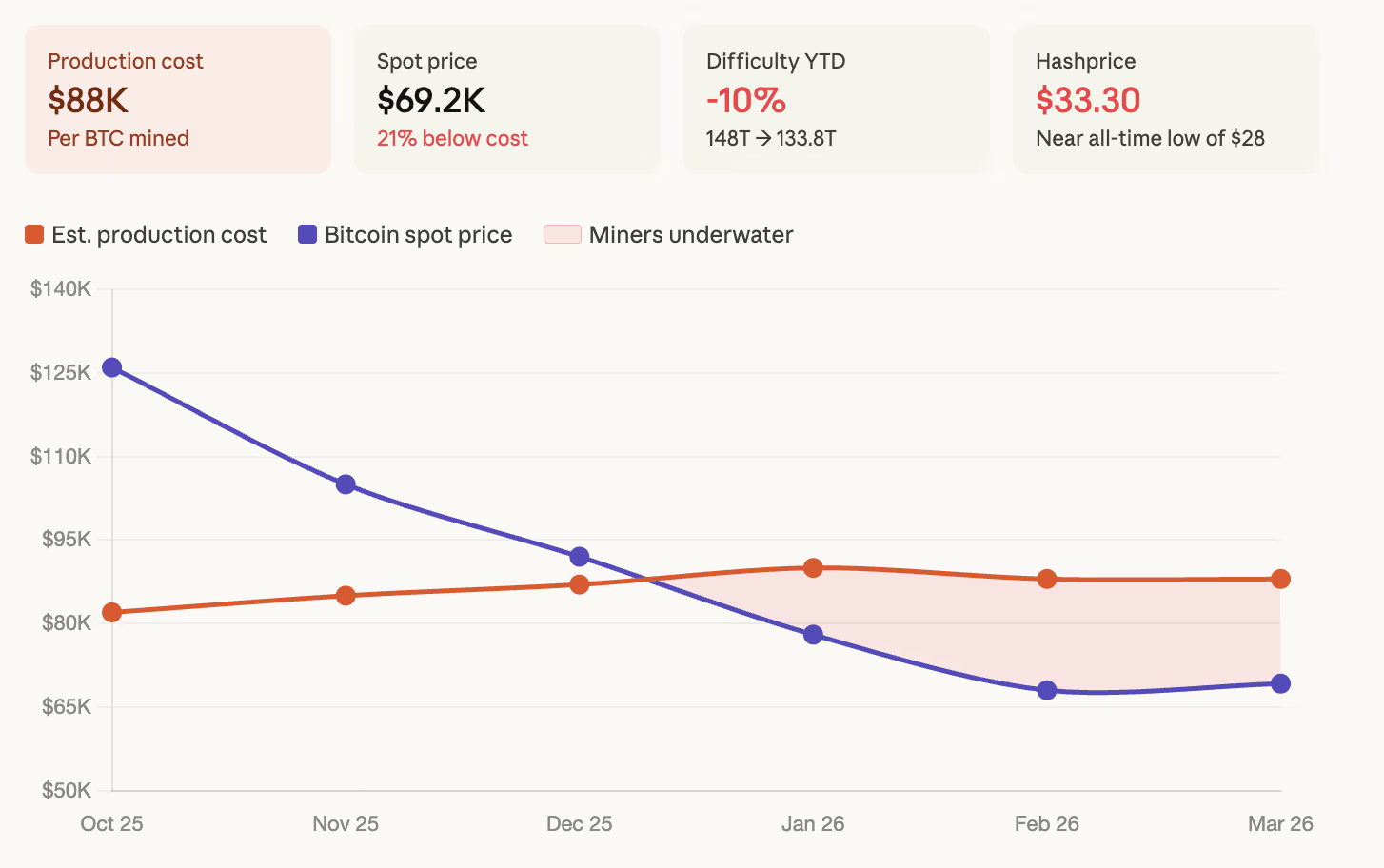
On-chain data platform Checkonchain’s “Difficulty Regression Model” (which estimates average production costs based on network difficulty and energy input) shows that as of March 13, the cost to mine one Bitcoin has surged to $88,000.

However, as of the time of writing, Bitcoin spot prices hover around $68,000. This means that for each Bitcoin mined, miners are incurring nearly a $20,000 loss; translating to a 21% loss per block mined.
Cost Storm and Geopolitical Double Blow: Oil Prices Breaking $100 as a Deadly Signal
Since Bitcoin’s peak of $126,000 in October last year, followed by a plunge below $70,000, miners’ profit margins have been continuously squeezed; recent conflicts in Iran have become the final straw crushing profitability.
International oil prices have broken through $100 per barrel, directly increasing the massive electricity costs required for mining. As a result, about 8% to 10% of global hash power—located in regions highly sensitive to Middle Eastern energy supply—are experiencing the most severe impact.
Adding to the woes, nearly halted is the commercial shipping through the Strait of Hormuz, which controls about 20% of global oil and gas transportation. Meanwhile, U.S. President Donald Trump issued a “48-hour ultimatum,” threatening to attack Iran’s power plants, triggering chain reactions in geopolitics that make miners’ situations even more precarious.
Online Data Sends Alarm: Hash Rate Loss and Block Time Delays
Signs of miners exiting the market are increasingly reflected in network indicators.
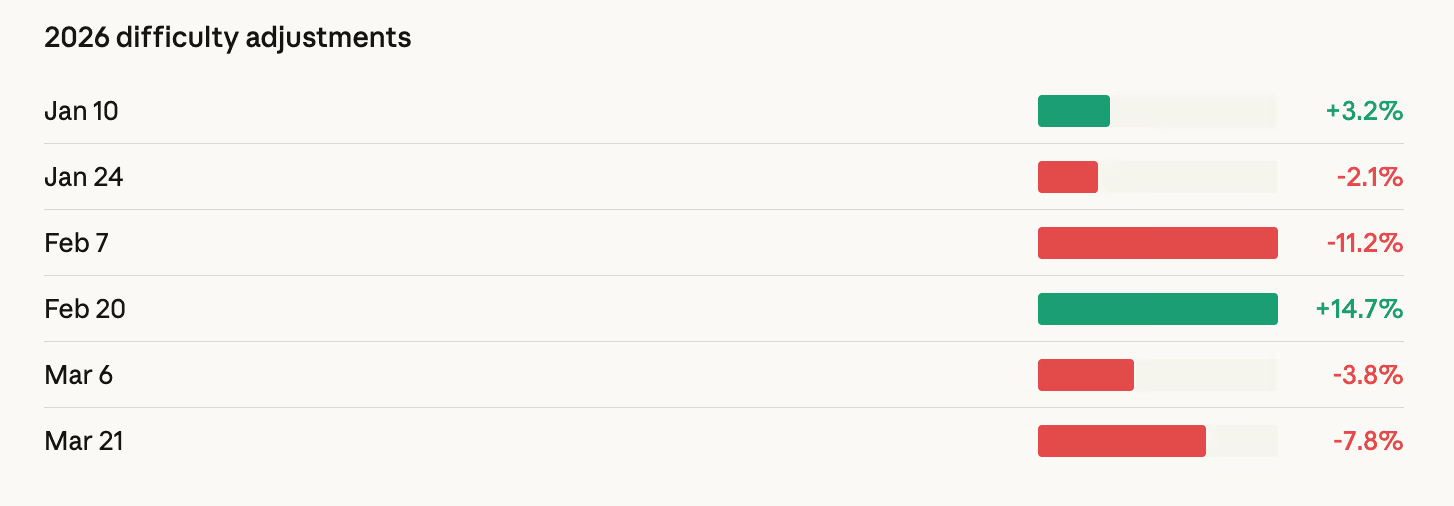
Bitcoin mining difficulty recently decreased by 7.76% to 133.79 T. This is the second-largest drop since 2026, following an 11.16% plunge in February caused by the “Fern” winter storm. Currently, Bitcoin mining difficulty is nearly 10% lower than at the start of the year and well below the November 2025 peak of nearly 155 T.
Additionally, total network hash rate has sharply retreated to about 920 EH/s, far below the impressive record of 1 Zetahash (1,000 EH/s) set in 2025.
The loss of hash power has led to an increase in average block time during the last difficulty adjustment cycle to 12 minutes and 36 seconds, far exceeding Bitcoin’s original 10-minute design target.
Selling Wave Emerges: Not Just Industry Crisis, but Structural Market Risk
According to the Hashprice index released by Luxor Pool, which measures miners’ expected revenue per unit of hash rate, the current “hash price” hovers around $33.30 per PH/s per day. This figure has nearly reached the breakeven point for most mining rigs, just one step away from the $28 low recorded on February 23.
When revenues fall short, the only survival strategy for miners is to “sell Bitcoin for cash.”
This forced liquidation undoubtedly adds heavy selling pressure to an already weak market. Currently, about 43% of Bitcoin holdings are in loss, with whales taking advantage of rebounds to sell high, and high leverage positions dominating price movements. In other words, miners are facing not only industry challenges but also increasingly influencing market structure.
Mining Companies Fight for Survival: Transitioning to AI and Hash Power Reallocation
Faced with the “mining at a loss every day” predicament, publicly listed mining companies are seeking diversification, extending their computational resources into artificial intelligence (AI) and high-performance computing (HPC) sectors to achieve more stable cash flows. Major players like Marathon Digital and Cipher Mining have begun expanding data centers on existing mining sites.
According to CoinWarz data, the next difficulty adjustment is expected in early April, likely to decrease further. If Bitcoin prices fail to return to the $88,000 mining cost threshold, this “miners’ exodus” will likely continue to spread.
Disclaimer: The information on this page may come from third parties and does not represent the views or opinions of Gate. The content displayed on this page is for reference only and does not constitute any financial, investment, or legal advice. Gate does not guarantee the accuracy or completeness of the information and shall not be liable for any losses arising from the use of this information. Virtual asset investments carry high risks and are subject to significant price volatility. You may lose all of your invested principal. Please fully understand the relevant risks and make prudent decisions based on your own financial situation and risk tolerance. For details, please refer to
Disclaimer.
Related Articles
ETH/BTC Price Ratio Rebounds to 0.0313 in Q1 2026 as Ethereum User Base Surges 82%
In Q1 2026, the Ethereum-to-Bitcoin price ratio reached a three-month high at 0.0313. Ethereum added 284,000 users and surpassed $180 billion in stablecoin supply. Bitcoin remained strong above $74,000, driven by significant ETF inflows.
GateNews35m ago
Why is Bitcoin up today? Trump says Iran is seeking a truce, and risk assets move higher across the board
On April 15, Bitcoin rebounded about 6% after Trump said Iran is seeking to reach an agreement, breaking above $75,000. Expectations for the resumption of U.S.-Iran negotiations warmed up, lifting Asian stock markets. Technically, roughly $6 billion worth of short positions were forced to close, accelerating the rebound. Analysts said that if the U.S.-Iran situation continues to ease, Bitcoin could break through $80,000, and they predicted it may reach $150,000 by year-end.
MarketWhisper4h ago
Bitmine is promoted to the NYSE main board! Tom Lee: US stocks may be at a bottom, and selling pressure on Ether could ease
Bitmine officially transferred from the NYSE American market to the main board, marking a significant milestone for the company. Despite a sharp drop in its share price, it still increased the share repurchase program to $4 billion. The company holds a large amount of Ether, and expects that a rebound in the crypto market will help improve its assets and share price performance.
CryptoCity4h ago
ETH 15-minute up 0.66%: On-chain large transfers in sync drove a net inflow of funds, boosting spot buying pressure
2026-04-15 00:00 to 00:15 (UTC), ETH shows a local anomaly. The 15-minute return rate is +0.66%. The trading price range is 2321.93–2343.2 USDT, with a range of 0.92%. During this period, market attention increased, volatility slightly intensified, buy pressure in the order book shifted upward in the short term, and quickly pushed spot prices up into a key resistance area.
The main drivers of this anomaly are large on-chain transfers and inflows of capital in combination. At the beginning of the window, multiple large ETH transfers appeared, including 8,676 ETH and 6,551 ETH, respectively, transferring from a large source to the
GateNews5h ago
BTC 15-minute drop of 0.54%: Liquidity worsens and whales actively reduce positions, putting short-term pressure on the market
From 22:15 to 22:30 (UTC) on 2026-04-14, BTC saw a short-term pullback of 0.54% within the high-range band of 73911.6 - 74314.4 USDT, with a return of -0.54%. During this period, market swings were evident, volatility intensified, attention from the market quickly increased, and downward pressure on the order book was prominent.
The main drivers behind this unusual move were the continued deterioration of market liquidity and a clear lack of order book depth, which made the BTC price extremely sensitive to large sell orders. At the same time, during the key time window, whale wallets carried out large transfers and also engaged in active de-risking,
GateNews7h ago
ETH 15-minute drop of 0.61%: Sell orders concentrate and release while bearish sentiment intensifies, increasing downward pressure
2026-04-14 22:15 to 2026-04-14 22:30 (UTC) during this period, on the 15-minute K-line, ETH recorded a -0.61% return, with a price range of 2313.68 to 2328.54 USDT and a fluctuation of 0.64%. During this period, market attention increased, trading volume expanded noticeably, and heightened short-term volatility sparked strong interest in the subsequent trend.
The main drivers behind this unusual move are the concentrated release of sell orders and continued net outflows of on-chain funds. Specifically, the sell volume share rose to 52%, higher than the buy side at 48%, indicating heavy selling pressure
GateNews7h ago


