Author: Deep Tide TechFlow
Everyone around the world is talking about AI, but the discussions about crypto have quieted down quite a bit.
Meanwhile, ETH has been hovering around 2000 for nearly two months. Vitalik’s words and actions seem to have less impact than before.
However, recently I checked his X account and found that AI’s influence on him is more than just us. Over the past month, a large portion of what he posted relates to AI, even down to specific technical solutions.
The most noteworthy is a proposal he co-published on ethresear.ch on February 11 with Davide Crapis, the head of AI at the Ethereum Foundation, titled “ZK API Usage Credits.”
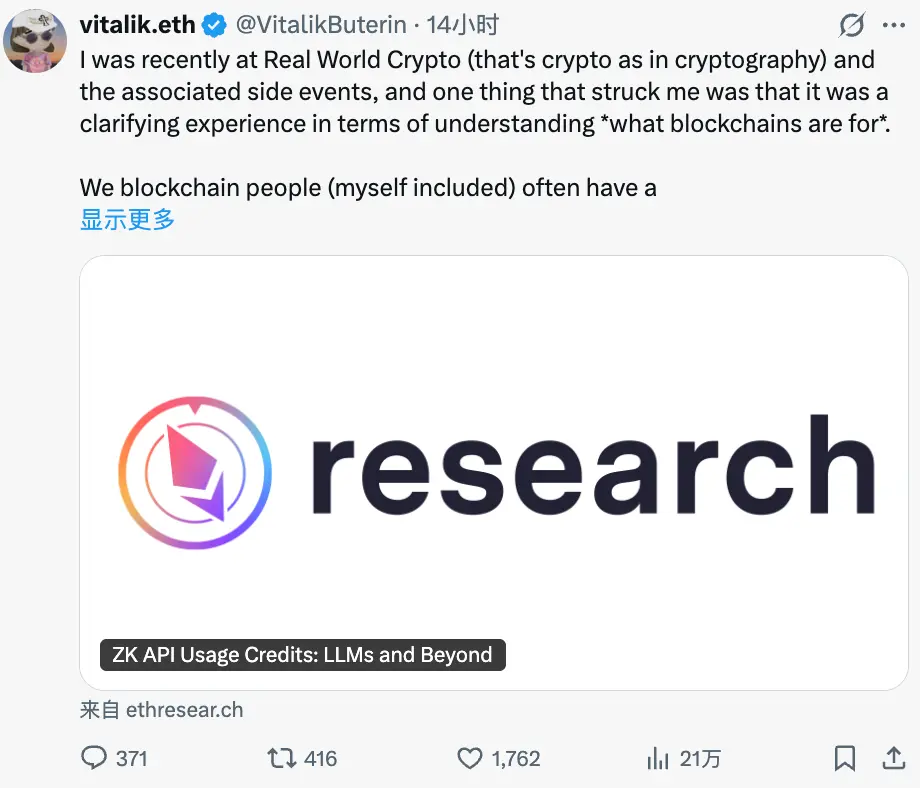
In a nutshell: Using zero-knowledge proofs to enable anonymous access to large AI models.
Currently, whether you’re using ChatGPT or calling Claude’s API, there’s only one way to pay:
Register an account, link an email, link a credit card.
Every conversation or prompt you send, the platform knows it’s you. What you asked, when you asked, how many times — all tied to your real identity.
Vitalik and Crapis’ proposal offers an alternative.
- Users deposit a sum into a smart contract, e.g., 100 USDC.
- The contract registers this deposit on an encrypted list on the blockchain. Afterwards, each API call doesn’t require revealing identity—just generate a zero-knowledge proof.
- It can prove to the service provider two things: that you’re on the list, and that your balance is sufficient. But the proof itself doesn’t reveal which one on the list you are.
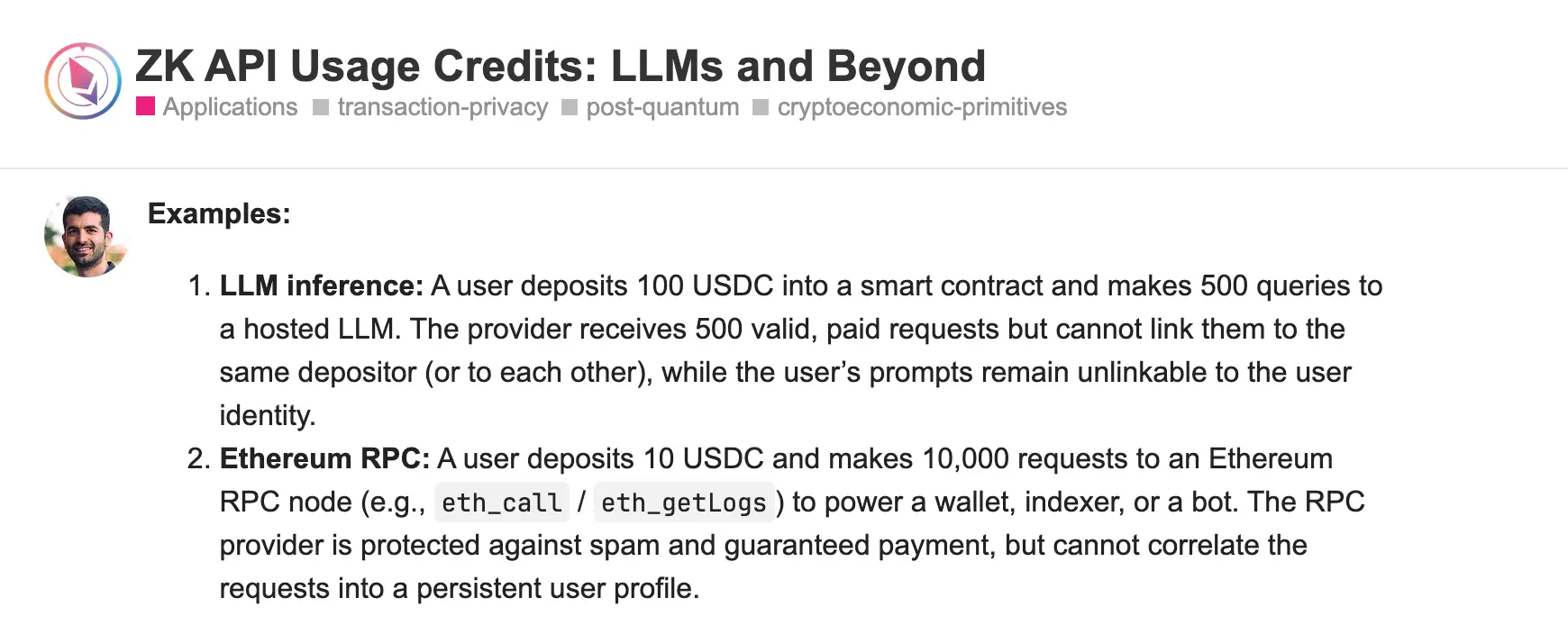
The service provider receives the payment and can prevent abuse, but from start to finish, they don’t know who you are.
You can interpret this proposal as a statement: Vitalik believes that in the AI era, users shouldn’t have to give up their identity to use an AI tool.
This proposal is still in the research phase and not yet practical. Major AI model providers might not agree with this approach; also, the comment section is full of rebuttals and doubts, arguing that AI companies will always find ways to identify users.
But I think the significance of this proposal isn’t solely whether it can be implemented.
Privacy has been a ten-year focus for Vitalik. From early support for Tornado Cash to promoting zero-knowledge proofs as a core Ethereum technology, this thread has never been broken. Yet in recent years, privacy in the crypto industry has lacked a compelling story to carry it forward.
AI has filled that gap. When you talk to large models more than anyone else, privacy becomes a real need.
Vitalik Embraces AI
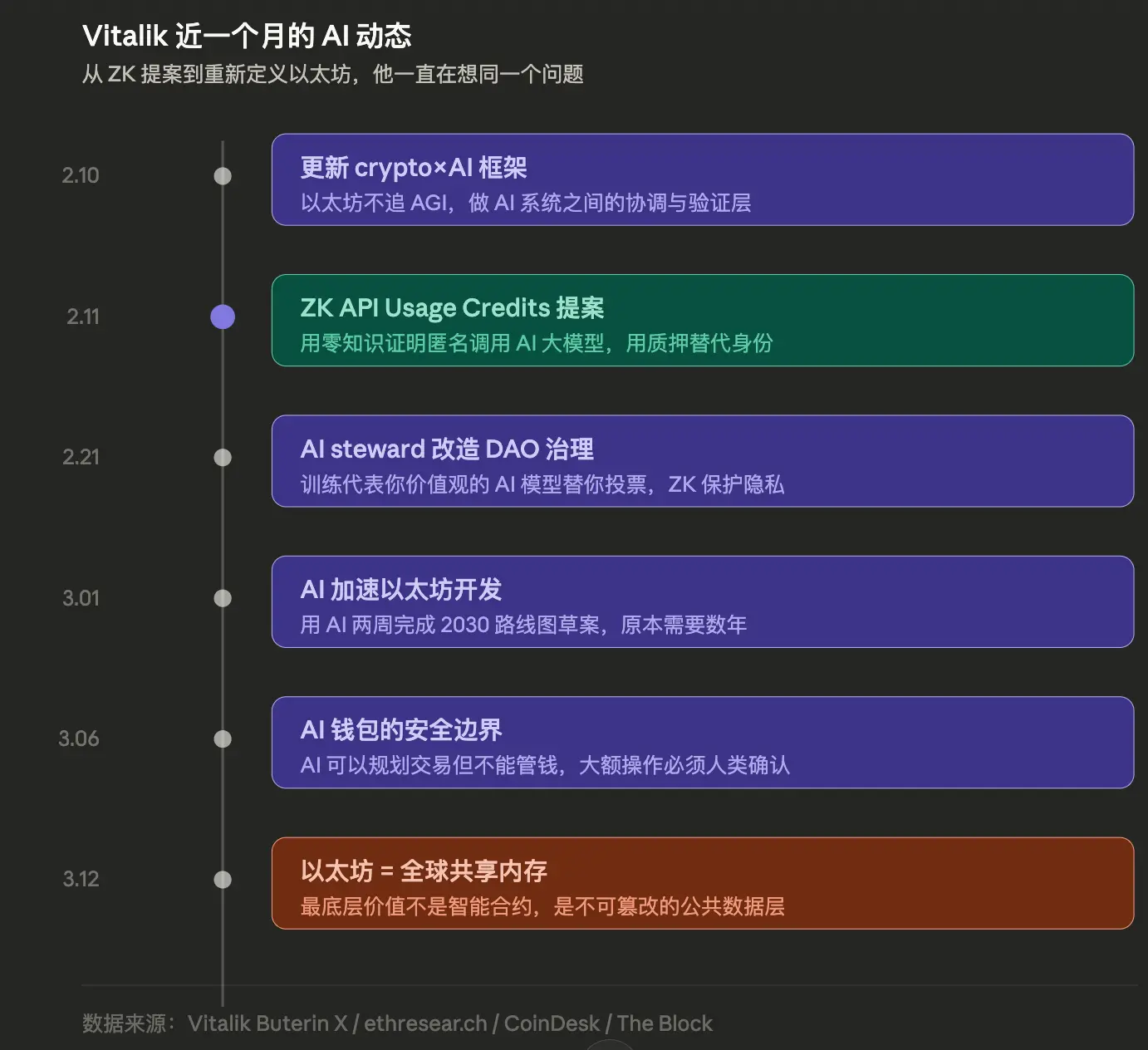
Since February, a significant portion of what Vitalik posts on X relates to AI, with such frequency that it doesn’t seem casual.
Yesterday, he posted a long message saying he recently attended a cryptography conference where people cared about privacy, open source, anti-censorship… but had no emotional connection to blockchain.
Among that crowd, he conducted a thought experiment:
Forget “we are the Ethereum community,” start from zero, and think about where Ethereum is most useful.
His conclusion: the fundamental value of Ethereum is as a bulletin board. A place anyone can write, anyone can read, no one can modify or delete.
In the context of AI, this might be the most important statement Vitalik has made in the past two years.
We are entering an era where AI can generate infinite cheap content. Text, images, videos, identities—all mass-produced by AI. When everything can be forged, what becomes scarce?
All these questions ultimately point to the same place: a public, persistent, irreversible data layer. And a record that no one can tamper with is exactly what Ethereum can provide.
Over the past two years, criticisms of Ethereum can be summarized as: what do you have that others can’t replace?
Looking now, Vitalik hasn’t directly answered this question.
However, over the past year, the Ethereum Foundation has done a few seemingly small things: assembled a 50-person privacy team, established a nearly 50-person privacy research group, released the Kohaku privacy framework, and appointed an AI lead; the 2026 roadmap prioritizes institutional privacy and faster transaction confirmation.
Looking back at his intense output over the past month, most of it revolves around privacy and efficiency issues for Ethereum in the AI context.
I believe Vitalik is betting on one thing: the more powerful AI becomes, the more rigid the demand for privacy and verification infrastructure will be. Whether Ethereum can meet this demand is another matter, but he has clearly chosen his table.
ETH is still hovering around 2000. Most people still aren’t paying much attention to what he’s been saying lately.
But perhaps in a few years, when we look back, what truly matters is what’s happening right now.
Disclaimer: The information on this page may come from third parties and does not represent the views or opinions of Gate. The content displayed on this page is for reference only and does not constitute any financial, investment, or legal advice. Gate does not guarantee the accuracy or completeness of the information and shall not be liable for any losses arising from the use of this information. Virtual asset investments carry high risks and are subject to significant price volatility. You may lose all of your invested principal. Please fully understand the relevant risks and make prudent decisions based on your own financial situation and risk tolerance. For details, please refer to
Disclaimer.
Related Articles
BlackRock Bitcoin ETF pulls in 612 million yuan over seven days, and investors keep adding to their positions despite losses
Data from April 13 shows that weekly net inflows into Bitcoin spot ETFs reached $786 million. Of this, BlackRock’s IBIT accounted for $612 million alone, indicating market concentration. Although IBIT investors are facing paper losses, they continue to add to their positions, reflecting an institutional strategy of lowering the average cost through averaging. For other crypto assets, Ethereum ETF inflows were $187 million, XRP fund inflows were $12 million, and Solana products saw outflows of $6 million.
MarketWhisper1h ago
ETHGas and ether.fi Announce $3B Deal to Build Institutional Blockspace Markets on Ethereum
ETHGas and ether.fi have entered a $3 billion agreement to enhance Ethereum blockspace markets. ether.fi will allocate 40% of its ETH holdings to ETHGas’ High Performance Staking Service, enabling future block inclusion rights trading and new yield opportunities.
GateNews1h ago
ETH/BTC Price Ratio Rebounds to 0.0313 in Q1 2026 as Ethereum User Base Surges 82%
In Q1 2026, the Ethereum-to-Bitcoin price ratio reached a three-month high at 0.0313. Ethereum added 284,000 users and surpassed $180 billion in stablecoin supply. Bitcoin remained strong above $74,000, driven by significant ETF inflows.
GateNews1h ago
Ethereum Social Protocol EFP Integrates with Etherscan, Enabling ENS and On-Chain Social Data Display
EFP, an Ethereum-based social protocol, has integrated with Etherscan, enabling users to view ENS domain names, avatars, and social data through the "Cards" tab on account pages, including follower counts and profiles.
GateNews2h ago
Gate’s “Crazy Wednesday” is live with a hot launch. Complete tasks to win XRP and Glenfiddich whisky. For USDT savings, earn up to 100% APY. For BTC/ETH/SOL staking, earn up to 16% mining APY.
Gate News message, according to Gate’s official announcement on April 15, 2026
Gate launches a “Crazy Wednesday” campaign, running from April 15, 2026 at 14:00 to April 19, 2026 at 16:00 (UTC+8). Users complete multiple tasks to unlock mystery boxes, with a chance to win XRP tokens and Glenfiddich whisky. The mystery box tasks include multiple categories such as flash swaps, spot, and futures trading, as well as top-ups, invitations, and VIP upgrades, and each tier corresponds to a different number of mystery box openings.
Campaign Two launches a USDT wealth-management product, with a 14-day fixed-term annualized yield of 6%. New users can also participate in a 3-day product offering 100% annualized yield. In addition, Yu’e Bao also offers multi-currency wealth-management options such as USAT, USDD, 0G, and APT, with annualized returns of up to 300%. Campaign Three introduces a boosted rewards policy for staking users, offering up to a 16% annualized return for staking BTC, ETH, and SOL; for SOL staking, staking 0–1 coins can yield up to 16% annualized.
GateAnnouncement2h ago
Bitmine Quarterly Report: ETH Staking Income Grows 7x, but a Price Drop Turns into a $3.8 Billion Quarterly Loss
Bitmine Immersion Technologies’ 10-Q quarterly report, released on April 14, shows that as of February 28, 2026, although its revenue grew by 7 times to $11.04 million, it recorded unrealized losses of $3.78 billion due to a decline in the price of ETH, resulting in a net loss of $3.82 billion for the quarter. The company is shifting from traditional mining to an ETH treasury management strategy, emphasizing growth in staking income while also facing price volatility risk.
ChainNewsAbmedia2h ago


