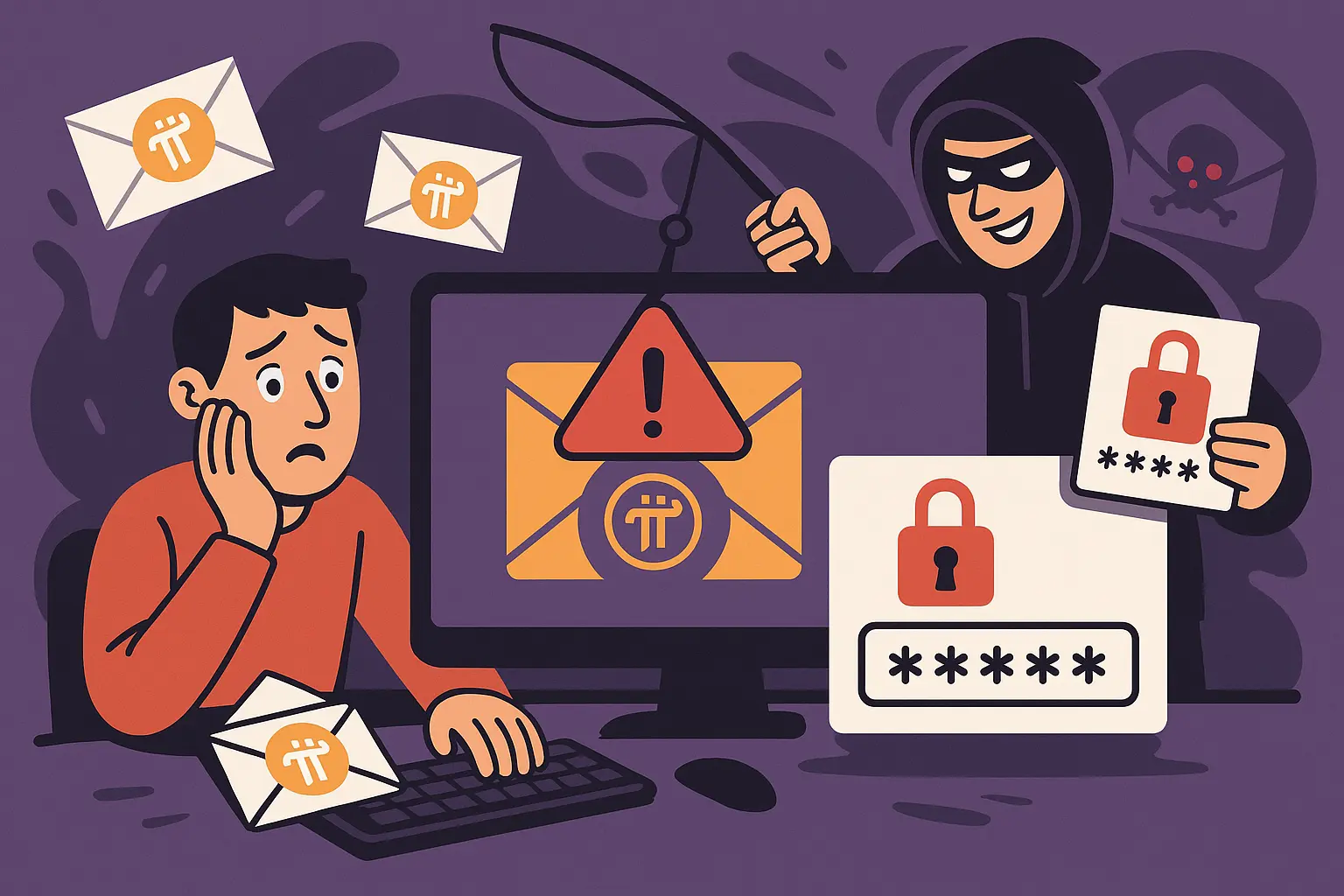
Pi Network issues a scam warning, emphasizing that they will never ask for passwords or phrases via email. After 2.5 million users have unblocked their accounts, scammers are impersonating the official team to send fake migration emails to steal private keys. Fingerprint authentication Beta testing has begun, and in the coming weeks, 700,000 users will be able to submit KYC. The official team urges users to only check messages through the Pi App and to avoid clicking unknown links.
Fake Migration Emails Target 2.5 Million Unblocked Users
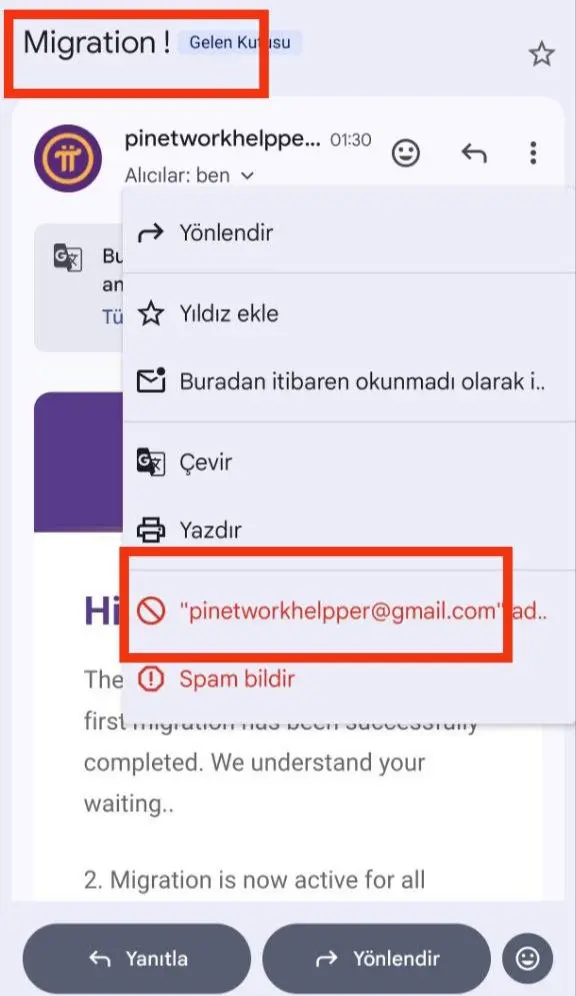
(Source: Pi Network Moderator)
Pi Network has once again issued a warning to its community today, reminding everyone to be vigilant against scam emails and false information. The Pi team states they will never contact users via email to perform wallet migrations, nor will they ask for passwords or phrases. As more users approach mainnet and complete KYC verification, this alert was issued. Scammers are attempting to copy official messages to trick users into giving up account access.
The Pi community states that Pi Network will not send emails regarding wallet migration, nor will it request private keys or password phrases. Any email claiming to perform such migrations is a scam. The Pi team points out that some scammers impersonate customer service staff, sending seemingly legitimate links, but once users click and input information, their wallets are immediately compromised. Such phishing attacks are common in the crypto industry, but Pi Network users, unfamiliar with the migration process, are more vulnerable targets.
Because many users are migrating to the mainnet, scammers see an opportunity. They target users who are less familiar with the migration process. Typical scam emails use the Pi Network logo and official tone, claiming “Your account needs to migrate immediately” or “Failure to migrate within 24 hours will result in token loss,” creating urgency to prompt hasty actions. Links in these emails lead to carefully crafted fake websites that look almost identical to the official Pi Network site, but the URLs often have subtle differences.
Once users enter their password phrases or private keys on these fake sites, scammers gain full control of the wallet and can transfer all PI tokens out. Since blockchain transactions are irreversible, once tokens are transferred out, they are nearly impossible to recover. Over the past few months, hundreds of Pi users have reported falling victim to such scams, losing from thousands to tens of thousands of PI tokens.
Top 5 Ways to Identify Pi Network Scam Emails
Urgent tone: Claims that immediate action is required or accounts will be frozen or tokens lost
Asking for sensitive info: Requests for password phrases, private keys, or seed words
Suspicious links: Emails contain URLs that need to be clicked, often with slight domain differences from official sites
Grammar errors: Many scam emails are machine-translated, with obvious grammatical or spelling mistakes
Non-official sender addresses: Sender addresses are not from @minepi.com or other official domains
The Pi team urges users to only view messages through the official app. The official app is the only trusted source of information; any notifications about account status, migration progress, or KYC requests will only appear within the app. Additionally, the Pi team encourages community members to share scam awareness tips on platforms like Telegram, Discord, and Reddit to help protect new users from attacks.
Unblocking 2.5 Million Users & Fingerprint Authentication Beta Test
The recent update has lifted restrictions on 2.5 million previously limited Pioneer users for mainnet migration. These users have passed new security and compliance checks. If they remain active and meet relevant criteria, their account balances will automatically migrate to the mainnet. This marks a significant step in the Pi Network mainnet migration process, showing that the project is accelerating ecosystem maturity.
Unblocking these 2.5 million users is not a one-time event but occurs in batches. The Pi team states they will lift account restrictions gradually, with each batch requiring individual technical fixes and security verifications. This slow approach helps strengthen network defenses against abuse and prevents large influxes of fake or bot accounts onto the mainnet. Before each batch is unblocked, the system performs activity checks, anomaly detection, and compliance reviews to ensure only genuine users are approved.
In the coming weeks, over 700,000 users will be able to submit KYC forms. Some accounts may still require further review, depending on past activity and local laws. Pi Network’s KYC process requires users to submit identification documents and pass liveness detection to ensure “one person, one account” fairness. This process is crucial to prevent Sybil attacks (creating multiple accounts to farm tokens).
The fingerprint authentication feature has launched Beta testing to enhance liveness detection. Pi Network is testing a new fingerprint verification tool, adding an additional authentication method that does not replace all verification methods but is useful for extra security. Its goal is to improve privacy and reduce account theft.
The fingerprint verification works by scanning the user’s palm’s unique ridges and vein patterns, a biometric that is harder to forge than fingerprints and less invasive. It helps with account recovery and password resets; if users forget passwords or lose devices, they can regain access through fingerprint verification. In the future, this feature may also support two-factor authentication to add an extra layer of security.
Currently, only a small subset of KYC users can participate in testing. The team will analyze results before expanding the scope, evaluating technical stability, user experience, and privacy protection. Additionally, Pi Network states that rewards for KYC verifiers are being distributed as planned. The system is in testing, and if all goes well, rewards will be issued by the end of March 2026. These rewards aim to incentivize community members to assist in verifying other users’ KYC applications and accelerate the overall validation process.
Security First, Speed Second: Development Strategy
These updates reflect Pi Network’s dual nature. On one hand, growth: more users are joining the mainnet, and KYC slots are opening, expanding the ecosystem. On the other hand, security concerns: major updates often bring increased scam activity. The Pi team chooses to sacrifice some speed for higher security, a strategy that may be wiser in the long run.
Pi encourages users to rely solely on the app rather than private messages or emails. This principle is critical because scammers cannot infiltrate the official app to push fake messages but can easily forge emails and social media posts. As long as users stick to official app channels for information, most scams can be avoided. For Pi pioneers, this should be common sense: never click unknown links or share your password phrases, and regularly check for updates within the Pi App.
From a broader perspective, the scam issues faced by Pi Network mirror the wider challenges in the crypto industry. As a project moves from closed testing to a public mainnet, user numbers surge, and scammers follow suit. Pi Network has hundreds of millions of users, many of whom are new to crypto and lack awareness of scam tactics, making them more vulnerable. This user structure underscores the importance of security education.
As the network develops, security will become more important than speed. Pi’s slow but cautious approach, though frustrating some users, may prevent catastrophic security incidents seen in other projects. History shows that rapid expansion often neglects security, leading to hacks or scams. Pi clearly aims to avoid repeating these mistakes.


