Bitcoin (BTC) only recorded a modest 2.2% growth last month, but February could usher in a new positive phase. According to statistics since 2016, the week ending on February 21st typically yields the highest median returns, at 8.4%, with a probability of Bitcoin closing higher reaching up to 60%.
Seasonal Advantage of February and Its Impact on BTC
Economist Timothy Peterson from Network Economist states that February has always been one of the most stable growth months for Bitcoin, even outperforming the famous “Uptober” effect in Q4. According to Peterson, the main reason stems from macroeconomic factors rather than specific cryptocurrency market conditions.
Mid-February is when companies release their annual financial reports and forecast future business prospects, which are often optimistic. This boosts risk-taking investment sentiment, and part of the capital flow shifts into Bitcoin. Peterson emphasizes:
“The period from February 7-21 often records median returns of up to 7% per week!”
He also notes that the first three weeks of February play a crucial role in years of market correction. Bitcoin increased by 4% at the beginning of 2018, decreased by 3% in 2022, and fell by 5% in 2025—all years ending with prices lower than at the start of the year.
In the context of sustained high market volatility but showing signs of cooling down, Peterson believes Bitcoin is fully capable of a strong recovery if macro stress indicators like the CBOE Volatility Index (VIX) continue to decline.
Bitcoin Price Outlook for 2026 Remains Above $200,000
Bitcoin researcher Sminston With maintains an optimistic view of BTC’s long-term growth potential. Based on the Bitcoin Decay Channel model, With predicts that the peak price of Bitcoin in 2026 will be between $210,000 and $300,000. He states that although this model does not specify exact timing, its price ranges have proven reliable in the past.
This long-term perspective is further supported by momentum data. Sina, author of the Bitcoin Intelligence Report, states that Bitcoin’s momentum has shifted to positive despite recent sharp corrections.
Sina believes that accumulation since early January has helped maintain the overall cash flow structure. The recent sell-off coincided with the decline of the Nasdaq index after US tariff tensions re-emerged, indicating this is a timely reaction rather than an intrinsic sign of Bitcoin’s weakness.
XWIN Research also agrees that Bitcoin is still in an accumulation phase and has not shown a clear downward trend.
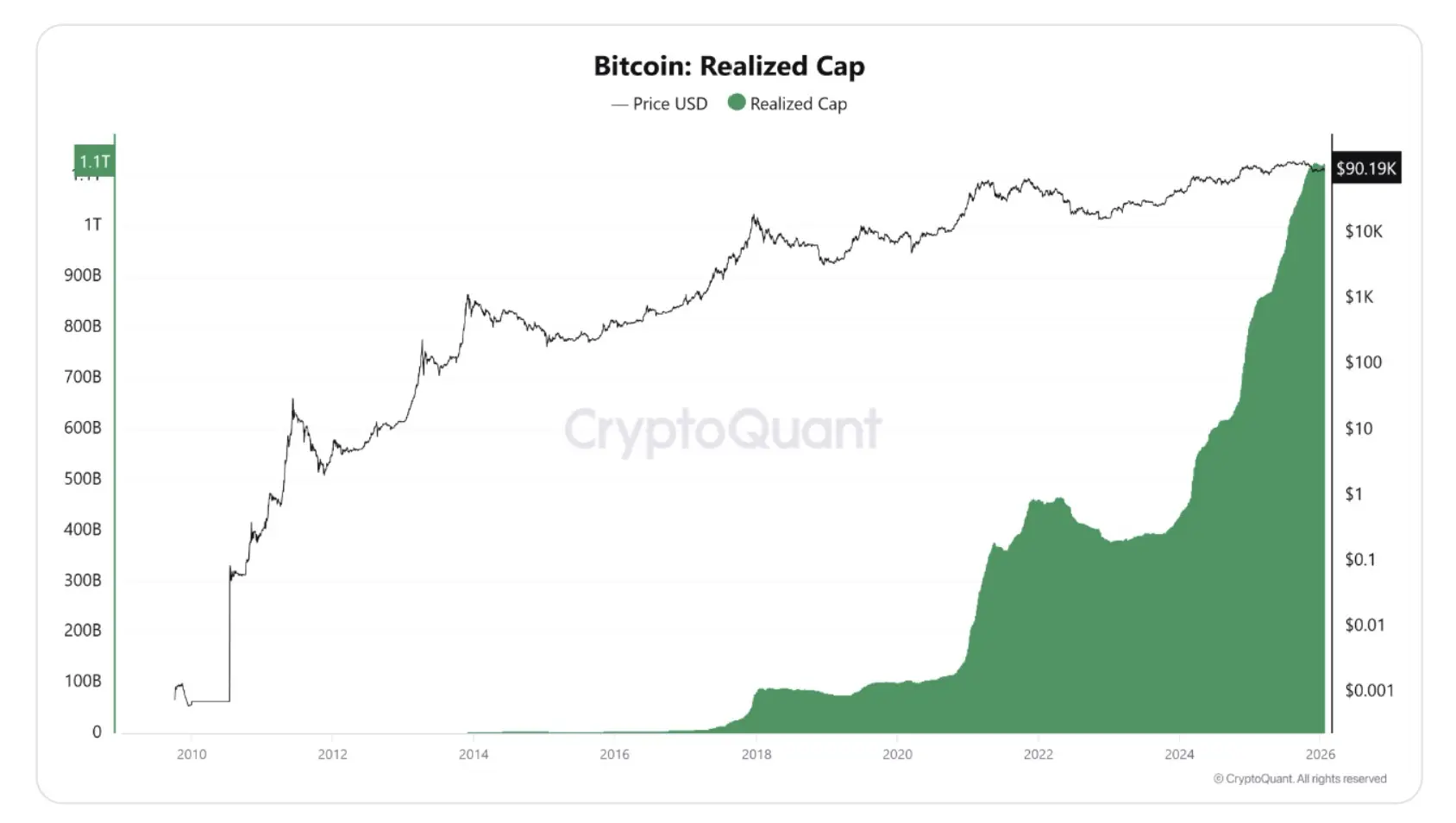 Real Market Capitalization of Bitcoin | Source: CryptoQuant Although rising long-term bond yields may limit valuation expansion, the Realized Cap index continues to increase, indicating that spot capital flow is still entering the system.
Mr. Giáo
Disclaimer: The information on this page may come from third parties and does not represent the views or opinions of Gate. The content displayed on this page is for reference only and does not constitute any financial, investment, or legal advice. Gate does not guarantee the accuracy or completeness of the information and shall not be liable for any losses arising from the use of this information. Virtual asset investments carry high risks and are subject to significant price volatility. You may lose all of your invested principal. Please fully understand the relevant risks and make prudent decisions based on your own financial situation and risk tolerance. For details, please refer to
Disclaimer.
Related Articles
X’s product lead hinted at launching a crypto product, and the market is speculating it may be related to X Money and Bitcoin.
X product owner Nikita Bier hints at a plan to launch a product aimed at fixing the encryption industry, drawing market attention. Speculation links it to X’s financial ecosystem expansion, possibly including features such as payments, digital wallets, and stablecoins. X’s official account has not yet made a formal response. Musk says the early public version of X Money will go live in April.
GateNews8m ago
Strategy will release its 2026 Q1 earnings report on May 5 and hold an online briefing.
Gate News update, April 14, Bitcoin Treasury company Strategy announced it will release its 2026 first-quarter financial results after the close of trading on U.S. stocks on May 5, 2026, and will hold a video earnings call at 17:00 Eastern Time that day to discuss the results.
GateNews52m ago
A publicly traded U.S. company, Hyperscale Data, increased its Bitcoin holdings to 644.76 BTC, for an estimated total market value of about $45.6 million
Hyperscale Data announced that its Bitcoin holdings have increased to 644.7581 BTC, with a total market value of approximately $45.6 million. Its wholly owned subsidiary, Sentinum, holds 597.5324 BTC; the Bitcoin was acquired through market purchases and mining. Another subsidiary, ACG, purchased approximately 47.2257 BTC.
GateNews1h ago
An ETF under BlackRock transferred about 884 BTC and 604 ETH to a certain custodial platform
Gate News message, on April 14, Arkham monitoring shows that about an hour ago, BlackRock, via its spot Ethereum exchange-traded fund ETHA, transferred 604.044 ETH to a certain CEX custodian service, worth $1.44 million; it transferred 884.142 BTC to the same custodian service, worth $65.95 million, via its spot Bitcoin exchange-traded fund IBIT.
GateNews1h ago


