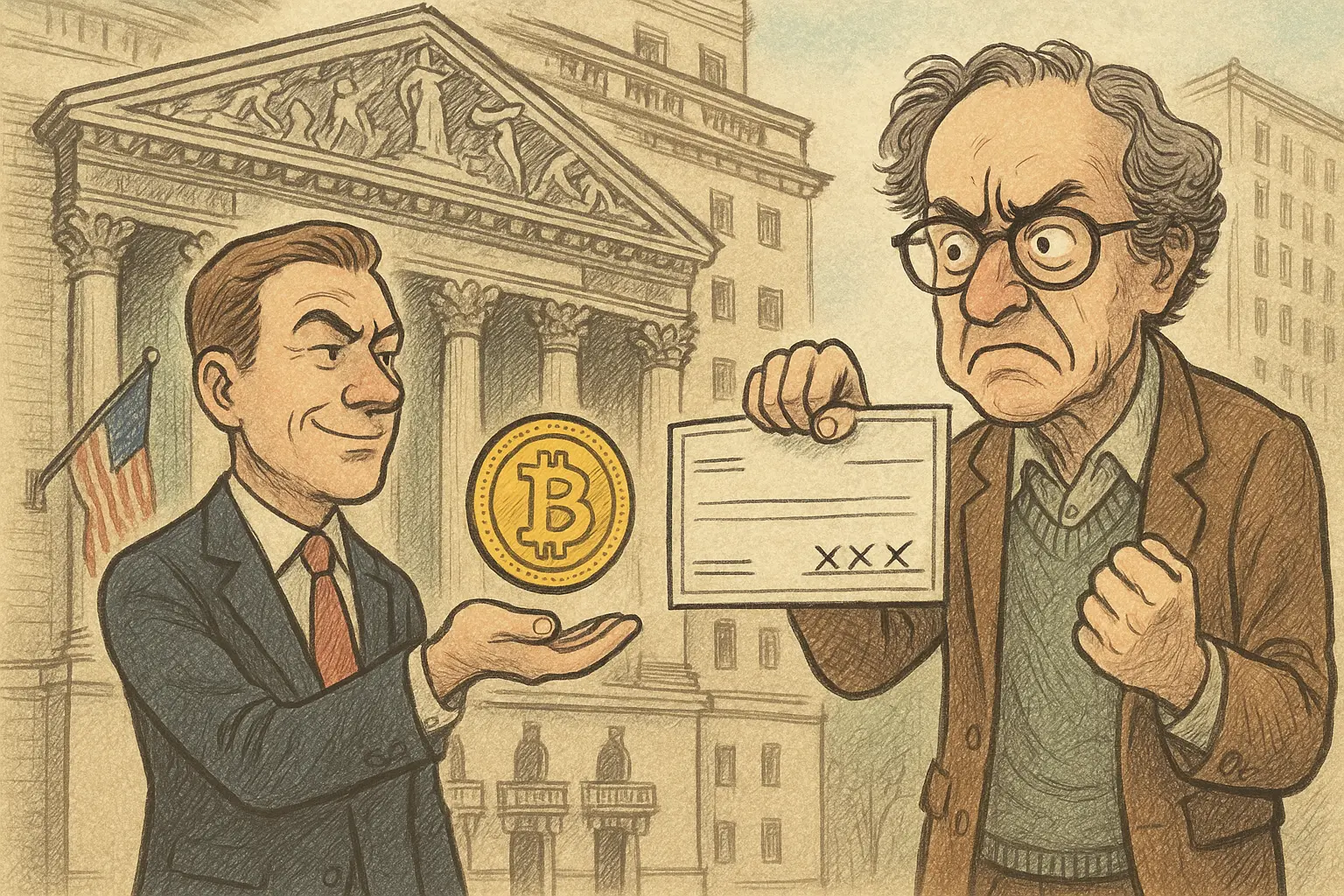
The New York Stock Exchange announces a blockchain tokenization plan to enable 24/7 trading and real-time settlement of stocks and ETFs. Columbia Business School professor Omid Malekan criticizes it as “like a bounced check,” lacking details such as which blockchain to use and whether permission is required, and points out that the NYSE’s “oligopolistic structure” conflicts with the spirit of tokenization. Despite ongoing skepticism, the industry remains supportive, with ARK Invest predicting the RWA market will grow from $22.2 billion to $11 trillion.
NYSE Blockchain Plan Criticized as a Bounced Check by Columbia Professor
On Monday, NYSE and its parent company Intercontinental Exchange announced that the platform will implement 24/7 trading and real-time settlement for stocks and exchange-traded funds through a blockchain transaction post-trade system, including multi-chain support and custody features. This plan is seen as a significant milestone for traditional finance embracing blockchain technology, as NYSE is one of the world’s largest stock exchanges. Its involvement is expected to bring substantial trust and liquidity to the tokenized securities market.
However, Columbia Business School professor Omid Malekan expresses concerns over the lack of details in NYSE’s blockchain project for real-world asset tokenization, fearing it may contradict the ethos of cryptocurrencies. On Tuesday, Malekan posted on X that NYSE’s announcement sounds like a “bounced check,” with many questions still unanswered.
Core Questions Raised by Malekan Include
Which blockchain: NYSE has not specified which blockchain will be used—Ethereum, Solana, or a proprietary chain?
Permission model: Will tokens be permissioned, permissionless, or a hybrid?
Economic model: What will the tokenomics and fee structure look like?
Technical architecture: How will multi-chain support be achieved? How will cross-chain interoperability be ensured?
“Concept products” refer to those that have been announced and heavily promoted but do not yet exist in functional form, often lacking concrete details on implementation. Malekan believes NYSE’s business model is rooted in a “highly centralized and oligopolistic structure,” and in a commentary in Fortune magazine, he added that unless NYSE abandons its relationships with numerous partners, no amount of computer science or cryptography can change this fact.
Does NYSE Tokenization Contradict Decentralization?
Malekan compares NYSE’s move to the late 1990s attempt by American telecom giant AT&T to dominate the early internet, noting that pioneering a technological era does not guarantee continued leadership in the next. This historical analogy is highly instructive: AT&T was the absolute dominant player during the telephone era but lost its leading position in the internet age because the decentralized nature of the internet fundamentally conflicted with AT&T’s centralized business model.
“Tokenization represents a fundamentally different architecture. It requires different skills and business models to work,” he wrote on X, summarizing that he cannot see how NYSE-focused blockchain tokenization will ultimately succeed. His core argument is that NYSE’s value derives from its role as a centralized marketplace, controlling trade matching, clearing, settlement, and regulatory compliance.
But the essence of blockchain tokenization is decentralization: transactions can be peer-to-peer, with instant clearing and settlement, without a centralized exchange acting as an intermediary. If NYSE truly embraces the decentralization spirit of blockchain, it would disrupt its own business model. If it merely uses blockchain technology to optimize its existing centralized architecture, then this “tokenization” is merely a name without substance.
This concern is not unfounded. When traditional financial institutions attempt to adopt blockchain technology, they often fall into a “both-and” dilemma: wanting the efficiency and transparency of blockchain while maintaining existing control and business models. This contradiction often results in products that are “centralized databases dressed up as blockchain,” losing the core advantages of the technology.
Industry Supports NYSE’s Plan to Change the Game
Despite Malekan’s skepticism, other industry observers believe that NYSE’s tokenization plan is overall positive for the blockchain industry. “On-chain trading of NYSE-native tokenized stocks, without packaging, derivatives, or tokenized rights, looks promising,” said Carlos Domingo, founder and CEO of RWA tokenization platform Securitize, on Tuesday.
Domingo’s view reflects a pragmatic approach within the crypto industry. They believe that even if NYSE’s implementation is not “pure,” as long as it promotes mainstream adoption of tokenized securities, it is a positive step. Securitize itself is a company focused on securities tokenization, and NYSE’s entry will attract significant attention and capital flow into the entire RWA sector.
“It’s time to leverage the most advanced technology,” added Alexander Spiegelman, research director at Aptos Labs. His comment implies that regardless of NYSE’s specific approach, its willingness to explore blockchain technology is commendable. The participation of traditional financial institutions will accelerate the maturation and standardization of blockchain technology.
Supporters also emphasize network effects. NYSE has thousands of listed companies and trillions of dollars in market cap. If these assets can be tokenized and traded on blockchain, it will bring enormous liquidity and application scenarios to the entire crypto ecosystem. Even if NYSE’s approach is centralized, it paves the way for more decentralized solutions in the future.
ARK Invest Predicts Tokenized Market to Reach $11 Trillion
ARK Invest forecasts that, driven by clearer regulation and improved institutional-grade infrastructure, the RWA tokenization market will grow from $22.2 billion in 2023 to $11 trillion by 2030. This prediction provides a macro context for NYSE’s tokenization plan: tokenization is not a niche experiment but a core trend in future financial infrastructure.
Growing from $22.2 billion to $11 trillion represents approximately a 50-fold increase, with a compound annual growth rate exceeding 100%. This growth projection relies on multiple assumptions: gradual regulatory improvements, large-scale adoption by institutional investors, mature technological infrastructure, and traditional asset holders recognizing the value proposition of tokenization.
NYSE’s involvement could be a key catalyst for realizing this forecast. As one of the most influential stock exchanges globally, NYSE’s endorsement will alleviate many institutional investors’ concerns about tokenized securities.
Disclaimer: The information on this page may come from third parties and does not represent the views or opinions of Gate. The content displayed on this page is for reference only and does not constitute any financial, investment, or legal advice. Gate does not guarantee the accuracy or completeness of the information and shall not be liable for any losses arising from the use of this information. Virtual asset investments carry high risks and are subject to significant price volatility. You may lose all of your invested principal. Please fully understand the relevant risks and make prudent decisions based on your own financial situation and risk tolerance. For details, please refer to
Disclaimer.


