The U.S. Senate withdraws the “Market Structure Bill,” XRP drops 6.2% from $2.19 to $2.05, with legislation delayed until summer. Coinbase’s withdrawal of support highlights XRP’s sensitivity to regulation. Despite setbacks, it held above the 50-day moving average and $2 support, with ETF inflows totaling $1.27 billion supporting medium-term $3 and long-term $3.66 targets.
Overview of the Withdrawal of the Market Structure Bill and Legislative Delay
The U.S. Senate Banking Committee canceled the scheduled voting on the “Market Structure Bill,” potentially delaying much-needed cryptocurrency legislation until summer. Chairman and Senator Tim Scott announced this, stating that the bill reflects months of bipartisan negotiations and incorporates constructive input from innovators, investors, and law enforcement.
Following Coinbase’s withdrawal of support, the Senate Banking Committee postponed the review and vote. Coinbase CEO Brian Armstrong criticized the draft bill, saying it’s better not to introduce a poor bill than to push one out. Armstrong emphasized key issues:
Key Controversies of the Bill
· Essentially bans tokenized equity
· DeFi ban grants the government unlimited access to financial records
· Weakens the U.S. Commodity Futures Trading Commission (CFTC) authority, stifling innovation
· Proposed amendments would eliminate stablecoin reward mechanisms and allow banks to prohibit competitors
The banking committee’s review and vote were also delayed, after the U.S. Department of Agriculture postponed its review to January 27. Affected by legislative developments, XRP’s price fell from a high of $2.1903 on January 14 to a low of $2.0538 on January 15, down 6.2%, while BTC also declined 2.8%, indicating XRP’s higher sensitivity to regulatory news.
Coinbase’s Withdrawal of Support Sparks XRP Regulatory Sensitivity
Given Ripple’s prolonged legal battle with the U.S. Securities and Exchange Commission (SEC), XRP remains highly sensitive to regulatory developments. As background, on July 17, after the U.S. House passed the Market Structure Bill and submitted it to the Senate, XRP surged 14.69%, while Bitcoin (BTC) only rose 0.39% that day. Subsequently, influenced by the Federal Reserve’s Federal Open Market Committee announcing a review, XRP’s price increased 33.4% from December 31, reaching a high of $2.4151 on January 6.
Thursday’s price movement highlights XRP’s sensitivity to crypto regulation dynamics. This sensitivity stems from the years-long legal dispute between Ripple and SEC. Although a July 2023 court ruling stated XRP sales in secondary markets do not constitute securities, institutional sales were still deemed securities offerings. This legal ambiguity amplifies the impact of any regulatory legislative progress on XRP’s price.
Despite recent pressures, a positive aspect is that U.S. legislators quickly responded to Coinbase’s criticism by withdrawing support. Senator Bill Hagerty expressed confidence that consensus will be reached soon, and mutually acceptable products will be launched. This swift response demonstrates lawmakers’ attention to industry opinions and creates space for more reasonable future legislation.
While recent regulatory setbacks pose challenges, the short-term outlook remains cautiously optimistic, with a positive medium-term view. Capital inflows into the U.S. XRP spot ETF market and XRP’s increasing real-world utility tilt supply and demand favorably. The ongoing progress of the Market Structure Bill remains a key variable, but the current delay is not a complete rejection, rather a pause to craft a version better aligned with industry expectations.
ETF Capital Inflows Provide Strong Support Against Legislative Setbacks
Since its launch in November last year, the U.S. XRP spot ETF has accumulated net inflows of $1.27 billion. In comparison, the U.S. SOL spot ETF, launched in October last year, has net inflows of $864.77 million, while the U.S. BTC spot ETF has experienced net outflows of $1.26 billion since the XRP ETF’s debut.
This contrast is compelling. The inflow of XRP spot ETFs not only surpasses the SOL ETF launched in the same period but also remains strong despite net outflows from BTC ETFs. This indicates institutional investors’ demand for XRP holdings is based on long-term value recognition rather than mere speculation. The $1.27 billion inflow equates to roughly 600 million XRP tokens, a significant proportion of the current circulating supply.
Key Data Comparison for XRP News Today
XRP Spot ETF Cumulative Inflows: $1.27 billion
SOL Spot ETF Cumulative Inflows: $864.77 million
BTC Spot ETF Net Outflows: $1.26 billion
The robust capital inflows into the U.S. XRP spot ETF support investor optimism regarding crypto legislation and practical utility, forming a key medium-term bullish indicator. The persistence of ETF capital inflows is more meaningful than single-day inflows; currently, XRP ETFs show steady demand patterns, often a sign of limited downside potential.
From a supply-demand perspective, XRP purchased via ETFs is typically locked in custodial accounts long-term, reducing circulating supply in the market. When legislative setbacks cause short-term selling pressure, continuous ETF buying acts as a natural buffer. This explains why XRP, despite a 6.2% decline, has not experienced panic selling, and the $2 support level remains intact.
Technical Support Levels and Multiple Price Scenarios
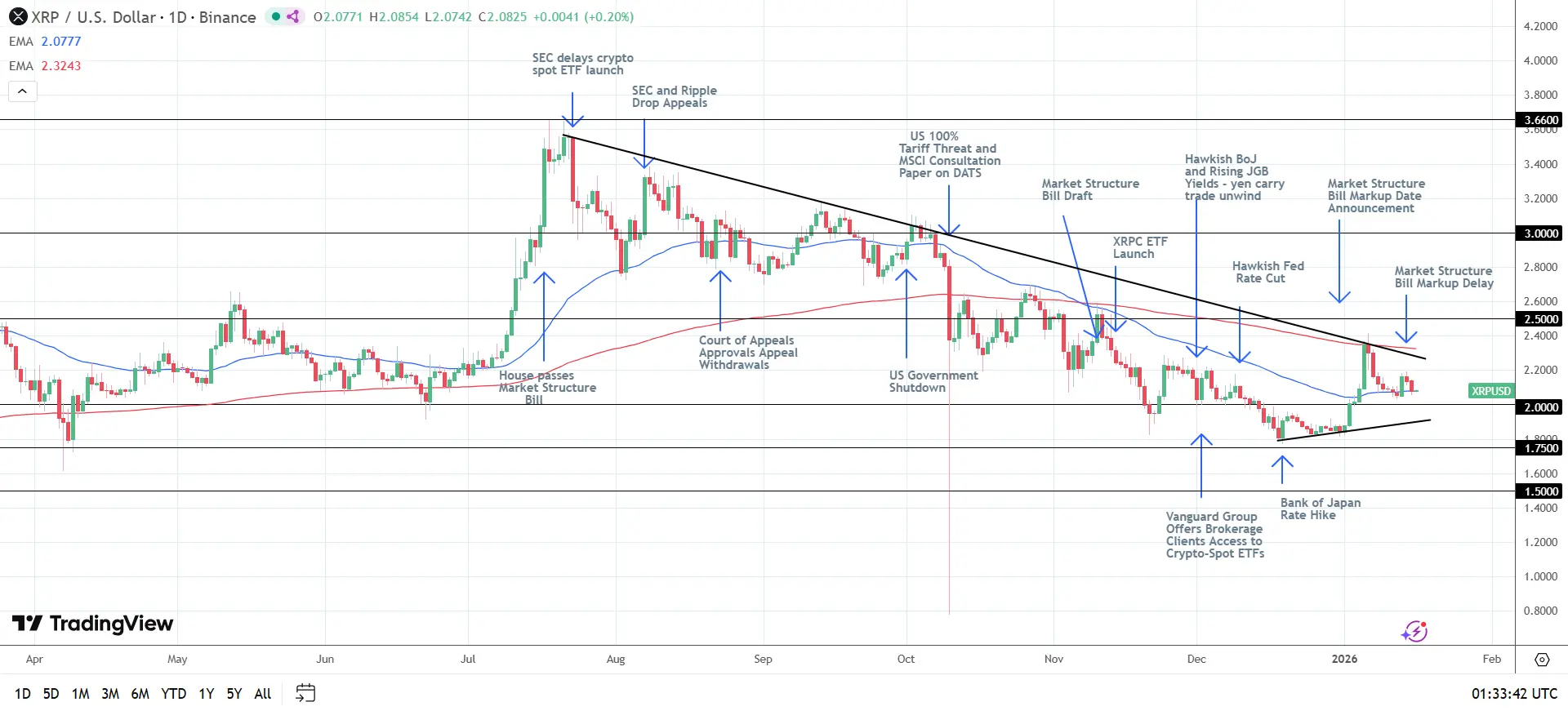
(Source: Trading View)
On January 15, XRP declined 2.77%, after a 1.23% drop the previous day, closing at $2.0784. The selling pressure on this token was greater than the overall crypto market, which fell 1.46%. Despite the correction, XRP remains above the 50-day moving average but below the 200-day moving average. The moving averages suggest short-term bullishness but long-term bearishness; however, the fundamental outlook remains predominantly bullish.
[XRP]# Key Technical Levels to Watch
Support Levels: $2.00, $1.75, then $1.50
50-day EMA Support: $2.0777
200-day Moving Average Resistance: $2.3243
Resistance Levels: $2.5, $3.0, and $3.66
From the daily chart, breaking above $2.2 would open the door to testing the 200-day moving average. If the price continues to break above the 200-day MA, it could signal a trend reversal, with $2.5 becoming a critical resistance. Importantly, a break above the EMA line would reaffirm the medium-term bullish outlook and target the longer-term $3.66 level.
The ongoing progress of the Market Structure Bill, strong demand for XRP spot ETFs, and increasing XRP utility reinforce a cautiously optimistic short-term (1-4 weeks) outlook with a target of $2.5. Additionally, expectations that the Senate will eventually pass crypto-friendly legislation bolster the long-term bullish targets: $3.0 in the medium term (4-8 weeks) and $3.66 in the long term (8-12 weeks).
Major risks to the bullish outlook include: the Bank of Japan maintaining hawkish neutral interest rate hints, potentially raising rates multiple times; U.S. economic data weakening expectations of rate cuts in early 2026; legislative delays or blockages by U.S. lawmakers on the Market Structure Bill; and outflows reported in XRP spot ETF funds. These factors could pressure market sentiment and cause XRP to break below $2, signaling a reversal of the bear trend.
Avoiding a drop below $2 remains critical to maintaining the bullish structure. Favorable fundamentals continue to offset long-term technical negatives, indicating ongoing recovery. A break above $2.2 would trigger an upward trendline, and sustained breakout would confirm trend reversal, supporting the $3.0 medium-term and $3.66 long-term targets. Looking ahead 8-12 weeks, if the Fed cuts rates in March and the Senate passes the Market Structure Bill, these factors could push XRP beyond the $3.66 all-time high, confirming a $5 target within the next 6-12 months.


