Article by: imToken
In recent times, if you have been paying close attention to the Ethereum ecosystem, you might feel a sense of disconnection.
- On one side are intense discussions about scalability routes, Rollup architecture, Interop, ZK, PBS, Slot shortening, and other technical topics;
- On the other side are debates around questions like “Is the Ethereum Foundation arrogant,” “Why not be more aggressive,” “Why is the token price sluggish,” and even emotional confrontations;
These discussions actually point repeatedly to a deeper question: What kind of system does Ethereum ultimately want to become?
In fact, many disputes do not stem from technical disagreements but from different understandings of Ethereum’s “value premises.” Only by returning to these premises can we truly understand why Ethereum has made choices that many consider “out of date” today.
1. Ethereum’s “Ten-Year Itch”: Is Ethereum Degenerating?
Recently, the Ethereum community has not been peaceful.
From reflections on the Rollup-centric route, to debates about the “Alignment” concept, and comparisons with high-performance public chains, a subtle but persistent “Ethereum anxiety” is spreading.
This anxiety is understandable.
While other public chains continuously improve TPS, TVL, trending narratives, latency, and user experience metrics, Ethereum keeps revisiting architecture splitting, execution outsourcing, interoperability, and finality issues—appearing neither intuitive nor clever.
This also raises a sharper question: Is Ethereum “degenerating”?
To answer this, one cannot just look at recent one or two years of technical routes but must zoom out to a longer timeframe—returning to what Ethereum has truly persisted with over the past decade.
In fact, over the past few years, many emerging high-performance public chains have chosen a more direct path: reducing node counts, raising hardware thresholds, centralizing ordering and execution to achieve maximum performance and experience.
From the Ethereum community’s perspective, such speed often comes at the cost of fragility.
A frequently overlooked but highly illustrative fact is that, in nearly ten years of operation, Ethereum has never experienced a network-wide shutdown or rollback, maintaining 7×24×365 continuous operation.
This is not because Ethereum is luckier than Solana, Sui, and others, but because from the start, it chose to prioritize the system’s ability to operate under worst-case conditions over raw performance metrics.
In other words, Ethereum today may seem slow, not because it cannot go faster, but because it has always asked a harder question—when the network scales up, with more participants, and in less friendly environments, can the system still continue to operate?
From this perspective, the so-called “Ten-Year Itch” is not Ethereum degenerating but actively enduring short-term discomfort and doubts for longer-term survival.
2. Understanding “Ethereum Alignment”: Not Taking Sides, But Defining Boundaries
Because of this, the first step to understanding Ethereum is accepting a crucial, albeit unpopular, fact: Ethereum is not a system with “maximized efficiency” as its sole goal. Its core aim is not to run the fastest but to remain “trustworthy even in the worst cases.”
Therefore, within the Ethereum context, many seemingly technical issues are fundamentally value choices:
Should we sacrifice decentralization for speed?
Should we introduce powerful nodes to increase throughput?
Should we prioritize user experience at the expense of security assumptions?
Ethereum’s answers are often no.
This also explains why within the Ethereum community, there is an almost instinctive caution towards shortcuts—“Can we do it” always gives way to “Should we do it.”
Against this backdrop, “Alignment” has become one of the most controversial concepts recently, with concerns that it might turn into a moral coercion label or a tool for rent-seeking.
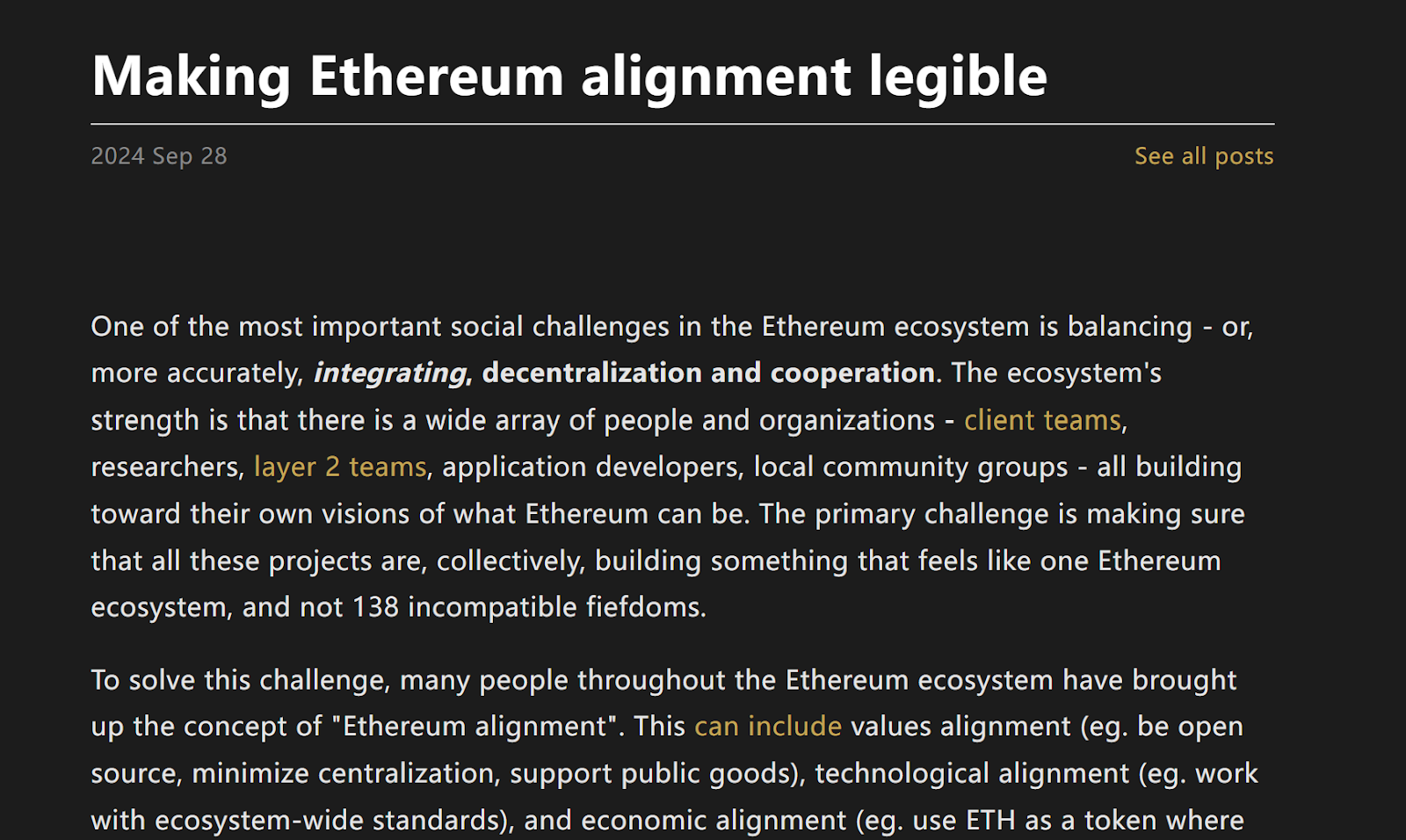
In fact, these worries are not unfounded. As early as September 2024, Vitalik Buterin explicitly pointed out this risk in “Making Ethereum alignment legible”:
If “alignment” means whether you have the right friends, then the concept itself has already failed.
Vitalik’s proposed solution is not to abandon alignment but to make it explainable, decomposable, and discussable. In his view, alignment should not be a vague political stance but broken down into a set of attributes that can be scrutinized:
- Technical alignment: Are you using Ethereum’s security consensus? Do you support open-source and open standards?
- Economic alignment: Are you promoting long-term value capture of ETH rather than one-way extraction?
- Moral alignment: Are you pursuing public interest rather than predatory growth?
From this perspective, alignment is not a loyalty test but a social contract of mutual benefit and coexistence.
The Ethereum ecosystem allows chaos, competition, and even fierce internal competition among L2s; but ultimately, these activities should feed back into the core system that provides security, consensus, and settlement guarantees.
3. Reflections on “Decentralization” and “Censorship Resistance”
If “alignment” defines the boundary of values, then what truly sustains this boundary are Ethereum’s two long-standing pillars: decentralization and censorship resistance.
First, in the Ethereum context, “decentralization” does not mean more nodes are always better, nor does it mean everyone must run a node. It means that the system can operate normally without trusting any single participant.
This implies that the protocol should not rely on a single sequencer, coordinator, or company; it also means that node operation costs cannot be so high that only professional institutions can run them, ensuring ordinary people can still verify that the system is functioning according to rules.
Because of this, Ethereum maintains long-term restraint on hardware thresholds, bandwidth requirements, and state bloat—even if this slows down some short-term performance metrics (see also “ZK Roadmap ‘Dawn’: Is Ethereum’s Finality Roadmap Accelerating?”).
In Ethereum’s view, a system that is fast but cannot be verified by ordinary users essentially loses the meaning of “permissionless.”
Another often misunderstood value is censorship resistance.
Ethereum does not assume the world is friendly. On the contrary, from its inception, it presumes participants may seek profit, power may concentrate, external pressures will emerge, etc. Therefore, censorship resistance does not mean “no one will ever censor,” but rather that even if someone attempts to censor, the system will not fail because of it.
This is why Ethereum places great importance on mechanisms like proposer/builder separation, decentralized construction, and economic game design—not because they are elegant, but because they can keep the system operational under the worst conditions.
In many discussions, people ask: “Do such extreme scenarios really happen in reality?”
But at the end of the day, if a system is only safe in an ideal world, then it is not trustworthy in the real world.
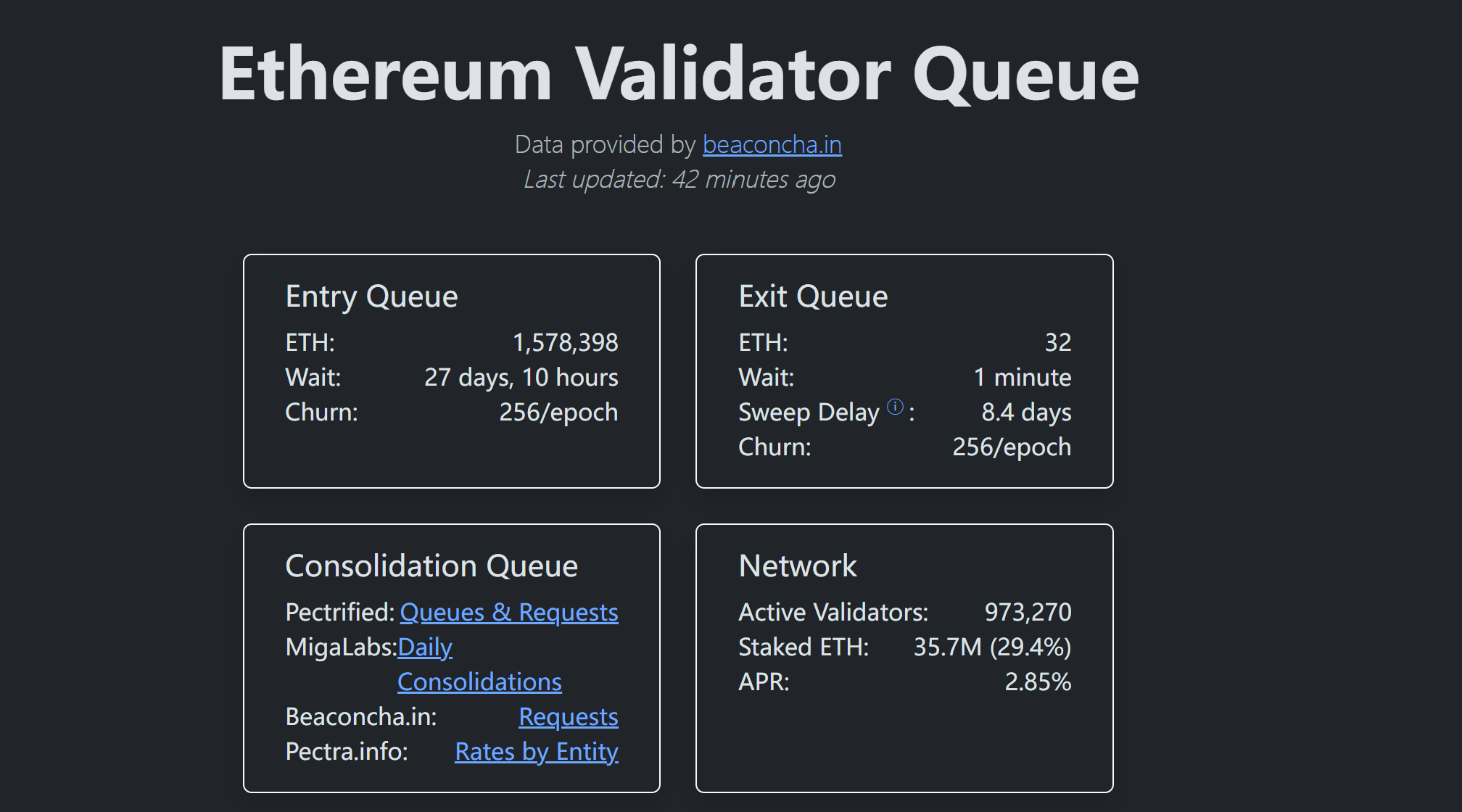
Finally, to close with an interesting data point: currently, the queue for ETH staking withdrawals on Ethereum PoS is nearly empty, while the queue for staking deposits continues to grow (over 1.57 million ETH).
Despite controversy and doubts, a large amount of ETH remains locked in this system long-term.
Perhaps this speaks more than any declaration.
Final Words
Many critics say Ethereum is always “discussing philosophy after others have already started.”
But from another perspective, it is precisely these discussions that have helped Ethereum avoid repeated rebuilds—whether it’s the Rollup-centric roadmap, the gradual introduction of ZK, or interoperability, fast finality, and slot shortening—all are based on a fundamental premise:
All performance improvements must be compatible with existing security and value assumptions.
This also explains why Ethereum’s evolution often appears “conservative but steady.” Ultimately, it is not that Ethereum does not pursue efficiency but that it refuses to trade current short-term advantages for future systemic risks.
And this is the underlying spirit that has supported Ethereum’s ecosystem through ten years—also the most scarce and valuable aspect to protect in an era dominated by “efficiency/TVL first.”
Disclaimer: The information on this page may come from third parties and does not represent the views or opinions of Gate. The content displayed on this page is for reference only and does not constitute any financial, investment, or legal advice. Gate does not guarantee the accuracy or completeness of the information and shall not be liable for any losses arising from the use of this information. Virtual asset investments carry high risks and are subject to significant price volatility. You may lose all of your invested principal. Please fully understand the relevant risks and make prudent decisions based on your own financial situation and risk tolerance. For details, please refer to
Disclaimer.
Related Articles
ether.fi's Liquid ETH Vault Now Accepts aWETH Deposits for Aave Users
Gate News message, April 23 — ether.fi announced that its Liquid ETH vault now accepts aWETH deposits, providing an exit option for users facing liquidity constraints on Aave.
The Liquid ETH vault does not hold WETH exposure to Aave, according to the
GateNews6m ago
Newly Created Address Withdraws 4,000 ETH Worth $9.59M from Major CEX
Gate News message, April 23 — According to Onchain Lens, a newly created address (0x66e...5b6b) withdrew 4,000 ETH, valued at approximately $9.59 million, from a major CEX.
The tokens were transferred to the address earlier
GateNews15m ago
Ethereum Futures Open Interest Surges 7.29% to $32.96B in 24 Hours
Gate News message, April 22 — According to Coinglass data, Ethereum's global futures open interest increased 7.29% over the past 24 hours, reaching a total of $32.96 billion.
Among major exchanges, open interest is distributed as follows: a leading exchange holds $7.67 billion, another major
GateNews5h ago
ETH Liquidation Levels: $1.445B in Short Liquidations at $2,492; $1.334B in Long Liquidations at $2,257
Gate News message, April 23 — According to Coinglass data, if ETH breaks above $2,492, cumulative short liquidations across major centralized exchanges would reach $1.445 billion. Conversely, if ETH falls below $2,257, cumulative long liquidations across major CEXs would reach $1.334 billion.
GateNews6h ago
Ethereum Breaks Through $2,400 as Daily Decline Holds at 0.15%
Gate News message, April 22 — Ethereum broke through the $2,400 mark today, though the cryptocurrency recorded a 0.15% decline over the 24-hour period.
GateNews6h ago
Bitcoin breaks through $78,000, and the market moves out of the extreme fear range
The crypto market is recovering, with BTC trading above $78k, up about 2% day over day. After breaking $75k, a short squeeze emerged; spot ETFs have seen consecutive net inflows, and MicroStrategy’s additional purchases have driven growth in institutional holdings. Open interest is rising, funding rates are falling, and even turning negative, suggesting potential explosive upside. Tensions on the geopolitical front have eased, and the fear index has rebounded back into a fear range—sentiment has improved, but it’s not yet a full bull market. To hold the $78k–$83k range steadily, improve liquidity, and maintain macro stability, we can enter a long-term bull market. This article was first published by Chain News ABMedia.
ChainNewsAbmedia8h ago


