
Pi coin trading price is $0.20, down 93% from $3.0. User X criticizes five major flaws: lack of major exchanges, mainnet not launched, unclear supply, centralization, and locked balances. The exchange holds 425 million coins, with Gate accounting for 52%. In the past 30 days, 130 million coins have been unlocked, with a record 5.3 million today. The bullish camp targets $0.57.
Five Deadly Flaws Making Pi Coin Difficult to Bullish
Unlike many leading cryptocurrencies, Pi Network’s native token failed to surge significantly in the first few days of the new year. Over the past few months, the token has been in a sharp downtrend, leading some analysts to be quite pessimistic about its future. Meanwhile, certain indicators suggest further corrections may occur.
According to CoinGecko data, PI is currently trading at about $0.20, with a weekly increase of only 2%, but compared to the $3 all-time high set in February last year, it has plummeted 93%. Such a decline is extremely rare among mainstream cryptocurrencies; even during the 2018 bear market, Bitcoin only fell 83%. The 93% drop in Pi coin indicates its price is severely detached from fundamentals.
Recently, X user pinetworkmembers, who has been critical of the project, states that it is currently hard to be optimistic about PI. He points out that during Bitcoin’s rebound in early 2026, PI hardly increased, and lists several obstacles facing its price. Major issues include lack of support from large exchanges, “no real open mainnet,” unclear supply, centralization control, and locked balances.
They add: “To some extent, you have to ask yourself whether this is innovation or just wasting time and opportunity costs.” This sharp criticism directly targets core issues of Pi Network. The project claims decentralization, but in practice operates in a highly centralized manner. Although the mainnet is online, most users’ coins remain locked and cannot be transferred freely. The total supply has never been transparently disclosed, making it impossible for the market to assess inflationary pressures.
Five Deadly Flaws of Pi Coin
Lack of mainstream exchanges: No new CEX listing initiatives, liquidity severely lacking
Mainnet not truly open: Although claiming mainnet is online, most user balances remain locked and non-transferable
Unclear supply: Total and circulating supply not explicitly disclosed, inflationary pressures cannot be assessed
Severe centralization control: Core team controls large amounts of tokens and network decision-making power
Locked balances controversy: Slow KYC verification progress, most users cannot freely use their holdings
Shadow of 425 Million Exchange Reserves
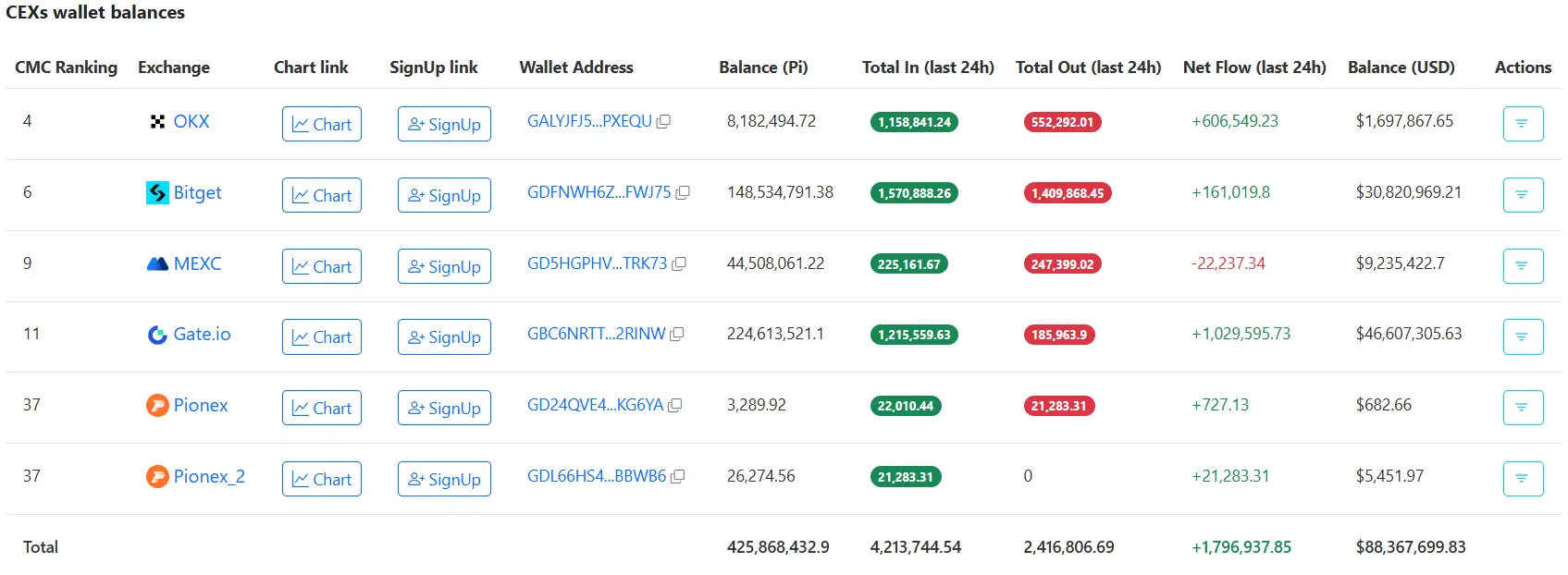
The increase in exchange supply exacerbates bearish expectations. In the past 24 hours alone, nearly 1.8 million tokens have been transferred to centralized platforms, typically during pre-sale phases. To date, the exchange-held PI exceeds 425 million, with Gate holding about 52%.
This level of exchange concentration is extremely dangerous. Gate alone controls 52% of the exchange supply, over 220 million Pi coins. If Gate were to delist Pi due to regulatory pressure or business decisions, market liquidity would collapse instantly. Moreover, the large concentration of Pi on exchanges means it could be sold at any time; these are not long-term holders’ cold wallet holdings but hot wallets ready for sale.
The continuous inflow of 1.8 million coins transferred in the past 24 hours is even more concerning. This steady selling pressure indicates that Pi holders are moving tokens from Pi Network to exchanges in preparation for selling. Possible reasons include loss of confidence in the project, need for liquidity, or immediate cash-out after completing KYC verification and gaining transfer rights.
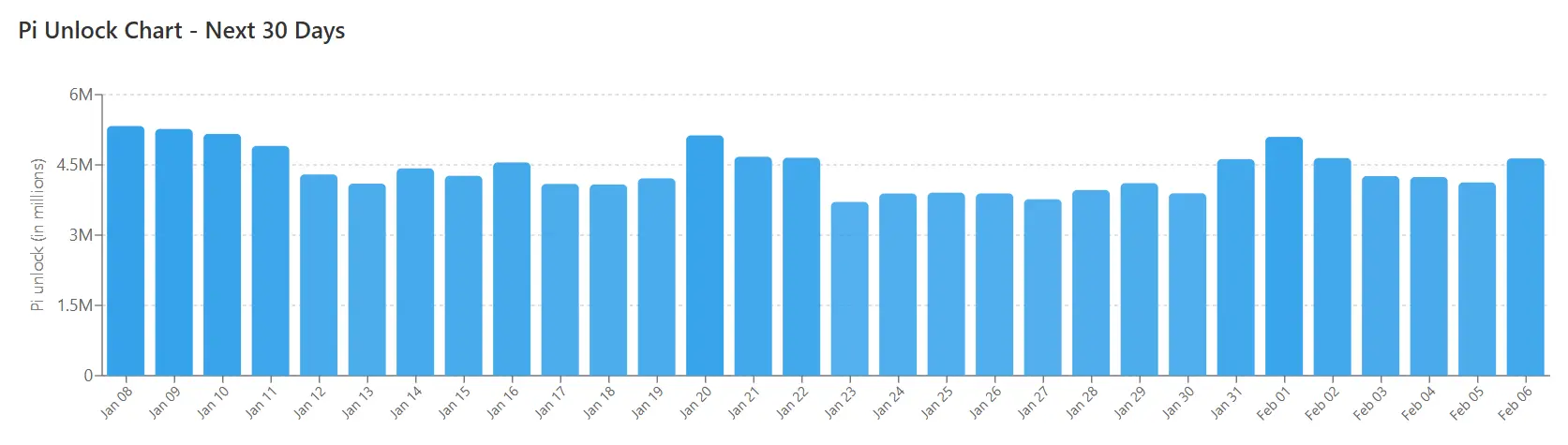
Upcoming token unlocks are also noteworthy. Over the next 30 days, more than 130 million PI tokens are expected to be released, with today (January 8) setting a record of 5.3 million tokens unlocked. The average daily unlock is about 4.36 million, lower than in previous months, possibly providing some short-term price stability. However, the 130 million monthly unlock represents selling pressure of roughly $26 million at current prices, raising doubts about market absorption capacity.
The Lone Persistence of the Bullish Camp and the $0.57 Target
Some analysts refuse to give up, believing the market may soon rebound. User Vuori Trading claims that PI has broken an eight-month downtrend and predicts its price could soon rise to $0.57. Previously, Oman believed the asset had been consolidating below a key resistance after a rally. This market observer predicts that if valuation surges above $0.215, a new high could be achieved.
The $0.57 target implies about 185% increase from current levels. This forecast is based on technical breakout from a downtrend channel but ignores serious fundamental issues. Technical analysis is more effective on assets with ample liquidity and market maturity, but for Pi coin, with questionable fundamentals and low liquidity, the reliability of technical patterns diminishes significantly.
A more realistic scenario is that even if Pi coin experiences a short-term rebound, it may face strong resistance around $0.35 (200-day EMA). Large amounts of trapped positions are concentrated in the $0.30-$0.50 range; once holders see a chance to break even, they may choose to exit. Without strong fundamental catalysts (such as new CEX listings, true mainnet launch, killer apps), the bullish technical pattern may merely be a trap to lure buyers.
Overall, Pi coin faces five major fatal flaws, 425 million coins of exchange selling pressure, and 130 million coins of monthly unlocks, making bullishness extremely difficult. Although some analysts insist on optimism and predict $0.57, such optimism lacks fundamental support. Investors should be extremely cautious, participate with very small positions, and be prepared for the possibility of project failure at any time.
Disclaimer: The information on this page may come from third parties and does not represent the views or opinions of Gate. The content displayed on this page is for reference only and does not constitute any financial, investment, or legal advice. Gate does not guarantee the accuracy or completeness of the information and shall not be liable for any losses arising from the use of this information. Virtual asset investments carry high risks and are subject to significant price volatility. You may lose all of your invested principal. Please fully understand the relevant risks and make prudent decisions based on your own financial situation and risk tolerance. For details, please refer to
Disclaimer.
Related Articles
Pi Network Transfers 30M Coins as Migration Resumes
Pi Network has restarted its long-running migration process after a short pause. In the latest update, around 30 million Pi coins moved from an intermediary address to user-linked wallets. The transfer happened just hours after activity resumed, following a one-week break
The update suggests the n
Coinfomania22h ago
Pi Network restarts the migration, and 30 million Pi have been transferred into users’ wallets
Pi Network resumed mainnet migration after a pause, transferring about 30 million Pi tokens to users’ wallets, mainly targeting users who have completed KYC. The first migration has been completed, and a second migration is currently underway, with the core team emphasizing batch processing. Some false information appeared during the process; the official account has issued a clarification, reminding users to obtain information through official channels.
MarketWhisper04-10 06:39
Pi Network version 21 released; mainnet RPC and smart contract acceleration are advancing
Pi Network released version 21 on April 9. The key update is that the testnet RPC has officially gone live, providing developers with a secure environment to test smart contracts and DApps. Next, smart contracts are expected to be deployed within two months, enabling Pi幣 to transition from a community token into a functional digital asset and to support DeFi applications and automated workflows, while also advancing the KYC migration to ensure compliance.
MarketWhisper04-10 01:50
Pi Network Launches RPC Server on Testnet for Smart Contracts
Pi Network has introduced a new tool for developers. The project has launched an RPC server on its testnet. This update is an important step toward building smart contracts and real applications on the network
For now, the feature is only available in the test environment. Still, it shows that Pi
Coinfomania04-10 01:18
Pi Launchpad 12 Grid testnet launch, pioneer token distribution completed
Pi Network recently launched a token distribution test for the Pi Launchpad. More than 300k users participated, staking 24 million Test-Pi. The core architecture “12 Grid” enables end-to-end token delivery, and all transactions are publicly verifiable. This test confirmed the system’s feasibility and paved the way for a future official launch. The upgrade roadmap includes the PiRC1 framework and Protocol 23, which will be rolled out in April and May, respectively.
MarketWhisper04-09 05:21
Pi Launchpad Testnet Begins 12 Grid Token Distribution Trial
Pi Network has taken another step toward building its ecosystem. A new update shows that its Launchpad feature has started testing token distribution on the testnet. This test uses a system called the “12-Grid.” While the name may sound complex, the idea is simple. It allows users to subscribe to a
Coinfomania04-08 18:02


