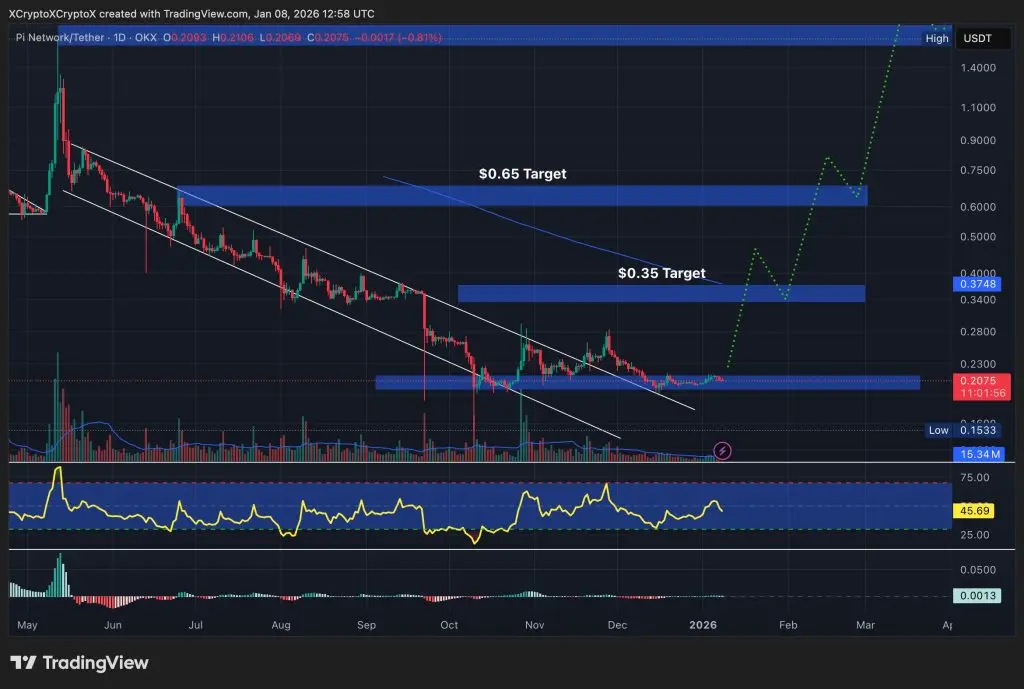
The trading volume of Pi Coin surges, with a buy wall forming at $0.20. It has increased by 2% over the past 7 days, with trading volume at the beginning of the year significantly rising. Investors have repeatedly bought at $0.205, and the RSI has broken above 50. If a rebound occurs, the first target is $0.35 (200-day EMA), with an aggressive target of $0.65, up 225%. The project suffered a major setback after the mainnet launched in February 2025, but may bottom out as market sentiment improves.
Technical Significance of the $0.20 Pi Coin Buy Wall
(Source: Trading View)
Pi Coin’s trading volume has surged because the token touched a key support level near $0.20, which favors bullish price forecasts for Pi Coin, as it briefly rebounded from this level in recent hours. Over the past 7 days, Pi Coin has risen 2%, and the cryptocurrency market seems poised for a comeback in 2026.
The project was heavily impacted shortly after the mainnet went live in February 2025. However, as market sentiment begins to turn positive, Pi Coin may soon bottom out. Accurately predicting the bottom is difficult, but recent price movements suggest Pi Coin may already be near or have reached its bottom. Data from CoinCodex shows that Pi Coin’s trading volume has grown significantly since the beginning of the year, and such volume expansion often signals a trend reversal.
The daily chart shows that investors have repeatedly bought Pi Coin at $0.205. This confirms that this level is an important “buy barrier” for the token. Therefore, if market sentiment continues to improve, this level can serve as a buffer. In technical analysis, when a price level is tested multiple times without breaking below, its support validity is confirmed, increasing the likelihood of a subsequent breakout.
The formation of the $0.20 buy wall is not accidental. This level may be the average cost zone for many early holders, who are motivated to defensively buy when the price falls back near their cost basis. Additionally, $0.20 is a psychological round number, likely to attract concentrated limit buy orders. From volume distribution, there is a large amount of historical transaction records around $0.20, which often provide strong support during price pullbacks.
Four Major Technical Signals Indicating Pi Coin Bottoming
Multiple Tests Without Break: $0.20 has been tested several times without effectively breaking down, confirming support
Volume Expansion: Trading volume has increased significantly since the beginning of the year, indicating renewed market attention
RSI Breakthrough: Relative Strength Index briefly broke above 50, indicating increasing buying momentum
Breakout of Downtrend Channel: Price broke above the long-term downtrend channel’s upper boundary, suggesting a trend reversal
Stepwise Targets from $0.35 to $0.65
The RSI has briefly broken above the midline, which is favorable for bullish prospects as positive momentum accelerates. If Pi Coin rebounds from this level, the first target could be set at $0.35. This is a critical resistance level and coincides with the 200-day exponential moving average (EMA).
The 200-day EMA is one of the most commonly used long-term trend indicators in technical analysis. When the price is above the 200-day EMA, it is generally considered a long-term uptrend; below it indicates a downtrend. Currently, Pi Coin trades at $0.20, about 75% below the $0.35 200-day EMA. Breaking above this moving average would confirm a trend shift from downtrend to uptrend, attracting more technical traders.
Meanwhile, considering that the recent rally also broke through the downtrend channel, if FOMO sentiment heats up, the price could rebound strongly to $0.65. This implies a potential 225% increase in the short term. The downtrend channel is a technical pattern connecting a series of lower highs and lower lows; breaking above the upper boundary typically signals the end of the downtrend.
Although the $0.65 target is aggressive, it is not entirely impossible. This level was the high point during Pi Network’s initial mainnet launch and is also a zone where many early users are trapped. If the price returns to $0.65, these trapped positions may be forced to sell, creating new selling pressure. Therefore, $0.65 is both a target and an important resistance level.
Early-stage projects like Pi Network often offer the highest returns if invested in at the beginning. While tempting, this overlooks fundamental issues Pi Coin faces: although the mainnet is live, KYC verification progress is slow; the token is not yet fully listed on mainstream exchanges; the ecosystem’s application scenarios are limited; and its actual utility is questionable. If these fundamental issues are not addressed, the bullish technical pattern may only be a short-term rebound rather than a trend reversal.
Three Risks and Rational Investment Advice for Pi Coin
Despite the bullish technical outlook, investors should remain cautious of three major risks. First, liquidity risk. Pi Coin is only traded on a few exchanges, with insufficient order book depth, and large trades could cause severe slippage. Second, project progress risk. Many promised features of Pi Network have not yet been fully realized; continued delays could crush market confidence. Third, regulatory risk. Countries like China have taken strict regulatory actions against unlicensed crypto projects, and Pi Coin’s legal status remains uncertain.
For those considering investing in Pi Coin, a cautious approach is recommended. Only invest funds that you can afford to lose entirely, set strict stop-losses below $0.19 (if it breaks below the $0.20 support), and take profits gradually at $0.35. Do not chase high positions with aggressive targets like 225% gains; the probability of such targets being achieved is low. A more rational approach is to wait until the price breaks above $0.35 and stabilizes before adding to positions.
In the long term, whether Pi Coin can truly rise depends on Pi Network’s ability to fulfill its promise of a decentralized payment network. If it remains a speculative hype without real-world applications, even a short-term rebound to $0.65 may eventually fall back to lower levels. Investors should focus on Pi Network’s ecosystem development, merchant acceptance, and actual usage data rather than just price charts.
Overall, Pi Coin is bottoming at $0.20, with a bullish technical outlook, short-term target of $0.35, and an aggressive target of $0.65. However, fundamental issues remain unresolved, so caution is advised, and investors should not ignore project risks based solely on technical signals.
Disclaimer: The information on this page may come from third parties and does not represent the views or opinions of Gate. The content displayed on this page is for reference only and does not constitute any financial, investment, or legal advice. Gate does not guarantee the accuracy or completeness of the information and shall not be liable for any losses arising from the use of this information. Virtual asset investments carry high risks and are subject to significant price volatility. You may lose all of your invested principal. Please fully understand the relevant risks and make prudent decisions based on your own financial situation and risk tolerance. For details, please refer to
Disclaimer.
Related Articles
Pi Network 18 million users complete KYC, and 26.5 million PI are issued to verifiers
Pi Network distributes 26.5 million PI tokens to more than 1 million community members who have completed KYC verification, to accelerate user identity verification and strengthen the decentralized model. 18 million already-verified users have laid the groundwork for the ecosystem’s development, but the key lies in how to convert these users into active participants. With the protocol upgrade, Pi Network is moving toward the open network phase, and smart contract support signals richer application scenarios.
MarketWhisper3h ago
Pi Network price hits a new 7-week low as a wave of 60 million token unlocks comes in
Pi Network's native token PI fell to $0.165 in April, hitting a 7-week low and leaving market sentiment weak. The unlock peak will release more than 60 million PI, adding downward pressure. Despite the core team recently publishing technical updates, it failed to improve market confidence and instead drew community criticism due to KYC access issues and the ongoing slide in price. Increased future supply could further drive prices lower.
MarketWhisper5h ago
Pi Network Distributes 26.5M PI to 1M KYC Validators
Pi Network has taken another step forward in building its ecosystem. The project recently distributed 26.5 million PI tokens to more than 1 million KYC validators.
These rewards were given to users who helped verify identities on the network. This process is important. Because it ensures that
Coinfomania19h ago
Pi Network PIRC baseline protection mechanism sparks controversy, implying a “quasi-stablecoin” logic
Pi Network member Daniel F raised a logical contradiction in the PIRC token design, noting that if it has a 23.8% floor protection, it would need to behave like a stablecoin, which conflicts with its high volatility on CEX. This floor is based on Pi’s price calculations; if Pi itself fluctuates significantly, it will be unable to effectively protect holders. Daniel emphasized the importance of transparency, but the project team did not respond to it, leading the community to continue speculating about the reasons for its silence.
MarketWhisper04-13 02:23
Pi Network Major Transformation: 210 Ecosystem Applications Deployed, 23k Developers Ready
The Pi Network ecosystem is accelerating its transition, with more than 210 active applications and 23,000 developers actively participating in Pi Studio, spanning multiple areas such as payments, community engagement, education, and gaming. The ecosystem’s diversity shows indicators of healthy development, and developers’ engagement is driving ongoing application optimization. In the future, improving the usefulness of the mainnet will be a key challenge, including issues that need to be urgently addressed such as scalability, security, and user adoption rates.
MarketWhisper04-13 02:06


