Pi Network becomes a failure case in the crypto industry by 2025, with its price dropping from a peak of $3 to $0.1960, a decline of over 80%, resulting in a total loss of more than $18 billion for holders. Millions of pioneers watched helplessly as the price hit new lows, while the tokens they mined over years remained locked in the closed mainnet. Despite recent improvements in the KYC process, many users still cannot transfer their tokens to the mainnet for trading.
From Peak to Trough: The Timeline of Pi Network’s Collapse
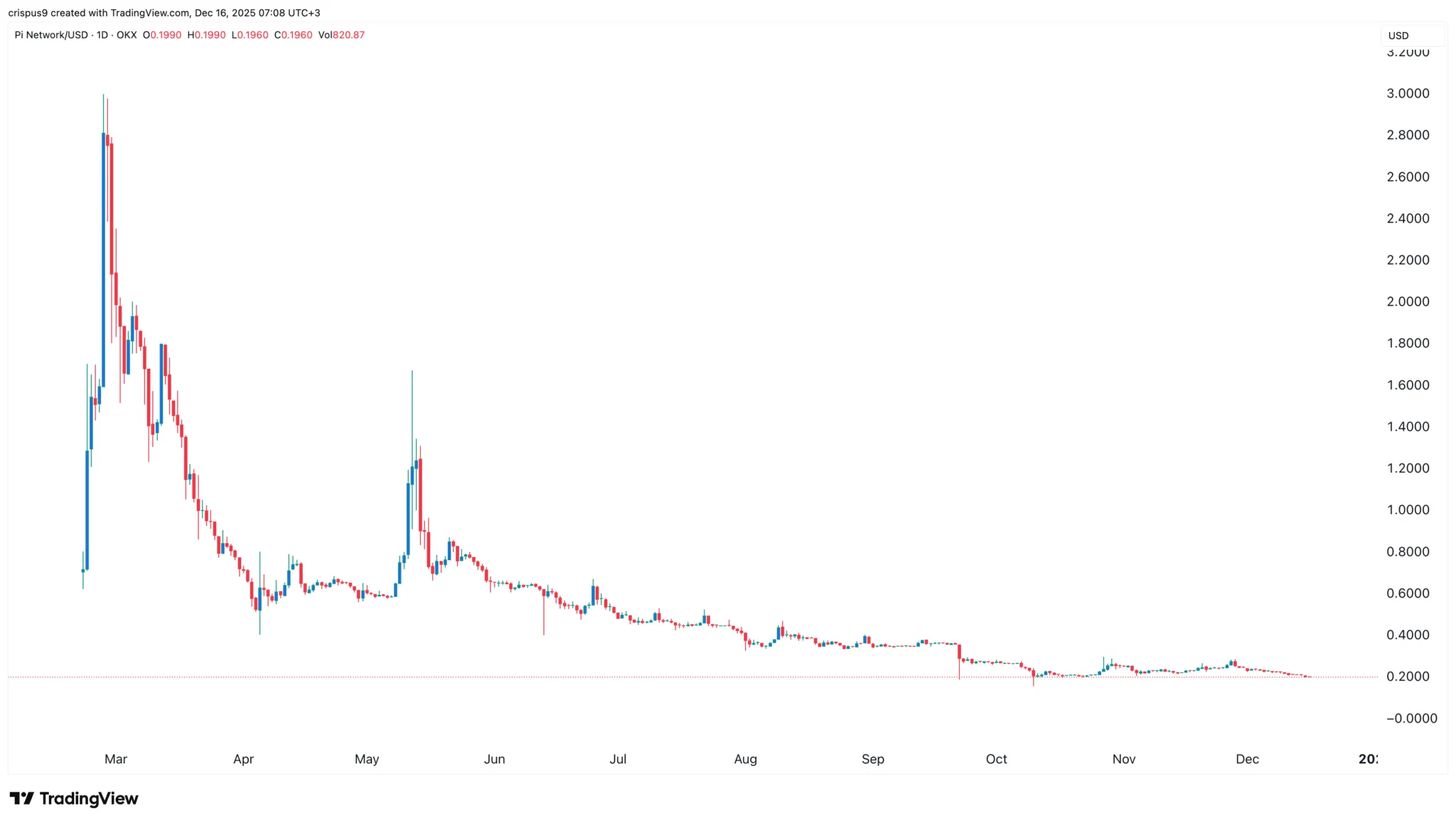
(Source: Trading View)
The failure of Pi Network did not happen overnight but was the inevitable result of a series of structural flaws. When the mainnet launched in February, the market held high hopes for Pi Network. The project claimed to have over 35 million users, making it one of the largest crypto projects in terms of user base in history. In its early days, driven by speculative sentiment, Pi Network’s price surged to nearly $3, with a market cap exceeding $10 billion.
However, this peak marked Pi Network’s absolute zenith. Over the following months, the price entered a continuous decline. In March, it fell below $2; in April, below $1; by December, it was under $0.20. Such a unilateral downtrend is extremely rare among mainstream cryptocurrencies. Even during bear markets, Bitcoin and Ethereum experience rebounds and fluctuations, but Pi Network exhibited an almost unsupported free fall.
The collapse of its market cap is even more shocking. From a peak of $10 billion to less than $2 billion today, $8 billion in market value evaporated within a few months. For holders, this loss is catastrophic. Many users spent years mining Pi tokens on their phones, hoping for substantial returns after the mainnet launch, only to see their wealth vanish before their eyes.
What’s more brutal is that most Pi Network users had no chance to cut losses. Due to the cumbersome and slow KYC process, hundreds of millions of tokens remain locked in the closed mainnet and cannot be transferred. When users finally complete KYC and migrate their tokens, the price has already halved. This “watching assets depreciate without being able to act” despair is the most painful aspect of Pi Network’s failure.
Analysis of the Five Fatal Flaws of Pi Network
The most fatal flaw of Pi Network is its extreme centralization. In the blockchain world, decentralization is a core value, but the Pi Network team controls billions of tokens. This control means the team can manipulate the market at any time, leaving ordinary users completely passive. This asymmetry of power utterly destroys market confidence; investors are reluctant to hold an asset that could be dumped by the team at any moment.
The failure to list on exchanges further restricts Pi Network’s development. Unlike many tokens launched in 2025 (such as NIGHT and Aster), Pi Network has not been listed on mainstream exchanges. The rejection from top CEXs reflects industry skepticism about the project’s quality. Without support from major exchanges, Pi Network’s liquidity is extremely limited, making price manipulation easy and accelerating its decline.
Structural Problems Leading to Pi Network’s Collapse
Extreme Centralization: The Pi Network team controls billions of tokens, making it one of the most centralized projects in the crypto industry, contradicting the original blockchain principle of decentralization.
Failed Exchange Listings: After listing on Gate and other exchanges, mainstream platforms completely ignored it, severely limiting liquidity.
Island-Mode Operation: Users can only access applications via the Pi Browser; there is no bridging to mainstream blockchains like Ethereum or Solana, resulting in a fully closed ecosystem.
Ongoing Token Unlocks: Millions of new tokens are released daily, with over 1.2 billion tokens unlocking in the next 12 months, creating huge selling pressure amid weak demand.
Ghost Chain Reality: Network activity is minimal, no staking features are provided, the team remains silent on future plans, and development progress has stagnated.
Comparison of Pi Network with Other 2025 Projects’ Failures
Pi Network’s failure is particularly glaring in the 2025 crypto market, as many projects launched simultaneously have performed far better. This contrast highlights fundamental flaws in Pi Network’s project design and execution.
Projects like NIGHT and Aster, launched in 2025, gained support from major exchanges, established bridges with other blockchains, and maintained active development. Although they experienced price fluctuations, they did not suffer the one-sided crash that Pi Network did. Their market caps recovered somewhat and remained within reasonable ranges, and holders did not face the despair of assets being locked and untradeable like Pi Network users.
The island-ecosystem strategy of Pi Network is a key reason for its failure. Modern blockchain projects highly value interoperability, allowing users to transfer assets freely across different chains and manage funds with multi-chain wallets. But Pi Network requires users to download a dedicated Pi Browser and cannot bridge to Ethereum, Solana, or other mainstream ecosystems. This closed nature isolates Pi Network from the entire DeFi and NFT ecosystems, preventing users from participating in broader crypto activities.
The token unlock mechanism also exposes Pi Network’s shortsightedness. Releasing millions of new tokens daily, with over 1.2 billion unlocking in 12 months, completely disrupts supply-demand balance. In the face of weak demand, the influx of new tokens will only further depress prices. In contrast, successful projects typically adopt more cautious unlocking plans to ensure supply growth aligns with ecosystem development.
Pi Network’s status as a “ghost chain” is the final footnote to its failure. Analysts point out that activity on Pi is minimal, with no popular dApps, no active developer community, and no staking features. The team remains silent about future plans, with no roadmap or clear development direction. This silence erodes investor confidence and accelerates capital flight.
Weak Hope for Rescue and Investment Warnings
Pi Network’s developers have taken some measures to salvage the project. They have applied for certification with the European regulator MiCA, which may help it get listed on top European exchanges. Pi Network has also shifted its focus to the AI industry, investing in companies like OpenMind and CiDi Games, seeking new growth points in AI and gaming.
However, whether these efforts can reverse Pi Network’s decline remains uncertain. MiCA certification takes time, and market confidence recovery will be even longer. Investments in AI and gaming provide new narratives but are far from generating actual revenue and user growth. Token burns and potential listings on mainstream exchanges could be catalysts, but whether they will materialize is still unknown.
For investors, Pi Network’s failure offers a painful lesson: user count does not equal value, centralized control is a fatal flaw, and exchange support is crucial.


