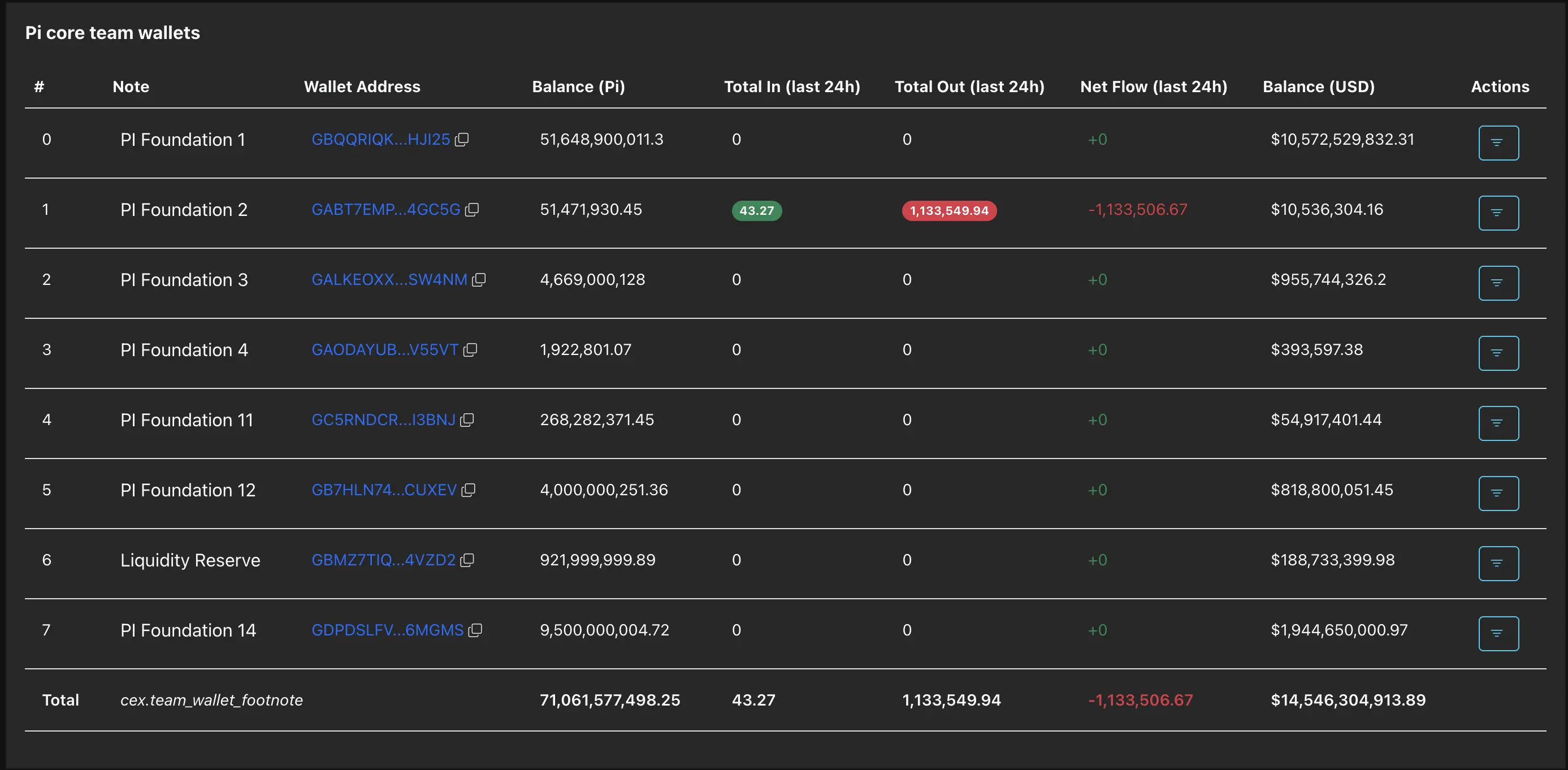
Pi Network December 16th followed the overall crypto market decline, currently reported at $0.1959. PiScan data shows that the Pi Foundation wallet has unloaded 1.13 million PI tokens in the past 24 hours, indicating low confidence from the core team wallet. What worries the market even more is that three wallets transferred over 2.4 million PI tokens to addresses associated with the payment gateway Banxa.
Pi Foundation 3.5 million tokens moved to withdrawal channels
(Source: PiScan)
On-chain data from Pi Network in the past 24 hours reveals alarming signals. The Pi Foundation wallet directly unloaded 1.13 million PI tokens, a large-scale transfer that typically indicates the team is adjusting fund management, with the worst-case scenario being preparing to sell for cash. For a project still in the mainnet transition phase, such large transfers by the core team can easily trigger market panic.
Even more damaging are transactions related to Banxa. Banxa is a payment gateway that provides withdrawal channels for PI, allowing users to convert PI tokens into fiat currency via Banxa. Three wallets transferred over 2.4 million PI tokens to Banxa-related addresses, the largest transaction in the past 24 hours. Notably, PiScan data shows these three wallets are likely subsidiaries created by the Pi Foundation wallet, suggesting that the Pi core team may be selling some assets through Banxa.
113,000 plus 2,400,000, totaling approximately 3.5 million PI tokens transferred to withdrawal channels or moved out of the foundation’s control within 24 hours. At the current price of $0.1959, this amounts to a potential sell pressure of about $686,000. For Pi Network, which has limited daily trading volume, such a scale of selling pressure could significantly impact the price. The market’s biggest concern is not the amount itself but the signal sent by team behavior: if even the core team is unloading, what reason do retail holders have to continue holding?
Pi Foundation 24-hour on-chain abnormal movements
Direct transfer out: Pi Foundation wallet unloaded 1.13 million PI, purpose unknown
Banxa inflow: Three sub-wallets transferred 2.4 million to withdrawal channels, suspected to be preparing for cash-out
Total sell pressure: about 3.5 million (686,000 USD), a significant proportion of daily trading volume
Market signal: Large-scale transfers by the core team severely damage investor confidence
Technical despair after 8 consecutive days of decline
(Source: Trading View)
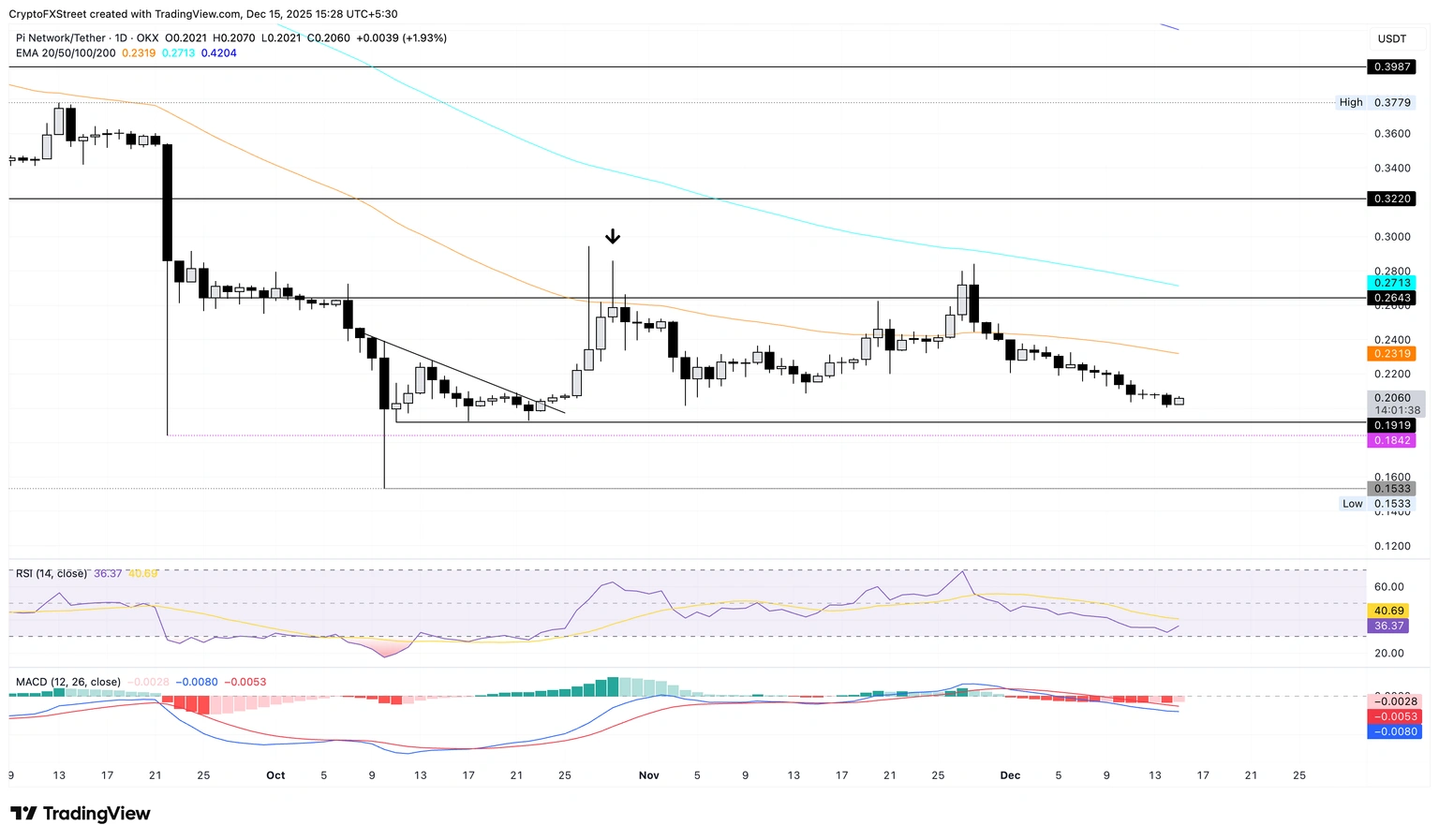
Pi Network’s price is approaching the psychological level of $0.20, rebounding nearly 2% at the start of the week, but it has already declined for eight consecutive trading days. This persistent downward momentum indicates heavy selling pressure, with each rebound suppressed by new sell orders. The low point on October 11 at $0.1919 is the direct support level for PI, having rebounded three times in October, confirming its effectiveness as support.
However, technical indicators are extremely bearish. The Relative Strength Index (RSI) is at 36, having moved out of oversold territory (below 30), but still in a bearish zone. An RSI at 36 suggests selling pressure remains dominant but has not yet reached extreme oversold levels, implying downward momentum may not be fully exhausted. The Moving Average Convergence Divergence (MACD) remains below the zero line, indicating strong bearish pressure. MACD below zero suggests short-term momentum is weaker than long-term momentum, a typical bearish trend feature.
Potential rebound target for PI could be the 50-day Exponential Moving Average (EMA) at $0.2319. However, reaching this target under current technical conditions requires strong buying support and clear positive catalysts. From the current price of $0.1959 to $0.2319, there is about an 18% upside potential, but given the eight-day decline and the team’s selling doubts, such a rebound seems unlikely.
A more realistic scenario is testing the support at $0.1919. This level provided effective support three times in October, but under the current large transfers from the foundation, the reliability of this support is questionable. If PI falls below $0.1919, it could accelerate downward to test the October 10 low of $0.1533. This represents about a 22% decline from the current price, which would be catastrophic for holders.
The final collapse of the GCV $314 myth
Pi Network’s price, from the community’s claimed GCV (Global Consensus Value) of $314.159, to the current market price of $0.1959, the valuation gap of 1600 times has completely shattered the belief system of “pure Pi holders.” Those who initially insisted that GCV was not traded on external exchanges as IOUs now face the stark reality of $0.19. Even more critically, the core team appears to be cashing out via Banxa, with these funds coming from the loyal community members who believed in GCV and supported the mainnet launch.
Pi Network currently faces not only a price decline but a total trust collapse. The performance after the mainnet launch has fallen far below community expectations. Technical progress such as smart contract deployment and Testnet2 completion has failed to halt the price decline. The large-scale transfers by the core team are the icing on the cake; when leaders are exiting, what reason do retail holders have to persist? The eight-day downward trend, bearish signals from RSI and MACD, and the support at $0.1919 are all pointing to a conclusion: Pi Network’s short-term bearish outlook is unlikely to reverse.
For investors still holding PI, tough choices lie ahead. Holding at the $0.1919 support level and then stopping loss might prevent further rapid decline. But if the support holds and a rebound occurs, they might miss the opportunity. A rational strategy is to set clear stop-loss levels; if it falls below $0.1919, decisively exit to avoid larger losses caused by emotional holding. The story of Pi Network’s rise from widespread anticipation to price collapse again proves that ultimately, the valuation of crypto projects must be determined by the market, not community consensus.
Disclaimer: The information on this page may come from third parties and does not represent the views or opinions of Gate. The content displayed on this page is for reference only and does not constitute any financial, investment, or legal advice. Gate does not guarantee the accuracy or completeness of the information and shall not be liable for any losses arising from the use of this information. Virtual asset investments carry high risks and are subject to significant price volatility. You may lose all of your invested principal. Please fully understand the relevant risks and make prudent decisions based on your own financial situation and risk tolerance. For details, please refer to
Disclaimer.


