Tether CEO Paolo Ardoino has strongly rejected S&P Global Ratings’ recent downgrade of USDt’s peg stability to the lowest possible score, calling the assessment “incomplete and misleading.”
What S&P Got Wrong, According to Tether
S&P cited Tether’s exposure to Bitcoin (5.6% of reserves) and other “higher-risk” assets like gold and secured loans as the primary reason for the “weak” rating, warning that a sharp BTC price drop could threaten the 1:1 peg.
(Sources: X)
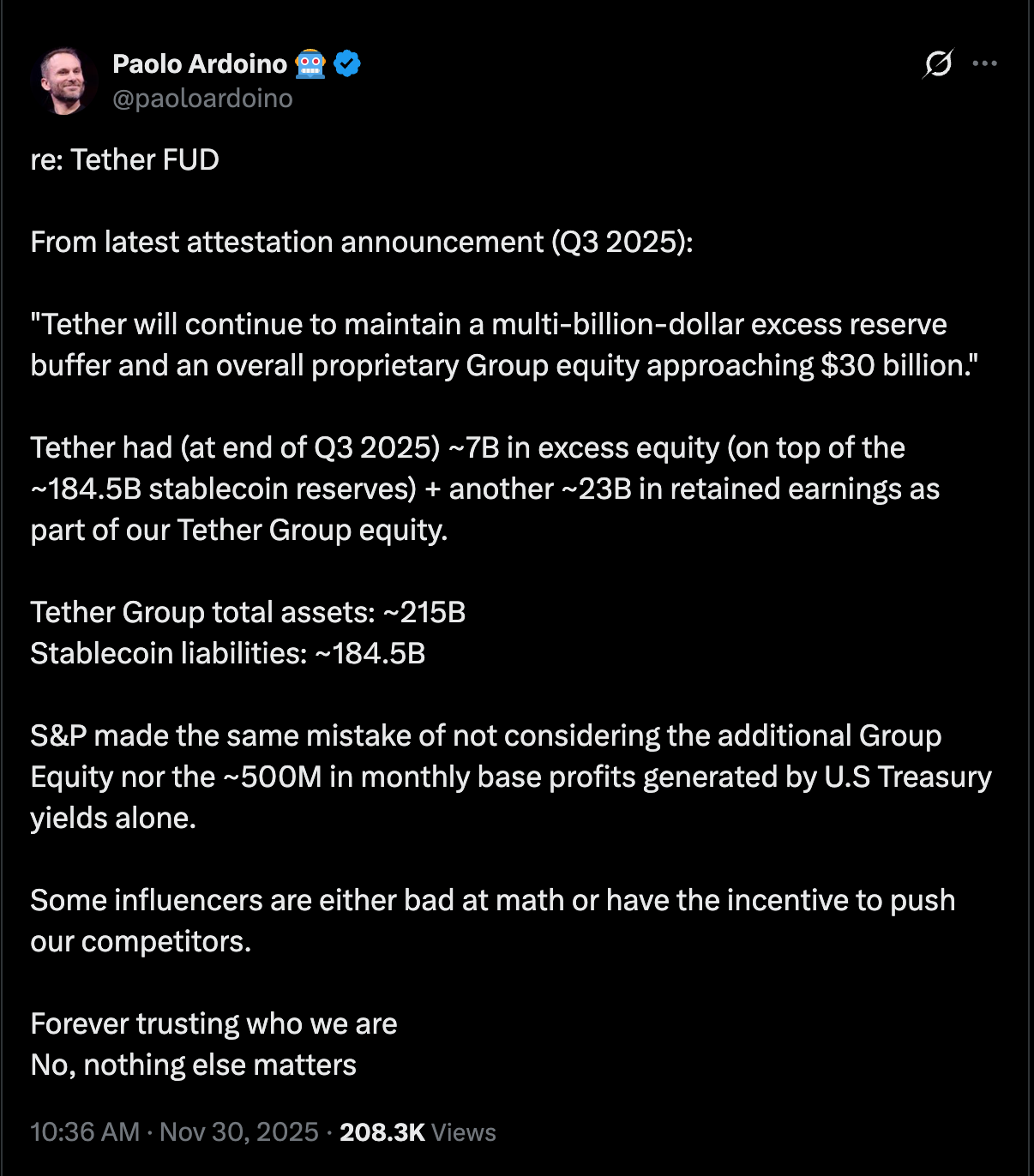
Ardoino countered that the agency:
- Failed to include $30+ billion in excess reserves and profits not yet reflected in the balance sheet
- Ignored Tether’s $7.7 billion in Q3 2025 net profit (the most profitable quarter in company history)
- Did not account for the company’s $215 billion in total consolidated assets against $184.5 billion in stablecoin liabilities — a 116%+ over-collateralization ratio
“S&P looked at a snapshot and missed the full picture. We are more over-collateralized and profitable than ever,” Ardoino wrote on X.
Market Reaction and Broader Context
Despite the downgrade, USDt has traded within ±0.01% of $1.00 across major venues, with no visible de-pegging pressure. 24-hour volume remains above $50 billion, and redemption queues are normal, and the token’s market cap sits at $184.5 billion — still the largest stablecoin by a wide margin.
Analysts note that S&P’s methodology appears to penalize diversification into yield-generating assets (U.S. Treasuries, BTC, gold, loans) while giving higher marks only to cash-like holdings — a stance that disadvantages profitable stablecoin issuers.
Bottom Line
While S&P’s report made headlines, the market has largely shrugged it off. USDt continues to function normally, redemptions, trading, and settlements, backed by the strongest reserve report in Tether’s history.
For now, the downgrade appears to be more noise than signal — another chapter in the ongoing tension between traditional rating agencies and the cryptocurrency industry they still struggle to understand.
Disclaimer: The information on this page may come from third parties and does not represent the views or opinions of Gate. The content displayed on this page is for reference only and does not constitute any financial, investment, or legal advice. Gate does not guarantee the accuracy or completeness of the information and shall not be liable for any losses arising from the use of this information. Virtual asset investments carry high risks and are subject to significant price volatility. You may lose all of your invested principal. Please fully understand the relevant risks and make prudent decisions based on your own financial situation and risk tolerance. For details, please refer to
Disclaimer.
Related Articles
Tether launches open-source local AI toolkit QVAC SDK
Tether launched the open-source software development kit QVAC SDK on April 9, supporting running AI applications locally, compatible with multiple platforms, with features such as text generation and speech processing, and enabling peer-to-peer distribution via Holepunch. In the future, it will add decentralized training and toolkits tailored for robots.
GateNews5h ago
Tether launches open-source AI toolkit QVAC SDK, positioning it as a general-purpose artificial intelligence foundation module
Tether’s QVAC team launched the QVAC SDK, which is an open-source, cross-platform AI development toolkit aimed at building the intelligent ecosystem of the future and supporting a wide range of devices. QVAC is seen as a next-generation intelligent framework with modular and infinitely extensible features to adapt to future development.
GateNews8h ago
A CEX co-founder donates $5.4 million to the UK’s Reform UK party
A CEX co-founder, Ben Delo, donated $5.4 million to the Reform UK party, and the donation took place before new UK regulations came into effect. Delo was previously fined $10 million for violating anti–money laundering compliance and received a pardon from Donald Trump. Reform UK positions itself as a pro-cryptocurrency political party and is currently facing a pause order on crypto donations. After relocating to the UK, Delo plans to be exempt from donation limits.
GateNews9h ago
ZachXBT discloses internal payment server data from North Korean IT workers, involving a $3.5 million flow of funds
On-chain detective ZachXBT revealed that an anonymous source shared stolen data from North Korea’s internal payment servers, involving 390 accounts and encrypted transaction information. More than $3.5 million in funds vanished, and it is connected to a sanctioned company. ZachXBT has compiled a detailed organizational chart.
GateNews04-08 13:46
Tether CEO: The team is developing a decentralized search engine, hypersearch.
Gate News message. April 7, Tether CEO Paolo Ardoino said the team is developing a decentralized search engine called hypersearch. The product is built on a distributed hash table (DHT, a decentralized data storage technology) architecture.
GateNews04-07 13:51


