The institution reported that argt, a peso-linked stablecoin, constitutes a security, subject to the regulatory regime for capital markets for these instruments. The stablecoin, issued by Twin Finance and listed by Belo, offered up to 32% APR.
Regulator Classifies Argentine Peso Stablecoin as a Security, Blocks Operations
The Argentine equivalent of the SEC, the CNV, executed the first measure against a stablecoin linked to the national fiat currency, the Argentine peso.
On March 12, the institution issued a resolution ordering the suspension of the listing, offering, and intermediation of argt, stating that the token was classified as a security offered to investors without complying with the rules established for these assets.
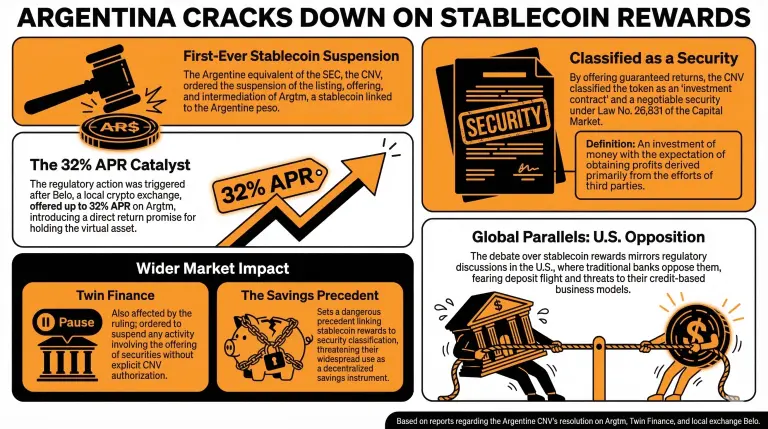
The action comes after Belo, an exchange that listed the stablecoin, offered up to 32% in APR, introducing a return promise linked to holding the virtual asset. As a consequence, the CNV assessed that this would make it “fall under the figure of an investment contract included in the definition of negotiable security provided for in article 2 of Law No. 26,831 of the Capital Market, which results in its classification as a negotiable security subject to the public offering regime.”
The institution clarified that when these assets meet the criteria of an investment contract, “an investment of money in a joint venture with the expectation of obtaining profits derived primarily from the efforts of third parties,” it can be considered a security, and will be subject to the compliance regime described for these assets.
The action also affects Twin Finance, which will have to suspend any activity, including the offering of securities, without the CNV’s authorization.
The development sets a precedent in Argentina, linking the offering of rewards for holding a stablecoin to its classification as a security, closing the potential savings use case for these instruments in the future, with no regulation tackling this issue.
The subject of stablecoin rewards is also being discussed in the U.S., as banks have opposed it, alleging that it could fuel deposit flight from the financial system and affect their credit intermediation-based business model.
FAQ
- What recent action did Argentina’s CNV take regarding a stablecoin?
The CNV suspended the listing and intermediation of argt, classifying it as a security being offered without regulatory compliance.
- Why was argt classified as a security?
The token was categorized as a security because it was linked to an investment contract promising up to 32% APR for holding the virtual asset.
- What implications does this resolution have for Twin Finance?
Twin Finance must halt all activities involving the stablecoin, including offering securities, without prior authorization from the CNV.
- What broader impact does this decision have on stablecoin offerings in Argentina?
This action sets a precedent by linking rewards for holding stablecoins to their classification as securities, potentially limiting their use for savings in the country.
Disclaimer: The information on this page may come from third parties and does not represent the views or opinions of Gate. The content displayed on this page is for reference only and does not constitute any financial, investment, or legal advice. Gate does not guarantee the accuracy or completeness of the information and shall not be liable for any losses arising from the use of this information. Virtual asset investments carry high risks and are subject to significant price volatility. You may lose all of your invested principal. Please fully understand the relevant risks and make prudent decisions based on your own financial situation and risk tolerance. For details, please refer to
Disclaimer.
Verwandte Artikel
Soziale Medienplattform X reicht bei der Europäischen Kommission einen Reformplan zu Fragen der blauen Verifizierung ein
Musks Social-Media-Plattform X reichte einen Reformplan unter Druck der Europäischen Kommission ein, nachdem sie zuvor wegen Verstößen wie der "blauen Verifizierung" mit einer Geldbuße von 120 Millionen Euro belegt worden war. Die EU wies auf Probleme mit Xs kostenpflichtiger Verifizierung, unzureichender Werbtransparenz und nicht konformer Datenzugang hin.
GateNews6Std her
Bank–Crypto Clash verlangsamt Fortschritt des Senate Clarity Act
Streit über Stablecoin-Belohnungsprogramme zwischen Banken und Kryptofirmen hat den Fortschritt beim Senate Clarity Act verlangsamt.
Die Banken warnen davor, dass Belohnungen zu einer Flucht von Einlagen führen könnten, während Kryptoverfechter sagen, dass es nur begrenzte Hinweise auf größere Verschiebungen gibt.
Gesetzgeber, darunter die Senatoren Alsobrooks und Tillis, sind
CryptoFrontNews7Std her
Bitcoin Policy Institute fordert die Änderung der US-Steuerregeln auf, wonach alle BTC-Zahlungen als Kapitalgewinne behandelt werden.
Gate News Meldung: Am 13. März forderte das Bitcoin Policy Institute (Bitcoins Politikinstitut) eine Änderung der geltenden US-Steuervorschriften. Nach den geltenden Regeln werden alle Zahlungen mit BTC als Kapitalgewinnttransaktionen behandelt und unterliegen entsprechenden Steuerzahlungen. Das Institut ist der Ansicht, dass diese Regelung die praktische Anwendung von Bitcoin als Zahlungsmittel einschränkt.
GateNews9Std her
Die erste Liste der Hongkonger "Stablecoin-Lizenzen" steht bevor! Gerüchten zufolge gehen sie an "HSBC, Standard Chartered und OSL"
Hongkongs erste Liste der „Lizenzen für Stablecoin-Emittenten" wird nächste Woche veröffentlicht. Die drei Hauptantragsteller sind HSBC, Standard Chartered Bank und die Virtual-Asset-Plattform OSL. Diese Lizenzerteilung könnte sich eher zugunsten von Banken neigen, da diese über Kapitalstärke und Regulierungsvorteile verfügen, während OSL umfangreiche praktische Erfahrung hat. Obwohl Gerüchte besagen, dass die Hauptliste bereits vorliegt, könnten sich die tatsächlichen Verhältnisse noch ändern.
区块客9Std her
Amerikanischer Krypto-Regulierungs-"Bürgerkrieg" erreicht Waffenstillstand: Der zehnjährige Machtkampf zwischen SEC und CFTC erlebt eine Wende
Die US-amerikanische Kryptoindustrie hat lange Zeit unter Chaos im Regulierungssystem gelitten, das sich hauptsächlich in der Bestimmung der Natur von Kryptoanlagen und der Aufteilung der Aufsichtsbehörden manifestiert. Die Meinungsverschiedenheiten zwischen der SEC und der CFTC führen zu vielfältigen Regulierungsherausforderungen für Unternehmen. Kürzlich unterzeichneten beide Seiten ein Memorandum of Understanding und begannen, Regulierungskonflikte koordiniert zu lösen, um ein anpassungsfähiges Regulierungsrahmenwerk zu etablieren, mit dem Ziel, ein umfassendes Regulierungssystem für digitale Vermögenswerte zu schaffen. Dies signalisiert, dass die USA bei der Regelgestaltung im Zeitalter der digitalen Finanzwirtschaft allmählich Klarheit gewinnen.
PANews10Std her


