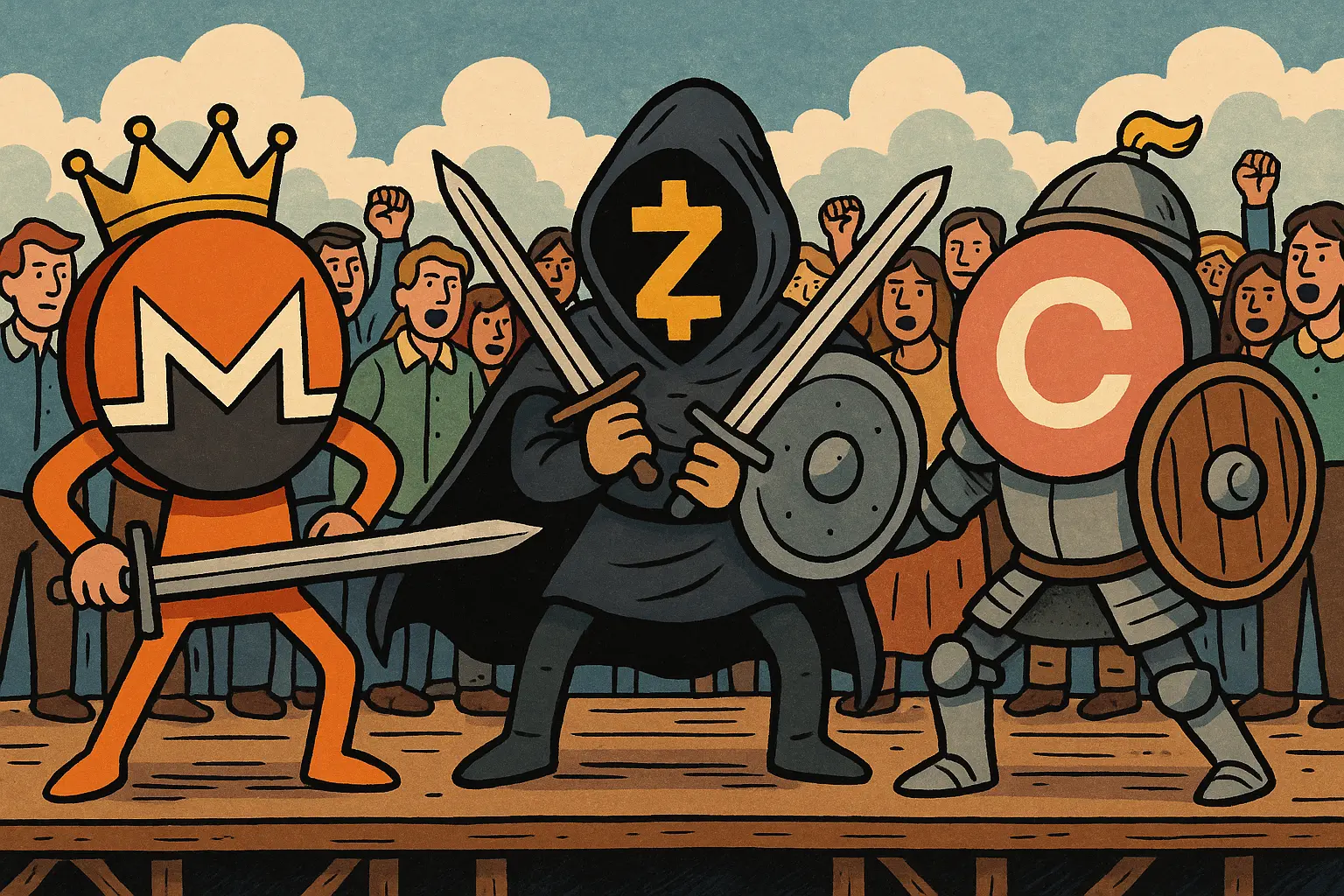
Tiger Research points out that privacy technology is a decisive narrative in 2026. Monero’s complete anonymity cannot be disclosed and does not support KYC or AML, facing regulatory exclusion. Zcash offers selective privacy but can only achieve full disclosure or full concealment, without granular disclosure. Canton Network achieves fine-grained permissions through Daml, allowing individual data provision, and has been adopted by DTCC.
Monero’s Complete Anonymity: The Dilemma of Privacy Purists
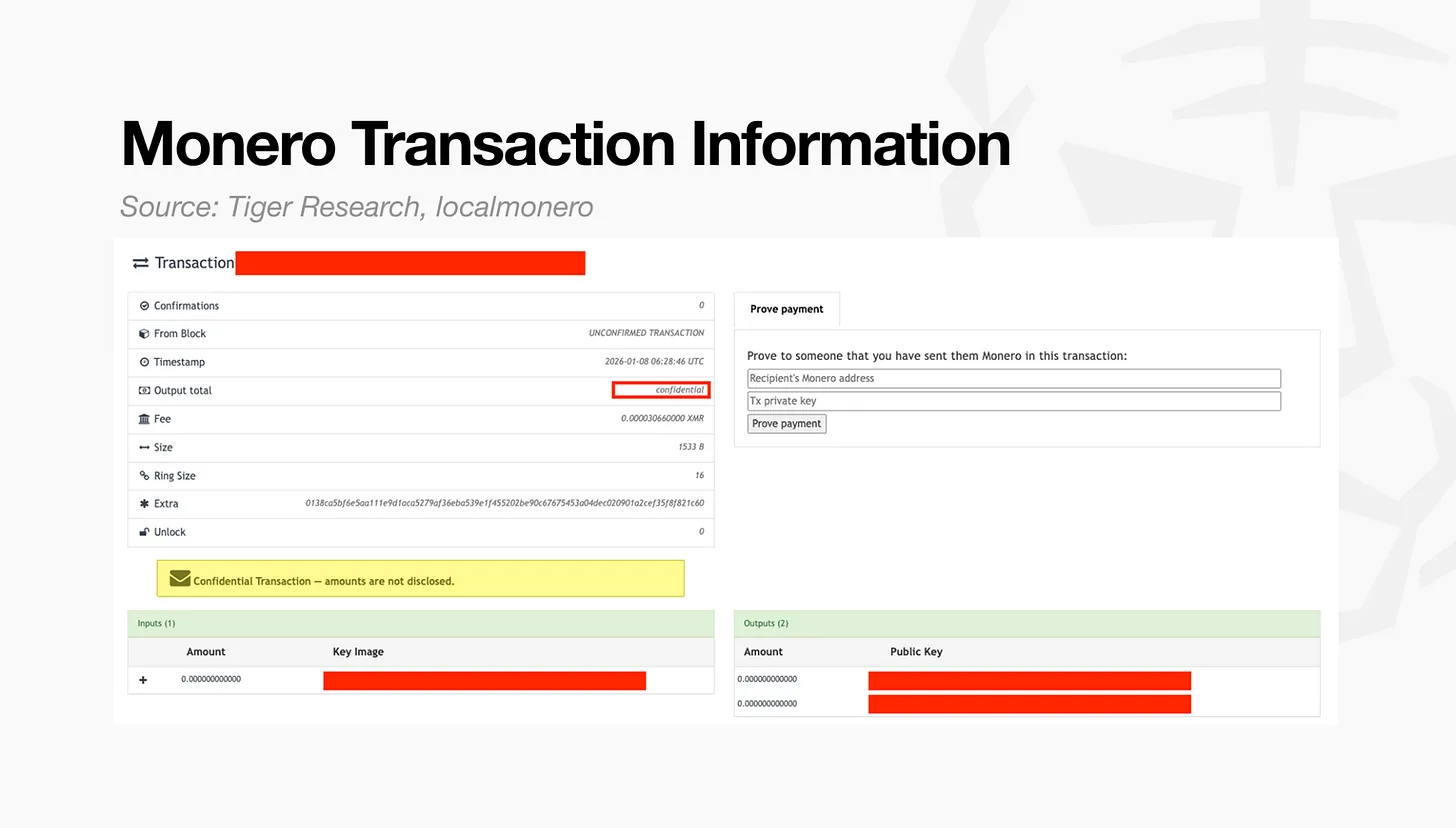
(Source: Tiger Research)
Monero represents the extreme form of blockchain privacy, with all transaction details permanently encrypted. The sender, receiver, and transaction amount are all hidden, a model in direct opposition to traditional blockchains. In Monero’s transaction records, transfer amounts are displayed as “confidential” rather than specific figures. Ring signature technology mixes a single sender with multiple decoys, making it appear as if multiple parties are sending funds simultaneously.
These mechanisms ensure transaction data remains opaque to all external observers, without exception. Monero’s primary objective is to prevent third-party surveillance; it is not about enabling selective disclosure, but rather aims to completely prevent external observers from extracting meaningful information. This design philosophy appeals to privacy-conscious individual users but completely disconnects it from institutional needs.
Financial institutions have Know Your Customer (KYC) and Anti-Money Laundering (AML) obligations for every transaction. They must retain transaction data internally and immediately respond to requests from regulators or supervisory authorities. However, in an environment built on Monero’s complete anonymity privacy model, all transaction data is irreversibly hidden. Because information cannot be accessed or disclosed under any circumstances, institutions are structurally unable to fulfill their compliance obligations.
Monero consequently faces regulatory suppression globally. Exchanges in multiple countries have been forced to delist Monero, and banks refuse to service transactions involving Monero. This regulatory hostility ensures Monero can never enter mainstream financial systems, destining it to circulate only in grey markets and among extreme privacy seekers. For blockchain projects seeking large-scale adoption and institutional recognition, Monero’s path is a dead end.
Zcash’s Selective Privacy: Seemingly Perfect Yet Awkwardly Flawed

(Source: Tiger Research)
Zcash attempts to find a balance between privacy and compliance. It offers selective privacy, allowing users to choose between transparent addresses (similar to Bitcoin) and shielded addresses (encrypted transaction details). Transactions sent to shielded addresses are recorded on the blockchain but stored in encrypted form. Address type, amount, sender, and receiver are all encrypted, with only parties granted view keys able to examine transaction details.
This design appears to solve Monero’s compliance issues, but reveals fatal flaws in practical application. Zcash does not allow users to choose which information to disclose; users must choose to disclose the entire transaction or fully conceal it. For example, in a transaction where “A sends B 100 dollars,” Zcash does not allow hiding only the amount. The transaction itself must be either completely hidden or completely disclosed.
In institutional transactions, different participants require different information. Not all participants need access to all data in a single transaction. For instance, regulators may only need to verify the transaction amount, auditors may only need to confirm the transaction time, while counterparties require complete information. Zcash’s binary choice structure cannot meet such granular disclosure requirements, making it unsuitable for complex institutional transaction workflows.
Furthermore, Zcash’s shielded address usage remains extremely low. According to on-chain data, over 95% of Zcash transactions use transparent addresses rather than shielded addresses. This phenomenon reveals an awkward truth: even when privacy options are provided, most users abandon their use due to technical complexity or interoperability issues. The existence of a privacy coin whose privacy features go unused deserves questioning.
Canton Network: Enterprise-Grade Solution for Fine-Grained Permissions
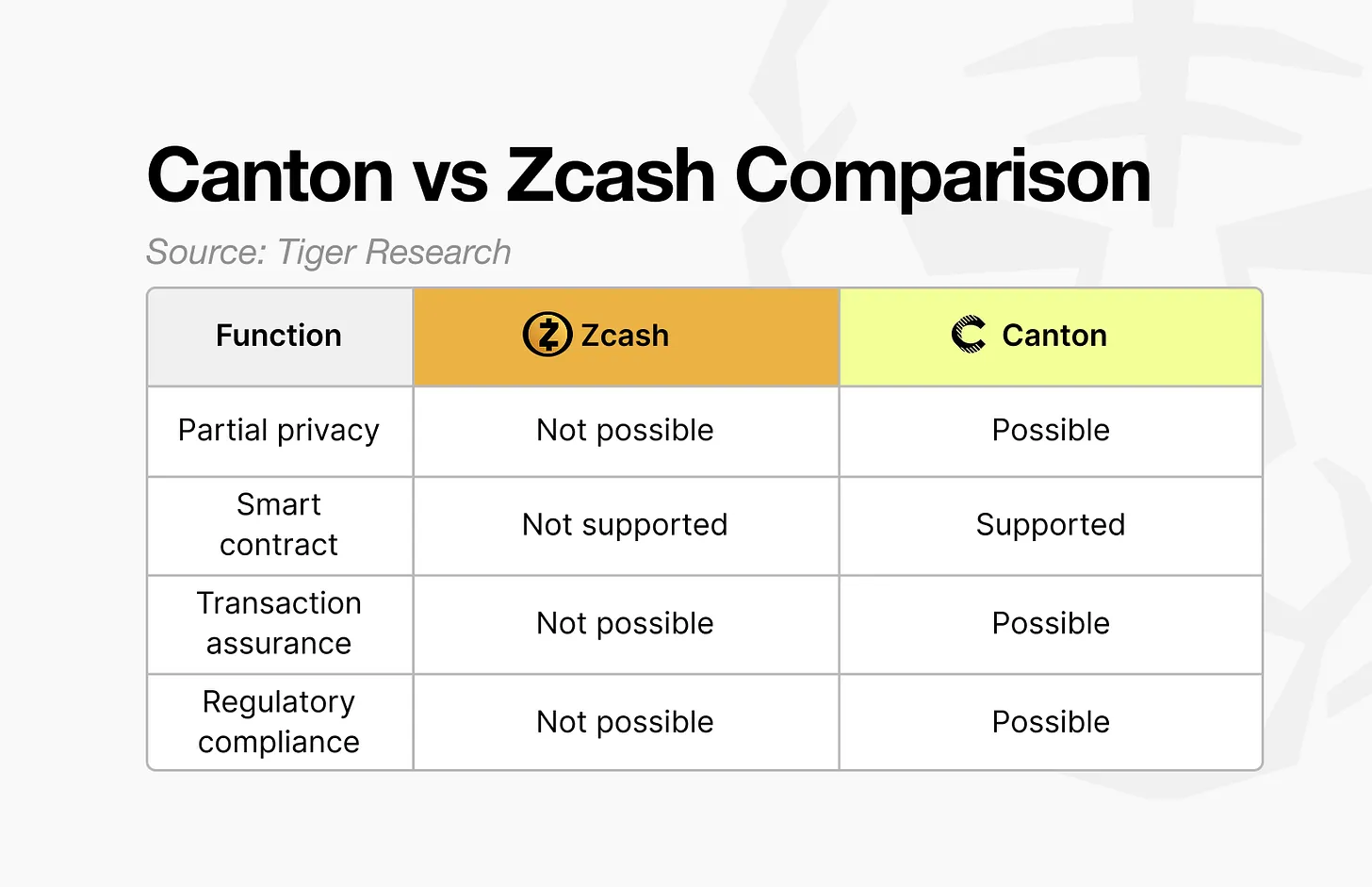
(Source: Tiger Research)
Canton Network represents a third evolutionary direction for privacy blockchains, designed specifically for institutional needs. Canton allows transaction information to be broken into separate components for management. If a regulator only requires the transaction amount between A and B, Canton enables institutions to provide only that specific information without disclosing counterparty identity or other sensitive details.
This fine-grained permission control is achieved through Daml, the smart contract language used by Canton Network. Daml differs from Ethereum’s Solidity or other general-purpose smart contract languages in that it considers privacy and permission separation from its inception. Each transaction participant can only see information relevant to themselves, and data owners can precisely control which information is visible to which entities.
Canton Network’s institutional adoption data says it all. It has been adopted by the Depository Trust & Clearing Corporation (DTCC) and is currently used by over 400 companies and institutions. DTCC is the world’s largest securities settlement organization, processing hundreds of trillions of dollars in transactions annually. Its choice of Canton over Zcash and other privacy solutions validates institutions’ critical need for fine-grained permission control.
Three Key Advantages of Canton Network Relative to Zcash
Granular Disclosure: Can disclose only amounts without counterparties, or only time without amounts, flexibly matching regulatory requirements
Workflow Compatibility: Daml language natively supports multi-party collaboration and permission separation, requiring no additional adaptation layers
Institutional Endorsement: DTCC adoption and 400+ institutional users create network effects, attracting more participants
Privacy blockchains evolve with changing demands. Early projects like Monero aimed to protect individual anonymity. However, as financial institutions and enterprises enter the blockchain environment, the meaning of privacy has shifted. Privacy is no longer defined as making transactions invisible to everyone; rather, the core objective has become protecting transactions while still meeting regulatory requirements. This shift explains why selective privacy models like Canton Network have garnered attention.
Disclaimer: The information on this page may come from third parties and does not represent the views or opinions of Gate. The content displayed on this page is for reference only and does not constitute any financial, investment, or legal advice. Gate does not guarantee the accuracy or completeness of the information and shall not be liable for any losses arising from the use of this information. Virtual asset investments carry high risks and are subject to significant price volatility. You may lose all of your invested principal. Please fully understand the relevant risks and make prudent decisions based on your own financial situation and risk tolerance. For details, please refer to
Disclaimer.
Related Articles
On-chain exchange Drift Protocol suffers a hack loss of $280 million—could the Solana ecosystem see a chain reaction?
Decentralized exchange Drift Protocol was hacked on April 2, resulting in losses of up to $280 million, becoming one of the largest DeFi security incidents in the Solana ecosystem. The attacker exploited a multisig vulnerability to obtain administrator keys and quickly transferred assets. Drift has paused deposits and withdrawals and has promised to continue updating the incident investigation. Security experts noted that this incident highlights the risks of high-privilege key management for DeFi protocols, urging stronger security measures to protect users’ assets.
ChainNewsAbmedia5m ago
Monad locks in $350 million, and its low fee rate and FDV being halved release a cautious signal
Monad blockchain reached a total value locked (TVL) of $355 million within about four months, setting a record for rapid growth, but its daily transaction fees are less than $3,000, indicating a disconnect between locked capital and real trading activity. At the same time, the fully diluted valuation of the MON token fell from $4.7 billion to about $2.2 billion, reflecting the market’s lack of confidence in its continued ability to attract users.
MarketWhisper9m ago
SlowMist Reveals the Drift Attack Chain: Multi-Signature Mechanism Change, Administrator Privileges Leaked
SlowMist analyzed the Drift Protocol hack, pointing out that the core vulnerability was that the multisig mechanism change did not include a time lock. After the attacker gained administrator privileges, they systematically extracted assets by forging tokens, manipulating oracles, and disabling security modules, ultimately stealing about 105,969 ETH. ZachXBT criticized Circle for not freezing USDC in time during this process, which had a negative impact on the industry and sparked widespread discussion.
MarketWhisper38m ago
A whale-led selloff is driving the Bitcoin market, and ETF institutional buy pressure is unable to turn the tide
A CryptoQuant report indicates that as of the end of March, Bitcoin’s “apparent demand” is -63,000 BTC, showing that the market has an oversupply situation, and institutional buying cannot offset retail selling. Starting in mid-2025, the giant whales began large-scale selling, pushing the market into a distribution phase. Although ETF institutional buying has increased, it has not been able to change the weak demand situation, and weakening domestic U.S. demand may further affect the market. Easing geopolitical tensions could become a catalyst for a short-term rebound.
MarketWhisper1h ago
ZachXBT criticized Circle for not taking action in the Drift hacker incident, with millions of USDC flowing out via CCTP
ZachXBT criticized Circle for not taking action in the Drift hacking incident, with millions of USDC moved from Solana to Ethereum. Circle has frozen part of its hot wallets, but progress has been slow to resume. He says Circle is a bad actor in the industry.
GateNews1h ago
HyperEVM suffers a major outage; the official status page shows it as normal, raising concerns
On April 2, on-chain monitoring firm PeckShield warned that HyperEVM could face a major outage, with blocks and transactions coming to a halt, impacting users’ transaction confirmations and smart contract interactions. The official status page, however, shows “All Systems Operational,” reflecting insufficient monitoring of HyperEVM layer conditions. This outage exposed issues with the new mainnet’s early stability; the specific causes are pending an official announcement.
MarketWhisper1h ago


