# FebNonfarmPayrollsUnexpectedlyFall

893.11K
💥Immediately following the data release, Bitcoin dropped below the psychological level of $70,000, falling as low as the $68,700-$69,000 range on some exchanges. This movement mirrored a general sell-off in stocks and risky assets. Investors shifted to "risk-off" positions as the weak employment data was interpreted as a recession signal. Oil prices rising above $90 due to tensions with Iran fueled stagflation fears, while the short-term strengthening of the dollar put pressure on BTC. However, this decline was limited; Bitcoin recovered during the day, trading near $70,000, and the total cap
BTC-1,33%
post-image
post-image
post-image
User_anyvip
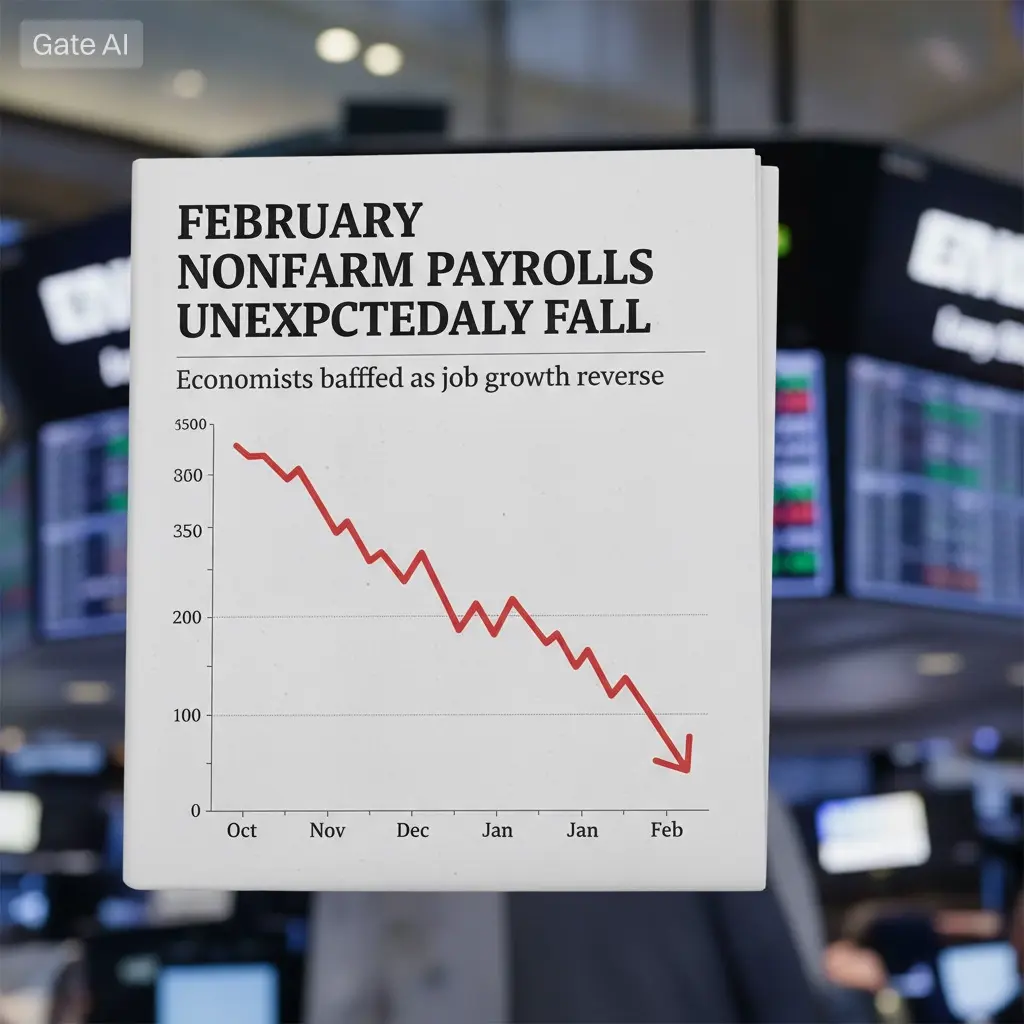
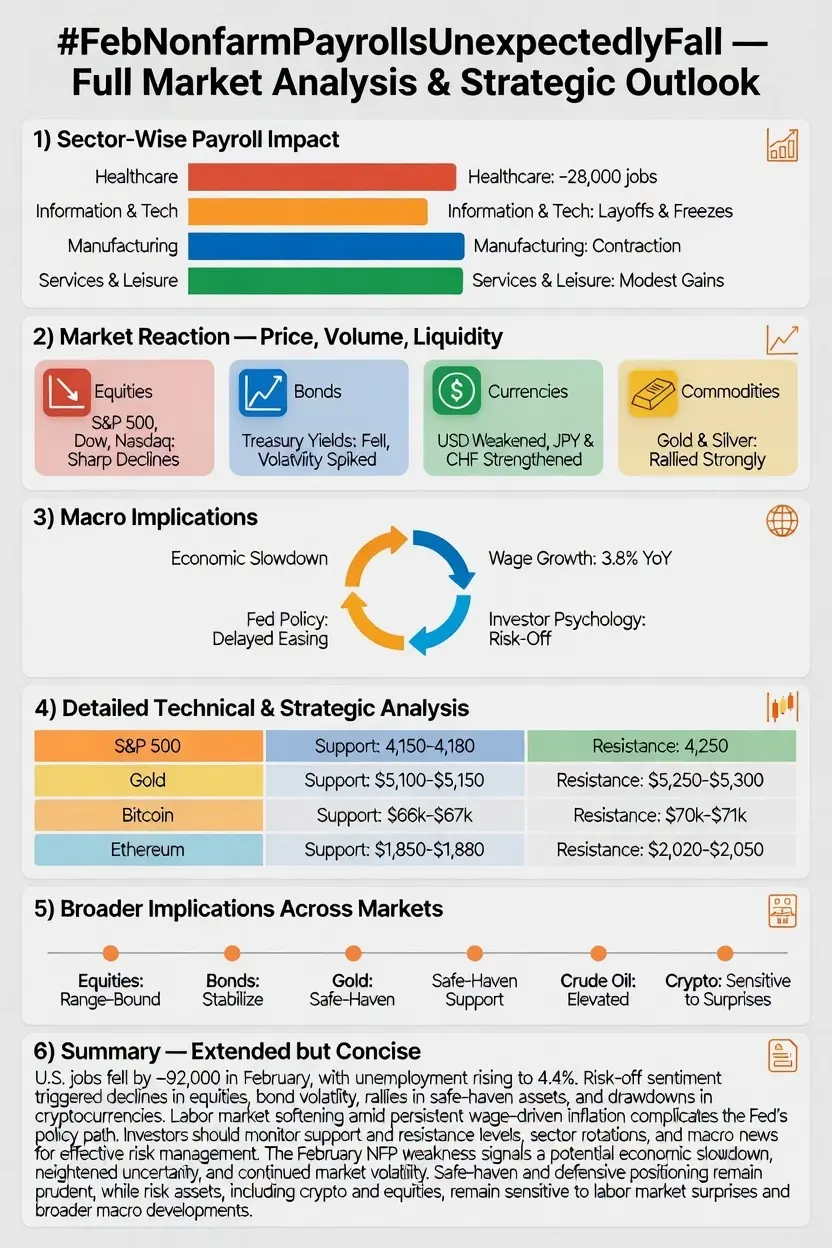
💥One of the most critical indicators of the US economy, nonfarm payrolls data, came as a major surprise with the February 2026 report released on March 6, 2026. According to data published by the US Bureau of Labor Statistics (BLS), total nonfarm employment decreased by 92,000 people in February. Economists had expected an increase of approximately 50-60,000 people. This unexpected decline, combined with the rise in the unemployment rate from 4.3% to 4.4%, strengthened signals of a cooling in the American labor market and resonated across a wide spectrum, from Wall Street to the Fed.
💥This decline is not just a one-month data point; it also represents a continuation of the weak trend that has been ongoing since the last quarter of 2025. The January 2026 data was revised downwards from 130,000 to 126,000, while the increase in December 2025 was also pulled into negative territory. Thus, the end of 2025 paints a much more fragile picture than previously thought. The healthcare sector, which has long been a driving force behind job growth, suffered a net loss in February due to strike activities. The nurses' strike in California, in particular, directly impacted employment in the sector. Construction and transportation/storage sectors were also hit by harsh winter weather conditions. Information technology and the federal government were already on a downward trend.
⏬Markets reacted immediately to this data. On Friday, the day the report was released, the Dow Jones index lost between 1.2% and 1.9%, while the S&P 500 and Nasdaq experienced similar losses. Bond yields initially fell but later recovered; the dollar showed mixed performance. Investors are concerned that this weak employment picture will fuel recession fears.
☝️Especially with the tensions in the Middle East stemming from Iran, and oil prices exceeding $91, stagflation scenarios have been brought back to the forefront. On the one hand, unemployment is rising, and on the other hand, energy costs are increasing; This dilemma is putting the Fed in a difficult position.
🔎From an analytical perspective, the February report seriously undermines hopes for a "soft landing." The labor market, which has been sustained by the health and social welfare sectors throughout 2025, is now showing broad-based weakness. Although average hourly earnings increased by 0.4% monthly to $37.32, this increase, while consistent with the inflation target, is outweighed by the psychological impact of job losses. Uncertainty regarding the Fed's interest rate policy has deepened: On the one hand, weak employment data fuels expectations of an early rate cut, while on the other hand, the oil shock could reignite inflation. Analysts state that the Fed will maintain its "data-dependent" stance, but this report increases the likelihood of a possible rate cut in June 2026.
Globally, the impact was felt immediately. European and Asian stock markets also opened negatively, while emerging markets were under pressure due to the strengthening dollar. For energy-importing countries like Turkey, the rise in oil prices poses additional risks in terms of both inflation and current account deficit. Investors will now be closely watching the March and April reports; while a single bad month may not necessarily mean a trend reversal, consecutive revisions and sector-specific losses are sounding the alarm. As a result, this data, circulating under the hashtag ✍️#FebNonfarmPayrollsUnexpectedlyFall, has put the first quarter of 2026 in a "wait and see" mode. While the US economy still has a strong foundation, this unexpected drop in employment sends a clear message to policymakers and investors: the labor market is cooling, and this cooling could reshape both domestic and global economic balances. The next report will show whether this decline is a temporary weather event and strike effect, or the beginning of a deeper slowdown. For now, uncertainty remains the biggest enemy of the markets.
repost-content-media
  • Reward
  • 3
  • Repost
  • Share
dragon_fly2vip:
2026 GOGOGO 👊
View More
BTC Falls Below $71,000! U.S. Crypto-Related Stocks Decline Broadly — Will the Crypto Market Continue to Drop?
Bitcoin (BTC) dipped below the $71,000 level in recent sessions, trading around $68,000–$70,800 on March 6, 2026, after earlier volatility pushed it toward $67,000–$71,000 ranges in daily highs/lows. The pullback was influenced by ongoing Middle East geopolitical tensions (including U.S.-Iran escalation), rising oil prices, and a stronger U.S. dollar pressuring risk assets. Crypto-linked U.S. stocks, such as those tied to exchanges and miners, saw broad declines alongside the broader
BTC-1,33%
CryptoSelfvip
BTC Falls Below $71,000! U.S. Crypto-Related Stocks Decline Broadly — Will the Crypto Market Continue to Drop?
Bitcoin (BTC) dipped below the $71,000 level in recent sessions, trading around $68,000–$70,800 on March 6, 2026, after earlier volatility pushed it toward $67,000–$71,000 ranges in daily highs/lows. The pullback was influenced by ongoing Middle East geopolitical tensions (including U.S.-Iran escalation), rising oil prices, and a stronger U.S. dollar pressuring risk assets. Crypto-linked U.S. stocks, such as those tied to exchanges and miners, saw broad declines alongside the broader market dip.
Spot Bitcoin ETFs experienced mixed flows: while some days showed strong inflows (e.g., over $200M–$300M net on certain sessions led by BlackRock's IBIT), March 6 reflected softer sentiment with outflows in parts of the week. Total crypto market cap hovered near $1.36T–$1.4T levels. Analysts view $67,000–$68,000 as near-term support; a break lower could target $60,000–$64,000 zones seen earlier in the year. However, institutional accumulation during dips and long-term bullish structures suggest the correction may be temporary, with potential rebounds if geopolitical risks ease or ETF inflows resume strongly.
#FebNonfarmPayrollsUnexpectedlyFall #CryptoMarketsDipSlightly
  • Reward
  • 15
  • Repost
  • Share
kader1vip:
To The Moon 🌕
View More
#FebNonfarmPayrollsUnexpectedlyFall
Is the US Labor Market Finally Cracking? 🤔
Just in: #FebNonfarmPayrollsUnexpectedlyFall. The latest jobs data is out, and it missed estimates by a significant margin. This isn't just a small deviation; it's a potential game-changer for the macro landscape.
Here is the breakdown of what this means for crypto: 👇
1. The "Fed Pivot" Narrative Gains Strength
A cooling labor market takes the pressure off the Federal Reserve to keep raising rates. If jobs are shrinking, the focus could shift back to stimulating growth. For crypto, this could mean increased liqui
BTC-1,33%
post-image
  • Reward
  • 8
  • Repost
  • Share
User_anyvip:
I wholeheartedly celebrate your International Women's Day, wishing you all the best. You are always an inspiration with your hard work, strength, and presence. Happy International Women's Day, March 8th.
View More
The Number the Market Wasn't Ready For
#FebNonfarmPayrollsUnexpectedlyFall · March 6, 2026
The consensus was +55,000.
The reality: -92,000.
Not a miss. A reversal.
The third negative payroll print in five months — and the market felt every one of those three words at once. Unemployment hit 4.4%. The shock was sharp enough to trigger the universal reflex: reduce risk, raise cash, ask questions later.
The Immediate Reaction
Bitcoin dropped more than 5% on release day and fell below $69,000.
Bitcoin ETFs saw $228 million in outflows in a single session. That number tells you something specific —
BTC-1,33%
post-image
  • Reward
  • 15
  • Repost
  • Share
MuteVersevip:
To The Moon 🌕
View More
#FebNonfarmPayrollsUnexpectedlyFall
📉 U.S. Nonfarm Payrolls Shock Markets: Job Growth Falls Below Expectations
The latest U.S. economic data has delivered a surprise to global markets. The Nonfarm Payrolls (NFP) report came in below market expectations, signaling that the pace of job creation in the United States may be slowing.
Since the labor market is one of the most important indicators for the Federal Reserve’s monetary policy, this unexpected decline has quickly attracted the attention of investors across stocks, bonds, and crypto markets.
📊 Why the Labor Market Data Is So Important
T
BTC-1,33%
post-image
  • Reward
  • 1
  • Repost
  • Share
Discoveryvip:
To The Moon 🌕
#FebNonfarmPayrollsUnexpectedlyFall — US Labor Market Shock 📉
The latest US Nonfarm Payroll (NFP) report delivered a major surprise: instead of the expected +59K jobs, the economy lost 92,000 positions, marking the largest labor slowdown since 2024.
Key Data
Payroll Change: -92,000 (vs +59K expected)
Unemployment Rate: 4.4% (previous 4.3%)
Wage Growth: 0.3% MoM, indicating slower income expansion
January and December figures were revised downward, weakening the narrative of a resilient labor market.
Market Impact Analysis
Primary Drivers of the Drop
1️⃣ Healthcare Strike – Kaiser strike mater
BTC-1,33%
ETH-0,63%
PAXG-0,11%
post-image
post-image
  • Reward
  • 2
  • Repost
  • Share
xxx40xxxvip:
2026 GOGOGO 👊
View More
#FebNonfarmPayrollsUnexpectedlyFall
📊 U.S. Labor Market Surprise: Nonfarm Payrolls Unexpectedly Fall
The latest U.S. Nonfarm Payrolls (NFP) report has surprised global markets as job growth came in below expectations. This unexpected slowdown in employment growth signals that the U.S. labor market may be starting to cool after a long period of strength.
For investors and crypto traders, this development is extremely important because labor market data directly influences Federal Reserve policy decisions.
📉 Why the NFP Data Matters
Nonfarm Payrolls is one of the most closely watched economic
BTC-1,33%
post-image
  • Reward
  • Comment
  • Repost
  • Share
#FebNonfarmPayrollsUnexpectedlyFall 📉
US Labor Market Shock – Recession Fears Return
The latest US Nonfarm Payroll report delivered a major surprise.
Instead of the expected +59K job growth, the US economy lost 92,000 jobs, signaling the biggest labor slowdown since 2024.
🔎 Key Data
• Payroll Change: -92,000 (vs +59,000 expected)
• Unemployment Rate: 4.4% (previous 4.3%)
• Wage Growth: 0.3% MoM, showing slower income growth
January and December numbers were also revised downward, weakening the narrative of a strong labor market.
⚠️ What Caused the Drop?
1️⃣ Healthcare strike impact – A large
BTC-1,33%
PAXG-0,11%
post-image
  • Reward
  • 8
  • Repost
  • Share
xxx40xxxvip:
To The Moon 🌕
View More
BTC Falls Below $71,000! U.S. Crypto-Related Stocks Decline Broadly — Will the Crypto Market Continue to Drop?
Bitcoin (BTC) dipped below the $71,000 level in recent sessions, trading around $68,000–$70,800 on March 6, 2026, after earlier volatility pushed it toward $67,000–$71,000 ranges in daily highs/lows. The pullback was influenced by ongoing Middle East geopolitical tensions (including U.S.-Iran escalation), rising oil prices, and a stronger U.S. dollar pressuring risk assets. Crypto-linked U.S. stocks, such as those tied to exchanges and miners, saw broad declines alongside the broader
BTC-1,33%
  • Reward
  • 30
  • Repost
  • Share
ApexStarvip:
To The Moon 🌕
View More
#FebNonfarmPayrollsUnexpectedlyFall ⚡ Flash Analysis: Jobs Report Flips Bullish for Crypto?
The Reality Check:
Forget the 92,000 jobs lost for a second. The market isn't just looking at the headline; it's looking at the consequence.
The New Math:
1. Bad News: Economy adds -92k jobs (ouch).
2. The Reaction: Traders now bet the Fed cuts rates in 2026 to fix it.
3. The Result: Rates down = Liquidity up.
4. The Play: Liquidity up = Crypto up.
The Thesis:
We are watching a potential "bad news is good news" scenario play out in real-time. The labor market is cooling just enough to force the Fed's ha
BTC-1,33%
  • Reward
  • Comment
  • Repost
  • Share
Load More