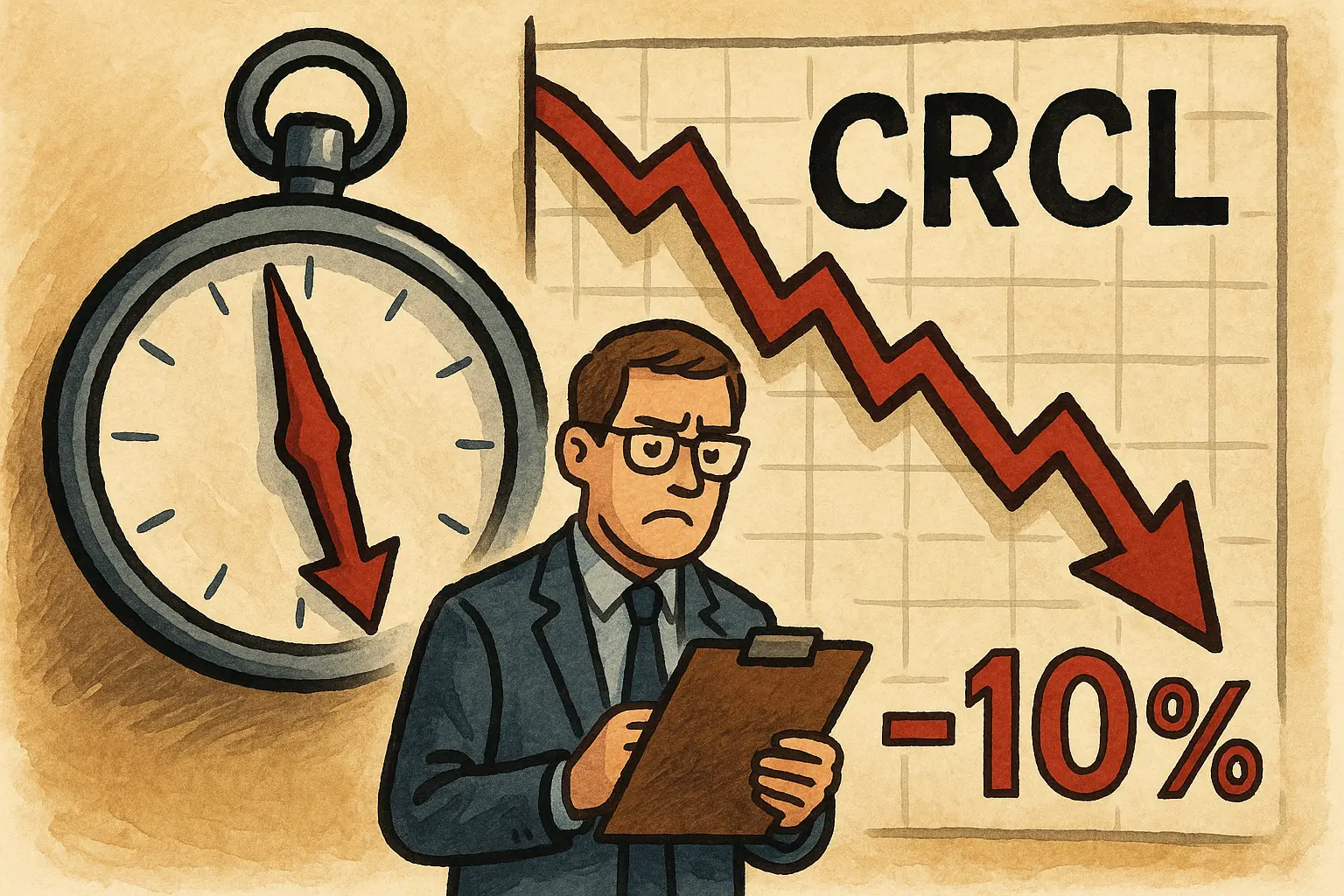
Stablecoin issuer Circle Internet Group (ticker: CRCL) fell 9.9% on Thursday on the Nasdaq, closing at $85.10. A research firm, Compass Point, downgraded CRCL to “Sell,” setting a price target of $77; an investigation into a class action lawsuit stemming from the hack incident involving the decentralized exchange Drift Protocol surfaced on the same day.
Compass Point Downgrades: Interpreting the $77 Price Target Signal
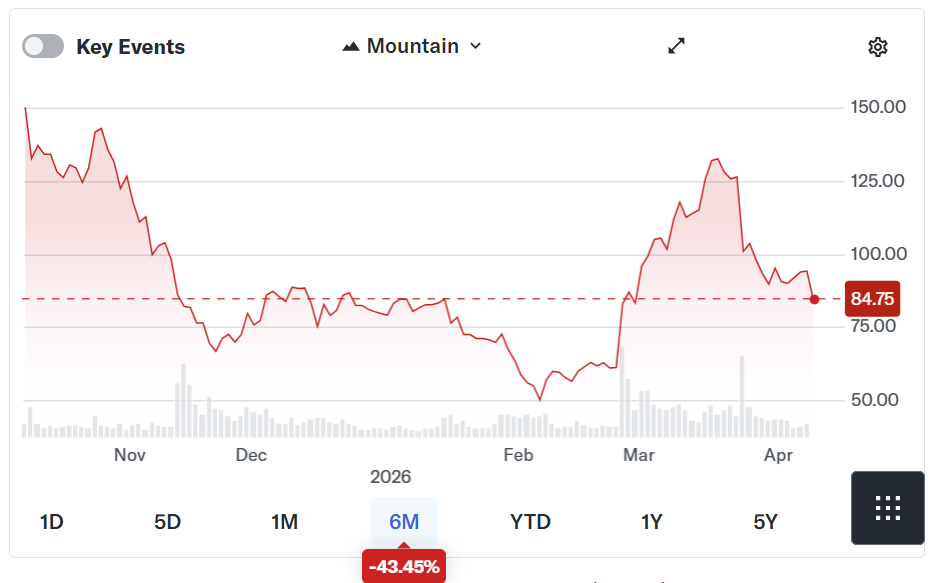 (Source: Yahoo Finance)
This time, Compass Point cut CRCL from “Neutral” to “Sell.” The $77 price target still leaves roughly 9% downside from Thursday’s closing price of $85.10, reflecting the firm’s cautious assessment of Circle’s mid-term business outlook.
Analyst Views on CRCL Are Split
Compass Point (bearish): Rating “Sell,” price target $77, saying regulatory risk and deteriorating market sentiment create real pressure
Bernstein (relatively optimistic): Believes market concerns are being exaggerated, pointing out that USDC adoption continues to rise, reserve income is strong, and core business fundamentals have not been shaken
It is worth noting that CRCL shares rose significantly between February and March due to higher stablecoin adoption, and this pullback also partly reflects market behavior of taking profits after reaching high levels, rather than being driven entirely by worsening fundamentals.
Spillover Effects of the Drift Protocol Legal Investigation
This week, an investigation into a class action lawsuit related to the Drift Protocol exploit officially kicked off. Injured investors were urged to contact the Gibbs Mura law firm in Oakland, California, to assess possible legal avenues for recovery. Losses estimated from this incident are as high as $280 million.
Circle was not directly involved in this hacked incident, but one key detail has sparked widespread market discussion: after the attack, Drift’s attacker transferred the stolen assets to USDC. As a result, observers have speculated whether Circle should take freezing action against the related addresses. Circle ultimately did not make a freeze decision, but the public discussion surrounding the issue has, at the market level, heightened awareness of counterparty risk for DeFi platforms, and has also created indirect downward pressure on CRCL’s stock price through sentiment transmission.
Regulatory Uncertainty: Stalled Stablecoin Legislation Creates Structural Pressure
In addition to the short-term events above, Circle also faces ongoing pressure from the regulatory side. Progress on U.S. market-structure legislation has stalled, and the compliance pathway for stablecoins remains unclear; banking industry groups continue lobbying against yield-bearing stablecoins entering a legal framework, directly limiting the potential expansion space for USDC’s business model. Compass Point’s rating downgrade is a comprehensive judgment made after incorporating the structural risks above into the overall assessment, rather than simply responding to short-term stock-price volatility.
Frequently Asked Questions
What company does CRCL stock represent, and what is its core business?
CRCL is the stock ticker for Circle Internet Group on the Nasdaq. Circle is the world’s largest issuer of the dollar stablecoin USDC. Its core revenue comes from interest generated by holding USDC reserve assets (mainly U.S. Treasury bills). Performance is highly dependent on interest-rate levels and the market circulation size of USDC.
What are the main reasons for Compass Point downgrading the CRCL rating to “Sell”?
Compass Point’s downgrade assessment includes multiple negative factors, such as the stalling of U.S. market-structure legislation, continued lobbying by banks against yield-bearing stablecoins, and the indirect impact of the Drift Protocol exploit incident on market sentiment. A $77 price target implies about 9% downside from current levels.
Why did the Drift Protocol exploit incident weigh on Circle’s stock price?
Circle was not directly involved in the Drift Protocol hack incident, but the hacker’s move to transfer stolen assets to USDC sparked market debate over whether Circle should intervene with a freeze. Although Circle did not take action, this controversy strengthened investors’ awareness of counterparty risk on DeFi platforms and, through sentiment transmission in the market, created selling pressure on publicly traded stablecoin-related stocks.
Disclaimer: The information on this page may come from third parties and does not represent the views or opinions of Gate. The content displayed on this page is for reference only and does not constitute any financial, investment, or legal advice. Gate does not guarantee the accuracy or completeness of the information and shall not be liable for any losses arising from the use of this information. Virtual asset investments carry high risks and are subject to significant price volatility. You may lose all of your invested principal. Please fully understand the relevant risks and make prudent decisions based on your own financial situation and risk tolerance. For details, please refer to
Disclaimer.
Related Articles
Circle Partners OSL to Expand USDC Access Across Markets
OSL integrates USDC for 1:1 conversions, trading pairs, and unified margin use across crypto and fiat markets.
Partnership adds tokenized assets like USYC, linking traditional finance products with blockchain-based liquidity tools.
Circle introduces native USDC bridging, enabling secure c
CryptoFrontNews04-23 11:12
RedotPay Adds SUI and USDC-Sui for Global Payments
RedotPay adds SUI and USDC-Sui, allowing 7M users to transact globally across 130M merchants in over 100 countries.
Native USDC support on Sui improves efficiency, removing reliance on bridged tokens and enabling near-instant settlement.
Integration links blockchain payments with
CryptoFrontNews04-23 09:17
Circle, OSL Expand USDC Access as Asia Cross-Border Demand Grows
Institutional access to digital dollar liquidity is growing as cross-border settlement demand rises and stablecoins gain a larger role in market infrastructure. OSL Group and Circle are expanding USDC use across trading, payments, and settlement in Asia.
Key Takeaways:
OSL Group expanded USDC acc
Coinpedia04-23 01:35
CHIP Liquidations Hit $1.2M in One Hour as Trader neoyokio.eth Opens $2.2M Long Position
Gate News message, April 23 — According to monitoring data from Hyperinsight and Coinglass, CHIP led all assets in liquidations over the past hour with approximately $1.2 million in liquidated positions, primarily long positions. On the Hyperliquid platform, a single address was liquidated twice ove
GateNews04-23 01:32
Pornhub Switches Creator Payouts from USDT to USDC for Greater Reliability
Pornhub swapped creator payouts from USDT to USDC, citing reliability and MiCA compliance; older USDT-PayPal ties and TronLink-based partnerships have been removed.
Abstract: Pornhub replaced USDT payouts with USDC for creators, arguing USDC is more reliable and MiCA-compliant. The move ends PayPal-USDT ties and TronLink-based payment infrastructure, and those partnerships were removed from the creator payment page.
GateNews04-23 00:31
Circle Proposes Emergency Rate Overhaul for Aave's Frozen USDC Pool
Summary: Circle proposes an emergency Aave V3 USDC overhaul, lifting Slope 2 to ~40% to restore healthy utilization (target ~85%), with max rate rising to ~48%, arguing borrowers ignore rates; also suggests pausing the USDC risk oracle.
Abstract: Circle has urged an emergency overhaul of Aave V3's USDC pool after four days at near-6% idle liquidity and 99.87% utilization following the KelpDAO exploit. The plan would immediately raise Slope 2 for USDC deposits from about 10% to 40%, followed by governance ratification of a 50% target within a week. The aim is to attract supply and restore balanced utilization, with a move to a higher max supply rate (about 48%) at full utilization. Liao argues current borrowers use USDC borrowing as a queue-bypass mechanism and are insensitive to current rates, making supply-focused incentives essential. The proposal also recommends pausing the USDC Risk Oracle due to past underperformance. Circle’s stance is notable because a stablecoin issuer is essentially saying the market for its asset on Aave is broken.
CryptoFrontier04-22 21:04


