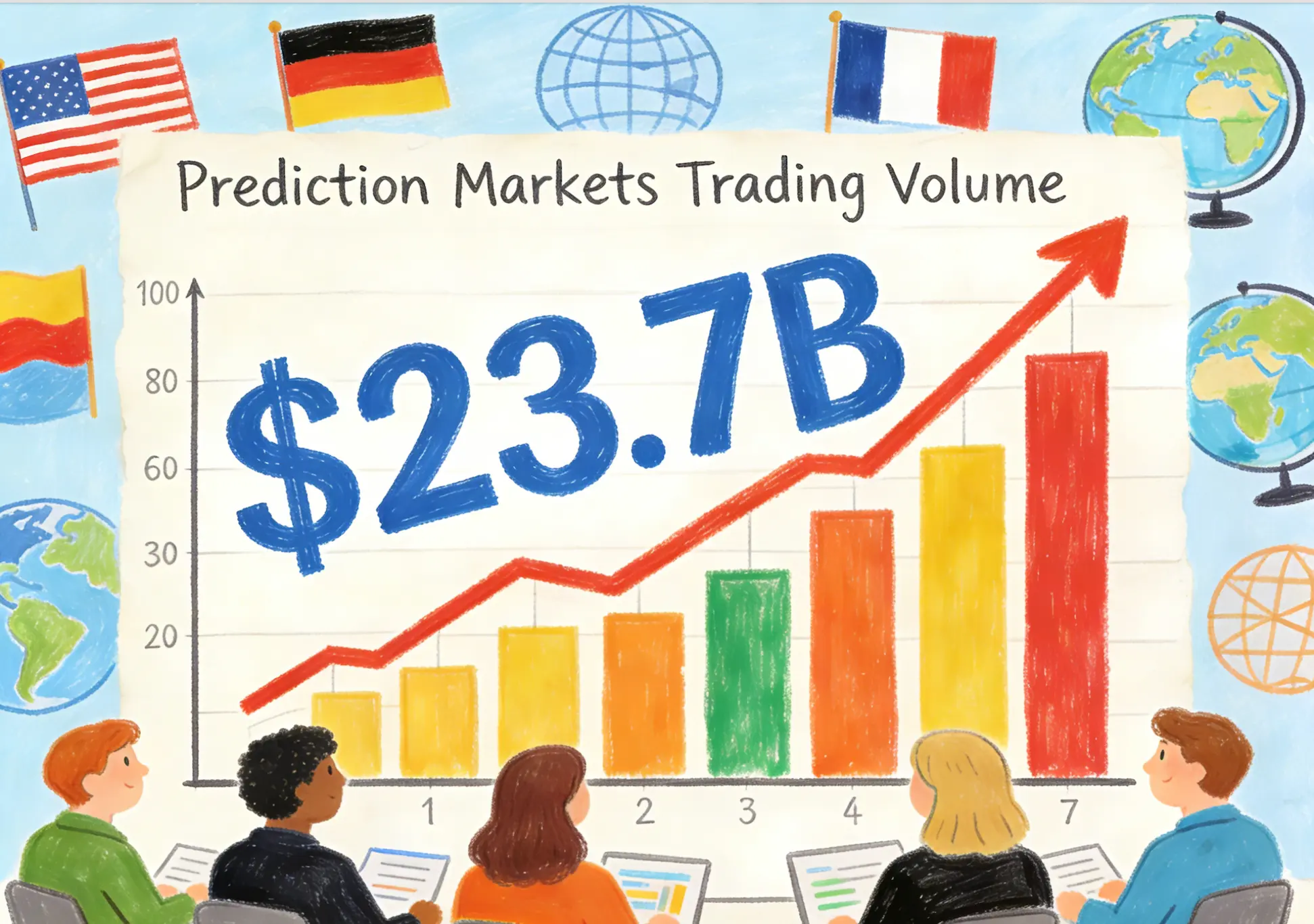
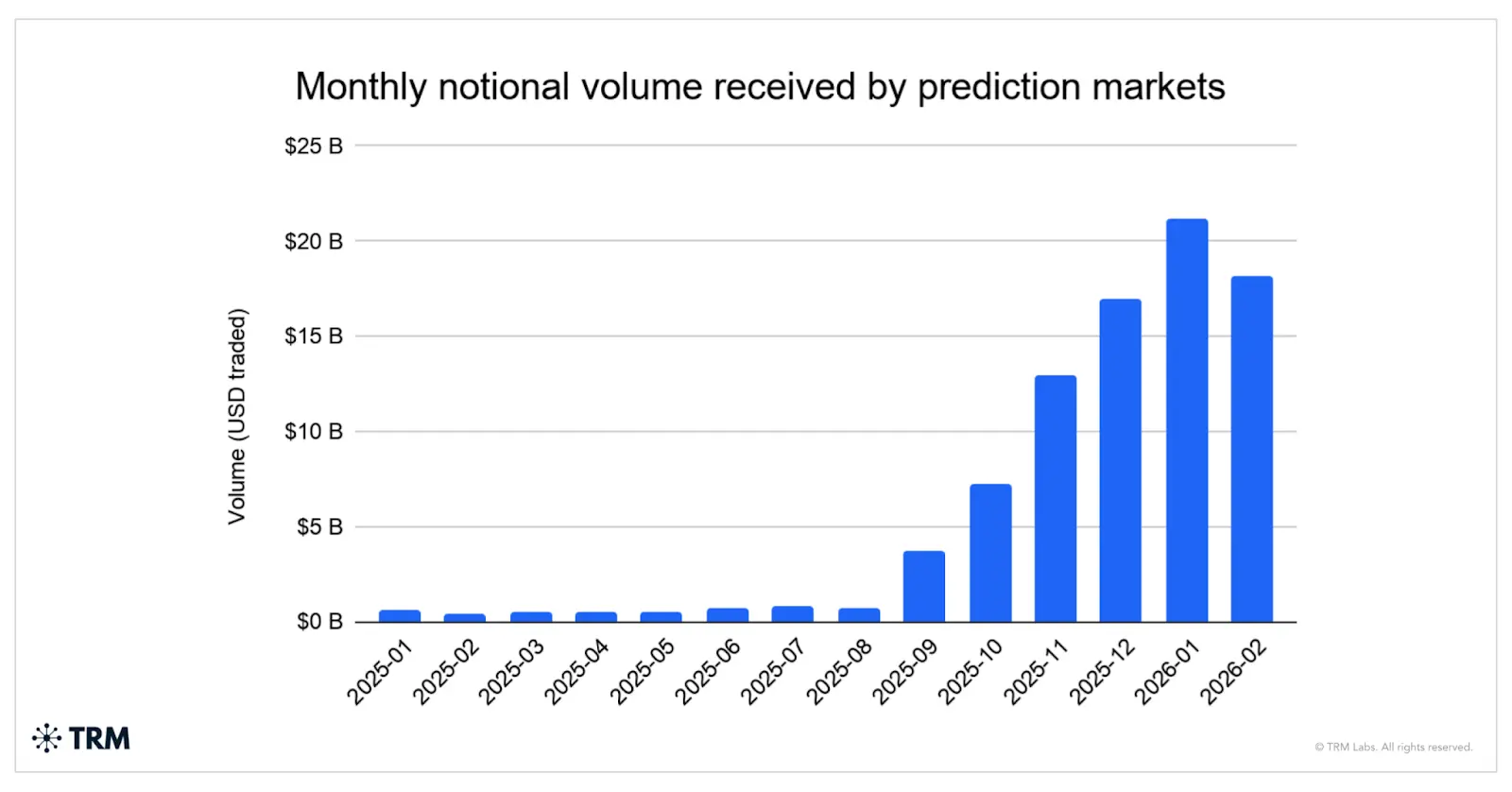
 Prediction market transaction volume reached approximately $23.7 billion in March 2026, a sharp increase from $1.9 billion in the same period last year, driven by growing interest in geopolitical and political event contracts, improved accessibility, and positive regulatory developments.
Blockchain intelligence firm TRM Labs reported that the sector has scaled rapidly with Google Finance and mainstream media coverage of live odds, positioning prediction markets as real-time indicators of geopolitical and macroeconomic events.
Monthly Transactions Increase 2,838% as User Base Expands to 840,000 Wallets
 (Source:TRM)
The number of prediction market transactions for March 2026 exceeded 191 million, representing a 2,838% increase compared to March 2025, according to Dune Analytics data. Monthly unique wallets nearly tripled in the six months leading to February 2026, reaching 840,000, indicating that growth is driven by a broad expansion of the participant base rather than solely by larger bets from existing users.
(Source:TRM)
The number of prediction market transactions for March 2026 exceeded 191 million, representing a 2,838% increase compared to March 2025, according to Dune Analytics data. Monthly unique wallets nearly tripled in the six months leading to February 2026, reaching 840,000, indicating that growth is driven by a broad expansion of the participant base rather than solely by larger bets from existing users.
Notional trading volume reached approximately $23.9 billion in March 2026, down 12% from January’s all-time high but still representing sustained double-digit billion monthly volumes. Polymarket set a single-day volume record of $425 million on February 28, 2026, surpassing the prior high from Election Day 2024, driven almost entirely by Iran-related markets resolving simultaneously.
Geopolitical and US Political Contracts Dominate Trading Activity
Geopolitical events, US politics, and macroeconomic decisions account for the majority of trading volume, with crypto-native topics representing a smaller share of overall activity. TRM Labs analysis of Polymarket data showed that the five highest-volume contracts as of March 2026 centered on 2028 US presidential nominations and whether Israeli Prime Minister Benjamin Netanyahu would remain in office by year-end.
A single market—“Will the US strike Iran by Feb 28, 2026?”—attracted $73 million in February 2026, becoming the largest geopolitical contract in Polymarket’s history. The “Khamenei out as Supreme Leader of Iran by February 28” market surged from $23,000 in volume on February 27 to $29.6 million on February 28, a 1,275x increase in a single day. Traders simultaneously moved into longer-dated Iran contracts as participants began pricing extended timelines for regime change.
User Segmentation Reveals Distinct Trading Patterns across Experience Levels
Wallets with between 11 and 1,000 lifetime fills account for 44.7% of all trades and $869 million in volume, making them the most active cohort. Wallets with over 10,000 fills—consistent with algorithmic market makers posting continuous buy and sell orders—account for 35.2% of trades and $774 million in volume. Casual bettors who placed a single trade represent less than 0.2% of activity and only $3.5 million in volume.
Median trade size varies by experience level: first-time bettors placed median bets of $30, while the most active wallets placed a median of just $12 per trade, suggesting that high-frequency participants execute many small trades to capture spreads rather than making large conviction bets. Across every experience level, geopolitical and US political markets account for the majority of activity, while crypto price markets represent a consistently small share.
The ten most profitable Polymarket wallets in early 2026 reflected three main strategies: macro conviction focused on Federal Reserve rate decisions, algorithmic market-making across Oscars markets and NBA games, and event-driven opportunism timed to specific price movements or geopolitical developments.
Regulatory Scrutiny and Market Integrity Challenges Emerge
Prediction markets have faced increasing scrutiny over allegations of insider trading and potential violations of gambling laws. On March 23, 2026, Kalshi and Polymarket announced plans to introduce trading guardrails, including restrictions on participants with potential access to non-public information and enhanced market integrity controls. US lawmakers unveiled a bipartisan bill to ban event contracts that resemble casino-style games.
TRM Labs analysis identified clusters of potentially coordinated activity coinciding with major geopolitical events. Four wallets that turned approximately $40,000 into $872,000 betting on US military action against Iran in January and February 2026 shared infrastructure, including funding through the same bridge within a narrow time window, synchronized wallet creation, and identical exit behavior. The analysis noted that these findings do not prove insider trading but demonstrate how on-chain data can surface anomalies warranting further investigation.
Nevada gaming regulators sued Kalshi in February 2026, and the Arizona Attorney General filed lawsuits against Kalshi in March 2026, representing ongoing regulatory headwinds despite the sector’s explosive growth.
Institutional Integration Accelerates with NYSE Investment and Robinhood Partnership
ICE/NYSE, parent of the New York Stock Exchange, announced a strategic investment of up to $2 billion in Polymarket at an $8 billion valuation in October 2025. A March 2026 partnership with Kalshi brought Robinhood’s prediction markets hub to its 27 million funded brokerage accounts. Google Finance began embedding live Polymarket and Kalshi odds, and prediction market prices began appearing in mainstream news coverage, creating a distribution flywheel.
In January 2025, Kalshi launched sports event contracts in all 50 states. A new CFTC chairman withdrew proposed rules restricting prediction markets in January 2026, and Polymarket received a no-action letter from the CFTC, reducing enforcement risk and paving the way for its re-entry into the US market.
FAQ
What are prediction markets and how have they grown in 2026?
Prediction markets are platforms where users trade contracts on the outcome of future events, with prices reflecting implied probabilities. Monthly trading volume grew from $1.2 billion in early 2025 to over $20 billion by January 2026, with monthly unique wallets reaching 840,000 in February 2026.
What types of events drive the most trading activity on prediction markets?
Geopolitical events, US politics, and macroeconomic decisions account for the majority of trading volume. Crypto-native topics now represent a smaller share of overall activity. High-volume markets in 2026 have included US-Iran conflict scenarios, Federal Reserve rate decisions, and 2028 US presidential election contracts.
What regulatory challenges are prediction markets facing?
Prediction markets face scrutiny over insider trading allegations and potential gambling law violations. Nevada gaming regulators sued Kalshi in February 2026, Arizona filed lawsuits in March 2026, and US lawmakers have proposed legislation to ban casino-style event contracts. Both Polymarket and Kalshi introduced trading guardrails on March 23, 2026 to address market integrity concerns.
Disclaimer: The information on this page may come from third parties and does not represent the views or opinions of Gate. The content displayed on this page is for reference only and does not constitute any financial, investment, or legal advice. Gate does not guarantee the accuracy or completeness of the information and shall not be liable for any losses arising from the use of this information. Virtual asset investments carry high risks and are subject to significant price volatility. You may lose all of your invested principal. Please fully understand the relevant risks and make prudent decisions based on your own financial situation and risk tolerance. For details, please refer to
Disclaimer.


