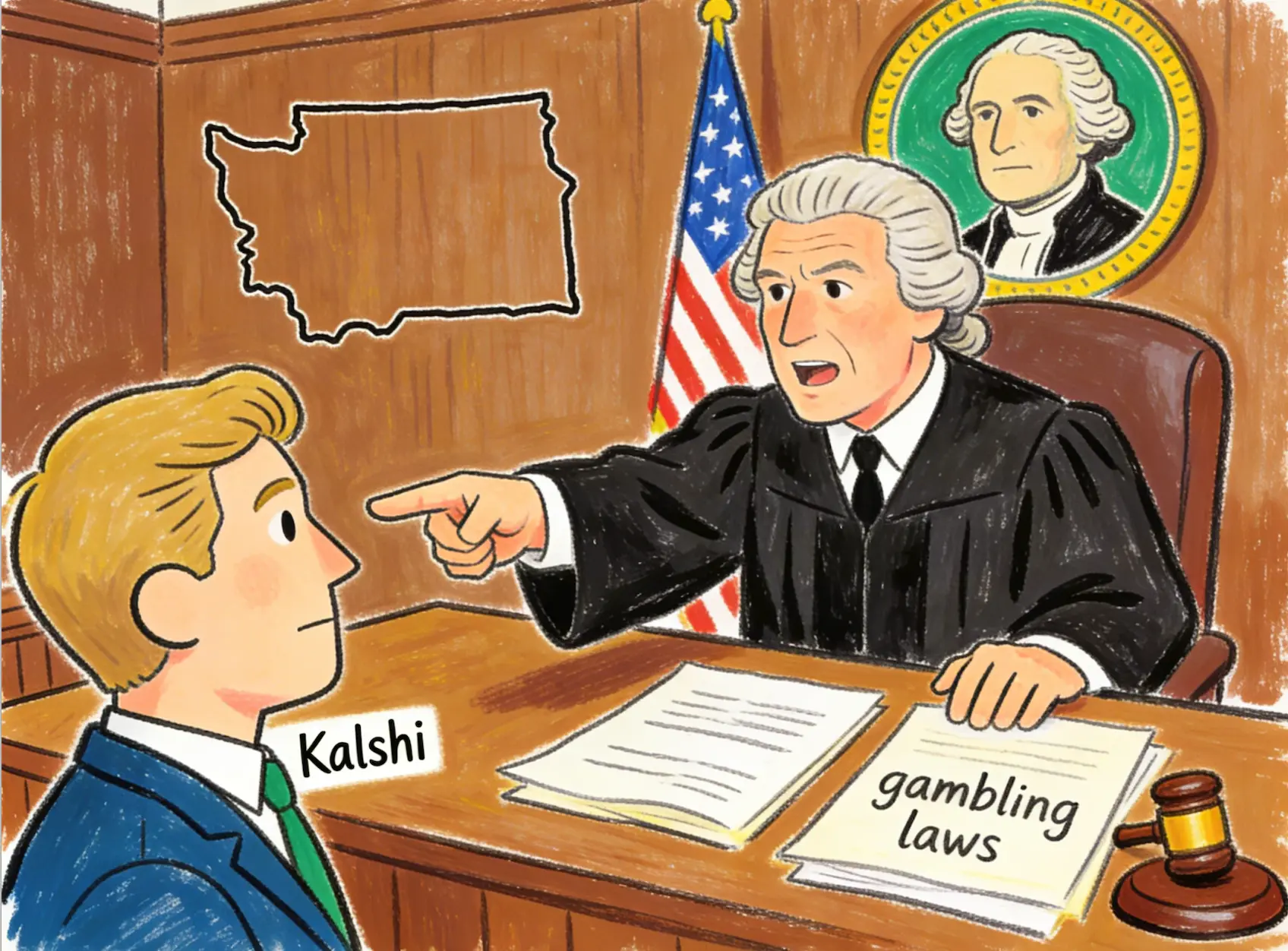
 Washington State Attorney General Nicholas W. Brown filed a lawsuit on March 28, 2026 against prediction market provider Kalshi, alleging the company violated the Washington Gambling Act by offering unlicensed wagering on sports, elections, entertainment and other events.
The lawsuit seeks restitution for Washington residents who lost money on the platform and marks the latest in a series of state-level legal actions challenging the classification of prediction markets as federally regulated derivatives rather than state-prohibited gambling operations.
Washington Lawsuit Alleges Kalshi Products Meet State Definition of Gambling
The complaint filed in King County Superior Court asserts that Kalshi’s offerings meet every definition of gambling under Washington state law. Washington defines gambling as “staking or risking something of value upon the outcome of a contest of chance or a future contingent event not under the person’s control or influence, upon an agreement or understanding that the person or someone else will receive something of value in the event of a certain outcome.”
The lawsuit alleges Kalshi allows bets on sports spreads, under/overs, player props and parlays, along with wagers on election outcomes, entertainment events and thousands of other topics. The state’s filing notes that Washington outlawed online gambling in 2006, with the sole exception of sports wagers placed and accepted on tribal lands. Kalshi is not licensed by the Washington State Gambling Commission to conduct online gambling activities.
The complaint further alleges that Kalshi’s mobile platform exploits psychological triggers designed to drive addictive behavior and encourages impulsive, high-risk engagement. The state also claims Kalshi recruited college students and influencers to market its gambling app to young adults.
Kalshi Seeks Federal Jurisdiction Citing CFTC Oversight and Exclusive Federal Authority
Kalshi filed to move the case to federal court following the Washington lawsuit, arguing that the company is a regulated nationwide exchange subject to exclusive federal jurisdiction. The company’s head of communication stated that Washington filed suit ahead of a scheduled meeting and disputed the allegation that Kalshi offers war markets, noting that no such contracts exist on the platform.
Kalshi’s legal position aligns with arguments advanced by Commodity Futures Trading Commission Chair Mike Selig, who has maintained that prediction markets constitute financial derivatives that fall under federal regulatory authority. The CFTC has asserted exclusive jurisdiction over these products, setting up a legal conflict with states that classify them as gambling operations subject to state prohibitions.
Nevada and Arizona Actions Intensify State-Level Legal Pressure on Prediction Markets
The Washington lawsuit follows a series of state actions against prediction market providers. Nevada secured a temporary restraining order against Kalshi on March 21, 2026 requiring the company to remove sports, entertainment and election contracts from the state for at least two weeks. A hearing scheduled for April 3, 2026 will determine whether the restriction will be extended.
Nevada also obtained a preliminary injunction against Coinbase on March 26, 2026 requiring the company to maintain a pause on its prediction market offerings in the state. The Nevada district judge wrote that Coinbase did not dispute offering event-based contracts related to sporting events, college basketball games, college and professional football games, and elections, which meet the definition of sports pools under Nevada law. Coinbase is partnered with Kalshi on prediction products and was given 60 days to make technological enhancements to comply with the order.
In Arizona, 20 criminal charges have been filed against prediction market operators, including counts of operating an unlicensed gambling business and betting on elections. Legal experts note that the jurisdictional dispute between federal regulators and states over prediction markets is likely to reach the U.S. Supreme Court.
FAQ
What specific products did Washington state allege Kalshi offered illegally?
Washington’s lawsuit alleges Kalshi offered unlicensed wagering on sports spreads, under/overs, player props, parlays, election outcomes, entertainment events, and thousands of other topics, all of which the state claims meet the legal definition of gambling under Washington law.
What legal arguments are Kalshi and the CFTC making against state gambling enforcement?
Kalshi and CFTC Chair Mike Selig argue that prediction markets are financial derivatives subject to exclusive federal jurisdiction under the Commodity Exchange Act, placing them outside the scope of state gambling laws and regulatory authority.
Which states have taken legal action against prediction market providers in 2026?
Washington filed a lawsuit against Kalshi on March 28, Nevada secured a temporary restraining order against Kalshi on March 21 and a preliminary injunction against Coinbase on March 26, and Arizona filed 20 criminal charges against prediction market operators including operating an unlicensed gambling business.
Disclaimer: The information on this page may come from third parties and does not represent the views or opinions of Gate. The content displayed on this page is for reference only and does not constitute any financial, investment, or legal advice. Gate does not guarantee the accuracy or completeness of the information and shall not be liable for any losses arising from the use of this information. Virtual asset investments carry high risks and are subject to significant price volatility. You may lose all of your invested principal. Please fully understand the relevant risks and make prudent decisions based on your own financial situation and risk tolerance. For details, please refer to
Disclaimer.


