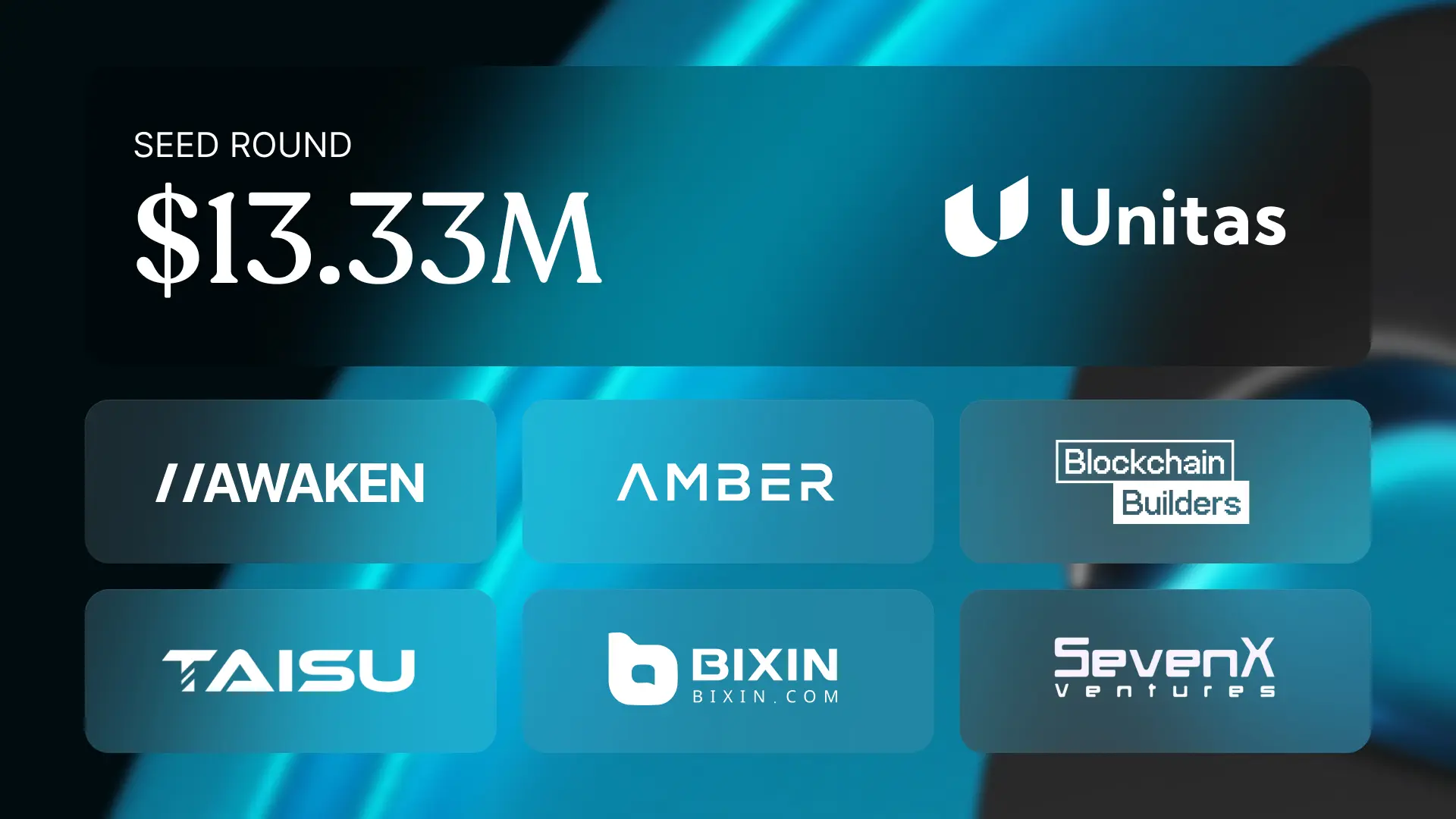
 Unitas, a protocol building infrastructure for sustainable onchain yield, has secured $13.33 million in seed funding from a consortium of crypto-native investment firms including Amber Group, Blockchain Builders Fund, Taisu Ventures, Bixin Ventures, and SevenX Ventures.
The March 2025 funding round will support development of an execution and strategy layer designed to enable transparent, market-neutral yield generation for stable assets under unified custody, risk management, and monitoring standards.
Funding Round Details and Investor Participation
Investment Structure
Unitas announced the completion of a $13.33 million seed funding round on March 26, 2025, with participation from prominent venture capital firms focused on blockchain and cryptocurrency sectors. The investor consortium includes Amber Group, Blockchain Builders Fund, Taisu Ventures, Bixin Ventures, and SevenX Ventures, firms that collectively manage billions in digital asset portfolios.
The participation of these investors, particularly Amber Group’s involvement, suggests institutional-grade due diligence preceded the investment and validates Unitas’s underlying technology and market thesis.
Capital Allocation
The funding will primarily be deployed to expand strategy development, strengthen infrastructure and risk systems, support compliant institutional access, and grow integrations across the decentralized finance ecosystem. Resources will also fuel further research and development of reserve management algorithms, expand security infrastructure, and grow the developer community.
Addressing Structural Challenges in DeFi Yield Markets
Current Market Inefficiencies
Unitas identifies several structural challenges facing today’s DeFi yield markets. Yield compression is becoming increasingly common, strategies are often opaque, and transparency remains limited. These issues create barriers for larger institutional capital seeking to participate with confidence.
The protocol aims to address these challenges by building an execution and strategy layer designed specifically for long-term capital deployment onchain.
Proposed Solution
Unitas is developing infrastructure that enables delta-neutral yield strategies while operating under unified custody, risk management, and monitoring standards. Transparency is maintained through continuous monitoring and proof of reserves frameworks, providing institutional participants with verifiable assurance about underlying assets and strategies.
The infrastructure is designed to support yield generation across a broader range of assets over time, including Bitcoin, tokenized commodities, real-world assets, and other forms of onchain collateral—all operating under the same execution, custody, and transparency framework.
Yield-Bearing Stablecoin Model
Mechanism Overview
Traditional stablecoins like USDC or USDT serve as mediums of exchange and trading pairs but typically offer zero yield to holders. Unitas addresses this limitation by embedding yield-generation mechanisms directly into its protocol layer, representing an evolution in DeFi design.
Unlike holding a traditional stablecoin in a separate lending protocol, a yield-bearing stablecoin accrues value automatically. The protocol achieves this by algorithmically managing a diversified reserve of income-generating assets, which may include staked Ethereum, liquidity provider tokens, or real-world asset vaults.
Key Differentiators
The Unitas model features automated yield strategy where the protocol autonomously allocates collateral to optimize risk-adjusted returns. All backing assets remain verifiable on-chain for users, ensuring transparent reserves. Yield accrues directly to the stablecoin’s price or via a rebasing mechanism, providing direct benefit to holders.
This approach contrasts with the 2022-2023 era of algorithmic stablecoins that failed due to unsustainable peg mechanisms. Unitas emphasizes over-collateralization and diversified, yield-generating reserves to ensure both stability and organic growth.
Market Context and Competitive Landscape
Industry Trends
The funding round reflects a broader trend of venture capital returning to DeFi infrastructure following a period of consolidation. Seed-stage funding of this magnitude indicates mature evaluation of both team and technology. The involvement of Asia-focused funds including Bixin Ventures and Taisu Ventures points to the global appeal of yield-bearing stablecoin narratives, particularly in markets that have shown strong adoption of DeFi savings products.
Stablecoin Market Opportunity
The stablecoin market exceeds $150 billion in total circulation, but the segment for native yield-bearing stablecoins remains nascent yet competitive. Protocols like Ethena’s USDe have gained traction using delta-neutral derivatives strategies, while others explore backing via tokenized treasury bills. Unitas enters this arena with significant resources for development, security audits, and ecosystem incentives.
Comparative Analysis
Traditional stablecoins require holders to seek yield externally through active management in separate DeFi protocols. In contrast, yield-bearing stablecoins generate passive yield automatically through protocol-managed reserves. Traditional backing consists of cash and cash equivalents in bank accounts, while yield-bearing models utilize diversified portfolios of yield-generating crypto assets. This shift represents a fundamental upgrade in financial primitive design, aligning with the core DeFi principle of eliminating intermediaries.
Future Development Path
Infrastructure Focus
Unitas’s mission centers on making stable assets productive through transparent, market-neutral strategies. The protocol’s focus is building sustainable yield infrastructure capable of supporting long-term onchain capital across digital and real-world assets.
Path to Mainnet
The protocol’s success will likely depend on its ability to maintain its peg during market volatility while delivering consistent, sustainable yield. The market will closely watch Unitas’s mainnet launch and its performance through various crypto market cycles. The funding will primarily fuel further research and development of reserve management algorithms, expand security infrastructure, and grow its developer community.
FAQ: Unitas Funding and Yield-Bearing Stablecoins
Q: What is a yield-bearing stablecoin?
A: A yield-bearing stablecoin is a cryptocurrency pegged to a stable asset like the U.S. dollar that automatically generates and distributes yield to holders through its underlying protocol mechanics, without requiring active staking or lending by the user.
Q: How does Unitas generate yield for its stablecoin**?**
A: Unitas generates returns by algorithmically managing a reserve of collateral deployed across various DeFi strategies such as staking, liquidity provision, or lending, with profits accruing to the stablecoin’s value. The protocol emphasizes over-collateralization with diversified, income-generating assets.
Q: Who invested in Unitas’s seed funding round?
A: The $13.33 million seed round included participation from Amber Group, Blockchain Builders Fund, Taisu Ventures, Bixin Ventures, and SevenX Ventures, all established venture capital firms with significant blockchain and cryptocurrency sector focus.
Q: What are the risks associated with yield-bearing stablecoins?
A: Primary risks include smart contract vulnerabilities, failure of underlying yield-generation strategies during volatile markets, potential de-pegging events, and regulatory uncertainty. These instruments are generally considered more complex than fully cash-collateralized stablecoins.


