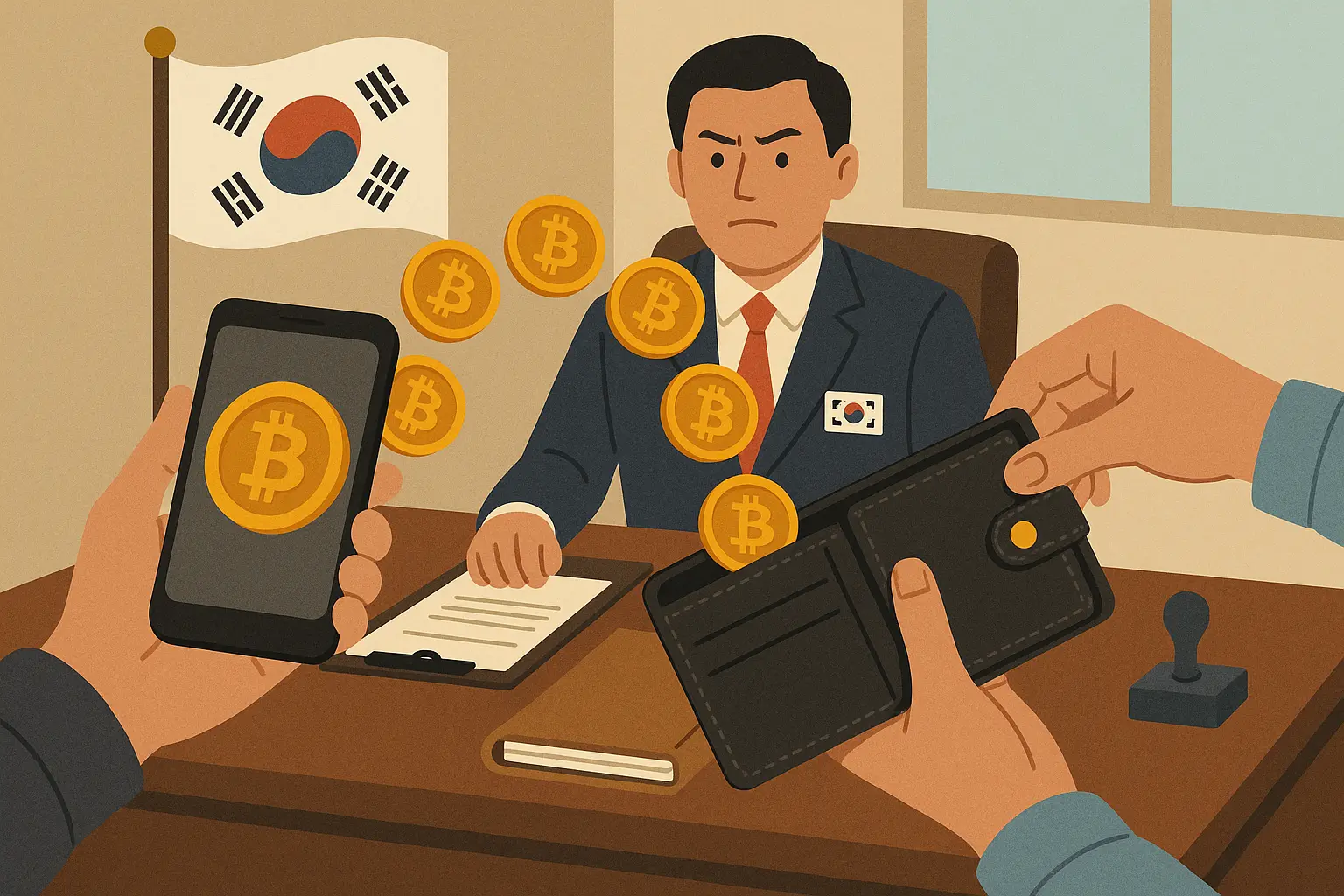
South Korea’s Financial Intelligence Unit (FIU), in accordance with the amended provisions of the Specific Financial Information Act, plans to impose tighter controls over individual wallet transactions and deposits/withdrawals involving overseas crypto exchanges. The new rules require reporting to the authorities when transferring digital assets of 10 million won or more to individual wallets, and remove the original 1 million won minimum threshold for the Travel Rule. Industry figures note that major exchanges may be designated as high-risk entities, which could lead to restrictions on related transactions by South Korean users.
New Rules’ Core Framework: Expanded Reporting Obligations and a Risk Classification Mechanism
The legislative notice released by the FIU last year covers two key changes: first, any transfer of digital assets of 10 million won or more to individual wallets must be reported to the competent authorities; second, abolishing the 1 million won minimum threshold previously set under the Travel Rule means the scope of the Travel Rule’s application will be broadened across the board.
The new rules operate on the principle of “low-risk transactions allowed, high-risk transactions restricted.” However, even if a transaction meets the definition of low risk, any single transaction exceeding 10 million won must still be reported as a suspicious transaction. The regulatory authorities have not yet completed a formal risk classification determination for specific overseas providers.
Three Conditions for Overseas Providers to Be Recognized as Low Risk
FATF Compliance: The provider’s country of operation has adopted and effectively implemented the anti-money laundering recommendations of the Financial Action Task Force (FATF)
Fulfillment of AML Obligations: Including customer due diligence (KYC), suspicious transaction reporting, and execution of the Travel Rule in line with domestic standards
Holding Valid Regulatory Licenses: The provider has obtained relevant compliant licenses recognized in its jurisdiction and internationally
Classification Dispute Involving Binance and MetaMask: High Risk or Low Risk?
A legal professional, in an interview with 《 Digital Asset 》 on April 9, said that under the current definitions, major overseas exchanges such as Binance and OKX, as well as decentralized exchanges (DEXs), are highly likely to be designated as high-risk entities. The same classification risk applies to non-custodial wallet services such as MetaMask, while Coinbase—holding certain overseas licenses—may be more likely to meet the low-risk standard.
However, there is room for exceptions with Binance. Industry consensus is that Binance has recently shifted its business focus to the United Arab Emirates (UAE). The UAE has adopted FATF recommendations, and Binance also holds licenses issued by authorities such as the Dubai Virtual Asset Regulatory Authority (VARA), providing the baseline conditions for being recognized as a low-risk entity. MetaMask’s parent company is based in the United States, a FATF-compliant country, but currently there is no dedicated regulatory licensing framework specifically for individual wallet services, so the final classification remains highly uncertain.
Industry Concern: Liquidity Dry-Up and the Risk of Market Isolation
Binance currently accounts for 29.42% of global spot and derivatives trading volume, while MetaMask holds a 28% share of the global individual wallet market. Both are among the overseas services most widely relied upon by South Korean users. The industry’s biggest concern is that if transactions by most overseas exchanges and individual wallets are restricted, it could sever South Korea’s crypto market connection to the international ecosystem, worsening the already weak market liquidity.
Jin Hyun-soo, managing partner at Decent Law Firm, said that while it is necessary to set appropriate regulations to address overseas money-laundering risks, “it is deeply concerning to implement strict rules rashly without sufficient discussion.” All parties are calling on the FIU, before the regulations officially take effect, to establish clear and forward-looking risk classification standards for providers, and to strike a reasonable balance between anti-money-laundering supervision and user protection.
Frequently Asked Questions
When will the FIU’s new rules in South Korea officially take effect?
The FIU completed the legislative notification process last year, and the exact effective timeline is still to be confirmed. At present, the regulatory authorities have not yet completed formal high-risk or low-risk classifications for specific overseas providers; the industry is calling for clear criteria to be established before full implementation.
Will Binance and MetaMask be designated as high-risk providers?
There is currently no official ruling. Legal experts believe both may be listed as high-risk, but industry stakeholders point out that Binance holds a VARA license, and MetaMask is based in a FATF-compliant country, both of which leave room for them to be recognized as low-risk. The final classification will depend on the results of the FIU’s case-by-case review.
How will the new rules affect ordinary crypto users in South Korea?
If Binance and MetaMask are designated as high-risk providers, South Korean users will not be able to freely conduct related deposits and withdrawals. In addition, the transfer of more than 10 million won to an individual wallet will be subject to mandatory reporting, and overall compliance costs and transaction restrictions will rise significantly.
Disclaimer: The information on this page may come from third parties and does not represent the views or opinions of Gate. The content displayed on this page is for reference only and does not constitute any financial, investment, or legal advice. Gate does not guarantee the accuracy or completeness of the information and shall not be liable for any losses arising from the use of this information. Virtual asset investments carry high risks and are subject to significant price volatility. You may lose all of your invested principal. Please fully understand the relevant risks and make prudent decisions based on your own financial situation and risk tolerance. For details, please refer to
Disclaimer.


