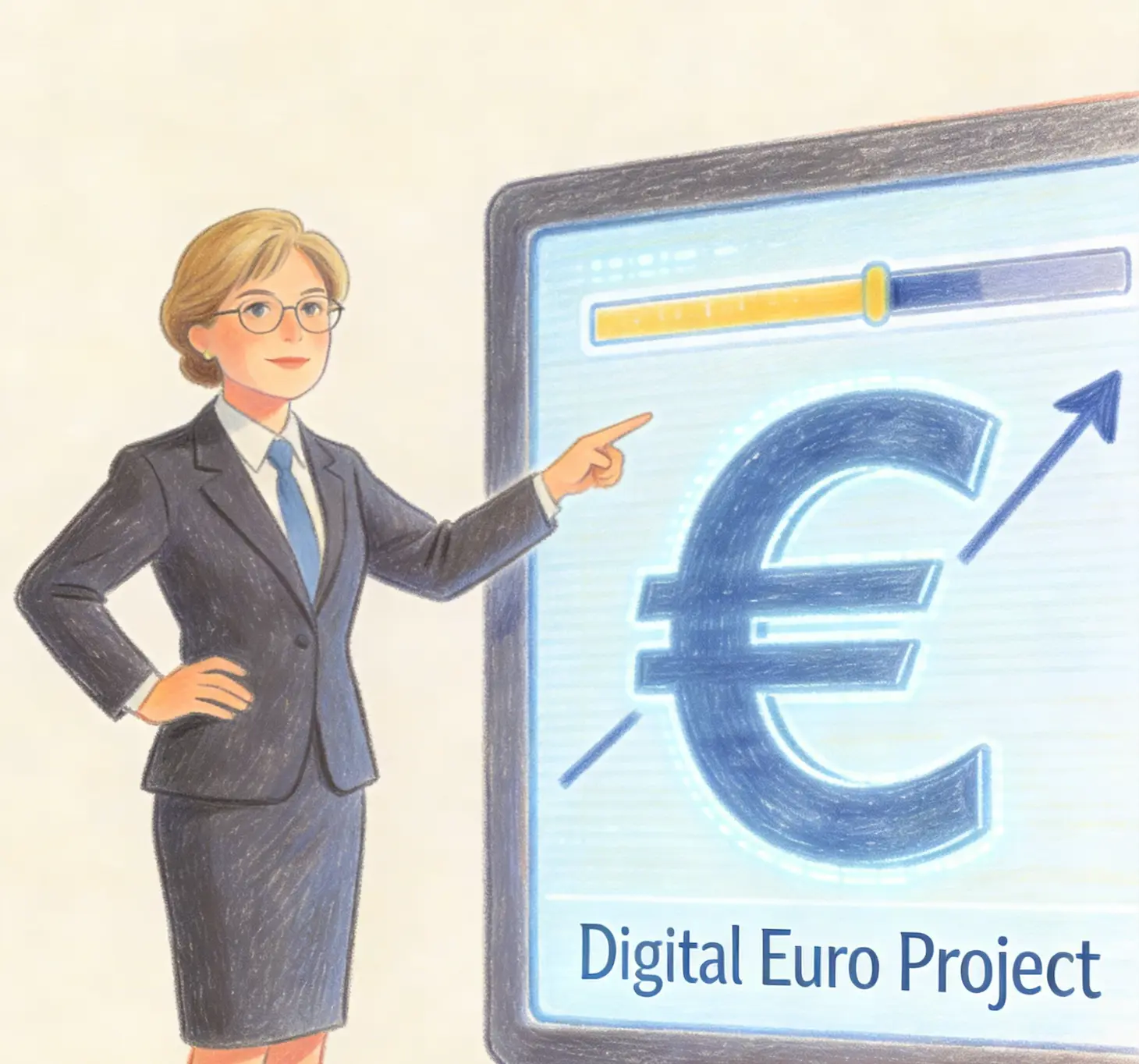
 European Central Bank Executive Board member Piero Cipollone stated on April 2, 2026 that the digital euro project has “good momentum” with a possible launch by July 2029, expressing confidence that sufficient consensus exists for the project to proceed and that he does not foresee any major hurdles.
Cipollone noted that banks are showing increased interest in participating in the pilot phase, which the ECB plans to launch in the second half of 2027, as European policymakers seek to reduce reliance on non-European payment systems including Visa, Mastercard, and dollar-pegged stablecoins.
Digital Euro Timeline Targets July 2029 Launch Following Legislative Process
Cipollone told Latvian TV on April 2 that if legislation is in place by the end of 2026, the ECB will issue the digital euro by July 2029. The ECB plans to start a 12-month pilot phase in the second half of 2027. Member states agreed on a common position on the European Commission’s 2023 proposal in December 2025, and the European Parliament is finalizing its views after voting in February for online and offline versions of the digital single currency. Once completed, negotiations between the two co-legislators can begin.
Cipollone expressed expectation that the project will deliver on time, stating that he sees good momentum from the legislative part and that banks are getting more interested in participating. The digital euro would function as a sovereign digital payment method available both online and offline, ensuring continuity and privacy.
ECB Highlights Reliance on Non-European Payment Systems as Key Driver
Cipollone warned that dependence on non-European payment infrastructure leaves users vulnerable to outright withdrawal of access. Currently, two-thirds of euro area card transactions are governed by business rules of companies based outside Europe, and international card schemes can set fees, technical standards, and dispute resolution procedures for hundreds of millions of European transactions daily.
Thirteen out of 21 euro area countries, including Latvia, Estonia, and Lithuania, depend entirely on international card schemes for in-store payments, and there is currently no pan-European digital payment solution governed in Europe that covers the entire euro area. Merchant charges for card payments in the EU almost doubled between 2018 and 2022 despite attempts to limit them, with smaller retailers facing charges three to four times higher than those paid by larger businesses.
Policymakers including ECB President Christine Lagarde have repeatedly expressed concerns about Europe’s reliance on US payment firms as well as dollar-pegged stablecoins. Cipollone linked the digital euro proposal to a broader strategy including tokenized central bank money and distributed ledger technologies to strengthen financial integration and prevent fragmentation.
Digital Euro Designed as Digital Cash with Offline Privacy and No Processing Fees
Cipollone described the proposed digital euro as a digital form of cash that would be legal tender across the euro area and usable both online and offline, including when there is no network connection. Offline digital euro payments would have cash-like privacy levels, with transaction details known only to the payer and the payee, while the Eurosystem would not be able to identify users.
The ECB would not charge scheme or processing fees for digital euro transactions, potentially lowering costs for merchants and consumers. The digital euro would reduce reliance on foreign providers, lower transaction costs, and create a unified infrastructure supporting competition and innovation across EU payment systems.
Cash Usage Declines as E-commerce Grows
Cipollone linked the proposal to a shift towards online shopping and away from cash. E-commerce now accounts for more than a third of retail sales by value, while cash use in the euro area fell from 68% of day-to-day transactions in 2019 to 40% in 2025, and from 40% to 24% in value terms over the same period. The declining cash usage intensifies dependence on digital systems beyond European control, underscoring the urgency of a sovereign digital payment solution.
The next steps are for EU legislators to complete the legal process for the digital euro, while the Eurosystem prepares the pilot and technical work needed for issuance.
FAQ
When could the digital euro launch?
ECB Executive Board member Piero Cipollone stated that if legislation is in place by the end of 2026, the digital euro could be issued by July 2029. The ECB plans to start a 12-month pilot phase in the second half of 2027.
Why does the ECB consider a digital euro necessary?
The ECB cites heavy reliance on non-European payment systems, with two-thirds of euro area card transactions governed by non-European companies. Merchant charges have nearly doubled, and there is no pan-European digital payment solution. The digital euro would provide a sovereign alternative, reduce dependence, and lower transaction costs.
What privacy features would the digital euro have?
Offline digital euro payments would have cash-like privacy levels, with transaction details known only to the payer and the payee. The Eurosystem would not be able to identify users for offline transactions, ensuring a level of privacy comparable to physical cash.
Disclaimer: The information on this page may come from third parties and does not represent the views or opinions of Gate. The content displayed on this page is for reference only and does not constitute any financial, investment, or legal advice. Gate does not guarantee the accuracy or completeness of the information and shall not be liable for any losses arising from the use of this information. Virtual asset investments carry high risks and are subject to significant price volatility. You may lose all of your invested principal. Please fully understand the relevant risks and make prudent decisions based on your own financial situation and risk tolerance. For details, please refer to
Disclaimer.


