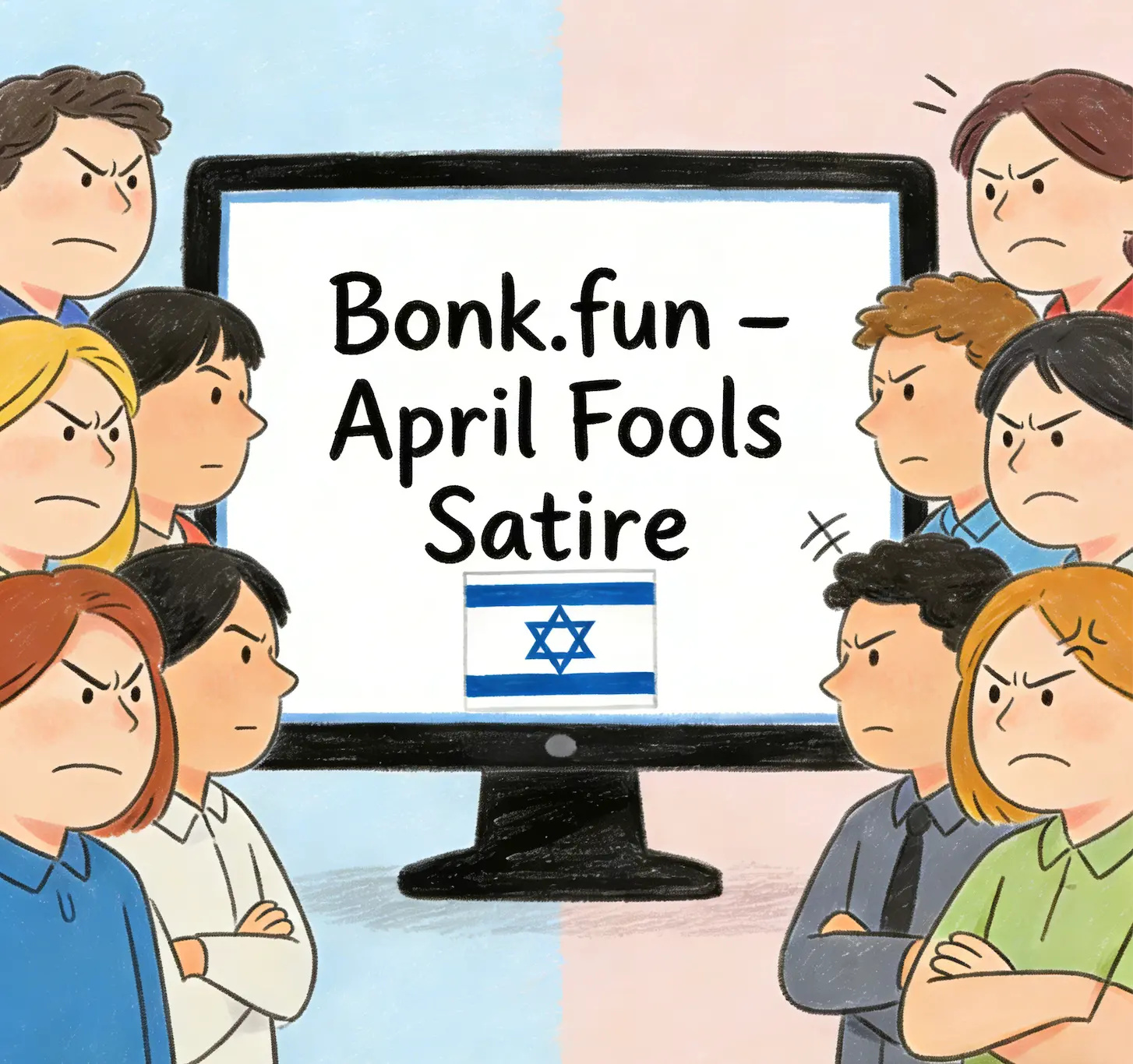
 Solana-based meme coin launchpad Bonk.fun published an April Fools’ Day post on April 1, 2026 depicting a mock “Trench Guard” feature that would geo-block users in Israel, using satire to critique the tension between crypto’s permissionless ideology and the real-world geopolitical pressures that increasingly shape platform decisions.
The post, framed as a compliance update showing an Israel flag geo-block screen, drew immediate attention for its timing and bold framing amid ongoing conflicts involving Gaza, Lebanon, and Iran that have driven strong online sentiment.
Satirical Post Mocks Selective Geo-Blocking and Permissionless Narrative
The Bonk.fun post was framed as a new “Trench Guard” system showing a geo-block screen with an Israel flag, implying users from the region would be blocked from trading. While presented as a compliance update, the tone and timing indicated satire rather than a real feature announcement.
The choice of Israel served as the central element of the joke, tapping into current geopolitical tensions where Israel sits at the center of ongoing conflicts involving Gaza, Lebanon, and Iran. Typically, platforms restrict access for heavily sanctioned regions such as Iran and Russia. The satire suggested a hypothetical scenario where the “bad actor” label could be applied differently, highlighting how political such decisions can feel.
The post also took a swipe at crypto’s “permissionless” narrative, noting that many platforms already restrict users based on geography or regulation. By exaggerating selective control with a controversial example, Bonk.fun underscored how quickly crypto platforms can shift from open access to selective control when global politics become involved.
Geopolitical Risks Overtake AI Concerns in Crypto Market Narratives
The incident coincides with a broader shift in market narratives where geopolitical risks have overshadowed concerns about AI-driven disruption. Analysts are tracking how geopolitical uncertainty affects sectors including crypto and DeFi, with oil supply, inflation, and global stability becoming key investor concerns.
Bonk.fun’s satire highlighted the growing reality that even decentralized platforms must navigate political and regional pressures. The joke underscored how geopolitical tensions influence crypto platform decisions, challenging the industry’s usual permissionless narrative at a time when actual platform restrictions based on geography and regulation remain common practice.
Meme Coin Sector Faces Structural Declines amid Broader Market Pressure
The meme coin sector is experiencing widespread declines, with market capitalization dropping to $36 billion as participation, dominance, and on-chain engagement fade. On Solana, a key hub for meme coin trading, daily decentralized exchange traders fell from 4.8 million to 640,000, with the network described by market observers as a “ghost town” for meme coin activity.
Structural issues plague the sector, with 12 Solana meme coin founders who raised $26.7 million having abandoned their projects, according to analysis. The recent exit of a Solana-based meme coin founder highlighted deeper vulnerabilities, as the founder of WhiteWhale left the initiative as the token’s value plummeted 50%.
Despite meme coin struggles, Solana’s blockchain posted strong performance metrics, processing 10.1 billion transactions in Q1 2026, a 50% increase from previous records. Stablecoin transaction volume reached $650 billion in February, driven by US regulatory developments including the GENIUS Act, with major liquidity providers designating Solana as a preferred network for institutional stablecoin settlements.
FAQ
What was Bonk.fun’s April Fools’ Day post about?
Bonk.fun posted a satirical “feature launch” depicting a mock geo-block screen with an Israel flag, suggesting the platform would restrict access to users in Israel. The post used satire to critique the tension between crypto’s permissionless ideals and real-world geopolitical pressures that influence platform decisions.
Why did the post spark debate?
The post’s timing amid ongoing conflicts involving Gaza, Lebanon, and Iran, combined with its choice of Israel as the subject of hypothetical geo-blocking, highlighted how political and regional pressures increasingly shape crypto platform operations. It challenged the industry’s narrative of permissionless access while acknowledging that many platforms already impose geographic restrictions.
How is the meme coin sector performing?
The meme coin sector is experiencing widespread declines with market capitalization at $36 billion, down significantly from previous levels. Daily DEX traders on Solana fell from 4.8 million to 640,000, and multiple meme coin founders have abandoned projects amid declining token values and shifting capital away from speculative assets.
Disclaimer: The information on this page may come from third parties and does not represent the views or opinions of Gate. The content displayed on this page is for reference only and does not constitute any financial, investment, or legal advice. Gate does not guarantee the accuracy or completeness of the information and shall not be liable for any losses arising from the use of this information. Virtual asset investments carry high risks and are subject to significant price volatility. You may lose all of your invested principal. Please fully understand the relevant risks and make prudent decisions based on your own financial situation and risk tolerance. For details, please refer to
Disclaimer.


