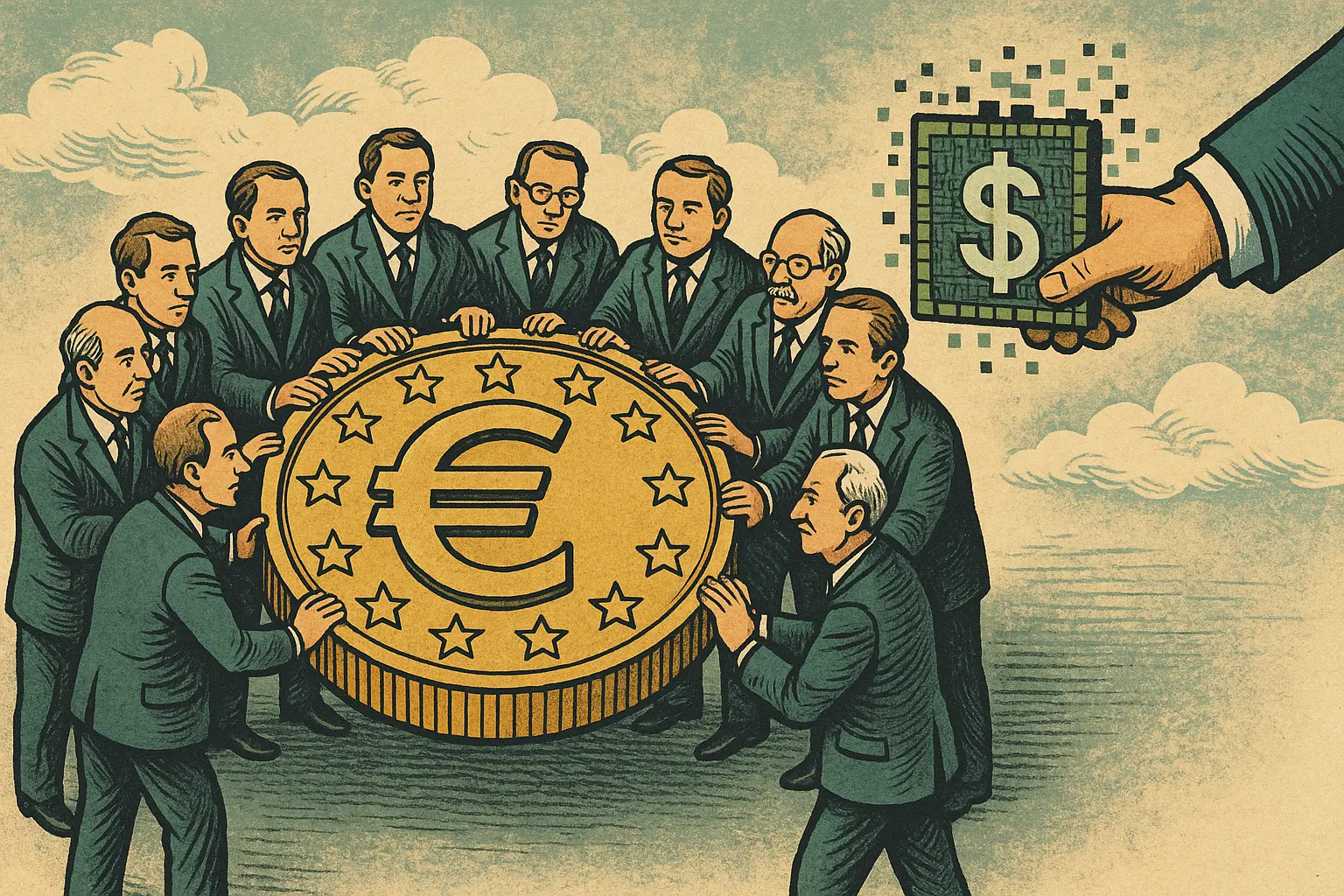
European Banking Union Qivalis CEO Jan-Oliver Sell recently said in an interview that in an increasingly tokenized global financial system, the euro faces a systemic risk of being sidelined. In on-chain trading, the euro accounts for only about 0.2%. Qivalis is supported by 12 major EU banks, including ING and BBVA, and plans to issue a euro stablecoin under the European Union’s Regulation on Markets in Crypto-Assets (MiCA) framework.
A Sovereign Threat to Digital Dollarization: The Missing Euro on the Blockchain
Sell pointed to the core of the problem: “If we don’t have euro on-chain trading with sufficient liquidity, then the only alternative is the dollar. This poses a real risk to Europe’s financial and digital sovereignty.”
At present, the stablecoin market cap is about $314 billion, dominated by dollar-denominated tokens such as Tether’s USDT and Circle’s USDC. According to Jefferies’ forecasts, this market could grow to between $800 billion and $1.15 trillion over the next five years. As financial activity accelerates its shift to blockchain infrastructure—from crypto exchange trading to DeFi and cross-border payments—lack of sufficiently liquid euro stablecoins will structurally make Europe dependent on dollar-based infrastructure.
Sell also highlighted the direct financial impact on euro users: European users using dollar-denominated on-chain products need to bear foreign exchange fluctuation risk, and exchange-rate swings may directly erode investment returns calculated in dollars, leaving euro users at a structural disadvantage in on-chain finance.
Qivalis’ Solution: A Bank Alliance to Break Up Stablecoin Fragmentation
Sell noted that the stablecoin market for the euro previously suffered from a core issue of fragmentation: “A few banks trying to issue tokens on their own would only further fragment the market; only by uniting institutions can we create the necessary channels for circulation and liquidity.”
Qivalis’ core positioning is infrastructure rather than simply a token. It plans to integrate exchanges, custodians, and DeFi platforms, building a complete ecosystem around the euro on public blockchains:
A 12-bank alliance model: Centralize distribution channels, avoid multiple competing fragmented tokens for liquidity, and create economies of scale in the market
MiCA compliance framework: Issue under EU regulatory standards, provide institutional-level compliance assurance, and attract integration from traditional finance
A public-chain native euro interface: Act as an “interface between the euro and the blockchain,” enabling integration into any on-chain scenarios that need euros
Attract demand with FX advantages: Provide an alternative for European users who use dollar-denominated on-chain products to hedge against FX risk
Relationship to the ECB’s Digital Euro: Complement, Not Competition
This private banking alliance action is taking place while the European Central Bank (ECB) is still advancing its digital euro initiative— the ECB plans to launch a digital euro as early as 2029. Sell made it clear that Qivalis is a private stablecoin that relies on public blockchains; the ECB’s plan relies on centralized infrastructure. The two are complementary rather than competitive.
He described a “currency stack” architecture: central bank money exists in a centralized system, while business scenarios such as cross-border payments and on-chain settlement that require public networks need euro native assets on public blockchains—this is the gap Qivalis intends to fill.
“We’re working to build the foundation for European digital sovereignty. If we can’t do that, we’ll face dollarization,” Sell said, emphasizing that the goal is not to replace the dollar, but to ensure that the euro maintains its proper position in a rapidly evolving global financial system.
Frequently Asked Questions
How is the Qivalis euro stablecoin different from the ECB’s digital euro?
Qivalis is a private stablecoin supported by 12 major EU banks and issued under the MiCA framework. It is deployed on public blockchains and is expected to launch in the second half of 2026. The ECB’s digital euro, meanwhile, relies on centralized infrastructure and is planned to launch as early as 2029; the two are positioned as complementary rather than competitive.
Why is the euro’s share in on-chain trading only 0.2%?
Even though the euro accounts for 20% to 25% of global trading activity in traditional financial markets, until now there has been a lack of sufficiently liquid, widely deployed euro stablecoins. Meanwhile, dollar-denominated tokens such as USDT and USDC have been deeply embedded in the global crypto markets and DeFi infrastructure, creating a clear structural dominance.
Which major banks are participating in the Qivalis plan?
The members confirmed so far include 12 major EU banks such as ING, UniCredit, and BBVA. The complete list of members has not yet been fully disclosed, and the planned launch timing depends on the Dutch central bank’s permission schedule.
Disclaimer: The information on this page may come from third parties and does not represent the views or opinions of Gate. The content displayed on this page is for reference only and does not constitute any financial, investment, or legal advice. Gate does not guarantee the accuracy or completeness of the information and shall not be liable for any losses arising from the use of this information. Virtual asset investments carry high risks and are subject to significant price volatility. You may lose all of your invested principal. Please fully understand the relevant risks and make prudent decisions based on your own financial situation and risk tolerance. For details, please refer to
Disclaimer.


