
The Taisugar AI animation commercial sparked backlash due to its poor quality and unnatural Japanese, highlighting how non-animation professionals want to create animations with AI, but lack professional aesthetic judgment. A freelance 3D animator who took the case also discussed the Taisugar example and said that after AI entered the industry, an “AI slacking-off phenomenon” emerged.
Taisugar AI animation commercial flopped
A “Taisugar Clam Essence” anime installment ad generated with AI by the Taiwanese state-owned enterprise “Taisugar” has recently repeatedly issued press releases and appeared in media coverage. After being assisted by Taiwanese influencers for promotion, it faced a large number of negative reviews, and even Big-Head Oil Dude Domidororo mocked it in the latest video: “These three f***ing X AI.”
The author actually watched Taisugar’s AI animation commercial during its promotion with Taiwanese influencer media, and the feeling was, “No surprise it got roasted.” Moreover, the whole marketing approach clearly showed disrespect toward Japan’s animation industry and expertise in Japanese translation. And in my view, that is the biggest failure of the entire project.
Taisugar quietly launched this AI animation commercial in January this year. Although the total views reached one million, the number of likes was only around 240. On March 24, the animation appeared on Taiwanese influencer media’s community. The headline copy was: “Has Taisugar turned into an animation company? This classic brand is using this move to go after the younger generation.”
That headline became the fuse for netizens to flood it with negative reviews. Even Taiwanese illustrator “仙界大濕” and Japanese animation professional “陳羽爵” both had their complaints, with the main reason being that the quality of this AI animation is not good—far from the level of “an animation company” mentioned in the headline, let alone “going after the younger generation.”
The Japanese lyrics in the OP for this AI animation are even more awkward. Phrases like “今日もハイ” are on par with “植物の優”—they’re basically not normal Japanese usage—so Domidororo couldn’t help but mock: “Whoever made this ad must be super old.”
And when the author went back to review the copy used by Taisugar’s official fan page: “Isn’t this really an announcement for a new season show?! Taisugar Clam Essence actually released a legendary-level AI anime commercial!”—it was even more something people couldn’t stop complaining about.
Taiwan already had excellent animation commercial work
In contrast, 104 Job Bank released, two years ago, a series of non-AI animation commercials called “Fearless Youth, Admirable Newcomers.” At the time, they received a lot of positive feedback. And the behind-the-scenes extras later released by 104 revealed that the series ads were produced by 30 Taiwanese young animation artists under 25, tightly tied to the planning theme: youth, passion, and ideals—making it a marketing case worth referencing.
Another good example is the animation commercial released by Pure Kikkucha in 2025, which also got shortlisted for the Kyoto Animation Production Awards that year.
And for a Hong Kong Nestlé company’s animation commercial released five years ago, it’s even more of a gem ahead of the curve—the director was Yōjirō Arai, who previously worked at the Studio Ghibli.
Taisugar AI animation director has no animation experience; crossing over from one field into another is like crossing a mountain
In contrast, the director who produced Taisugar’s AI animation commercial did not have any experience working on Japanese animation production in the first place.
Based on a post he shared in February, this work used AI tools such as Kling AI, Gemini Pro, Midjourney, ChatGPT, and others. It is said that it researched storyboarding and narrative methods from over 100 Japanese animation OPs, and referenced the styles of “Sword Art Online,” “Girlfriend of the Last Empire,” and “A Certain Scientific Railgun.” The production took three months in total.
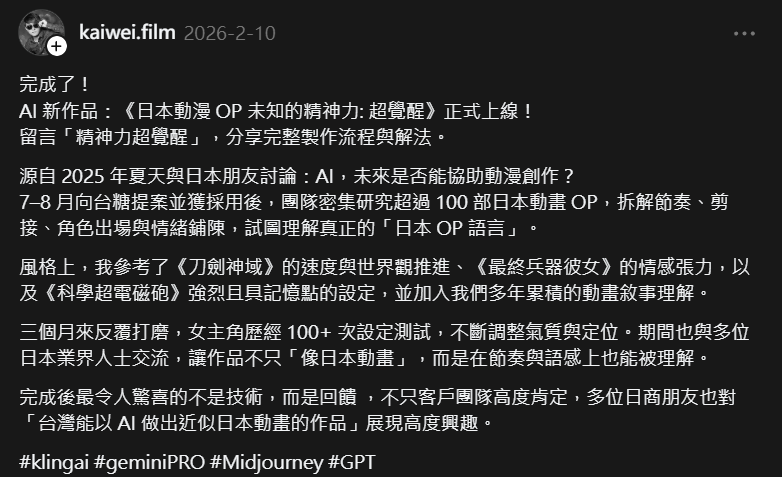
But judging from the finished product, it’s clear this director has some misunderstanding of Japanese animation OPs. They referenced masterpieces but didn’t truly internalize them successfully. Without the Know How and aesthetic standards of the animation industry, their work naturally couldn’t persuade young people who actually watch animation.
Although the director said in an interview with “Next TV” that gradually maturing AI tools may remove the gap between his cross-industry animation production and writing Japanese lyrics, his work tells us that even with AI assistance and live-action/video as a foundation, cross over into Japanese-style animation and it’s still like learning a whole different craft from scratch—you need long-term accumulation of aesthetics, and that can’t be done overnight.
AI slacking-off phenomenon
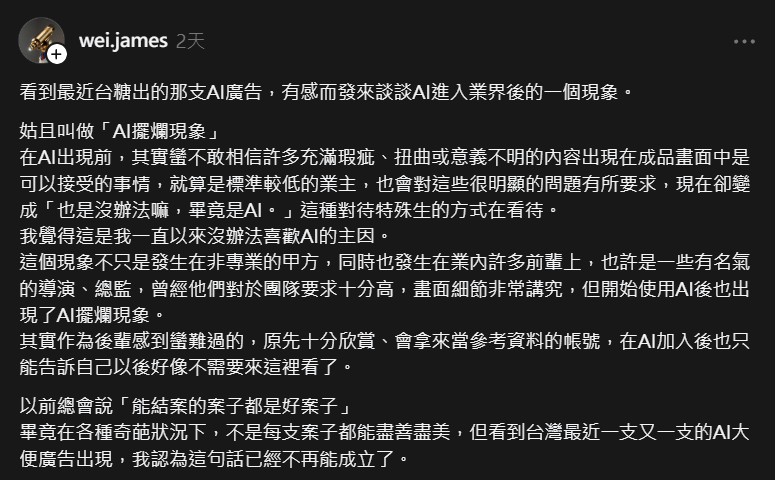
Wei James (魏君恆), a 3D animator who has previously handled projection production for Mayday concerts and CG scene design for Jay Chou’s “The Greatest Work” MV, also felt it and talked about the “AI slacking-off phenomenon” that appeared after AI entered the industry.
Sharing his own experience, before AI showed up, he didn’t dare believe that many contents full of flaws, distortions, or unclear meanings could appear in the final picture and still be accepted by the client.
Even clients with lower standards would demand something about these very obvious problems, but now it turns into, “Well, there’s nothing we can do—after all, it’s AI.” This kind of treatment of special cases also shows up when looking at it. Even some teams that used to be known for high standards have also experienced an AI slacking-off phenomenon after using AI.
AI is a trend and also a lie detector
A few months ago, the AI animation commercial quality released by the familymart convenience store chain was also poor. It was heavily criticized on Threads, and it was ultimately taken down from Threads (other platforms still have copies). Taiwan’s WBSC baseball championship documentary “The Road to Champions” also released an “energizing animation MV” that heavily used AI-generated roto/trace work, and it has already been taken down.
But that doesn’t mean audiences only react negatively to AI commercial ads without any recognition. No matter whether the ad uses AI, 3DCG, or other technologies, the end result still comes down to one thing: can the quality of this advertisement actually convince the audience?
Recently, 104 has a commercial that uses AI-assisted creation, and maybe it delivered a pretty good answer.
AI-generated content didn’t take up all of the content; instead, it was well integrated with real-person footage. And in the ad’s descriptive text, it also clearly explains the intent behind using AI (recreating Copernicus, the Wright brothers, and Madame Curie). At present, the comment section is seeing overwhelmingly positive feedback.
AI is a trend and also a lie detector. If vendors and AI artists want to ride the trend and release AI works, then audiences are also filtering them. In the future, will we end up seeing a pile of AI Slop, or will we see a work that, even though it used AI, is truly good enough?
Further reading:
Japan’s first AI animation airs! Netizens criticize: a Douyin “poop” video—what do Taiwanese animation artists think?


